
Over the past month or so, I’ve spent a strange amount of time explaining my career to strangers.
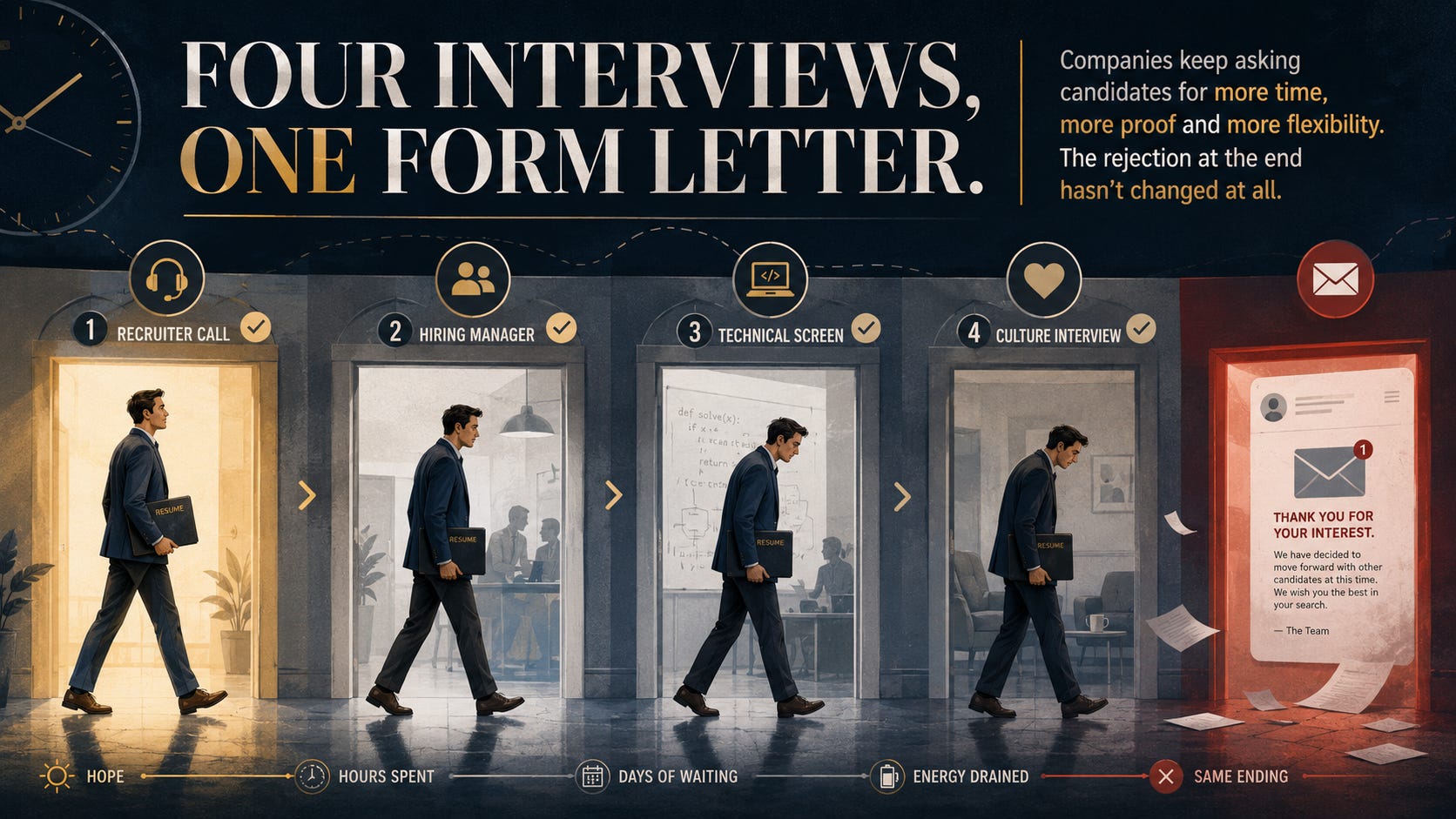
There were recruiter calls, hiring-manager interviews, technical screens and culture conversations, along with questions about tools I use today, tools I used years ago and tools I could probably learn quickly if the job needed them.
One of my most recent opportunities went four rounds!! Recruiter, Project Manager, HR Director and then the Final Boss!!
By the end, I’d explained my background from every angle: business intelligence, automation, Power BI, Alteryx, reporting, stakeholders and client work. I answered as honestly as I could, including the parts where my experience runs thin.
Then it ended with a canned email rejection. Not even from the original recruiter’s email address but a no reply system address.
No real explanation. No hint at what changed. No sense of whether another candidate knew the industry better, went deeper on the technical side or just connected with the team in a way I didn’t.
Just this:
Thank you for your time. We’ve decided to move forward with another candidate. We’ll keep your profile on hand for any future openings that may fit your experience.
That shouldn’t have bothered me as much as it did… it did anyway.
I understand how hiring works. I was a recruiter for 6+ years prior to my career pivot. The process bothered me when I was on that side of the equation as well.
Nobody owes me a job because I made it through several interviews. Someone else may have simply been better, more aligned with the role or more convincing under pressure. That’s fair.
What’s harder to sit with is the uncertainty afterward.
Was I weak technically or did they want more industry experience? Did I explain something poorly, or was it the salary? Did the gray hairs on my head and in my beard turn them off? Maybe the role changed shape mid-search or they already had someone internal lined up.
There’s no real answer that I’ll truly know, so eventually I started trying to fill in the blanks myself.
After enough of these, it’s easy to slide from “I wasn’t the right fit for this job” to “maybe I’m not as good as I thought.”
Those are different conclusions. I know that. Some days they don’t feel very far apart.
A four-round interview isn’t four calendar invites. It’s rereading the job description, hunting for examples that fit what they’re after, brushing up on a tool you haven’t touched in a year in case it comes up and rearranging your week around a 30-minute call, then doing it again for round two.
None of that is unreasonable by itself. Companies should take hiring seriously and candidates should show up prepared.
But by round four, both sides have real time on the table. The company spent hours learning who I am. I spent hours learning who they are. Several people talked to me directly, some more than once.
Then it ends with the same message someone can get after applying online at midnight and being rejected by 9 a.m.
I don’t think every candidate is owed a detailed critique. But after four interviews, there should be something between silence and a performance review. Even one line would do it:
You interviewed well, but we went with someone who had deeper experience in this specific area.
That’s enough. Now I know.
This is where a long job search wears you down.
I’ve built reporting solutions, worked directly with business stakeholders and used Power BI, Tableau, Alteryx, Excel and SQL for years to turn messy requests into something people could actually use. That’s real experience.
I also know where the gaps are. I’m not a data engineer. I’m not a data scientist. Plenty of people know more than I do in those lanes and that doesn’t bother me.
What bothers me is not knowing which gap actually mattered here.
Hearing “your SQL needs to be stronger for this role” gives you something to work on. A form letter gives you something to lie awake turning over at 11:30 p.m., wondering if the whole résumé was the problem.

Apply to more jobs. Apply to fewer. Aim higher. Aim lower. Take a junior role. Network more. Get another certification. Stop collecting certifications. Rewrite your résumé. Don’t overdo it. Learn Python. Learn SQL. Learn AI. Find a niche. Broaden your search.
Most of that advice probably helps somebody. The problem is that everyone’s situation is different.
Someone hunting for their first job out of college isn’t solving the same puzzle as someone building on fifteen years of experience. Someone switching industries has a different problem than someone coming back from a layoff. Someone with a deep network has options someone without one doesn’t.
There’s no single move that makes this market easy.
Sometimes you’re doing most of the right things and it’s still hard.
I don’t want hiring to get easier just so it feels better.
Ask hard technical questions. Test what people actually know. Compare candidates honestly. Hire whoever gives the team the best shot at succeeding.
But if a company asks someone to spend hours in a process, that process should end with more humanity than an automated sentence. Not because candidates are fragile, but because useful feedback may be the only valuable thing a rejected candidate can take from the process.
I can handle “someone was better.” I can handle “your experience wasn’t deep enough here.” I can handle “we needed something you don’t have.”
What’s harder is going through four rounds, opening a form email and being left to guess what it means about me.
Maybe that’s just how modern hiring works. I hope not.
Because on the other end of that email, this isn’t just a candidate record closing in a system. It might be one more small dent in the confidence someone is trying hard to carry into the next interview.
What has your experiences been like in this job market? Comment below!
-James Smart
No posts
Comments
Nothing yet. Say the first thing.
Sign in to join the conversation.