
These reports are a must read for anyone who calls New Zealand home and wants to understand what’s going on under the hood of New Zealand’s economy.
The mental model I employ to interpret them is a biophysical one. Viewed in this way the economy, in its purest form, is simply energy transformed into goods and services.
This is beautifully captured by Steve Keen, an energy aware economist who said “labour without energy is a corpse; capital without energy is a sculpture”.
In our political lexicon growth is generally associated with improved economic conditions, more jobs, more opportunity, improved standards of living. A rising tide lifts all boats, so to speak. This has traditionally been the case. However, the physics of life on this blue green planet would suggest that all things come to an end, or at least start a new cycle, but for the time being let’s run with the endless growth model.
To grow the economy in real terms, there are only two levers that we can pull, more energy or greater energy efficiency. Practically we need to pull them both.
To my way of thinking GDP, as a measure of economic growth is increasingly becoming a meaningless metric. GDP is too easily manipulated by financialisation, credit expansion and changes in the composition of economic activity that hide what is happening in the physical economy, and what we have all been feeling in recent years.
It is for this reason that I prefer to look under the hood of our economy, and into the energy system, to see the true macro-economic trends.
So that said, what does the 2026 edition of the Energy in New Zealand report have to tell us?
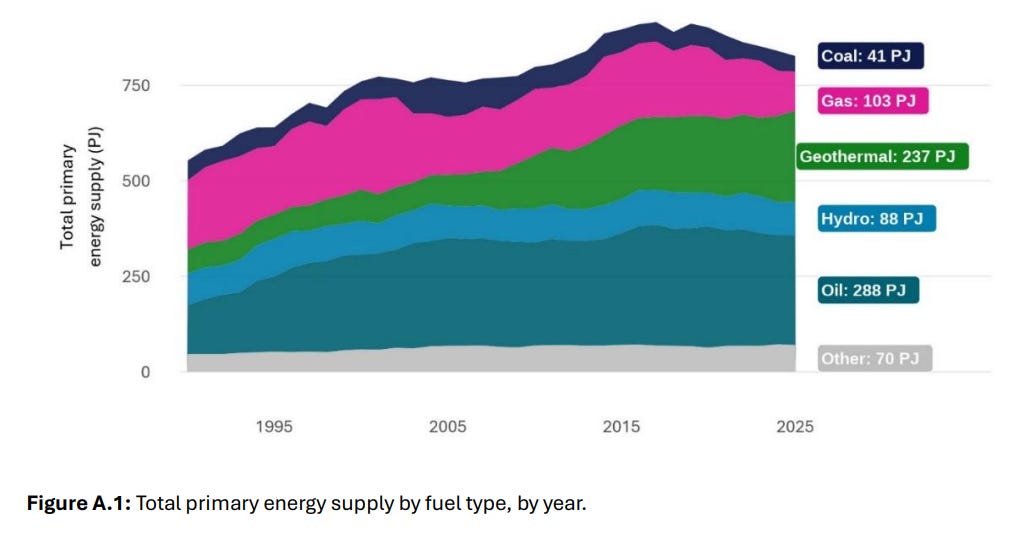
Total Primary Energy is arguably the most important chart in the whole report and shows us a number of key trends.
New Zealand’s total primary energy has been falling since 2019 and is now at the lowest level since 2011.
New Zealand’s economy in 2025 is 2% smaller on a GDP per capita basis than it was in 2019. The sluggishness and lack of growth in New Zealand’s economy is not due to us all being in some sort of psychological funk, as morning radio hosts would have us believe. The New Zealand economy is running out of gas both literally and figuratively.
When we look at this on an energy per capita basis the picture gets worse. Over the same 2019 to 2025 period population has grown steadily while total primary energy has been falling, meaning that we have less energy per capita.
With a biophysical lens, energy availability governs the economy’s ability to do work. Our money is simply a claim on energy services that produce work in the form of either goods or services.
When we have less energy, but more people, and more money circulating in the economy, we experience inflation in real terms.
I would posit that energy sits at the root of the cost-of-living issues we are experiencing.
Coal use has been steady over recent years and any seasonal fluctuations in use are directly related to the inflows to our hydro schemes. In dry years coal use goes up and in wet years it goes down, but it is still very much needed to keep the lights on in winter.
The most interesting for me isn’t how much coal we burned, but how much we stockpiled. Huntly ended 2025 with 1.16 million tonnes, its largest stockpile since 2012. In an electricity system generating 88.5% renewable electricity, we are simultaneously carrying more coal insurance than we have in more than a decade.
This is fundamentally due to the need to have firm reliable generation capacity over a two to three month periods of time if our hydro systems are constrained by low inflows.
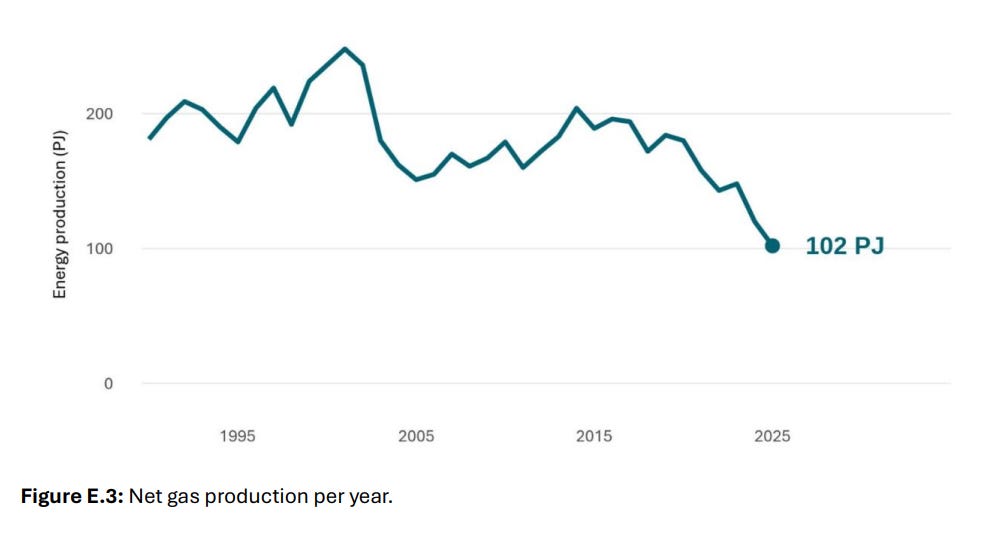
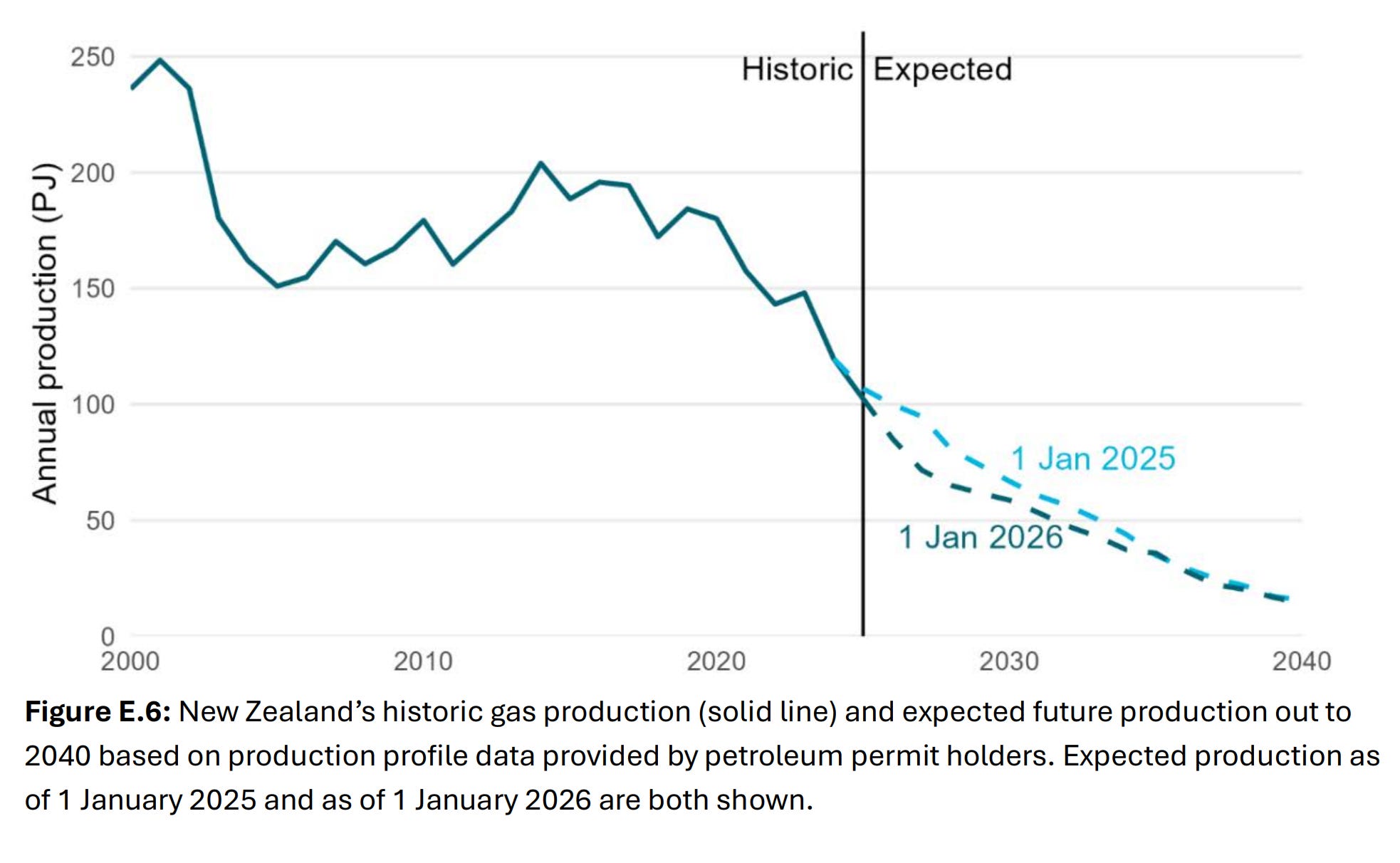
The drop in total primary energy can be attributed almost entirely to a significant, and sustained, drop in our domestic natural gas supply. This trend is persistent, we have seen the gas supply halve over the past decade.
Economically this translates into:
Very high electricity prices when hydro lake inflows fall heading into winter.
Less methanol production and associated export revenue.
Less fertiliser production, and more imported fertiliser. Which is negative for the balance of trade and increases the input costs for farmers, who are the single largest contributors to our economy.
Business closures for those unable to renew gas supply contracts or too price sensitive to absorb the supply constrained gas price increases. Particularly in the horticulture industry.
Higher prices at the supermarket due to the horticulture, meat processing and food manufacturing industries being significant gas users and having to pass on higher input costs.
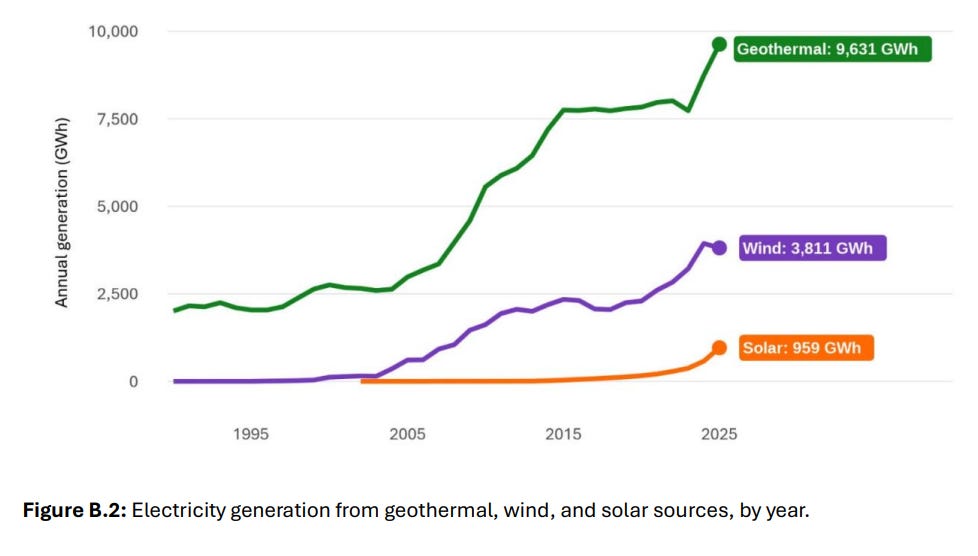
Mitigating the drop in natural gas supply somewhat is the growth in geothermal. It’s important to recognize the dual role of geothermal. It is not all used for electricity generation. Geothermal is also used for process heat and hot water applications in the Central North Island.
As our gas supplies continue to decline, we are going to become increasingly dependent on geothermal for firm electricity generation, which is not a bad thing, geothermal is a great resource and we are good at harnessing it. Geothermal is already doing a lot of the heavy lifting and is going to be an increasingly important resource in years to come.
New Zealand doesn’t have a lot of scope to substantially increase our hydro capacity, all the best catchments and geography have already been developed. As such our hydro derived total primary energy has been remarkably constant over several decades.
Note, pumped hydro isn’t going to add significantly more capacity. It’s a giant hydraulic battery. As such pumped hydro time shifts generation, it doesn’t provide a lot of additional energy outside of potentially reducing the amount of spill from the existing hydro schemes. It would however help with our emerging firm power issue. There are now a couple of schemes being proposed but both are at least a decade away. I will endeavour to write about these in the not too distant future because they are both interesting.
Imported oil in the form of refined products such as diesel, petrol, and jet fuel at the end of 2025 still makes up around 35% of our total primary energy.
The 2026 Energy In New Zealand report is based on data from 2025 and as such does not cover the significant supply chain shocks we have seen this year.
Next year’s report will be interesting as oil has emerged as a significant energy vulnerability for New Zealand that is not improving. I say this because what started as a crude oil supply and crude oil composition constraint, is now turning into a global refining capacity constraint that will take much longer to resolve, if it ever does.
This is primarily due to the Red Sea becoming another conflict choke point affecting Saudi Aramco refineries on the West Coast of Saudi Arabia and Ukrainian drone strikes on Russian refineries.
Russia has gone from being the 2nd largest global exporter of diesel to needing to import diesel from India to meet domestic demand. This is starting to have significant implications for the Asia Pacific, African and European fuel markets. New Zealand is not immune and with crack spreads, the price to produce refined products on top of the price of a barrel of oil, on the rise so are prices at the pump.
Refineries are major pieces of infrastructure and significant damage is not easy or fast to repair.

What may be the most surprising, given how much solar and wind we are installing, is how flat the “other” category is. Despite significant investments in wind and solar farms you would need a magnifying glass to find any increase in total primary energy contribution.
Solar generation reached 959 GWh in 2025, up 66% in a single year. That sounds substantial, but it is still only around 2% of New Zealand’s annual electricity generation and an even smaller component of the overall energy system. The important point isn’t that solar isn’t growing, it clearly is, but that it is growing from a very small base.
Wind generation capacity didn’t materially increase in 2025, but we still have a lot of it with a total capacity of 1,263MW at the end of 2025.
Given that electricity demand in New Zealand has remained remarkably flat over the past decade at around 44TWh plus or minus a bit each year. Much of the new renewable generation being added to the system is being substituted for gas and coal generation rather than materially increasing the total electricity production. The big question for me is if the additions can keep pace with the rapid decline of gas, specifically how we will ensure sufficient firm generation capacity in the North Island.
It’s also interesting to note that there is now about 1TWh of domestic and on farm distributed solar in New Zealand, all of which is behind the meter, but is captured in this chart.
I have a lot more to say about on farm solar, as I am increasingly enamored with it due to the unique use cases that farming has which can increase capacity factors, but that’s a story for another day.
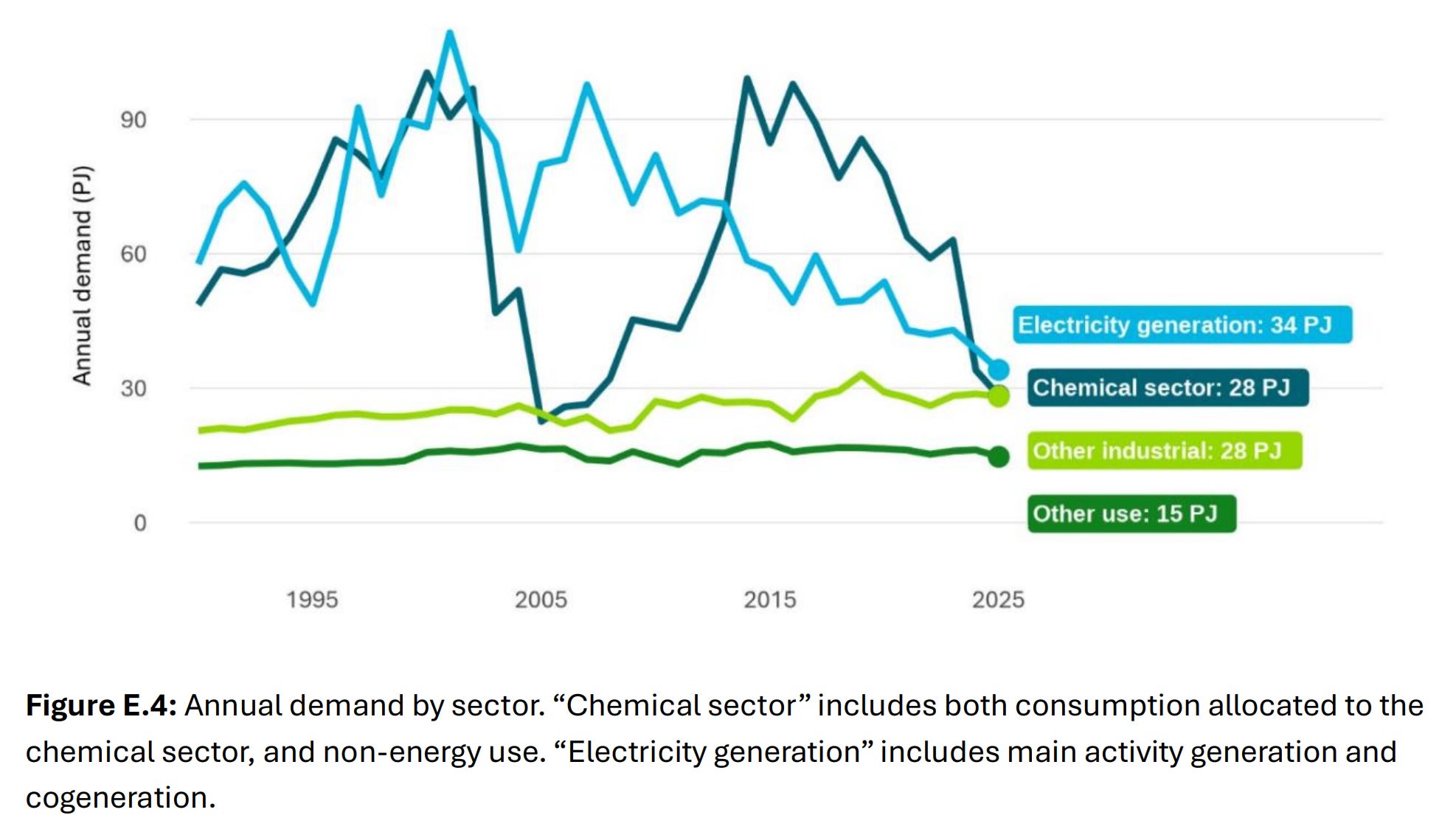
Our industrial production decline is most evident in our declining gas supply, as shown by our plummeting chemical sector energy use.
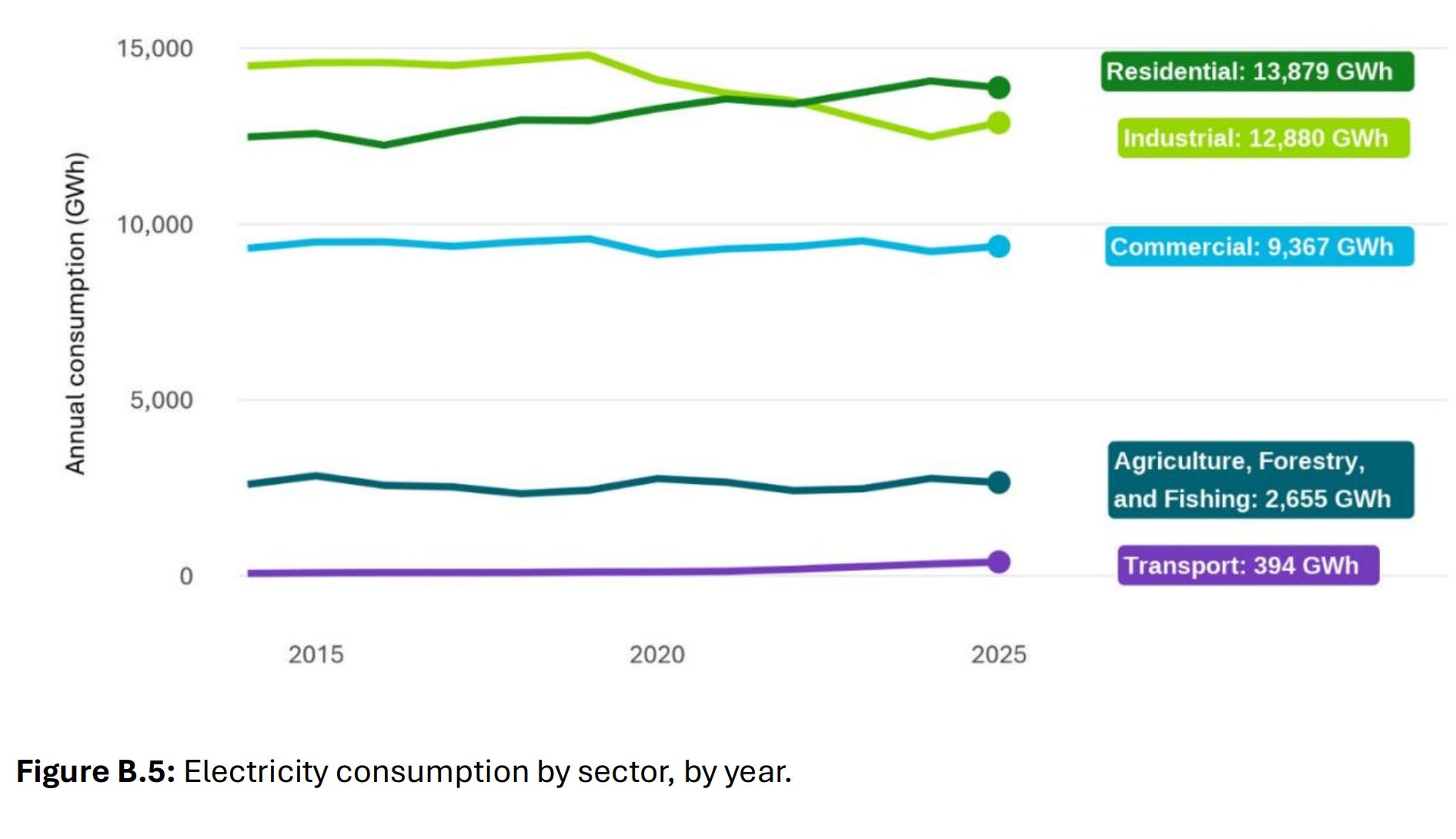
The de-industrialization trend is also evident in our electricity use data, but it’s more subtle.
For context, in 2023 our residential electricity use surpassed our industrial electricity use for the first time.
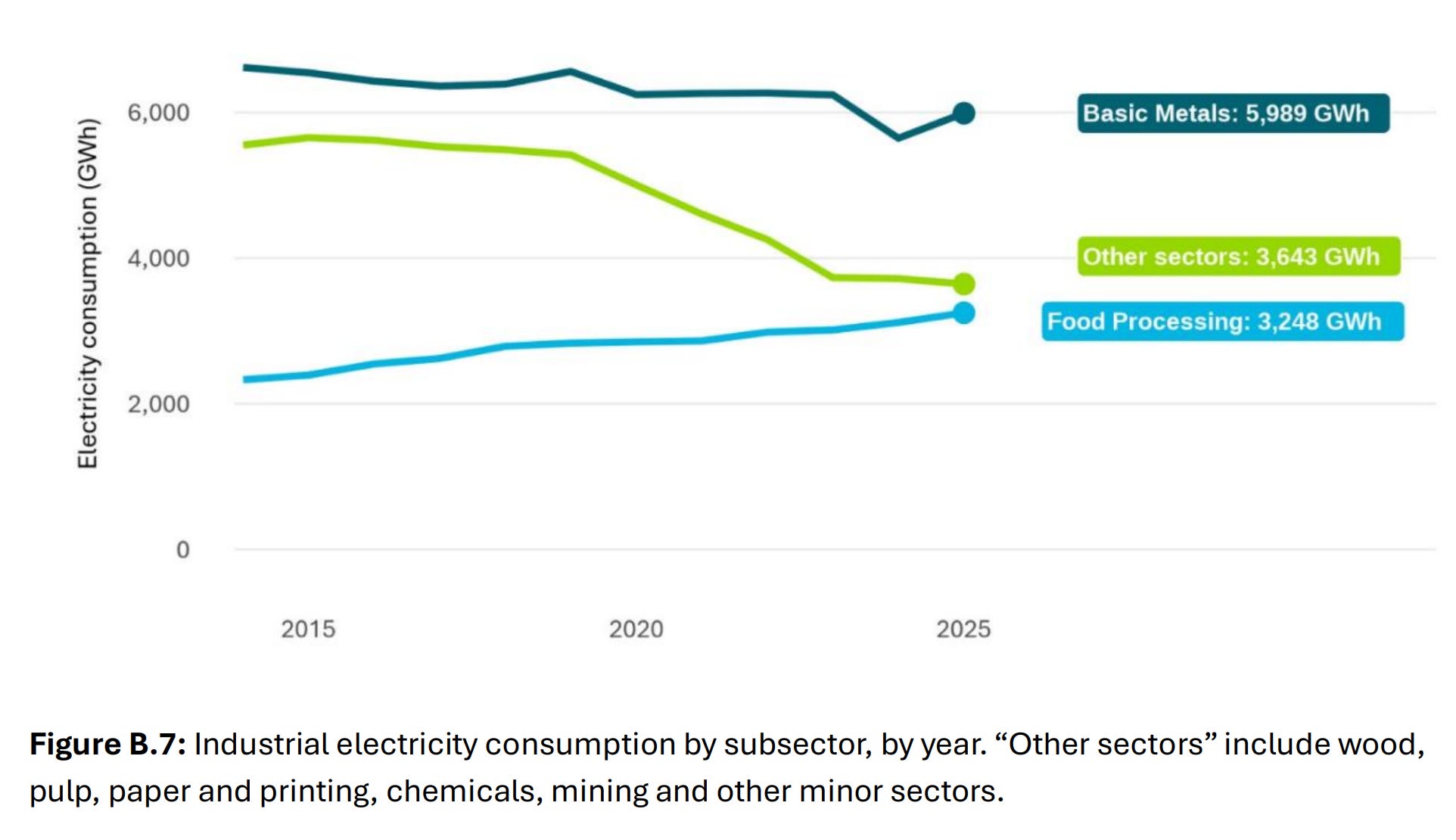
Industrial electricity use has been falling since 2019. This year there was a slight uptick which is nearly all attributable to increases at the Tiwai point aluminum smelter and modest increases in food processing.
Tiwai significantly reduced output in 2024 in response to our winter energy crunch. The 2025 data shown here is simply a return to normal levels of production.
I suspect the food processing electricity use increase comes primarily from electrification projects at Fonterra, which are an energy substitution, offset by less gas use, not an increase in production.
The key take away being that industrial electricity use is falling everywhere except in aluminium and milk production.
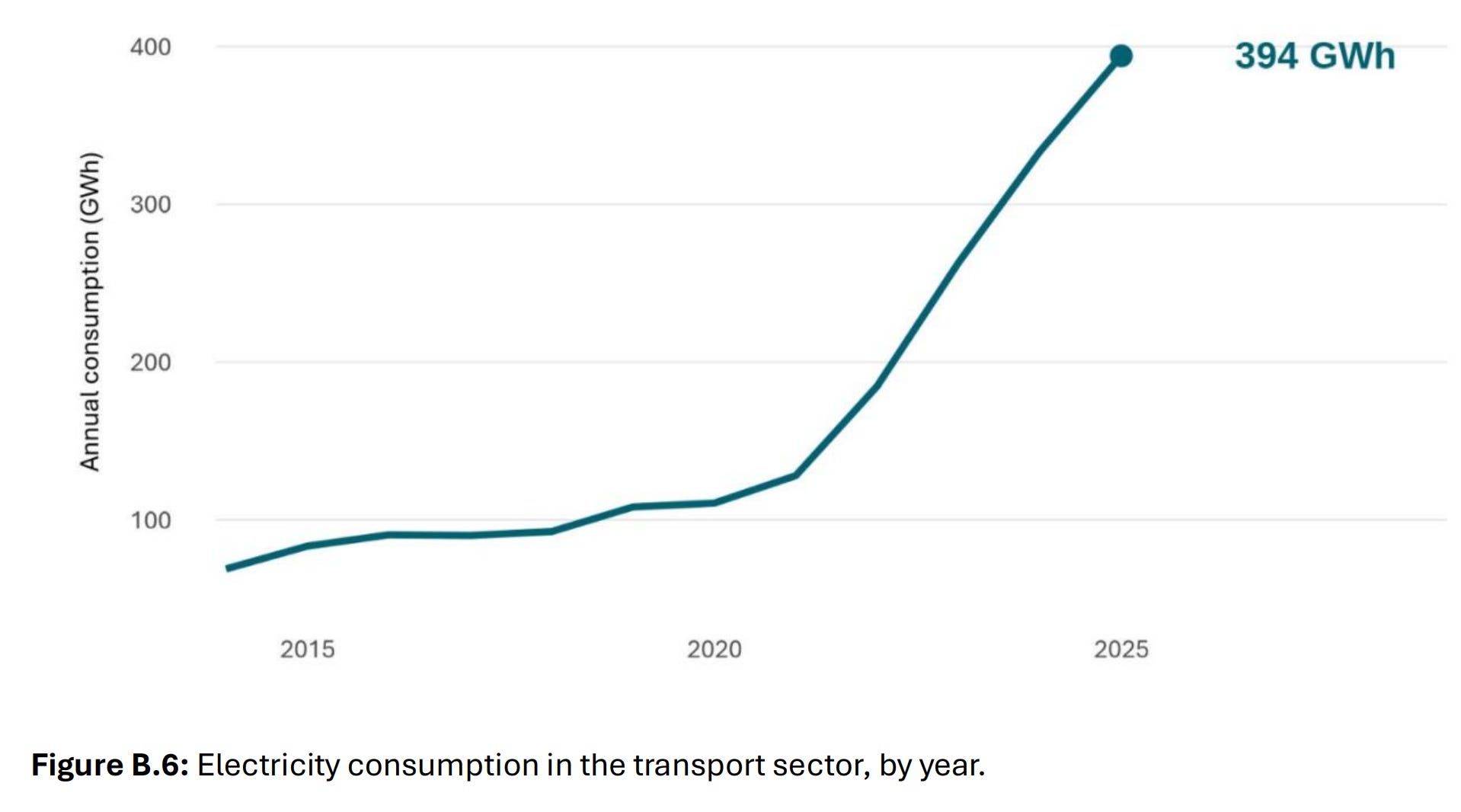
All those BYD’s I’m seeing on the roads are increasingly visible in our energy data.
Last year, before this year’s big upswing in EV uptake, we were already seeing about a 300% increase in transport sector electricity consumption. Expect to see another big jump in next year’s report.
Even assuming EVs require only around one-third of the input energy of an equivalent ICE vehicle, 394 GWh of transport electricity only represents roughly 4.2 PJ of displaced refined oil. NZ consumed 271 PJ of oil products in 2025, of which 76% was domestic transport, meaning EV’s displaced about 2%.
The most significant trend in the report is that we are running out of gas fast.
There are approximately 18,000 businesses in New Zealand that use natural gas, and many do not have any good options to fuel switch.
Electrification, outside of low temperature hot water systems, is not cheap or straightforward.
Meanwhile our biomass and biogas industries struggle to get off the ground. If, or when they eventually do, don’t expect then to be cheaper than the gas they are hoping to replace.
The most concerning aspect of our gas supply issue is the speed with which it is happening. Every year the decline curve gets revised and every year it gets steeper.
This isn’t simply my interpretation. Compare MBIE’s production forecast made on 1 January 2025 with the forecast made twelve months later.
I always look forward to this report coming out. It’s a good overview of the entire system.
The executive summary is that in 2025 geothermal was again the quiet achiever, otherwise there are very serious issues emerging in pretty much every category of our energy system.
Simultaneously our gas supplies are declining fast, global oil supply chain issues are casting a black cloud over our refined fuel supplies, and our renewables struggle to emerge and fill the gap.
We are at an interregnum.
The old world is dying, and the new world struggles to be born: now is the time of monsters.
P.s.
This Substack has grown a lot recently there are now over 2500 subscribers. If you’re new here, welcome it’s great to have you. Which brings me to a comment on comments. I appreciate all the thoughtful and considered comments. There is great expertise in this community and a lot of genuinely curious people. I’m struggling to find time to reply to them all but keep them coming anyway as they add another layer to these posts and I appreciate your contributions.
I publish these pieces freely in the hope they help people better understand the role of energy in our lives.
It costs nothing to subscribe or access the full back catalogue of over 160 articles that can be found here. However, if you choose to become a paid subscriber, that’s greatly appreciated, it allows me to dedicate more time to researching and writing.
Larry.
No posts
Comments
Nothing yet. Say the first thing.
Sign in to join the conversation.