
Each week, our editors select a New Yorker story for you to read: something timely, something important, or something unexpected—or even, perhaps, all three. To support journalism like this, consider subscribing.
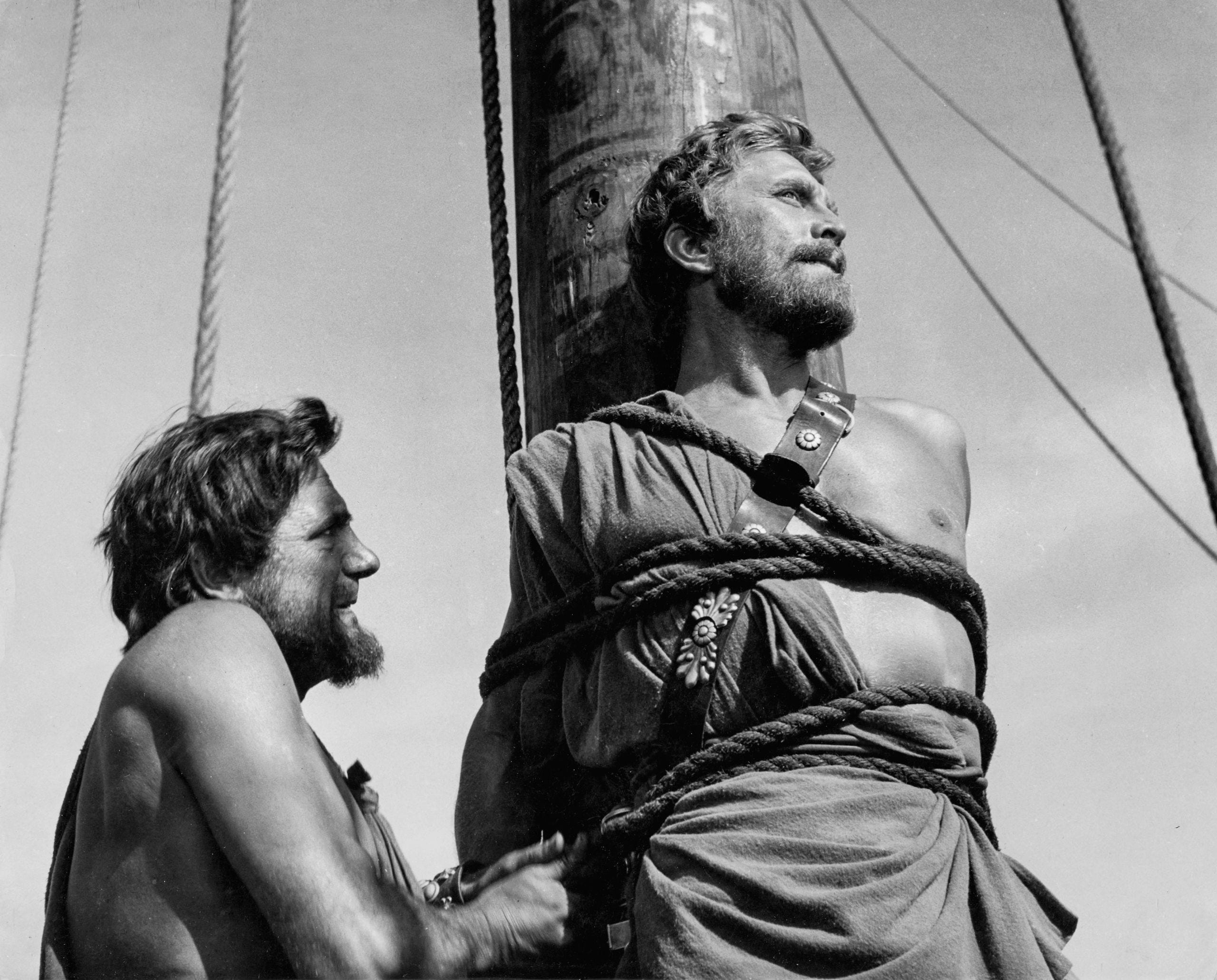
Full of violence, desire, monsters, and magic, Homer’s epic has tempted directors for decades. Can Christopher Nolan’s new adaptation survive the voyage?
By David Denby
In Book XIII of the Odyssey, which is both the most familiar and the strangest of great epics, Odysseus comes home at last. After ten years at war and ten more at sea, he is borne back to Ithaca by his gracious hosts the Phaeacians, who have feasted him and delighted in his tales. They lay him in the stern of a ship, where he remains through the voyage in a sleep “like death,” and unload him with great delicacy:
They disembarked, and lifted from the ship
Odysseus, wrapped up in sheets and blankets.
They set him on the sand, still fast asleep.
They unpacked all the presents he was given
by the Phaeacian lords to take back home,
Thanks to Athena’s care. They heaped the things
beside the olive tree, so no one passing
would do them damage while their owner
was sleeping. Then they rowed away back home.
A tired warrior needs his goods, but most of all he needs sleep. Homer’s homecoming epic is full of such lovely touches. The poem that precedes it, the Iliad, is a cruel and beautiful work, the ultimate story of war; the Odyssey has its warlike passages, but its central energies seem almost commonplace beside the merciless fury of Achilles. In Ithaca, Odysseus’ wife, Penelope, is besieged by insolent young men, freeloading suitors who want her to choose one of them. Homeless, his body torn, Odysseus needs to get back to her and Telemachus, his anxious son, and to clean up the mess. Along the way, when he’s lucky, he enjoys hot baths, a proper bed, carnal companionship, and gut-busting meals of spitted sheep, cow, stag, or pig. Few great works have been so devoted to physical pleasure and pain.
Odysseus is a warrior with wit and intellect, a con man and fabulist who constantly reinvents himself. Yet this complicated man wants only what any of us would want after terrible troubles—recovery and consolidation. Perhaps that is why he is the most beloved of heroes, and his story the most imitated of forms: a model for James Joyce’s word-drunk one-day Dublin epic, “Ulysses,” but also for “The Wizard of Oz,” for Charles Frazier’s “Cold Mountain,” and for countless other works, large and small, of adventure and return. The three-thousand-year-old poem is always with us, and always distant from us. The chaos in Ithaca may be political and ethical—a violation of custom—but stretches of the poem are barbarous and wild, beyond civilized life altogether. The foundational coming-home story is also the birthplace of science fiction and of horror. In the Odyssey, you swim for miles or drown at once; you attain knowledge or lose your mind; you eat or are eaten. None of Odysseus’ men make it back to Ithaca with him.
For more: A Father’s Final Odyssey
At the moment, the media is awash with storm-tossed boats and tufted bronze helmets. Christopher Nolan’s version, which reportedly cost two hundred and fifty million dollars and stars Matt Damon as Odysseus and Anne Hathaway as Penelope, opens on July 17th. I haven’t yet seen it, and I wonder: Do we need a big movie of the Odyssey at all? Filming it is like filming the Bible, or “Huckleberry Finn”—books so closely woven into us that some part of us doesn’t want to see them externalized as spectacle. The epic has been adapted many times, but the stiffness of most attempts makes one wonder whether the difficulties aren’t insurmountable. In recent years, Nolan has produced pop-sadistic fantasy (“The Dark Knight”), self-referential movie puzzles (“Inception,” “Tenet”), and real-world political and scientific drama (“Oppenheimer”). He likes to take chances, but he is now competing with a masterpiece in another form. It’s a death-defying risk.
Nolan and the cinematographer Hoyte van Hoytema, wielding heavy IMAX cameras, shot their picture across the Mediterranean and beyond, in caves, castles, beaches, black-sand wastes, and open water. Nolan seems to be striving for geographic realism interspersed with violent and fantastic episodes. A spectacular travelogue with thrills, however, will not be enough. We want some equivalent to what Homer provides—not just a sense of awe at natural and supernatural events but also a profound realization of the physical sensations of men and women. And maybe we want something harder to articulate: a movie that answers the needs of a sorely troubled national culture. The Odyssey has stuck around for three thousand years in part because every era takes what it wants from it.
The problems begin with the gods. What to do with them? Leisure-world swells, lustful and violent, they play favorites, altering the appearance of those they love, punishing those who have injured them. Athena, the goddess of wisdom, protects Odysseus, but she promotes mayhem and at times seems more interested in power than in any human being. Nolan has indicated that he mainly kept the gods off camera, signifying their presence through nature, yet he has cast Zendaya as Athena. Good luck to her: gods do not come off well in movies. In “L’Odissea” (1968), an eight-part Italian TV miniseries, conversations among Zeus and the other gods were heavily intoned offscreen, while the camera, in a series of jerking zooms, landed on statues of the immortals—highbrow kitsch. In “The Odyssey” (1997), an American TV series directed by the Russian Andrei Konchalovsky, Hermes, the messenger god who advises Odysseus on how to handle the temptress Circe, is a barely clothed young man butterflying around the Aegean. The gods belong to poetry, not to cinema.
Every filmed version of the poem takes on the sea god Poseidon, who is furious at Odysseus for blinding his monstrous one-eyed son Polyphemus (a.k.a. the Cyclops). In retaliation, Poseidon whips up the ocean, shredding sails, cracking oars, sweeping Odysseus and his men overboard. We’re eager for whirlpools and squalls, for “white calm” and mists. Homer does great weather. Yet Nolan has often expressed his wariness of C.G.I., which is the easiest way of roiling the elements. In the past thirty years, weightless digital imagery—exacerbated algorithms contending in nowhere space—has invaded everything from grand adventure stories to late-night commercials for S.U.V.s. Reality, in movies, has become fungible; nothing stays itself. Nolan’s distaste is palpable, up to a point. The visual distinction of his Oscar-winning “Oppenheimer” was enhanced by his sparing use of C.G.I. (The test detonation at Alamogordo was a real, non-nuclear explosion.) As he has recently remarked, he likes to work “in camera,” using sets, miniatures, and puppets—traditional special effects—before, inevitably, the C.G.I. boys get to work repainting the image.
When Odysseus and his men are trapped in Polyphemus’ cave, they blind the Cyclops with a red-hot stake—the sharpened end of an olive tree. The scene is discomforting in any version. How to make the moment scary but watchable, disgusting but entrancing? Homer at his most explicit can be unnerving. In Book XII, navigating between the twin female menaces Scylla (a six-headed sea monster who eats men) and Charybdis (a whirlpool who swallows ships), Odysseus loses six crew members:
. . . In agony they cried
to me and called my name—their final words.
As when a fisherman out on a cliff
casts his long rod and line set round with oxhorn
to trick the little fishes with his bait;
when one is caught, he flings it gasping back
onto the shore—so those men gasped as Scylla
lifted them up high to her rocky cave
and at the entrance ate them up—still screaming,
still reaching out to me in their death throes.
Agony is hard to watch in a movie. As for the simile of the little fishes, the cinema can hardly match it; the medium is mostly wedded to what it shows. An image may resonate with deeper meanings (that’s what great directors can bring about), but the compression and displacement that make the simile devastating on the page have no cinematic equivalent. Sometimes poetry leaves the cinema behind, gasping for breath.
Also from The New Yorker:
Comments
Nothing yet. Say the first thing.
Sign in to join the conversation.