
Local democracy has a problem. People want to get involved in their cities, but they don’t know where to start. And even if they do figure it out, getting involved can be daunting.
Heck, when I first started attending government meetings, I wrote a piece called "Community Board Meetings are too damn long." If you go down this rabbit hole, you often find two kinds of people: long-time residents with a lot of time on their hands or activists with a strangely strong interest in local government. You don't usually find the typical resident.
But two events this year gave me hope that we can make local democracy, well, more democratic. The first was a multi-borough scavenger hunt hosted by Zohran Mamdani, the frontrunner for the city’s mayoral race:
The scavenger hunters traveled around the city, Amazing Race-style, getting stamps based on clues about New York City history. The New York Post says about 2,000 people showed up. For a campaign event, that's a colossal crowd. It shows that people will show up in droves when political engagement feels less like work and more like a game.
The scavenger hunt reminded me of another social game I played this past summer. In this post, I want to review NYC Politics 101’s Primary Bootcamp and highlight what made it work.
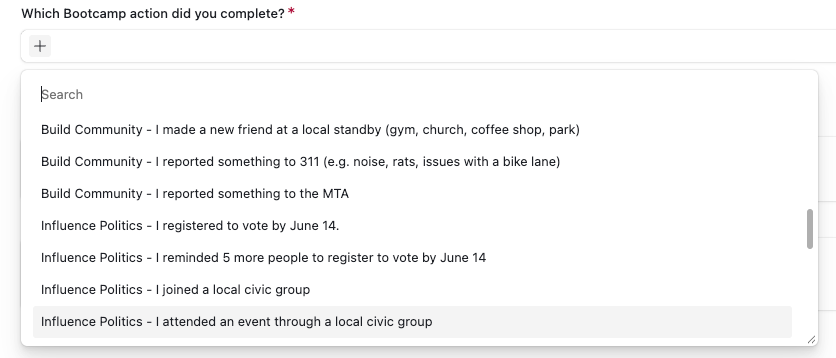
When you learn a new board game, you first figure out what you can do on your turn. What actions can you take? How do you score points? Which options seem the most fun?
No one spells out how to get involved locally that clearly. You learn through trial and error or with a persistent mentor. So, I appreciated that the Primary Bootcamp gave participants a list of actions to earn points. Like any to-do list, checking one item off made me want to knock out another. The points were especially helpful for procedural tasks, like signing up for my Community Board’s email list. The larger point totals inspired me to do more ambitious things, like host a fundraiser for a mayoral candidate.
I wonder if the next bootcamp could add more unpredictable rewards. In Zohran’s scavenger hunt, you didn’t know where the next clue would lead; you just knew you'd be spending the day nerding out about New York City. There’s something magical about that premise.
To that point, it was a neat, unexpected reward to attend Tea Time at Gracie Mansion for being a top points-getter. You can read more about that in this post from Big City Little Friend.
Learning about local government can be a solo activity, but participating has always been a multi-player game. NYC Politics 101 hosted meetups and a group chat for participants to connect and share their progress. Crucially, Sachi, the bootcamp organizer, helped publicize bootcamp-related events, like my fundraiser for mayoral candidate Zellnor Myrie.
I hope this virtuous cycle continues in future bootcamps: people complete tasks, host events, and other participants show up to support them.
A leaderboard with weekly updates keeps people engaged over time. And yes, players get a quick dopamine hit from checking the scoreboard each week. The bootcamp’s weekly update included the latest standings and highlighted interesting actions from participants. Here’s one of those updates:
Sometimes, points and leaderboards can make a game less fun for casual players. Some people might focus on optimizing for points instead of doing something ambitious or engaging. Personally, I stopped focusing on the leaderboard once it was clear I wouldn't be near the top, but I still wanted to earn points for my own education.
On that note, I think it was smart that the bootcamp gave a cool reward (a watercolor print) for clearing a certain point threshold, in addition to an invite to an awards party. Emphasizing tiers over exact point totals is probably a good way to keep a broad group of people engaged.
The bootcamp’s schedule cleverly dovetailed with the Democratic primaries. I know I was much more invested in the mayoral debates and election results after hosting a fundraiser for one of the candidates. People want to move beyond just scrolling through news headlines about an election; they want a deeper, more personal connection. Future bootcamps should probably always align with an election.
New York is a huge city, but only a small fraction of its residents get involved in local government. In 2021, about 940,000 New Yorkers cast a vote in the Democratic mayoral primary. That sounds like a lot, but it is less than a quarter of the city’s 3.8 million registered Democrats. So, on paper at least, there is plenty of headroom to get more New Yorkers engaged locally. For this bootcamp, about 180 people attended in-person events hosted by Sachi, and 64 people logged points.
The candidate I hosted a fundraiser for didn't win—in fact, they finished with only 4% of the first-place votes in the primary. Bummer. But an attendee told me they grabbed coffee with someone they met at the event to learn more about how tech in our city government works. That felt encouraging. When I met another bootcamp participant at an awards event, they gave me an idea for a whole new funding source for my Tree Guards project. I wouldn't have learned about that otherwise.
Over time, these bootcamps and scavenger hunts could build a real network of curious and abundance-minded New Yorkers. That would be a real victory for local democracy in today's New York City.
Thanks for reading Friends of New York City Abundance! This post is public so feel free to share it.
No posts
Comments
Nothing yet. Say the first thing.
Sign in to join the conversation.