
Debates about social categories like gender, race, class, and disability have never been more heated.
What is the status of such categories? Are they “real” or socially constructed or perhaps both? Moreover, debates about truth and its value continue to rage. We live in an era of widespread cynicism about truth itself, a so-called ‘post-truth’ moment in which truth claims are routinely dismissed as mere power moved or ideological impositions.
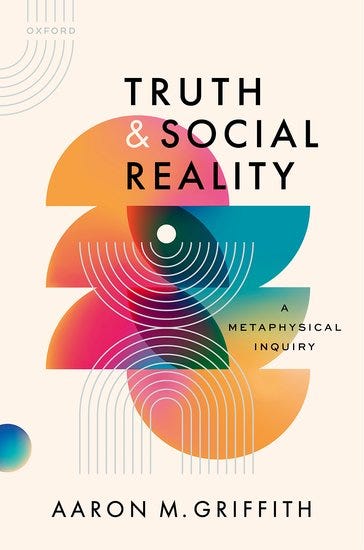
My book Truth and Social Reality: A Metaphysical Inquiry (Oxford, Clarendon Press, 2025) addresses both of these pressing issues together. The book’s central thesis is that the social world is real and that there is objective truth about it. Social reality is not a projection, an illusion, or a hallucination. But this realism is entirely compatible with the contingency, malleability, vagueness, and messiness of social life that we all recognize. There is objective social truth, but it is grounded in contingent and alterable social constructions.
The framework I develop is built around truthmaker theory — the view that true propositions are true in virtue of entities in the world that necessitate and explain their truth. Applying this framework to social ontology yields what I call the Simple Picture: social truths are made true by socially constructed entities and facts. Social truth is not itself socially constructed, despite being grounded in a socially constructed reality.
What does “socially constructed” mean on this view? I argue that non-causal, constitutive construction is best understood as metaphysical grounding. Drawing on and revising Brian Epstein’s ground/anchor framework, I distinguish between grounding principles — which specify the conditions under which social kinds are instantiated — and the social practices, beliefs, interactions, and material conditions that anchor those principles by making them true. To anchor a social kind is to make its grounding principle true, and it is this anchoring that constitutes social construction.
On this picture, social contexts are unique sets of interrelated grounding principles together with their anchoring conditions. Social truths are always socially situated — there is no view from nowhere when it comes to the social world — but they are objective within their contexts. This yields a form of contextualism rather than relativism about social truth. The content of a social truth may vary from context to context, but within each context it is genuinely true or false, not a matter of perspective.
This framework has direct payoffs for social ontology. It offers a new way to understand the metaphysics of gender, race, class, and disability as human social kinds. It explains how disagreement about the social world is possible, why social vagueness is real and ineliminable, while showing how specifying social contexts can reduce that vagueness. And it accounts for both the stability and the alterability of social reality: grounding principles are up to us to establish, for better or worse.
The book’s final chapter turns to the connection between truth and power. I argue against the view
— associated with Foucault and certain strands of critical theory — that truth itself is reducible to power or that all truth claims are simply exercises of authoritarian control. While I accept much of what Foucault says about how power can shape what and how we believe, I reject the reduction of truth to power. On the contrary, I argue that truth and truth-telling are essential to achieving justice.
Looking at truth and reconciliation commissions and efforts at racial reconciliation, I show that truth-telling is partially constitutive of reconciliation, reparation, and healing. To tell the truth about a history of injustice is to let victims be seen, known, and recognized in their dignity — and it is what makes genuine solutions possible.
The book concludes by addressing our current post-truth era directly. Insofar as post-truth culture involves despair about or indifference to truth, I hope that defending the possibility and moral value of social truth contributes something to resisting it.
Truth and Social Reality is available from Oxford University Press: https://academic.oup.com/book/60495
No posts
Comments
Nothing yet. Say the first thing.
Sign in to join the conversation.