
For seeing the Universities are the Foundation of Civill, and Morall Doctrine, from whence the Preachers, and the Gentry, drawing such water as they find, use to sprinkle the same (both from the Pulpit, and in their Conversation) upon the People, there ought certainly to be great care taken, to have it pure, both from the Venime of Heathen Politicians, and from the Incantation of Deceiving Spirits.
Thomas Hobbes, Leviathan
The downfall of Jason Arday provides us with an important ‘teachable moment’ that ought not to be wasted. With that in mind, I would like to set out some very brief thoughts, for those both within and outside UK academia who care about its future, on what can be done specifically to rescue scholarship in the humanities and social sciences at our univerisities. I will start by describing what precisely it needs rescuing from. Then I will set out two specific problems that urgently need to be addressed. I will conclude by proposing two solutions - one which academics themselves can provide, and one which requires solving by people with deep pockets (giving me billions of pounds would be a good start).
First, then, let me describe the problem. I would like to do this with a fairly trivial anecdote, which will open up for discussion a bigger theme.
Almost a year ago (if memory serves), a friend of mine shared with me a screenshot of a post on Bluesky, put out by the account of the Northern Ireland Legal Quarterly (NILQ). The NILQ is one of the UK’s most well-regarded generalist academic law journals, and the most important in Northern Ireland itself; I should say for American readers that law journals here (as in Europe) are edited by academics, not students. You can see said screenshot reproduced here, suitably anonymised:
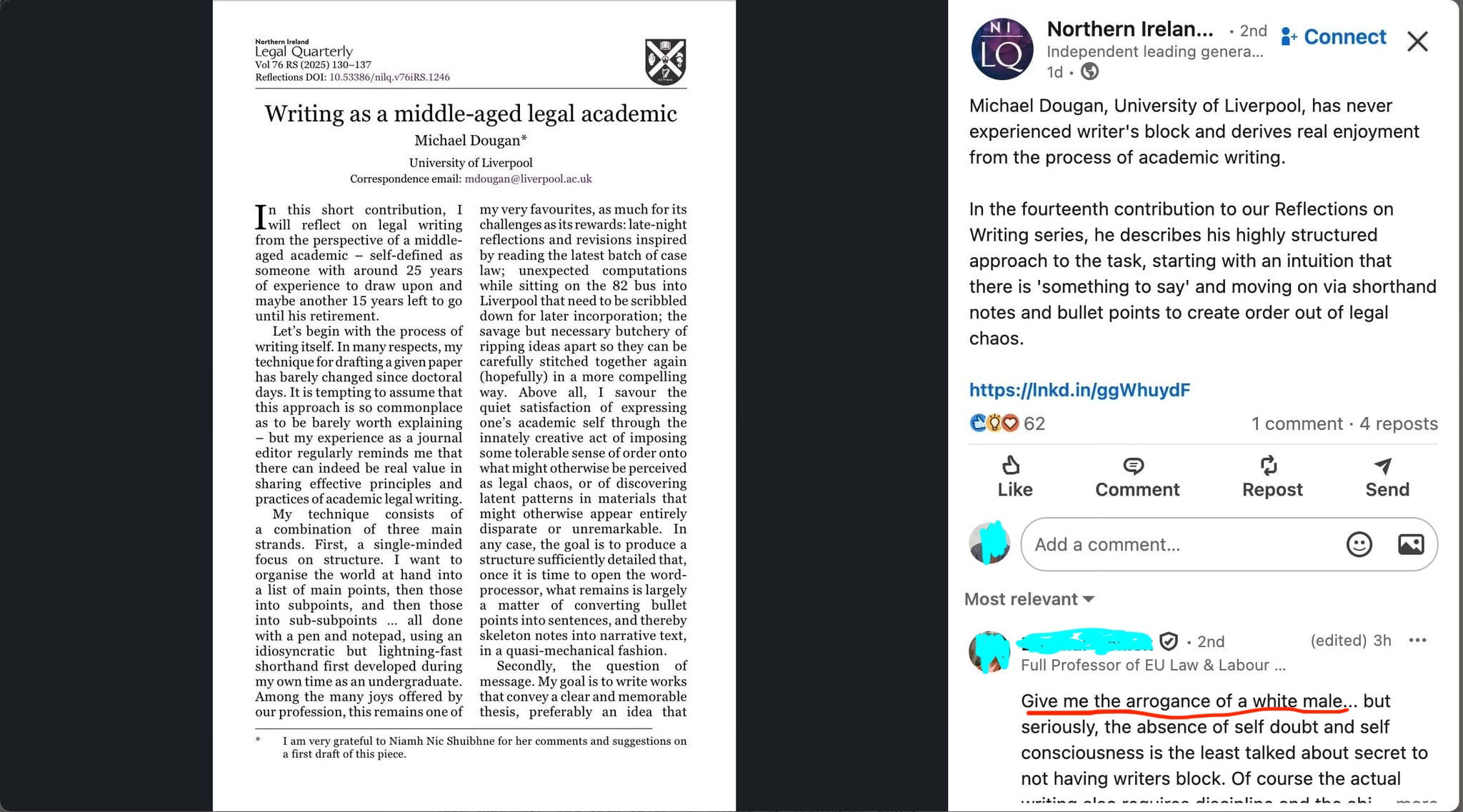
It depicts the first page of an instalment in a regular series on academic writing, called ‘Reflections on Writing’, which the NILQ has been running for a few years. Each instalment has a different author, and is intended as a kind of miniature Paris Review-style reflection on the writer’s craft from the perspective of a legal academic, if you can imagine such a thing. The author of this particular piece, Professor Michael Dougan, jots down some - I think quite touching - reflections on the experience of crafting a journal article; it’s nice to see a scholar giving voice to the pleasures of what should really be the essence of scholarship, which is getting to the bottom of things (‘discovering latent patterns in materials that might otherwise appear entirely disparate or unremarkable’); this is all too rare these days.
You can read for yourself the first page of the piece in the screenshot, of course, but what I’d really like to direct your attention to is the very first line of the very first comment made on it, visible to the bottom right, written by an eminent female Professor of EU Law at a very eminent university in a country whose name begins with ‘I’ and ends in ‘reland’ (admittedly not in the UK, but pretty close). And I’d like you to consider for a moment: this person not only thought it appropriate to make such a comment publicly, entirely without provocation; she also decided that it was appropriate to personally attack a fellow academic of good standing on the grounds of his race and sex in the opening sentence of her remarks. And she did this knowing that she was the first person to be posting, so that anybody reading the post would have more-or-less instantly seen her comment.
I’d like you then to consider: these are the thoughts she felt it appropriate to express in public. Imagine what she thinks in private. And then imagine the type of intellectual and professional milieu which she inhabits, where this type of behaviour not merely happens, but is done performatively - one might even say rather gleefully - by senior figures in the field.
I say this not to ride to the defence of Professor Dougan, who is perfectly capable of doing that for himself and who has a perfectly good career. And nor do I say it in order to add my voice to the chorus of bleats from the embittered ‘woke right’. I say it rather to try to describe the scholarly atmosphere (if I can call it ‘scholarly’) that a young, bookish, nerdy, person will expect to encounter if he or she is in any way inclined to try to forge a career in academia almost anywhere in the developed world in 2026. The problem is not really discrimination per se (although the reverse kind certainly exists - just take a look at any academic job advert on jobs.ac.uk if you don’t believe me). The problem is that what can only frankly be called prejudice is now openly expressed in such a general, sloppy and intellectually lazy way that it makes it almost impossible at any given moment to tell whether one’s successes or failures are due to one’s skills, abilities or experience, or due to one’s race and sex. The personal has become political, but it has also become scholarly. Increasingly, what matters is not the scholarship, but who has written it - what their immutable characteristics are, and whether, more broadly, they are properly politically aligned.
That is really the context in which Jason Arday saga has to be understood, of course. But I want here really to draw attention to the genuinely corrupting nature of this type of thinking for the disciplines themselves. And I want, perhaps perversely, to emphasise how it corrupts the nature of failure.
To fail, to be clear, is one thing, and it is generally valuable. To fail, to understand why one failed, and to therefore find ways to improve is the essence of trial and error and it is how all human beings learn. And it is how good scholarship is honed. It is what peer-review is all about; a piece is submitted and typically either rejected (‘this is not ready to see the light of day’, or, indeed, ‘this is fundamentally misconcieved and you must go back to the drawing board’), or sent back to the author with suggestions to make it better (what is often called ‘revise and resubmit’). It is what being a PhD candidate is all about, with work being submitted, read, and, hopefully constructively, criticised. And it is also what an undergraduate student is all about, from every seminar or tutorial right the way through to summative assessments.
What the prospective academically-inclined young person now faces, however, is a situation in which failure and success are becoming divorced from the quality of the work they produce, and are becoming connected instead to who they are. Whether they are appointed to a particular position, whether they get promoted, whether their papers are published, and so on, are matters decided not by the underlying quality of their work, but on the basis of whether their face fits or they indicate that their ideological views are consonant with those in the academic mainstream.
The results of this are obvious. Academic work in the humanities and social sciences has become highly performative. It has not become totally performative, because there are still lots of scholars out there who are well-established and who can rely on existing reputations and networks to get by if they don’t rock the boat. And there are still lots of younger scholars who are able to play the game in order to carve out space in which to do what they really want to do. But the performativity has a pernicious and detrimental effect on the disciplines, because of what it does to quietly eliminate a particular kind of scholarship which is, as a consequence, rapidly disappearing.
In order to explain this, it is necessary to tell you a little bit about the way a modern academic career works, at least in the humanities and social sciences - something which won’t take long and which, indefensibly, is almost never actually done.
The modern university lecturer does three broad things: teaching, research, and what often gets called ‘academic administration’ - i.e., managerial busywork for which they are often ill-suited and which gets in the way of their real jobs, but which has the great value for university management of being more or less uncosted.
Research (which is to say, scholarship) in the humanities and social sciences consists really of two things: publishing and writing what everybody refers to as ‘bids’. Publishing means either writing papers and submitting them to journals, or writing books and submitting them to publishing houses. Writing ‘bids’ means writing soul-destroying proposals and begging letters to research funders, typically dispensing state money, for some of said money, usually to buy out teaching. How this works is that Professor Paul Paulson or whoever says to the Arts & Humanities Research Council, ‘I want to write a book concerning poetry about the mating habits of pheasants written in the latter half of the 1670s, so giz cash’, and the Council gives the university which employs him £80,000 (or whatever) so that he can have a year of free time dedicated to writing his opus, with somebody else filling in for his teaching.
The two things are vitally important at a personal level because they are how you get promoted, and the emphasis is increasingly on the bidding aspect of the equation; at many institutions now the informal, unspoken requirement to be promoted at any stage is winning bids, with winning a ‘big bid’ being required to make to full Professor. And they are also vitally important for the disciplines because they are - well, because they should be - how we get closer to the Truth, or, if you prefer, how we better construct knowledge.
But you may already begin to see the problem. Writing papers is hard, and takes a long time. A decent journal article can easily take a year to write and make ready for submission. A book takes a lot longer. Writing bids is almost as hard, takes almost a long, and is a morale-crushing, horrible chore. And success and failure really matter, for the reasons given. But remember what I said - failure and success are becoming divorced from the quality of the work, and are becoming instead becoming connected to who is producing it. What, then, is the likely approach for academics to adopt?
I said earlier on that there were two problems that need addressing, and this is where those problems come in.
The first problem is peer-review. Many academics (I am not convinced it is a majority) are still, I would say, reasonably open-minded and just want to see good work produced. But consider my earlier remarks about the general intellectual milieu which now prevails at universities, where it is perfectly acceptable to demonstrate open prejudice on identitarian grounds, and where having the correct views is increasingly dispositive in determining success. Any paper that gets submitted to a journal, or any bid that gets written, has to be peer-reviewed, typically by two or three reviewers. Now, given everything that I have said, the chances are high that at least one of those reviewers will be a true believer in the cause of progressive politics, and will put the kibosh on anything that comes across their desk if it does not at least contain some genuflections towards the dogmas they hold dear. Moreover, while peer-review is supposed to be ‘blind’, in many cases it is not (proposals for funding ‘bids’ are not typically anonymised, for instance), and it is often not all that hard to work out, to anybody who knows their own field at all well, who has written any purportedly anonymised piece that they are reading. A politically motivated peer-reviewer, or one who has simply drunk the identitarian kool-aid, will have no difficulty whatsoever in finding reasons why a paper they are reading should not be published, or why a proposal they are reading should not be awarded money, on the grounds of who has written it and where they align politically.
What happens as a result of this is that the discipline becomes, progressively in both senses of the word, skewed. Nobody, unless they are already established and able to find alternative routes to publication, would dream of producing research that has a conclusion that could in any way come close to suggesting that progressive orthodoxies might be wrong. Why would you bother spending a year writing an article, or three months writing a bid, when you know the chance of it being rejected because its content suggests you hold the wrong views is close to 100%? You would have to be mad to do so. So you just don’t.
The second problem is institutional. Given the situation is as it is, work that gets published tends to have a certain ideological flavour. And given that academic promotions tend to function on the basis of publications and research income, the consequences are plain: the people who make their way up the ranks to professorships, and who thus set the tone within their disciplines, are the type of people who produce work that has that particular flavour. The result of that is a self-reinforcing narrowness that increasingly excludes people whose faces don’t fit or whose work does not echo orthodoxy. Everything becomes stultified. Nobody wants to be identified as outside of the orthodoxy, because to do so is to see one’s career ossify. One does not typically get ‘cancelled’ or fired. Instead, one finds oneself frozen in academic aspic - unable to produce the work which one wants to produce, because one is painfully aware that it will likely never see the light of day - or else writing in obscure Straussian esotericism, trying to smuggle publications out into the public domain as though on paper aeroplanes floated over the Berlin Wall at midnight.
In tandem, these combine to direct the path of the profession in a very odd direction, towards something akin to a clerisy. I do not here aim to convince you why this is undesirable; if you do not already know, there is probably no hope for you. Rather, I want to make two suggestions, mapping to the two problems identified, for those who know why, and care.
The first suggestion is for academics, and it is this: there is a pressing need for the founding and running of journals, and the publishing of edited collections, by people who care about getting to the bottom of things and who are connected to colleges of peer-reviewers who, likewise, are concerned only with quality. If it is increasingly difficult to find opportunities to publish heterodox work, those opportunities need to be created. I am not suggesting that such opportunities need to bill themselves as the Journal of Anti-Woke Studies or the Annals of the Far Right Academy or anything of that kind. Any ideological slant is corrupting and, to be frank, pointing out why wokeness is bad is unlikely to be very good or interesting scholarship. Rather, I suggest that people who care about the long-term future of the disciplines as disciplines need to roll their sleeves up and provide avenues to get work out there whose only virtues are significance, originality and rigour, irrespective of who the author is or the views they hold.
The second suggestion is for wealthy people based in the UK to get serious about funding academic research. The people who work at universities teach future politicians, lawyers, teachers, doctors, and journalists. They also generate the knowledge on which policy is founded. It really matters what their values are. And if their values are narrowly ideological and founded in identitarianism then we should not at all be surprised that our educated classes nowadays are rife with, frankly, daft and dangerous ideas. The solution lies in creating more space for universities to pursue non-ideological Truth. But this can only happen when Truth-seekers are funded to pursue it, and when, crucially, they are promoted to positions of academic leadership. To get to such positions, they need to have been awarded research grant income. Where is that to come from, other than through people with deep pockets who have the same broad goals?
It is increasingly said these days that universities should simply be allowed to fail, or to conclude they are ‘too far gone’. This is simplistic: the needs for education and rigour have not gone away. British academia can be rescued. But people have to want to rescue it, and be willing to act to do so - not by putting a tick on a ballot box in a general election but by making differences where they can. Now - about those billions pounds I mentioned; anybody who is interested should send me a direct message with your bank details and I’ll put you in touch with the Nigerian princess who handles my finances.
No posts
Comments
Nothing yet. Say the first thing.
Sign in to join the conversation.