
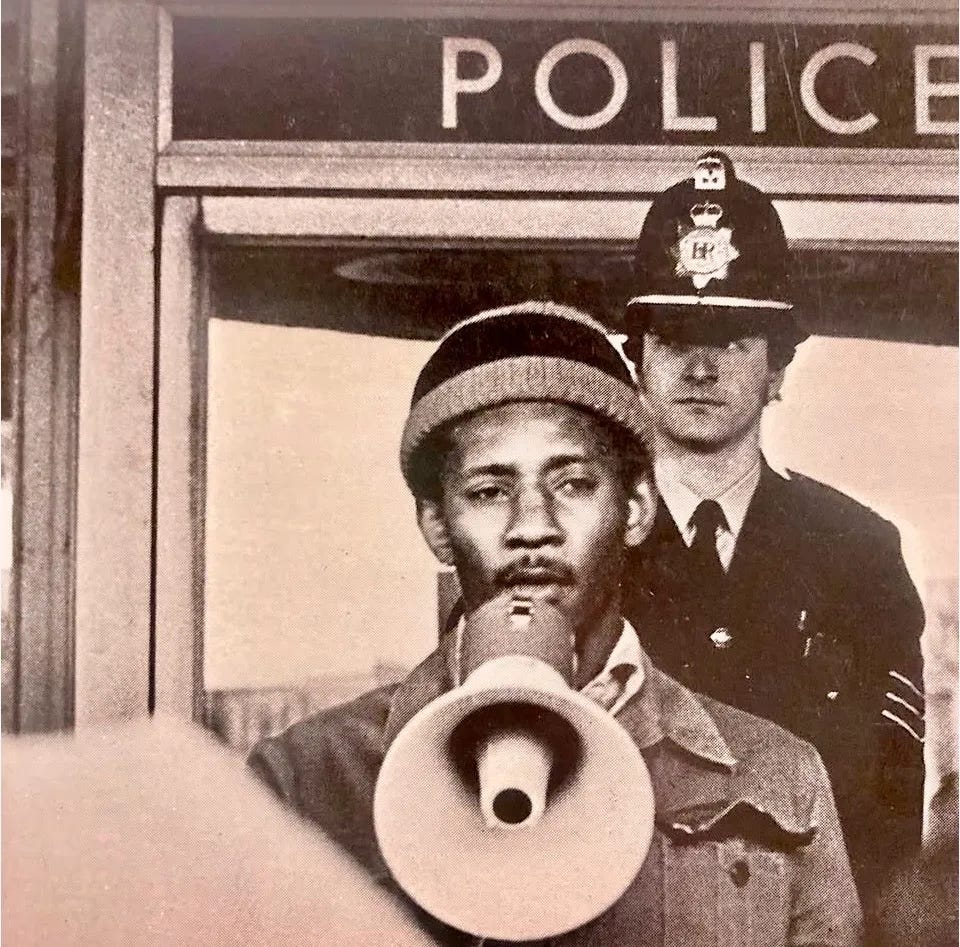
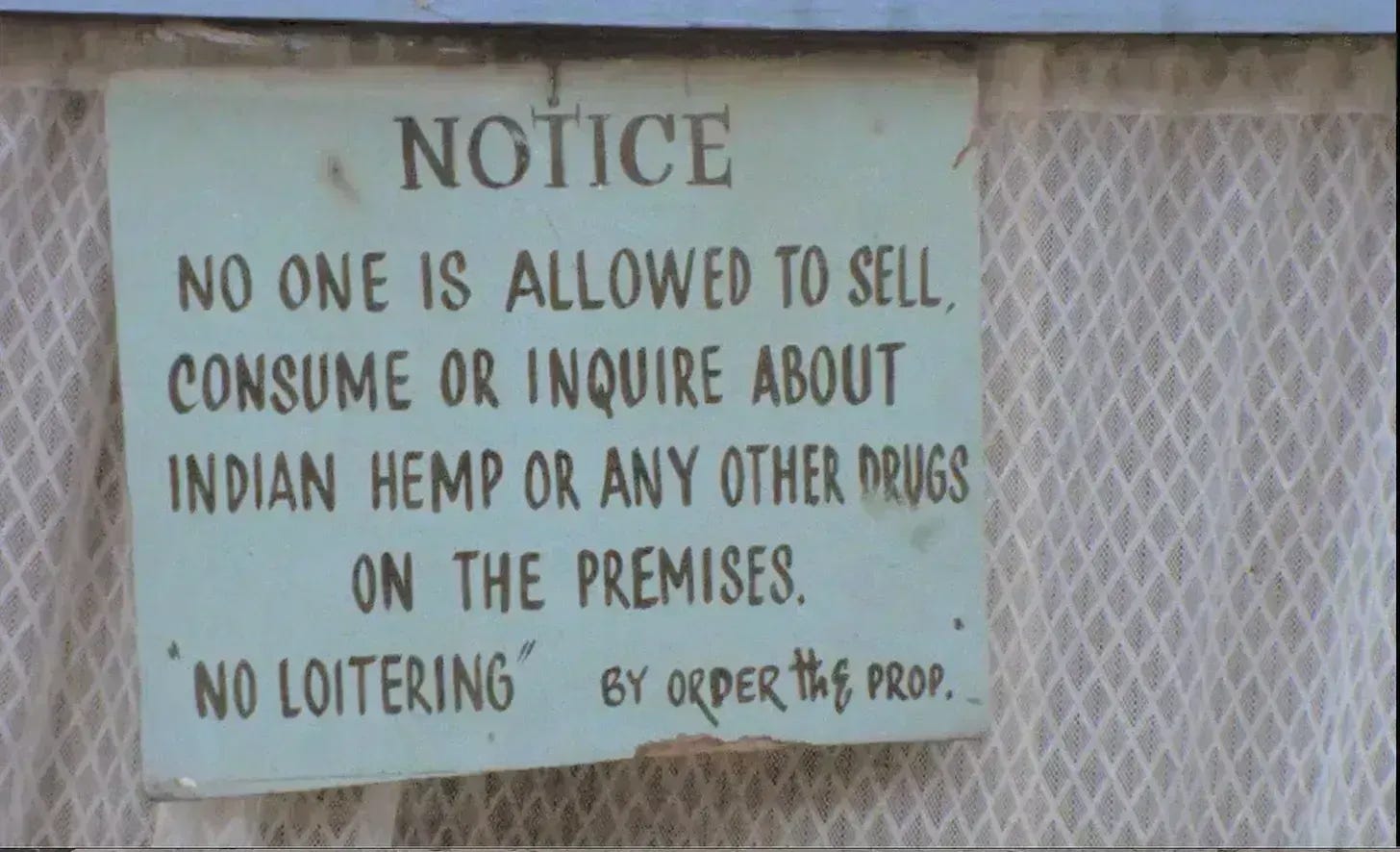
A still from DREAD BEAT AN BLOOD (1979)
Last fall, the powerful 1979 documentary DREAD BEAT AN BLOOD, newly-restored by the British Film Institute, premiered in the U.S. at the Brooklyn Academy of Music. Its subject, the Jamaican-born, British-bred dub poet / reggae legend Linton Kwesi Johnson, was in town to mark the occasion with a talk and a poetry reading.
I spoke with Johnson earlier that day, and planned to publish a piece when the film scheduled a wider U.S. release. That’s taken longer than expected — unsurprising for a film about a poet-activist making art that spoke out against government-sanctioned violence targeting immigrant communities; a film that spoke about racism, racial disenfranchisement, and how people sustain themselves as the struggle continues. It was made by the Italian-born director Franco Rosso, who’d go on to make the equally-potent UK reggae drama Babylon. It’s a film worth revisiting.
This Friday (July 24), DREAD BEAT AN BLOOD opens at Film Forum in NYC for a week-long run, with Linton Kwesi Johnson in Concert, a short but absolutely killer 1985 concert film of Johnson and the Dennis Bovell Dub Band, shot at the Albany Empire in Deptford for the Channel Four public affairs series The Bandung File. Both films will screen in LA on July 30 via Mezzanine at 2220 Arts + Archives (2220 Beverly Blvd). Screenings are planned for this fall in Austin and Philly.
Here’s an update of the piece I wrote, with our conversation lightly edited for concision and readability. Apologies for any misspelling or mis-handling of the patois, which is of course Johnson’s calling card.
muzik of blood
black reared
pain rooted
heart geared
— "Bass Culture (for Big Yout)"
Linton Kwesi Johnson in Mi Revalueshanary Fren (Ausable Press, 2006)
I’ve been thinking lately about poets.
Most of the music that moves me deeply is the sound of musical instruments combined with words. I’m not interested in dissecting the difference between “lyrics” and “poetry” — another time, perhaps. Suffice to say that many of my favorite musicians have also self-identified as poets. Lou Reed. Patti Smith. Gil-Scott Heron. David Berman. Leonard Cohen. Robert Hunter.
No modern day poet-musician has combined the disciplines more powerfully than Linton Kwesi Johnson.
His debut LP, Dread Beat an’ Blood, with the jazz-tinged “All Wi Doin is Defendin” (“all oppression/ can do is bring/ passion to di heights of eruption/ an songs of fire wi will sing”) was a hugely powerful opening statement — the sound of a young poet and musical group learning to make records together. Poet and the Roots was the original name for Johnson’s project with musician/producer Dennis Bovell, already making potent dub records under his moniker Blackbeard. (A nice overview of Bovell’s recordings can be found on Bandcamp, here.)
Everything sharpened on Johnson’s Forces of Victory, thanks in part to a deal with Island Records, who were certainly hoping to create some sort of homegrown variant of Bob Marley, then filling their coffers. Johnson had other things in mind. In any case, the deal resulted in three near-perfect LPs, including Bass Culture and Making History.
This music meant a lot to many of us in the U.S. during the Reagan ‘80s, when it seemed all the social progress of the ‘60s and ‘70s was going to be scuttled. A lot was. And we find ourselves in a similar situation today.
Articulate, cool-headed but smoldering, darkly funny, supremely poetic, and utterly committed, the 27-year-old Johnson we see in the 1977 documentary DREAD BEAT AN BLOOD is a young lion.
The man I meet in Brooklyn is an old lion, and, after a half-century of activist artmaking, he admits he’s a bit tired. And fair enough.
WH: So what have you been up to in recent years? Most folks in the States here understand your work through your recordings, and it’s been quite a while.
LKJ: I haven’t been doing much, really. I’ve been trying to have a quiet life, but people won’t leave me alone. I stopped touring with the Dennis Bovell Dub Band around a couple of years before COVID. I think the last gig we did was in Brussels with a band from Jamaica, Inna de Yard. It was a coming together of different people, including Ken Boothe, Cedric Myton [sky-high voice of The Congos], some others.
Yes — some of the greats.
We were headliners. Yeh. So after that, I just figured, you know what? I’m not doing this anymore. I’m tired now. I deserve a break, or I deserve retirement. And plus my arthritis is getting worse. It was quite painful standing up on stage for an hour and a half, two hours. So I called it a day, really. Apart from that, all I’ve been doing is the occasional poetry reading here and there. They reissued my Selected Poems — Penguin did — so I did a little tour to promote that in 2022. That’s like 20 years after it was first published.
The first edition, was that the one with the Russell Banks introduction?
Yeah, Russell Banks did an introduction for the American one, which was published by Copper Canyon — but it wasn’t Copper Canyon. It was a small poetry imprint that Russell Banks’ wife had. His wife’s called Chase [Twichell]. Copper Canyon bought them out.
The Penguin Classics edition was a big deal — you were you the first black British poet in that series, yeah? [NB: Johnson was also just the second living poet in the series in 2002, when the edition was published.]
I was, and I didn’t realize what it meant at the time. I thought it was a good marketing strategy on behalf of Penguin [laughs]. But it stirred up a lot of controversy amongst the gatekeepers of the cannon of British literature, who felt that my entrance to the citadel of British literature was somewhat premature.
The gatekeepers never sleep. We have our problems with them here, too.
That’s certainly true.
You’ve done work as a journalist and essayist over the years. I noticed that Race Today has their back issues archived on the internet now, as of last year. I discovered it the other day when I was preparing for this interview.
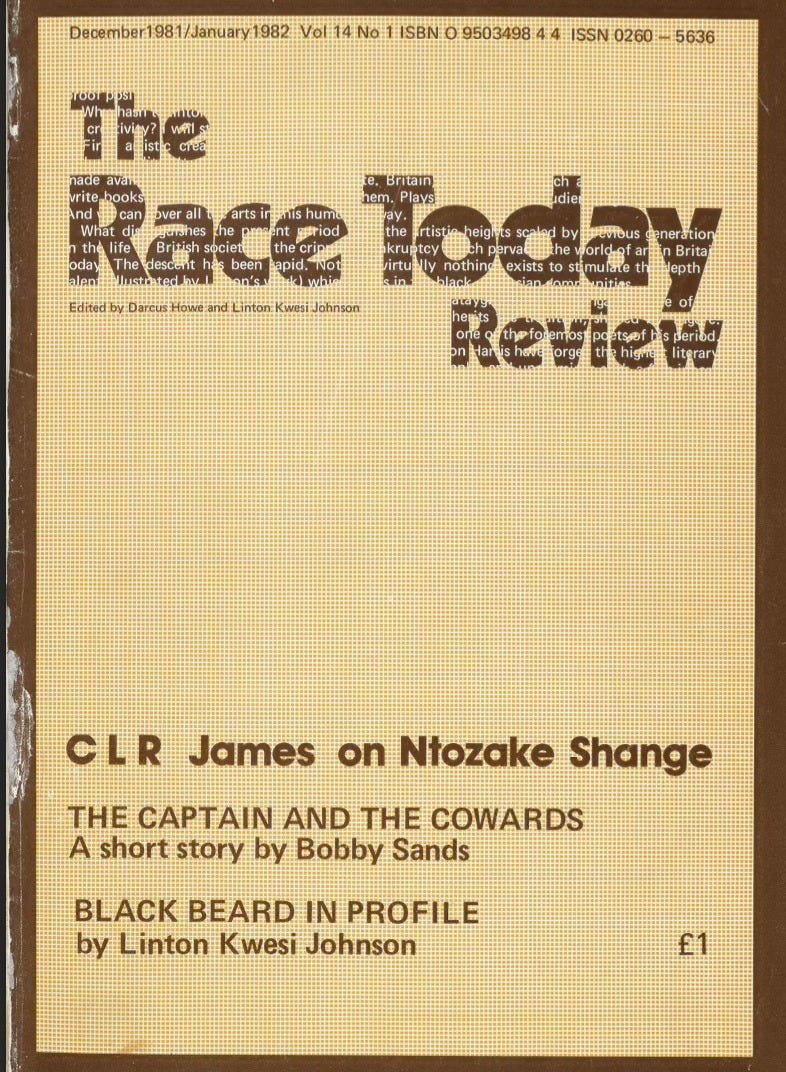
You are one step ahead of me! I know that they brought out some publications, huge publications, three or four volumes. And Darcus Howe, our editor, I think his papers went to Columbia University when he died. Darcus died about 10 years ago. And the Black Cultural Archives in Brixton, they have a lot of Race Today stuff there as well.
Right. Well, this was good to see because it’s archive.net, which means nobody has to pay for it. It’s just all out there
That’s wonderful. That’s really good to know. I’ll tell Leila [Hassan Howe], Darcus’ widow, when I get back to London. But she’ll probably say, “oh, I know, Linton — where have you been?” [laughs]
I’m not a very tech person. I don’t go on the internet. I just do my emails, yuh know? I think cyberspace is a toxic place, and I don’t want to be there. I don’t want Facebook, Instagram, X or whatever they call. I don’t do those stuff; I don’t do it. I’m afraid I’m a bit backward, yuh know, old school. Old dog that can’t be taught new tricks. [laughs]
Are there young writers you’ve crossing paths with that you think are doing particularly good work?
There’s a young poet called Caleb Femi. He’s of Nigerian ancestry, and he wrote a very good collection. He’s got a new book out now, I can’t remember the title, but his first book was really amazing, a book called Poor. It sort of gave you portraits of the social life, the everyday life of second and third generation kids of West African extraction in England, in London. Yeah. Gave you an insight into life on the housing estates, what you’d call the projects out here, and that kind of stuff. He’s a talented guy. I think he’s into films and filmmaking and other stuff apart from poetry. Poetry is like maybe something he does, but it’s not his full-time job. He’s a nice kid.
The West African community is generating a lot of amazing art that’s making it over here.
It’s happening in England too. Back in the day, it was people from the Caribbean, African-Caribbean heritage. But now in the world of film, visual arts, in the world of popular music, it’s kids from African, West African backgrounds, all this grime music and stuff. It’s 99% kids from African backgrounds. One of the leading actors in England is of Nigerian extraction, Daniel Kaluuya. There are other people whose names I can’t remember. I’m getting too old. But yeah, the impact on popular culture right now — second generation, third generation West Africans.
Yeah. It’s remarkable in the Afrobeats music and rap coming out of the country, and filmmakers, we’re seeing a lot of work.
Before I forget his name, there’s another young guy from Ghanaian ancestry called Caleb Azumah Nelson. He’s a novelist and he’s very, very popular amongst the younger generation of readers. He’s a man writing romantic novels, like a male version of what they call “chick-lit.” [laughs] Which I found really weird, but he’s a nice kid and yeah, he’s got a big following, huge. All the girls love him.
And your music has been introduced to a new generation of folks.
That’s how it’s been these last 20 years or so. Every time I go, I to perform at these huge festivals in France, Germany, Italy, Spain. I’m thinking there’s life after death. [laughs] I’m playing to kids in teenagers and people in their early twenties. There are a few old timers in the audience as well, of course, but mostly young people.
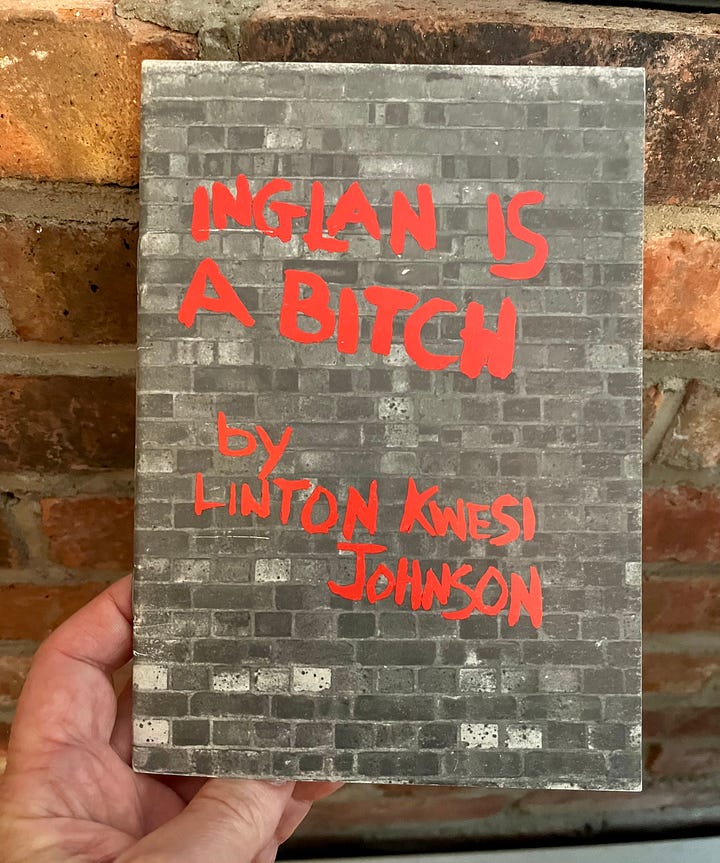
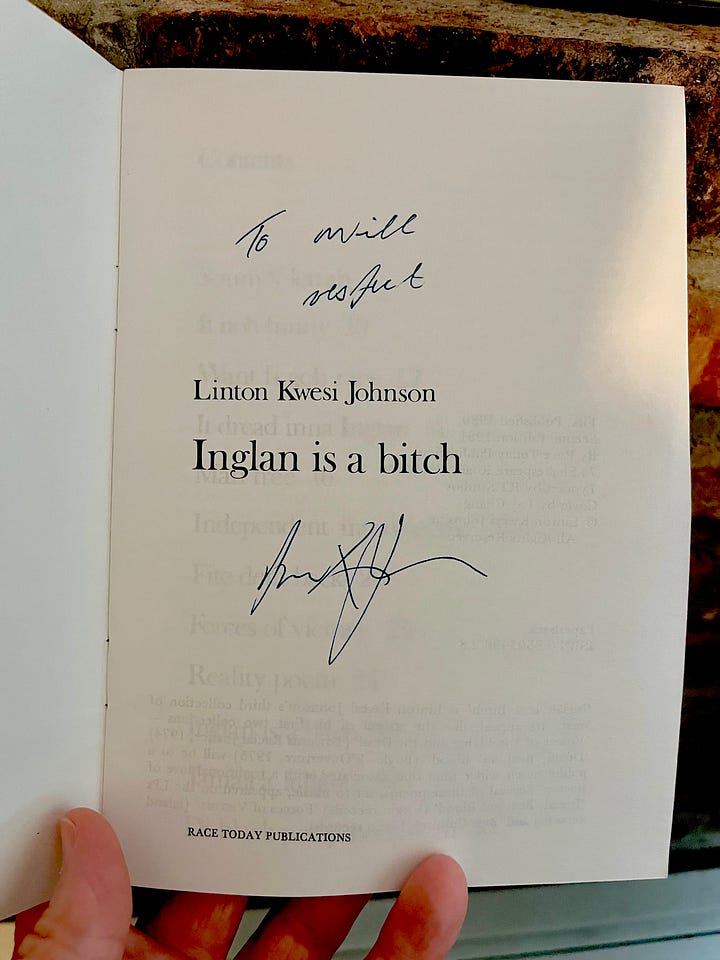
I saw the episode of that series The Crown that used “Inglan Is a Bitch” and “Fite Dem Back.”
I got a couple hundred quid for that. It all helps. [laughs]
And I saw Dennis [Bovell] in Steve McQueen’s Small Axe series of films.
That was really wonderful.
The “Lovers Rock” episode…
I was sat there with my wife watching “Lovers Rock,” and there’s all these young people dancing to the music, and all of a sudden the camera goes to this old guy with a gray bit, and I’m thinking, “What the hell are you doing there amongst those young people, Dennis?!” [laughs]
Did you know he was working with Steve on that?
Yeah, ‘cause Steve used some of my stuff as well in that series. He used the “New Crass Massahkah” poem.
And then at the end of the documentary, [Steve] asked me to write an end piece, like a coda, which I did. It’s a very, very short poem, maybe 15 seconds or 20 seconds, and he loved it. He’s a great, great voice coming out of the country. A great man.
He’s been around for a long time. I mean, his visual art stuff. Yeah, yeah, yeah. He’s won so many awards. And he just did a movie called Blitz, set in the Second World War. […] There’s a scene in there where there’s this guy standing on a soapbox, reciting a poem, but it’s like he’s making a speech or something. It’s about 10 seconds or so — if you blink, you would miss it. That was me.
I need to see that. What triggered the restoration of your documentary at this moment?
I don’t know. I just heard that British Film Institute just got around to it. I know [they] had bought the rights, about 20 years ago or more, and they promoted it with a documentary that they did with John Cooper Clark. So there’s a DVD put out by the British Film Institute — half of it is DREAD BEAT AN BLOOD, and the other half is John Cooper Clark.
Your albums have endured. They were really important to a lot of people. I was listening to Making History yesterday, and that record speaks to this moment so directly…
I was a bit pissed off with Chris Blackwell because he had it remixed for the American market. He thought it was too heavy for the American market. The British mix and the American mix are different.
Same thing with Bob Marley, yeah?
I don’t know what he did with Marley. But, I mean, Chris was a great when it came to marketing. I mean, that guy was a genius. The way he marketed Bob Marley — like a rock star, as opposed to the kind of clichéd kind of reggae marketing […] Yeah, but Making History — I didn’t like the American mix. I thought it was a bit soft.
Have you watched the film DREAD BEAT AN BLOOD recently?
Too many times! Not recently, though.
Do you recognize that young man?
No, not at all. Not at all. I mean…
He’s very confident young man!
Well, it’s the arrogance of youth, isn’t it? You’re full of self-confidence. But I belonged to a generation who were, we were the rebel generations. We were determined to change England and to combat racism. People like Malcolm X were the people who inspired us, the Black Panthers. And we weren’t going to sit back and put up with things our parents put up with reluctantly.
Not because our parents were Uncle Toms or anything like that. When I think back, look back at it, our parents weren’t old people when we were kids. Our parents were relatively young. They were in their thirties and forties, maybe fifties. But when they had the Notting Hill Riots in 1958 and all that, our parents stood up and fight. They fought. We were coming from an historical tradition of resistance.
The old history of the Caribbean is full of slave uprisings and rebellions. The most successful one, which led to the formation of the first black Republican in 1804 in Haiti, and which paved the way, which speeded up the abolition of the slave trade two, three years later — the slave trade was abolished in 1807, and slavery itself in the 1830s. All those uprisings and rebellions contributed to the eventual abolition of slavery and the slave trade. So the history of black people from the Caribbean can’t be just portrayed as victimhood. We weren’t just victims, we were fighters. And that historical tradition, it just didn’t evaporate. It went down through the ages. We saw that as a part of our heritage. And then, of course, there was the anti-colonial movement after the war, the struggle for independence and nationhood and self-determination and all of that. So we have all of that. So we came from a tradition of resistance, and we embraced it as youth, as young people, as young people do everywhere in every generation.
And we need to do that now.
Absolutely, absolutely. But I’m not afraid of the way things are right now. The old world is in reaction. The Western world is going through a serious period of reaction, and I’m not afraid for the future. I mean, it reminds me of the sixties and the early seventies, the assassinations and the Cold War and all of that. But I’m not afraid for the future. I’m optimistic about the future. You have to be, I believe in the capacity of the human spirit to triumph over oppression. And I think history is probably a circular movement. Things goes round. What goes round comes round. And so we’re living through a reactionary period in this time. Maybe, who knows, in another 40, 50 years, it will be a revolutionary period.
That’s a long time from now!
I exaggerate. But there’s contradictions. I mean, right now, the contradictions that we’re living through is globalization. And globalization and right wing nationalism. We’re living through this period of stuff like white supremacy rearin’ its ugly head. And not just in America, throughout Europe, not just in England, in Germany, in France, in Holland, in Belgium, all over.
I think it’s to do with the contradictions within globalization, yuh know. People are reacting, “Oh, we’ve lost our sense of nationhood.” “We’ve lost our sense of identity.” “We’ve lost our autonomy.” And it’s a lot of bullshit. Because of the revolution in new technology and so on, the world has become far more interconnected than it has ever been. And this reaction against the free movement of goods and services and capital, it’s a big contradiction. Of course they didn’t want any free movement of labor — they have this kind of fortress mentality. But this era reversion to nationalism and nativism and all the rest of it, I think it’s just a phase we’re going through. I hope so.
I had no idea you were working on a new record. Tell me about it.
Yeah, I’ve been working with this guy Fizzé, he has a record label called Mensch. And over the years, I’ve been doing bits and pieces there. I call it the vanity project. And then one day, I just said to myself, just, I want to finish this fucking thing. I want to finish this fucking thing before I’m dead. So, we finished it this year. I played the bass.
You played bass with Dennis [Bovell] in the room?
Yeah, Dennis co-produced and co-arranged and got the musicians together, the usual musicians, who I’ve worked with over the years. Except for the drummer, there’s the whole crew. We’ve got [guitarist] John Kpiaye. The horn section. Henry Tenyue on trombone. On trumpet we got Tan Tan, Eddie Thornton — who’s in hospice now, dying. A great musician. We have Michael Bammie Rose, saxophone and flute player. And of course, Steve Gregory, the white guy used to play with us on stage on tour, playing saxophone and flute. I mean, that guy — he’s one of the best musicians I’ve ever worked with. English guy, he’s played with everybody. Georgie Fame, the Stones, Wet Wet Wet, everybody.
So this record is done?
This is done, but it’s just there lying. I said to my wife, “when I’m dead, put that out.”
Before then, please!
It’s called [Speechless] because there’s no words, it’s just music. [Speechless] in brackets. The vanity project! [laughs heartily]
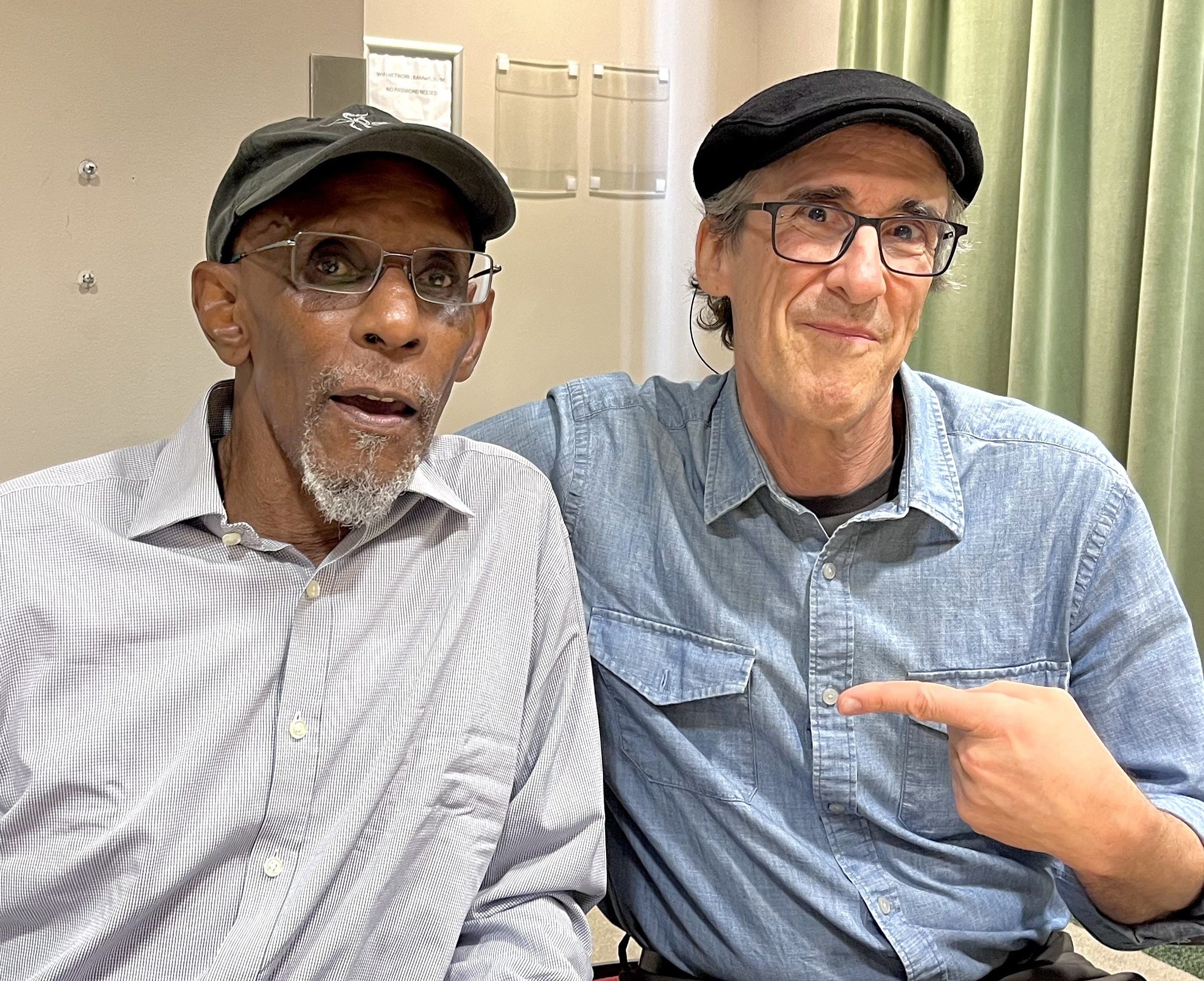
The dub poet and the journalist in Brooklyn, 2025.
No posts
Comments
Nothing yet. Say the first thing.
Sign in to join the conversation.