
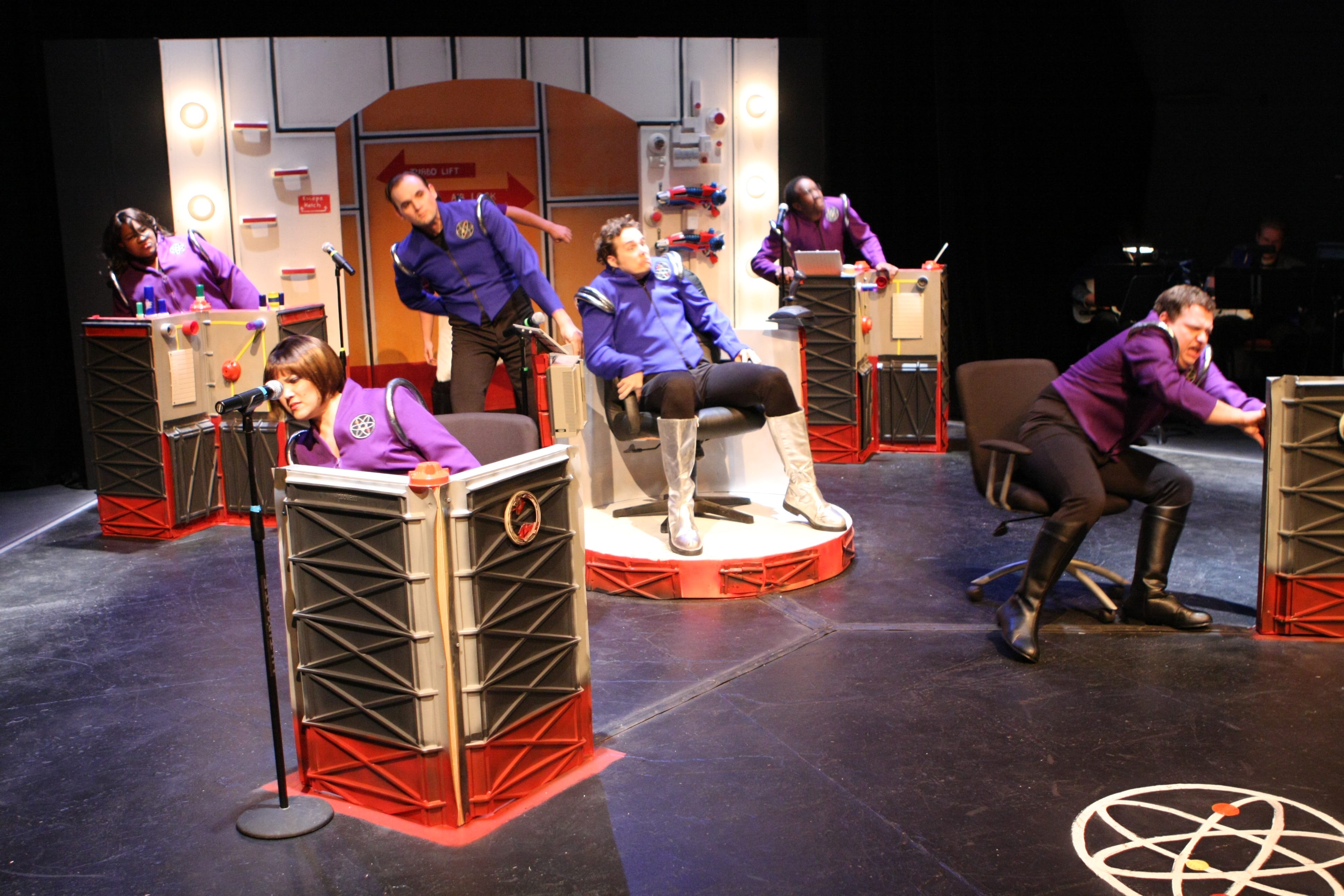
Not since Andrew Lloyd Webber’s Phantom of the Opera has a show been such a huge disappointment and a worldwide hit as We Will Rock You. (Interesting that both are British mega-musicals.) We Will Rock You (WWRY) is further burdened with the extra baggage of being a “jukebox musical,” almost as ripe and regular a target for mockery as Lloyd Webber musicals.
But the reason many jukebox musicals are so conspicuously crappy is incompetence or laziness; it’s not because the form itself is inherently bad. After all, I’d argue that Return to the Forbidden Planet, Jersey Boys, American Idiot, and Head Over Heels are all outstanding jukebox musicals — two of them very smart-silly, two of them powerfully dramatic.
Just as many non-musical theatre artists look down on musicals, many fans of musicals look down on “jukebox musicals,” sometimes known as “catalogue musicals,” shows that take an existing song catalogue and build a musical around those songs.
Sometimes, these shows are more revues than musicals, like Smokey Joe’s Café, Ain’t Misbehavin’, Blues in the Night, Five Guys Named Moe, Sophisticated Ladies, Forever Plaid. In other cases, these shows tell the story of a songwriter or musical group or period, like Tintypes, Ain’t Too Proud, MJ the Musical, Leader of the Pack, and one of the best of the genre, Jersey Boys.
Sometimes, these shows take a song catalogue and build something entirely new around it, like &Juliet, Moulin Rouge!, Return to the Forbidden Planet, Head Over Heels, Mamma Mia!, Bob Fosse’s Big Deal, and the powerful American Idiot. Of course, one of the most famous jukebox musicals of all time is Singing in the Rain. We just don’t usually think about it that way.
And if you really want to be technical about it, the 1962 version of Anything Goes, which dozens of companies still produce every year, is itself a jukebox musical, including songs from the original 1934 production of Anything Goes, but also songs from other Cole Porter shows, including Paris, (1928), Fifty Million Frenchmen (1929), The New Yorkers (1930), Red, Hot, and Blue (1936), and DuBarry Was a Lady (1939).
The jukebox musical goes back at least as far as The Beggar’s Opera, a huge hit in 1728 and for decades after. Almost three hundred years later, we see a lot of jukebox musicals now, partly because they’re cheaper to create (you don’t have to hire songwriters, for instance), and partly because they’re easier to market since the audience already knows the score.
The most successful of these shows have certain things in common. First, they don’t mock the music itself; the story may be a joke, but not the music. Second, the creators take care to match the story to the original vibes and emotions of the songs – Forbidden Planet, Head Over Heels, American Idiot, and Jersey Boys all work so well because that union is seamless. Most of all, the best of these shows work because they respect the original works, the original artists, and their fans. The jukebox musical knows how important these songs are to us, even if we don’t realize it.
How many songs do you remember from high school?
On the other hand, half the fun of a good jukebox musical is finding familiar songs transplanted into unexpected situations and contexts that make the songs feel fresh and shockingly organic to the story and characters. One of the great joys of Forbidden Planet is that each time a song begins and we hear the start of the lyric, the audience starts giggling, then laughing out loud, because they recognize the song and they recognize how improbably perfect the song is for this moment.
Veteran bookwriter Ben Elton had a huge head start with We Will Rock You because of the inherent theatricality of the songs of Queen. One of the things that makes the songs of WWRY work so well as a theatre score is the rich variety of forms and genres that make up Queen’s song catalogue, from the whimsical “Bicycle Race,” to the arena rock of “We Are the Champions” and “We Will Rock You,” to the Top 40 hits, “Another One Bites the Dust,” “Killer Queen,” and “Crazy Little Thing Called Love,” to the soaring rock opera of “Bohemian Rhapsody.”
It’s a wildly eclectic score, and yet all these songs have something in common; they all sound like Queen. And that gives the score a strong sense of unity, the mark of a well-wrought musical.
We Will Rock You succeeds as storytelling because its story is the right size for the arena rock of Queen – not physical size, but emotional size, dramatic size. This story matches the songs of Queen, a bit self-mocking, ironically dry, but sometimes fierce and grand. As funny as we might find these characters – mostly because we always know more than they do – they are fighting for the survival (revival?) of the human soul. The stakes are enormous.
There are a lot of people, including critics, who hate this show, and they are eager to opine that the songs are great, but the plot is silly. But this isn’t a dramatic pop opera with a novelistic plot. It’s a Hero Myth story, a fairy tale, and it follows that traditional form. Galileo is just another version of Luke Skywalker, Dorothy Gale, Don Quixote, Janet Weiss, Pippin, Veronica Sawyer, Claude Bukowski, Effie White, Jesus Christ, et al.; and Galileo follows the same arc they all do.
We laugh at these characters only because we’re outside the story. Inside the story, it’s not so funny. As we all know now in 2026. Outside the story, we might fool ourselves into thinking it’s just rock and roll, nothing important, nothing weighty. It’s just a story.
It’s just human connection.
It’s just art.
It’s easy for us to laugh and see it all ironically and cynically, but only because we still have music.
For now.
Long Live the Musical!
Scott
P.S. To get your tickets for We Will Rock You, click here.
P.P.S. To buy your 2026-2027 Season Tickets, click here.
P.³S. To check out my newest musical theatre books, click here.
P.⁴S. To donate to New Line Theatre, click here.
No posts
Comments
Nothing yet. Say the first thing.
Sign in to join the conversation.