
Hello readers,
I’m writing to you with a buzz still ringing in my ears after my recent trip to Bergamo, Italy, where I attended IWAHLM-17, the International Workshop on Anomalies in Hydrogen Loaded Metals, held at the famous Kilometro Rosso Innovation District. If you aren’t familiar, Kilometro Rosso is one of Europe’s premier hubs for advanced technology, a sprawling campus right off the highway designed specifically to let heavy industry and cutting-edge science collide.
It was the absolute perfect backdrop for what I’m sharing today: a deep dive into Low Energy Nuclear Reactions (LENR), a paradigm-shifting paradigm in clean tech that is quietly moving from “laboratory hypothesis” straight into commercial reality.
During my time covering the breakthrough energy scene, I caught up with Francis Tanzola, representing Brillouin Energy Corp, a fascinating outfit operating out of Emeryville/Berkeley, California.
I want to take you inside the video script of our discussion to show you exactly how this technology works, and why Brillouin is considered one of the top five companies leading this global charge.
If you want the “elevator speech” for what Brillouin has built, it comes down to controlling atomic-scale physics using incredibly precise electronic tuning.
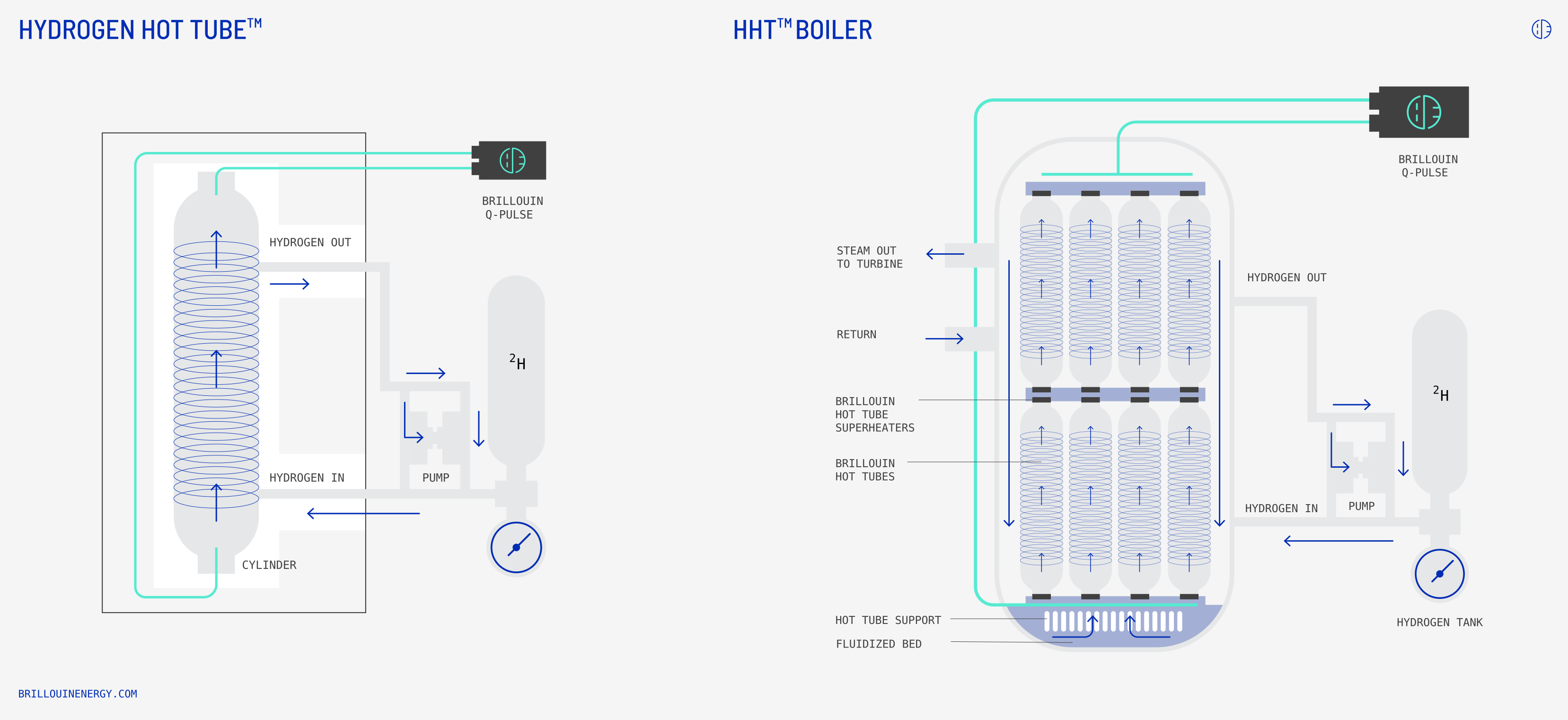
The heart of their apparatus is a proprietary component called the Hydrogen Hot Tube™ (HHT™), powered by their signature Q-Pulse™ control system. Francis walked me through the exact mechanics of how they are capturing clean thermal energy:
The Pulse: Brillouin utilizes a large electronic pulse generator (the Q-Pulse system) to send precise electromagnetic inputs into the reactor core.
The Material: The pulse enters a uniquely engineered sample: a ceramic tube loaded with specialized dielectric metal layers.
The Reaction: These electronic pulses excite phonons (vibrational energy states) within the metal lattice. This lattice excitation forces hydrogen, which has been completely absorbed into the material, to undergo a process known as Controlled Electron Capture Reactions (CECR).
The Output: Essentially using “cold neutrons” reacting with protons, the material ultimately creates Helium-4, releasing massive amounts of thermal energy—measured in tens of megaelectronvolts (MeV)—without producing any hazardous radiation or chemical pollution.
Architecturally, the machine is a masterclass in thermal management. The actual reactor tube sits securely inside a pressurized hydrogen chamber. Surrounding that chamber is a liquid water jacket designed to capture the heat, which is wrapped in a high-grade vacuum chamber to ensure no energy is lost to the outside environment.
What makes Brillouin particularly exciting right now isn’t just the math on paper; it’s the sheer scale of execution.
When you look inside their operating lab, you aren’t looking at a single, finicky prototype. Francis pointed out that they have rows of these units operating simultaneously, scaling up toward 18 active reactors in their racks by the end of the year.
The physical footprint of the reactor itself is remarkably compact, relying on a dense grid of electronic and cooling support systems to monitor and measure every single watt of heat generated. They strictly account for:
Heat lost from the electronic pulse generator.
Heat lost at the physical ends of the reactor tube.
Net-positive thermal energy is generated entirely within the reaction chamber.
The Big Picture: This isn’t a solo effort. Brillouin has scaled into a powerhouse team of roughly 28 world-class physicists, technicians, and engineers working alongside strategic industrial partners to bring decentralized, zero-emission heat to the world.
Whether it is powering industrial steam generation, district heating networks, or retrofitting legacy fossil-fuel infrastructure, LENR tech is stepping out of the shadows. Seeing the energy in Bergamo and reviewing the hard data coming out of Brillouin in Berkeley, CA makes one thing abundantly clear: the room is buzzing, the breakthroughs are repeatable, and the era of abundant, ultra-clean thermal energy is arriving right on time.
Here is a standard, professional disclaimer tailored for your Substack article. It covers the necessary legal bases regarding investment advice, forward-looking statements, and independent due diligence.
Website: Brillouin Energy
~New Fire Energy Inc.
Disclaimer: The information provided in this article is for informational, educational, and journalistic purposes only. It does not constitute investment, financial, legal, or tax advice. Readers should not rely on any information contained herein to make investment decisions. The technologies, companies, and developments discussed (including Brillouin Energy Corp and NFE Corp) involve high-tech research, emerging science, and significant risks. Past performance or laboratory results are not indicative of future commercial success. New Fire Energy and this publication make no representations or warranties as to the accuracy or completeness of the information provided. Always conduct your own independent due diligence and consult with a licensed financial advisor before making any financial or investment commitments.
No posts
Comments
Nothing yet. Say the first thing.
Sign in to join the conversation.