
Note: We read this book as an advanced review copy (ARC) given to our parent companies, everafterbooks.uk and theubergroup.org.
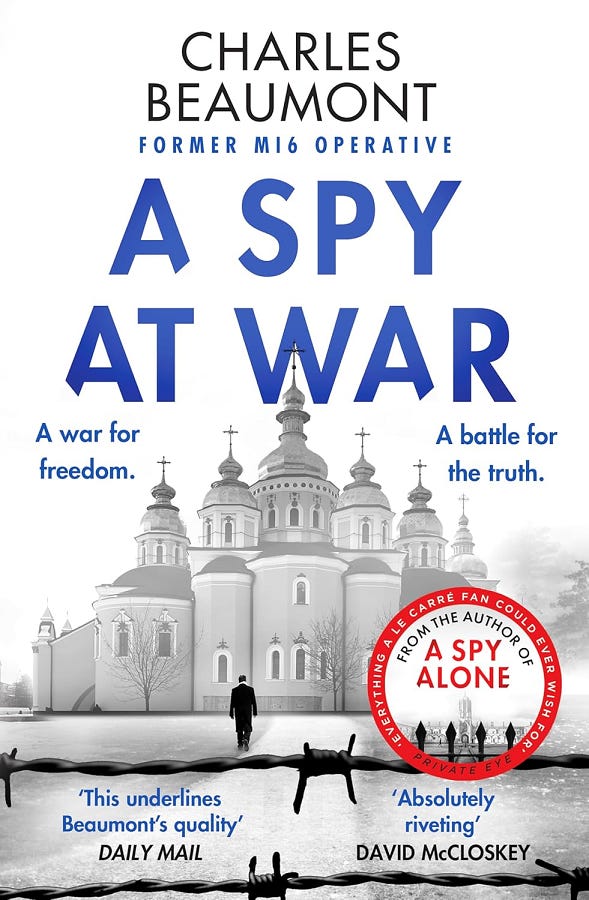
The coolest thing I noticed about Charles Beaumont’s second novel A Spy At War is how he induces curiosity in the reader about the reasons people have for their actions on all sides of a conflict, thus engendering empathy for the humans trapped in impossible choices by the luck of fate.
I was not expecting a story marketed on the street cred of a retired MI6 officer (and starring a British spy who is presumably a proxy for the author) to go so deep into the backstory of a Chechen mercenary. Once again, Beaumont demonstrates his personal intelligence, in the broadest and most emotionally nuanced sense of the word, by being deeply thoughtful about the full human being that lies behind any brief interaction we may see--even people we think of as “enemies” or “villains. He uses the classic literary technique that is often applied only to the protagonist of a story on the primary target our protagonist is chasing down, by showing the original traumatic experience which shaped the villain’s future behavior. “Humanizing the villain” is always the first hallmark of smart, character-driven fiction, and Beaumont goes on to do so for his entire ensemble.
What’s particularly remarkable is that he does this without losing pace. It’s possible to go too far into literary navel-gazing about character background and turn the reading experience into a slog. I’ve been specifically studying recent debuts (2022 and later) in the “smarter than usual spy thriller” category recently, and feel able to make comparative statements about the current cohort of up-and-coming spy-and-geopolitical thriller authors. An unfortunate example of someone who misses the mark is Patrick Worrall. He spends so long ruminating on backstory, one loses the plot and becomes bored. Beaumont, by contrast, pushes right up against the line of how much introspection one can get away with before it douses the pacing without crossing over it. Although I was less hooked than usual by the opening chapter, this was only because we started on the Russian side of the story after leaving off with the British side and the love story, and my curiosity was urgently to get back to the characters we had left off with. If you experience the same thing, keep going and trust in Beaumont’s mastery of craft: all the parts will come together and the opening information will be relevant going forward.
The character of Sarah took long enough to show up that I was rather afraid Beaumont was going to pull a David McCloskey and just entirely drop the plot thread of the nascent love story he’d established in book one, but was pleased to discover Beaumont instead doubles down on Sarah’s importance in her own right. This is drastically more interesting than a story in which the love interest is just obligatory set dressing. All of Beaumont’s characters are fully realized and deeply relevant to the grand game of 4D chess, and they come together so tightly I actually applauded (in my car, to the audiobook soundtrack) at the end. I only wish this had been a live performance so that Beaumont could have heard the ovation he well earned.
Read it. Don’t start with it though - start with Book 1, A Spy Alone. It is deeply worthwhile in sequence. I am pleased that Beaumont is bucking the trend of “everything must be a standalone.” He utilizes the risky proposition (in current publishing) of ending on cliffhanger to great effect, and it’s worth buckling in for the whole ride.
No posts
Comments
Nothing yet. Say the first thing.
Sign in to join the conversation.