
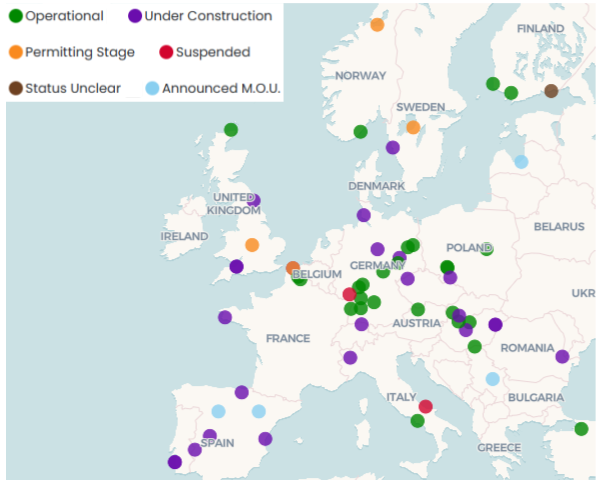
Map: Europe’s gigafactories planned and operational.
Europe’s battery supply chain continues to expand at pace, spanning gigafactories, recycling, and materials processing across the continent. Hundreds of projects are now planned, under construction, or operational, underpinned by billions of euros of public and private investment.
United Kingdom, Somerset: Agratas secured major state backing.
In early April, the UK government confirmed £380 million in support as part of a wider ~£700 million package for the Agratas gigafactory. This is a clear financing milestone tied to construction, reinforcing momentum behind one of Europe’s largest planned cell manufacturing sites.
United Kingdom, Coventry: Greenpower Park Coventry has cleared a key planning hurdle.
Warwick District Council approved detailed proposals for the first phase of the £2.5 billion scheme, including seven manufacturing buildings covering around 4.8 million sq ft. This moves the project from planning toward delivery, unlocking one of the largest advanced manufacturing clusters in the Midlands.
Across gigafactories, the pattern is clear. Progress is coming through funding commitments and planning approvals.
Germany / Europe: BASF has partnered with TSR Group.
The collaboration focuses on dismantling, discharging and processing end-of-life batteries into black mass, with further processing at BASF’s Schwarzheide facility. While timelines and volumes are not yet disclosed, this is a strategic integration step rather than a capacity announcement. This kind of integration will be critical if Europe is to build a viable battery ecosystem.
Finland, Kaustinen: Keliber lithium project has begun operating its Syväjärvi mine.
This marks a major milestone. Finland becomes the first country in Europe to host a fully integrated lithium value chain, from extraction through to refining into battery-grade lithium hydroxide. It is a significant step toward reducing dependence on imports from Asia and Australia.
However, full scale production is still estimated to not start until 2028. Even with this progress, Europe’s lithium production remains extremely limited, and most projects are still in development, permitting or construction. This is the beginning of output, not the scaling of it.
At both national and EU level, April has reinforced a clear direction: speed up delivery and strengthen domestic industry.
In France, the government has signalled plans to fast-track major industrial projects, including batteries and lithium, using accelerated permitting approaches.
At EU level, momentum continues behind the Industrial Accelerator Act, which aims to simplify permitting, support European manufacturing, and embed “Made in EU” considerations into procurement and funding.
Alongside this, instruments such as the Innovation Fund and broader state aid frameworks continue to move projects toward financial close.
We’re still banging the same drum on this one, demand certainty matters. All of this sits against continued uncertainty around Europe’s vehicle CO₂ standards and the trajectory of EV uptake. Debate around flexibilities, timelines, and the broader 2035 framework continues.
New analysis from New AutoMotive and E-Mobility Europe showed that EV registrations grew by 51% in March across Europe. They accounted for 22% of all new car sales across 15 key markets. So we end up in a slightly odd place - policy debate is introducing uncertainty but the market continues to grow.
Policy is creating uncertainty around a transition that is already underway. And when those signals wobble, investment decisions wobble with them. So the question isn’t about whether EV demand will show up (it already has), but it is about whether Europe is able to ensure that the batteries supplying that demand are made domestically, rather than imported.
About the Tool
The interactive tool is designed to help policy makers, industry experts, journalists, industrial strategists, and anyone with an interest in the European battery supply chain. It allows users to explore the landscape across the mining, refining, electrode, gigafactory, and recycling part of the supply chain. The app allows decision makers to be fully informed about the strengths and weaknesses of the industry and helps to inform where extra support may be necessary. Explore the data yourself & download it for free.
No posts
Comments
Nothing yet. Say the first thing.
Sign in to join the conversation.