
This is a story about my friend Aubrey, who died. It is also, inevitably, about me.
This is possibly - definitely - self-involved, but the loss of someone is not abstract, or simply about someone’s inherent human worth, it is also about how stricken we are not to have them around, about what they meant to us, the part they played in our story.
Aubrey Day died a year ago, October 2, 2024. We had known each other 20 years, having met when I joined Total Film magazine, at Future Publishing. He was overseeing a few publications, but his passion was clearly movies and TV. He was a few years older than me, which in your 20s feels like a generation, and seemed debonair and certain, insanely confident and very, very clever. A few colleagues disliked him, not least because as well as being the smartest guy in the room, he was never especially shy about letting you know he was the smartest guy in the room. I just felt I had a lot to learn. And he was more than happy to teach. Not that he had a curriculum, or talked down to you (well, he didn’t always talk down to you), but he would present a problem and push you to solve it. It was a little sink or swim - he’d worked a bit in tabloids and had a tougher approach than the pally magazine world I was used to - but if he believed you could swim, that belief would buoy you.
This is all a little inside baseball, but meeting a mentor - even if he didn’t style himself as such - can truly change your life, and it did mine. I’d been staff a few months and wanted to go on my first press junket in Los Angeles. These were in the days when studios would fly you out to interview filmmakers and actors and put you up somewhere fancy, so there was usually a bit of a dance between staff members to grab the slot. Except this junket was for The Jacket, a film no one in the office was particularly interested in, as I recall, apart from me, as I admired director John Maybury’s debut feature (Love Is The Devil), and also felt that with the magazine’s special 100th Anniversary issue coming up, and to-be-determined special articles planned, it probably wouldn’t be a bad thing to be in LA.
Aub said I could go, if I completed the redesign of the magazine’s review section.
“But that would usually take two months.”
“Yes.”
“And the junket is in two weeks.”
“Yes.”
I still remember him looking at me — like, “and…?”
I slept at least one night in the office.
We got it done.
I went to LA.
When I was there, our colleague Mark Dinning called and asked if I could possibly stay out a bit longer and interview Ewan McGregor. I looked around my room at the Four Seasons Beverly Hills and decided to suffer this. I met McGregor for breakfast and as we queued for coffee and croissants he whispered, “It’s the Governator!” I looked at him like he was mad, until realising that the then Governor of California Arnold Schwarzenegger was, indeed, a couple of people ahead of us.
Another morning, someone slipped into the hotel’s outdoor pool during my jet-lagged 6am swim, and I thought, “She really looks like Isabella Rossellini.” It was Isabella Rossellini. Later that day, I almost bumped into someone in the lobby’s revolving doors. It was Morgan Freeman.
This was quite an introduction to LA for a boy from rural Devon.
Mark’s next call was asking if I could also - if it wasn’t too much trouble - manage to interview David Fincher. The director of my favourite films of the ’90s, Seven and Fight Club, a filmmaker I’d admired since his early days in music videos? Again, I stood on the sun-kissed hotel patio, ordered a fruit plate, and heroically acquiesced.
The interview was for a retrospective piece on Fight Club, so I headed to Amoeba Music (back then, on Sunset Blvd), bought the DVD and watched it a few times, including with all the commentaries, and went for the first of what has now been so many interviews with Fincher I have lost count. Our chat led to visiting the sets of each of his films and TV shows since and to my currently writing a book about the making of Fight Club, which grew to be my favourite film.
All of which is an awful lot about me. But none of that happens without Aub.
It’s amazing what you can do when someone believes in you…
Still, we did eventually fall out. I left Total Film. And I remember him saying, knowingly, something like, “Now you’ll find out whether all the things that are bothering you are the situation, or whether it’s how you’re dealing with the situation.” I nodded to mask my absolute, incandescent fury… because I knew he was right (as I spent the next few years proving). We would fall out again a while later, when he was living in LA, over launching another magazine. And by “fall out”, I mean “Not speak about it and then eventually meet up again and still never speak about it, we’re English”. But I came to realise what I perceived as his flaws were ones borne of optimism and enthusiasm. It didn’t occur to him that we were both being screwed, because it wasn’t behaviour he would have countenanced himself.
A few years later still, he contacted me out of the blue, we caught up online, and he said he had been ill. He was in remission, it seemed, but the scare had made him want to do something he loved with someone he liked, so could we write a script together? I said “No, absolutely not, I am too busy”. Two weeks later we were writing a script together. Aub was like that. He would logon early, before his work day in marketing at Disney, and we would talk nonsense and make each other laugh and eventually stumble on a story point.
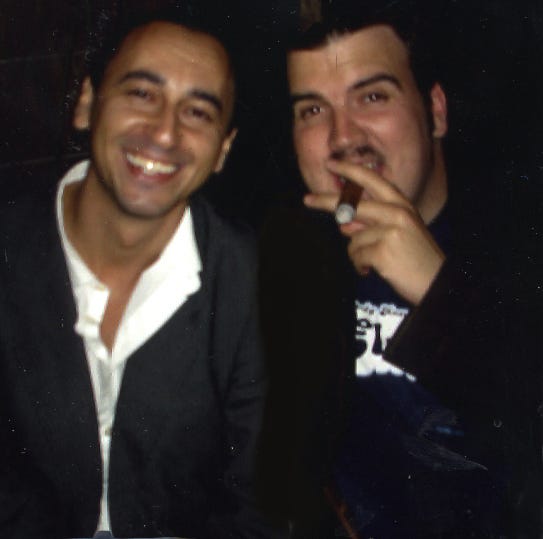
A few weeks later I asked my wife whether I was being silly, spending my time on this when I was so busy with other work, including actually paying gigs. She said, “When I walk past the door and hear you two, it’s the happiest you ever are at work. You can’t stop.” So we didn’t. The resulting script - a one-shot film noir inspired by Shampoo and Killing Them Softly and our desire not to research anything - is set at a film junket. It’s called The Long Sunset. Fincher liked it. I hope to see it made. And we had the best fun writing it. We last saw each other in person in February 2024. I was in Los Angeles to interview Brad Pitt, which did not suck, but the most fun was dreaming up new stories with Aub. When he dropped me off after what would prove to be our last writing session, he looked away and was very understated and matter of fact and I thought, “God, is he ill again?” and quickly tried to suppress the feeling this would be the last time we’d see each other. I wanted to take a picture, but felt like it would seem too loaded. So didn’t. And so, the only shot of us is from long before - again, in Los Angeles, circa 2007, on a trip where we were visiting together and couldn’t believe our luck, years before I got acquainted with hubris and he with cancer. The picture - where we are gleeful and I am going full Hollywood, with a Tony Scott cigar - is, thus, bittersweet.
We zoomed a couple of times last summer, but new treatment was taking a toll and our chats were relatively short. In his last email to me he said there were some small signs of improvement. Ever the optimist. I wrote back that I loved him.
Even this year, he’s helped - in morbid and beautiful ways. I’ve been casting a film, Comfort Box, where the main character suffers a terrible loss. While when I first read that script its appeal was bound up with historical emotional repression, and my own wife’s cancer (as well as the fact it is quite brilliant), it will no doubt benefit my directing to have been lately pole-axed by grief. I’ve also been wrestling with the manuscript for The First Rule, a book about the making of Fight Club that would never have happened without Aubrey's initial push, all those years ago, and his subsequent, quiet, cheerful encouragement. As self-doubt - and the word count - has mounted, I’ve seen his smile and heard his voice: “You’ll do it.”
He’d even appreciate me using his death to sell my work. He was a journalist, after all. But, more. He was a storyteller, a friend, a protector... a fantastic dad to his children, and a father figure - or perhaps a cool, caring big brother is more accurate - to several more of us. He was someone who grew out of cynicism and into himself. He helped me appreciate what matters, to care deeply but carry things lightly, to accept people for how they are, not what you want them to be. The cocky younger man grew into someone who understood, in his behaviour at least (we never spoke about this), the power of grace. I read recently that the late novelist Toni Morrison once said, “We will be judged on how well we loved.” This seems a scale Aubrey continues to score highly on.
We are all stories. Stories being written that aren’t yet finished. Not even, I think now, after it seems we are gone. So here’s to you, Aub. It has been a year since you left us. But you will never leave us.
No posts
Comments
Nothing yet. Say the first thing.
Sign in to join the conversation.