
Marcus is 64 years old, and he has been feeling tired recently. He looked outside the window and told himself he was just getting older.
Marcus used to be an avid walker. He could run up the stairs to his apartment and still have ample energy to do some household chores or even run on the treadmill. But now he gets winded even halfway up the stairs. Every Saturday he used to look forward to that walk in the park with his grandson. But now just thinking about walking to the park makes him tired. He had started to decline invitations from friends and family, not just because he felt tired, but because he did not want to attend the gatherings, look tired in front of everyone, and bring the festivities down.
Marcus mentioned the tiredness to his doctor, Dr. Bell, during a routine doctor’s appointment. Dr. Bell looked away from the computer he was busily typing on and narrowed his eyes. A series of questions followed. “Are you sleeping well? Are you following the diet I recommended? Are you active?” Marcus said yes to everything. Then he was asked whether he had considered that retirement can be a difficult adjustment. Marcus inclined his head, then slowly closed his eyes and nodded. The visit moved on.
Nothing in the doctor visit seems unreasonable. On the outside looking in, a man in his 60s who has just stopped working could have many physical and emotional burdens that could add stress and fatigue. In other words, there are many ordinary explanations available to describe the way he feels. That is exactly the problem with iron deficiency and the symptoms attached to it. They all have ordinary reasons as explanations.
Tired? You are busy, or you are older, or you are not sleeping well.
Hair coming out in the shower? You are forty-eight, and that happens.
Foggy, forgetful, losing the end of your own sentences? Everyone is foggy. Everyone is on their phone too much.
Breathless on a hill you used to run? You have had a hard training block, or you are getting older too, in your own way, and you should probably rest.
Each of the above dismissals is individually defensible, because most of the time when we feel tired it might not be linked to iron deficiency. The same with hair shedding, which might not be linked to iron. The trouble is not in any one dismissal. It is in what the dismissals do when you add them up, and understanding that requires seeing four things about how symptoms actually behave.
There is no symptom on the iron deficiency list that belongs only to iron deficiency. Fatigue, breathlessness, poor concentration, low mood, hair thinning, and cold intolerance are each shared by a dozen other conditions, from thyroid disease to depression to sleep apnea. No single one of them points anywhere on its own, which is exactly why each can be assigned an innocent explanation the moment it comes up.
When you read about iron deficiency online, the symptoms are set out neatly, ten of them, one after another. You scan it, you find that two of them sound like you, and you draw the natural conclusion: two out of ten is not a match, so this probably is not me. You disqualify yourself, because you assume that having the condition means having the whole list.
But the list you read is not a set of boxes that will all be ticked at once. A written article online will show ten symptoms side by side, as if they were meant to arrive together, and in a real body they almost never do. A deficiency does not switch on overnight. It develops slowly, over months and often years, and the symptoms surface gradually, one at a time.
The cold hands come first, two winters ago, and become your normal.
The fatigue arrives a year later and becomes your normal too.
The hair follows after that.
Each one settles in on its own before the next appears, so at any given moment you are only ever aware of the one or two that happen to be loud right now, not the trickle that has been accumulating the whole time.
Because they appear gradually and separately, you underreport them without meaning to. You mention the two that happen to be bothering you this week. You do not mention the cold hands, because that started two winters ago and you have stopped thinking of it as new. You do not mention the hair, because that feels like a separate issue for a separate appointment. You do not connect the restless legs to any of it. So you report two symptoms when, if someone sat you down and read you the full list, you might recognize six or eight of them. That gap between what you have experienced and what you actually say out loud is where the diagnosis quietly goes missing.
Two mild, common complaints do not raise an alarm. A busy clinician in a fifteen-minute appointment will not connect two mild complaints to iron, because two nonspecific symptoms are the most ordinary thing to walk through a door. They might connect dots for more obvious patients such as a pregnant woman, or an older individual, but never for seemingly healthy younger adults. And a routine blood panel does not necessarily rescue the situation, because a standard count can read normal while stores are already empty, which is the whole subject of the previous piece. So the picture is never assembled. It is taken apart faster than it can be built, complaint by complaint, appointment by appointment.
This is not a small point about assumptions and mistakes we make. This outlines how serious conditions go undiagnosed until late. The same slow, scattered, easily dismissed symptoms that hide an ordinary iron deficiency can also hide dangerous diseases. In fact, iron deficiency is sometimes the first sign of conditions such as gastrointestinal bleeding, colon cancer, or severe malabsorption disorders like celiac disease. And even diseases such as Alzheimer’s and Parkinson’s diseases. A shortage dismissed as no big deal can actually be the first warning sign of something not trivial at all. This is why seeing the full picture matters. The goal of learning these symptoms isn’t to diagnose yourself, but to share everything you’ve noticed with your clinician, not just the symptoms that feel most urgent right now.
This piece is about what iron deficiency actually does to a person: not the diseases that cause it, which come later in this series, but the experience of the shortage itself. And more usefully, it is about which of these symptoms are generic noise and which few genuinely raise the odds that iron is the answer. That sorting is the part almost nobody does, and it is the difference between walking into an appointment with a vague complaint and walking in with something a clinician can work with.
In the first piece in this series, we looked at what iron actually does, and the short version is that it is not a blood mineral. It is infrastructure. Iron carries oxygen, but it also runs the machinery inside your cells that converts fuel into usable energy; it is required to manufacture dopamine; it is needed to build DNA in tissues that divide quickly; and it is required to stabilize collagen.
All the infrastructure components I mentioned above are why the list of iron deficiency symptoms looks so scattered. If iron did only one thing, running low would cause one clear problem, and it would be easy to spot. But iron does all of those things at once, so running low does not break one thing loudly. It wears down many things quietly, all at the same time, and no single one of them is alarming enough on its own to make you stop and take it seriously. What follows is that slow wearing down, sorted by where it shows up.
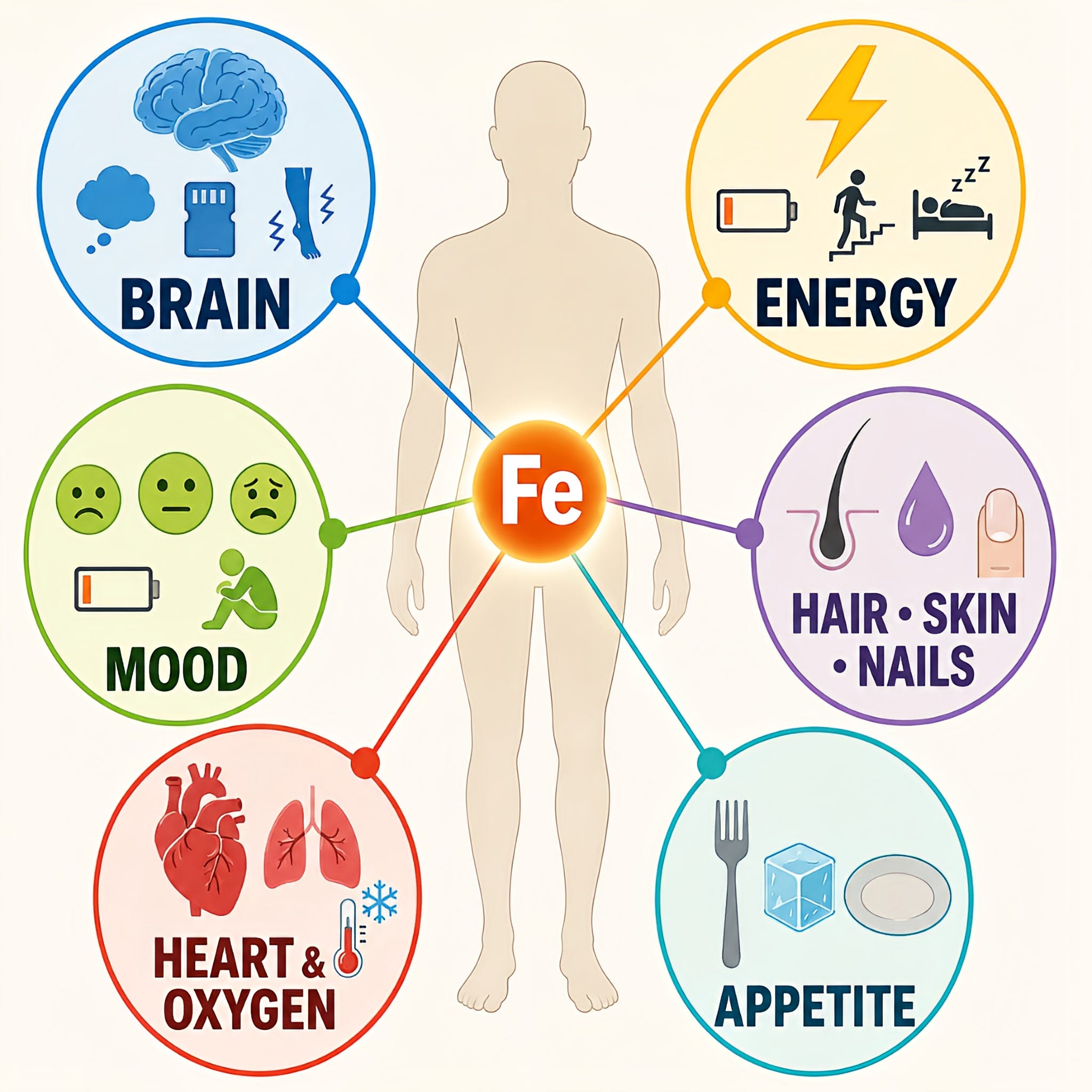
Fatigue, weakness, low energy, breathlessness when you exert yourself, pallor, cold hands and feet, dizziness, headaches, and a heart that races when it has no reason to. This is the cluster everyone associates with low iron, and it comes from two shortages happening together. Less oxygen is reaching your tissues, and less energy is being made inside the cells once the oxygen gets there.
The fatigue, weakness, and low energy are real, but they’re the part people find hardest to explain to a doctor because they’re not ordinary tiredness. Sleeping 7 to 9 hours every night does not fix it, a weekend away from home or work does not fix it, and an extended holiday does not fix it. People experience the same symptoms: a heaviness they carry around, or the feeling that everything they do now takes more out of them than it used to.
Brain fog, poor concentration, memory lapses, difficulty holding attention, and restless legs.
Erin, from the last article, is 27 years old, runs long distance, and noticed the physical side first because her training log made it impossible to miss. Paces that felt easy in the spring had become hard work by midsummer. Her heart rate on gentle runs climbed by ten beats and simply stayed there. But the part that unsettled her more had nothing to do with running. She could no longer read for an hour without losing her place in her own thoughts. And at night her legs would start to crawl, a sensation she could not quite describe and could not hold still against, so she lay there moving them to make it stop.
When she finally had her blood tested, the result came back normal, and she was told she was fine. She was not fine. The reason her test looked reassuring is the whole subject of the last piece: your iron stores run empty long before your blood count drops, and the symptoms start in that gap, while the standard test still reads normal.
Irritability, low motivation, apathy, anxiety, and low mood. This one deserves more attention than it gets, because it is where the wrong explanation does the most damage. Iron is needed to make dopamine, the brain chemical behind motivation and drive, so a person running low does not just feel tired. They feel like they no longer care about things they used to care about. Now picture that in a 64-year-old man who has just retired. The explanation almost writes itself. Marcus was asked, kindly and reasonably, whether he might be a little depressed. Nobody asked what his iron stores were.
Hair that thins and sheds more than it used to, nails that turn brittle or flatten and curl up at the edges, skin that is dry and itchy, skin that tears easily and is slow to heal, cracks at the corners of the mouth, and a tongue that goes sore or oddly smooth. These show up because iron feeds the tissues that renew themselves fastest, and because your body cannot properly build collagen without it. This is also the cluster people are most likely to take to a pharmacy or a salon rather than a doctor. It is worth its own section, and it gets one below.
An appetite that fades, and cravings for things that are not food. This one gets its own section too, because the way it works is genuinely cruel.
Amara is 31 and pregnant with her first child, which puts her in one of the few situations where the body needs iron faster than at almost any other time in adult life. A growing baby draws heavily on the mother’s supply, and by her second trimester it was showing. She was pale in a way her sister noticed before she did. She felt lightheaded standing up from a chair. At night she could feel her own heartbeat.
What she could not explain was that she had stopped wanting to eat. It was not the nausea, which had passed weeks earlier. It was that hunger simply did not arrive when it should have, at meals she knew her body needed.
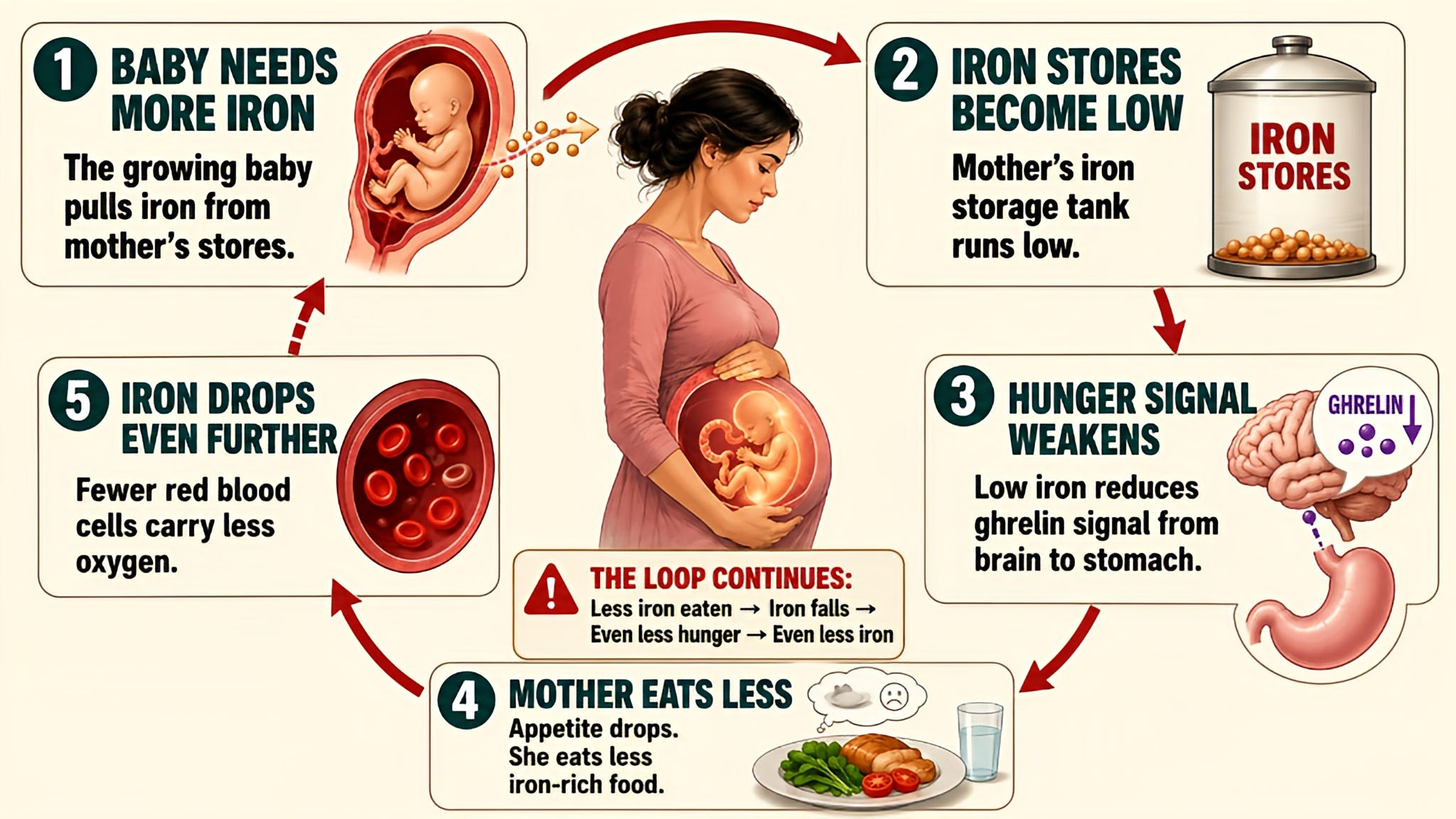
This is one of the loops, and it’s a detail most explanations of iron deficiency leave out. Hunger isn’t a matter of willpower. It’s a biological signal your body sends, primarily through a hormone called ghrelin, which tells you when to eat. When iron is low, this signal is disrupted, and your body suppresses the message to eat. As deficiency worsens and turns into anemia, another problem appears: the blood carries less oxygen, so your body starts prioritizing vital organs like the heart and brain, redirecting blood away from the stomach and gut. Digestion slows down, and eating can feel burdensome or unappealing.
Taken together, these effects are almost unfair: the deficiency quietly switches off the very appetite needed to correct it. The person who most needs to eat is the one least able to feel hungry. This matters not just for understanding iron deficiency itself, but because it challenges the usual advice that it’s simply a matter of eating better. Someone caught in this loop isn’t being careless or lazy about their diet—the thing they’re being told to fix has, in fact, switched off their hunger.
Sofia is 34 years old and has worked in commercial kitchens since she was 19, which gives her an unusually good excuse for the state of her hands.
Cuts that used to close in a few days had started taking weeks. The skin over her knuckles split and stayed split. The corners of her mouth cracked and would not settle, and she treated them as a chapped lip problem for most of a winter. Her forearms itched constantly, and her skin had become dry in a way no amount of the thick unscented cream she kept by the sink seemed to touch. She had a ready explanation for all of it, because kitchen hands are supposed to be wrecked. Heat, water, blades, and repetition will do that to anyone.
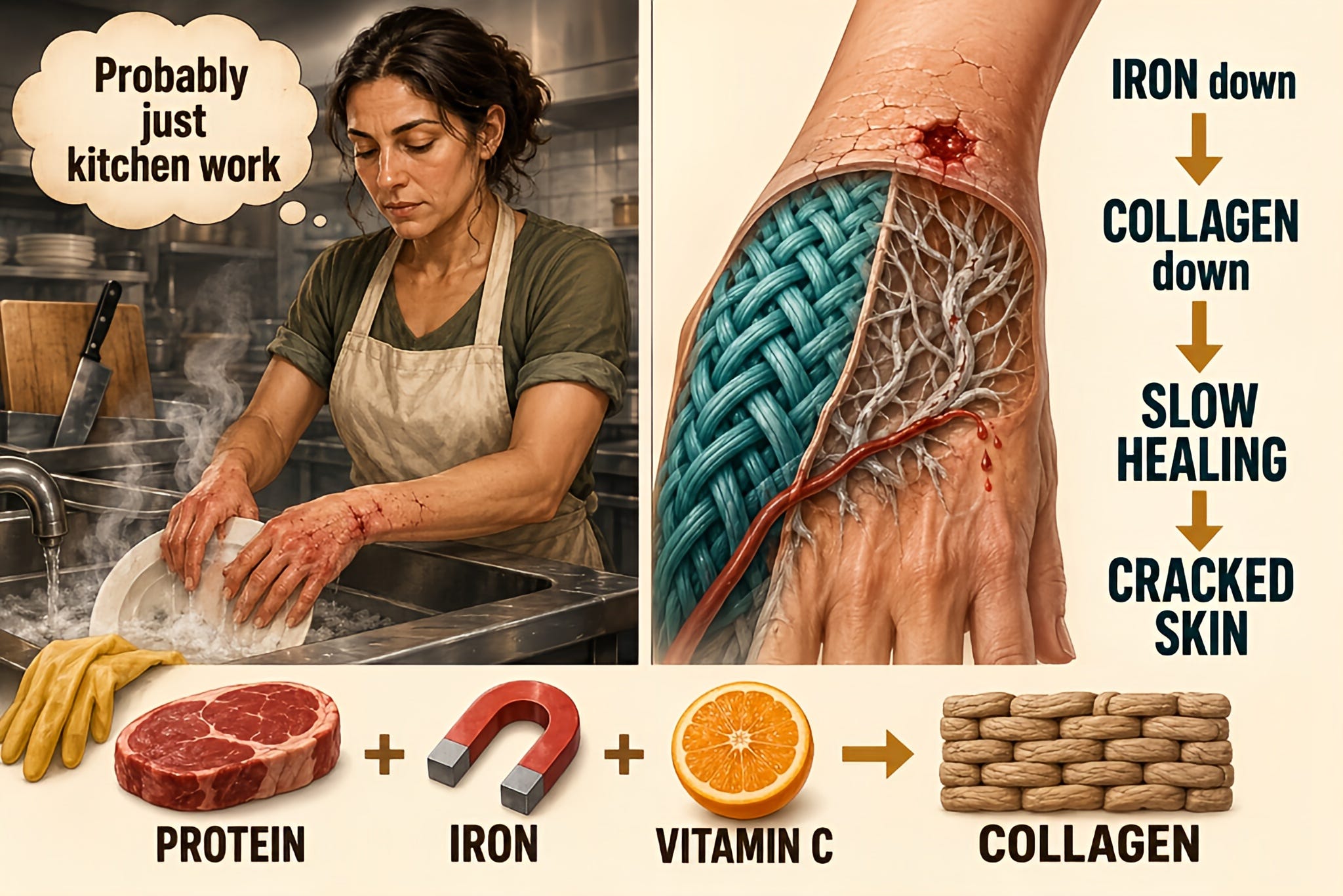
The explanation was available, plausible, and wrong.
Iron is required to build collagen. Two enzymes, prolyl hydroxylase and lysyl hydroxylase, cross-link and stabilize collagen so that it holds, and both of them need iron to work, along with vitamin C. Collagen is the structural protein of skin, of the walls of small blood vessels, and of the tissue that closes a wound. When it cannot be properly assembled, skin becomes fragile and tears more easily, small vessels become less robust, and healing slows because healing is largely a matter of laying down new collagen.
That is why this cluster is not a beauty complaint. Fragile, itching, slow-healing skin is a structural tissue problem that happens to be visible, and its visibility is the useful part, because it is one of the few things on this list a person can actually see.
It carries one more lesson, which the treatment chapter will return to. Iron does not work alone here. Collagen synthesis needs iron and vitamin C together, and it needs adequate protein to have anything to build from. Anyone whose intake is low across the board is short of all three at once, and correcting only the iron will only ever fix part of it.
Here is the part that matters most, and the reason this list is worth more than a symptom checker.
Almost everything above is nonspecific. Fatigue, low mood, poor concentration, breathlessness, and headaches are the least discriminating symptoms in medicine. They belong to thyroid disease, sleep apnea, depression, heart failure, chronic infection, several other anemias, and simply being under enormous strain. If you walk into an appointment with fatigue and brain fog, you have described something true and pointed nowhere in particular.
But a handful of symptoms do tilt the odds specifically toward iron. They are worth knowing by name, because naming them out loud changes what happens next.
Craving and chewing ice. This is the most specific of them all. Pica is the term for craving substances that are not food, and while it can extend to things like clay, starch, or paper, the compulsive chewing of ice, called pagophagia, is the version most closely tied to iron deficiency. It is also the one people are least likely to report, because it does not feel like a symptom. Diane, whose case opened this series, kept a cup of crushed ice on her desk and worked through it all day. She had been doing it for over a year. She mentioned it to Dr Whitfield almost as a joke, and it was the detail that most sharpened the picture.
Spoon-shaped nails. Nails that flatten and then curve upward at the edges, a change called koilonychia. It is uncommon, it takes time to develop, and it is meaningful when present.
Cracks at the corners of the mouth. Angular cheilitis: splits at the mouth’s corners that persist and resist the usual remedies.
A sore or smooth tongue. Glossitis, where the tongue becomes tender and loses its normal surface texture.
Restless legs. An urge to move the legs, worse at rest and worse at night. The link between restless legs and iron is one of the strongest in this entire field.
Hair thinning and a heart that races on exertion.
Hair thinning and a racing heart during exercise aren’t as specific as the other signs, but they matter more when they show up together.
None of these symptoms can give you a definite answer. That’s important to remember. Spoon-shaped nails don’t mean you definitely have iron deficiency, and neither does craving ice. Each of these things can happen for other reasons, and sometimes iron deficiency shows up with no obvious signs at all. What these symptoms do is raise the chance enough that it’s worth getting a specific test, rather than just being reassured everything is fine.
They could point to iron deficiency. But they do not confirm it.
If you recognize yourself in much of this, the next honest step isn’t to reach for a supplement. It’s to get a blood test that includes ferritin. Interpreted alongside an inflammatory marker, this will clarify exactly what to ask for, as we’ll discuss later in this series.
Because here is the limit of everything above: symptoms can tell you that something is wrong. Some can suggest that iron is a strong candidate for the cause. But none of them can tell you why you’re low.
And that’s the crucial question, because iron deficiency isn’t a diagnosis—it’s a finding that demands an explanation. Diane, Marcus, Erin, Amara, and Sofia are all running short, but for entirely different reasons. Some are trivial; at least one is serious.
There are only four ways a body can end up short of iron, plus one situation that looks like a shortage but isn’t. That’s the next piece.
This series is educational and is not medical advice. It is written to make your conversation with a clinician better, never to replace it. The people described here are fictional composites.
No posts
Comments
Nothing yet. Say the first thing.
Sign in to join the conversation.