
This post was written by NQC facilitator and administrator, KR Moorhead
In many ways I have always been a ‘facilitator’ or a ‘holder of space’.
Imagine little KR - undiagnosed autistic and ADHD, the only child of a single, working (undiagnosed ADHD) mom, and gendered ‘female’. From the age of eight I make my own way to and from school, a copy of my house key on a string around my neck, and spend most of my time out of school completely alone and responsible for my own well-being (this is the 90s, mind you). I do well in school, and teachers like me. I never get in trouble with my mother, or break her trust. Once, I called her at work to ask permission to have a cookie. Then I called back to ask if I could have a second. I am considered ‘responsible’, ‘independent’ and ‘mature for my age’. Most of my life, I assumed this was all true, that I was just a really good kid and my mom was lucky. I have since come to realise that a child who never pushes boundaries, who never shows anger or defies authority, is a child who does not feel safe, and has already taken on the pressure of managing the emotions and expectations of the adults around them, in order to feel some sense of control and safety.
I was conditioned (unknowingly) by my caretakers to make myself small, to constantly monitor the emotions of others, and to subvert my own needs to accommodate and appease those emotions.
My neuroqueering journey over the last five or more years has in many ways been a process of unlearning these coping mechanisms. Of unmasking, learning to ask for what I need, making space for myself. But I am also learning that these deeply embedded coping mechanisms are some of my strongest skills - and are likely part of the reason I have been drawn to teaching and facilitating spaces for others, from a very young age.
My first paid ‘teaching’ gig was during my Freshman year of college when I signed up for the America Reads classroom assistant programme, and spent one day a week in a New York public school fifth grade classroom, giving individual support to students struggling in math and reading. I loved being there - and I specifically loved working one to one with the ‘problem’ kids that the teacher seemed to have given up on. Because, even though I had been a ‘star pupil’ during school (ie: teacher’s pet) and couldn’t personally relate to their academic and behavioural struggles, it felt completely natural to attune myself to their emotional wavelength in order to unearth how they needed to be approached and communicated with so they could open up enough to even attempt a difficult task - something I knew the teacher didn’t have time or resources for. I felt able to meet them exactly where they were, in order to support them in getting closer to where they needed to be.
What’s funny is, when I was in high school and I would tell adults that I was going to study English Lit at university, they always asked me if I planned to be a teacher. And I would roll my eyes and become indignant. No, I wanted to be a writer! I wasn’t studying creative writing because I felt I needed to read and understand literature better first. I was insulted by the assumption that I would be pursuing such a ‘basic’, ‘boring’ career, when I was obviously a creative genius, and would be a wunderkind author! And I did study English Literature in my undergrad and went on to study for an MA in Creative Writing - and I did write and publish a novel by the time I turned 27! But I didn’t become some literary smash hit - instead, the publication of that book opened the door to teaching back up to me. I was given the opportunity to teach one intro to creative writing class for first year students each academic year. It wasn’t much, but my only other job was making coffee and waiting tables, so I jumped at the chance.
And again - I felt myself ease into the comfort of holding space for others. I mean, I had no idea what I was doing at first, and everything I was teaching had been prepared and given to me by my module organiser. But I was able to meet the students where they were - to attune to their wavelengths. I quickly fell in love with the job (and seemed to be quite popular with the students if I don’t say so myself) - and over the next fifteen years, what started as a one module per year gig, turned into a full-time lectureship and a lifelong career.
And now that I’ve moved away from traditional academia, into trying to build Neuroqueer Creative, I am holding even more spaces and managing even more emotions. But here’s the thing - I wouldn’t have it any other way.
Because now, in this amazing community, I have had the very rare opportunity to be held by others. I had the immense pleasure of joining all four NQC clubs this month and it proved to be incredibly healing, inspiring, and genuinely creatively productive.
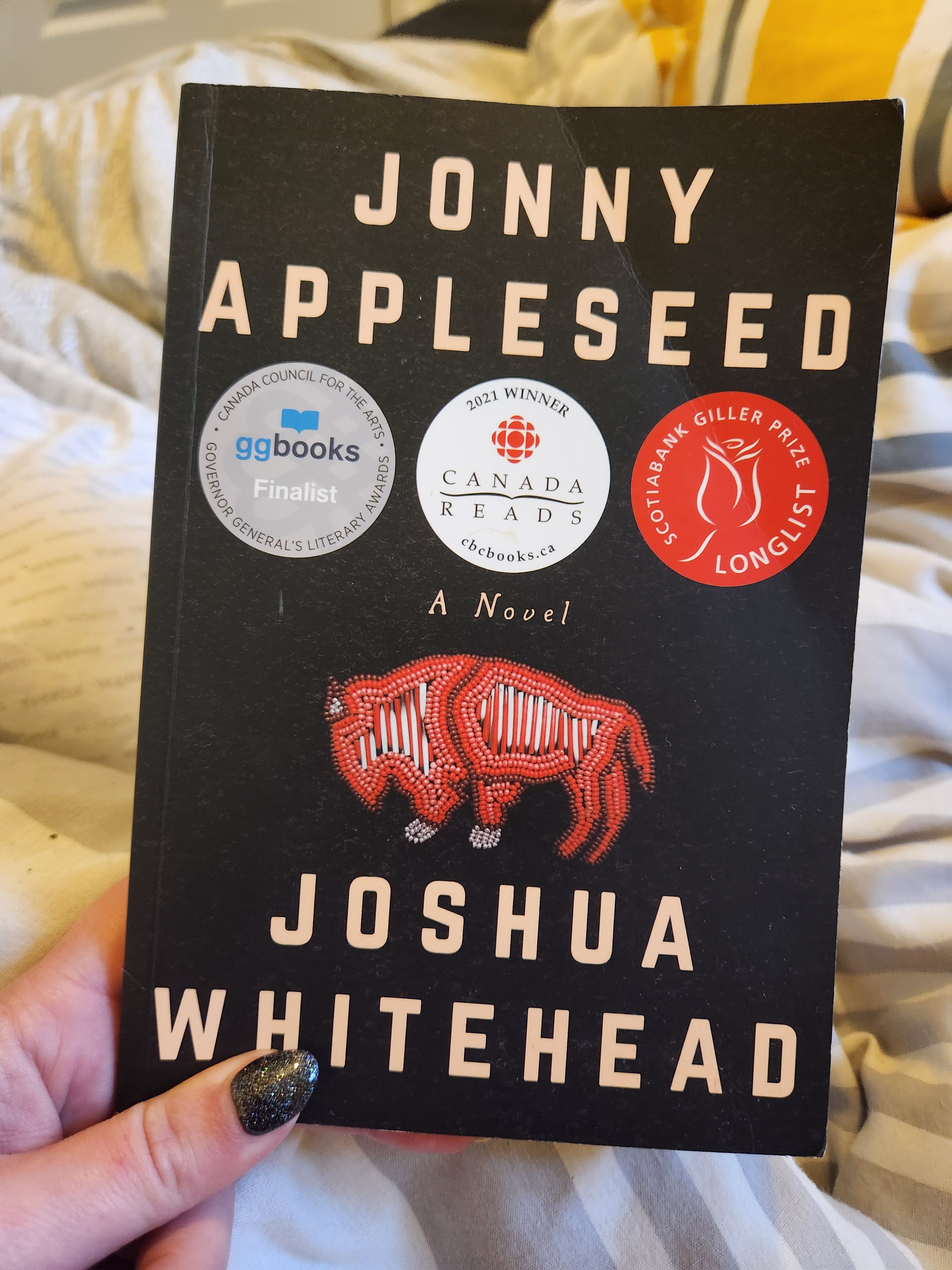
In the Queer Book Club, Jordan took so much care over bringing the group together, establishing a supportive container, and ensuring everyone’s voices were heard and needs were met. The atmosphere was warm and friendly, while still being overtly political in its intentions. We want to read books that create counternarratives to oppressive structures, that centre marginalised experiences, and that will connect us more to our fellow humans across the world! And we want to have fun doing it! QBC is clearly a space for learning and for joy, because the two are not mutually exclusive. Although once a voracious reader, I have struggled to read much as an adult. But the shared intentions and low-pressure accountability of the club has motivated me to embrace reading for fun again. As a group we voted on our first title, Jonny Appleseed, by 2Spirit, Indigenous author, Joshua Whitehead, (which admittedly I’ve read before so is a bit of a cheat for me, but I’m loving the second read through!), which we’ll be discussing in the next meeting (Sunday, March 1st), and I am so looking forward to having that time in my calendar to get cosy and talk books with some really lovely neuroqueerdos.
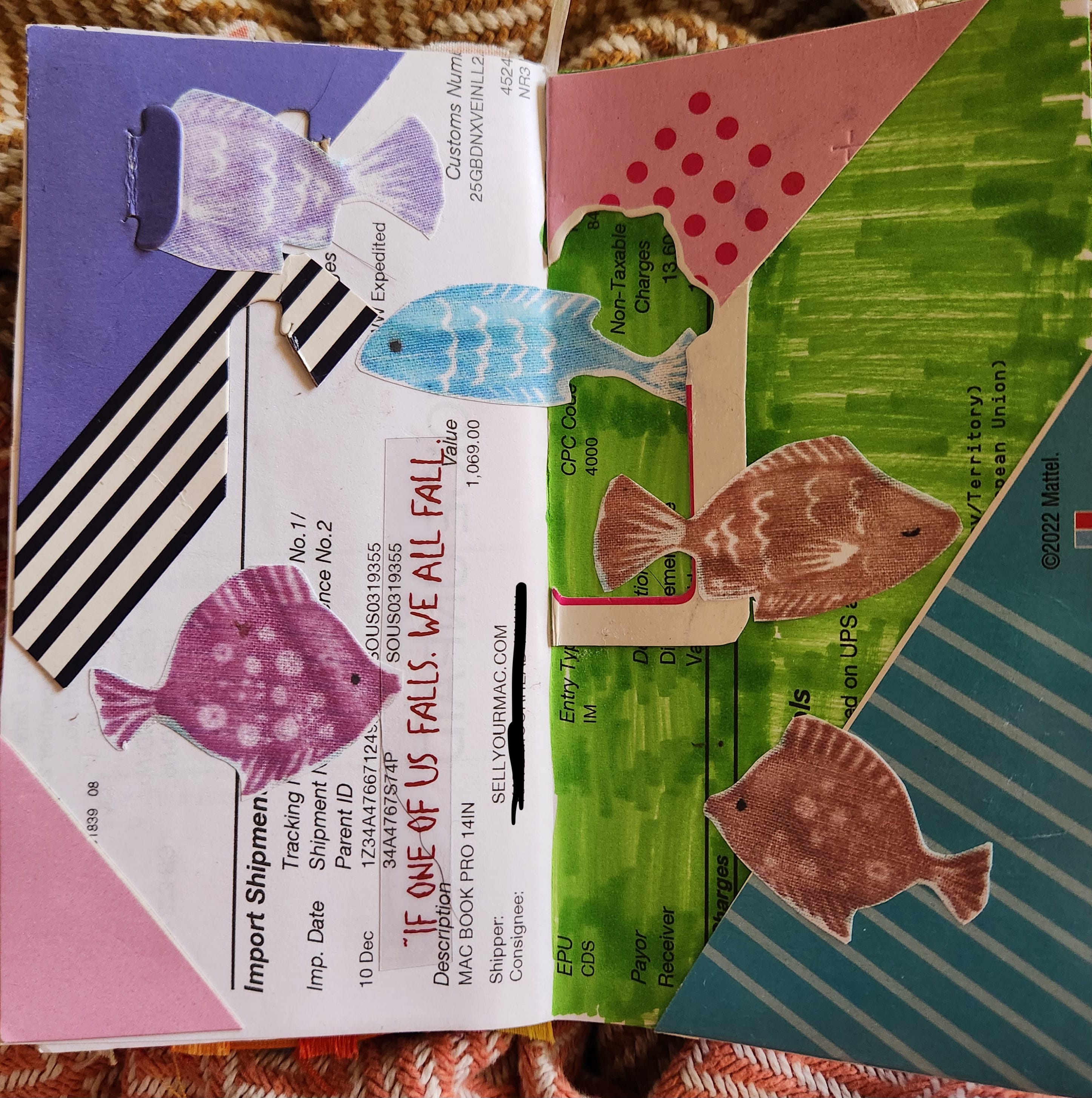
In the Bad Art Club, Sonya encouraged us to make art from whatever was around us - to let the materials come to us. We asked ourselves ‘what would happen if’ and just let the making take us wherever it wanted to go. Sonya really took the time to ground us in our intuitive processes - and encourage us to lean away from capitalist expectations of production, and to let the meaning be in the making. I have been using collage as a way to engage with my creative practice outside of writing recently, so used this invitation to create around some interesting rubbish that I’d been stepping over for weeks, and experimented with scanning/printing some colourful fabric swatches to use as paper collage materials. I was particularly drawn to the line of text I found on a book jacket : “If one of us falls. We all fall.” which seemed serendipitously appropriate in the moment. Is this a good collage? No! But it’s not meant to be - it’s Bad Art Club! Do I love it anyway? Yes! Did I feel joy while making it? Yes! The best part was seeing what everyone made and hearing about their processes.
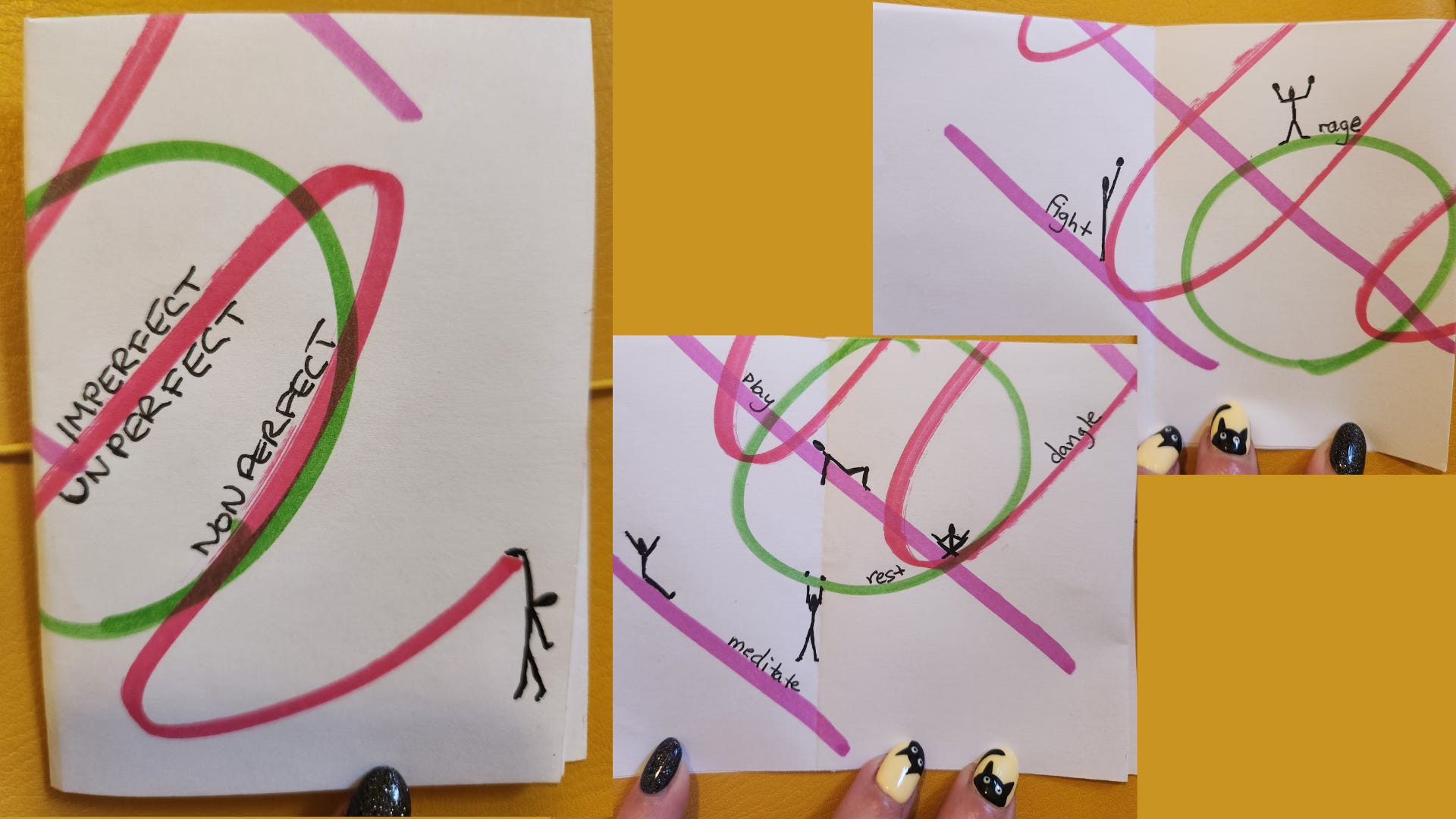
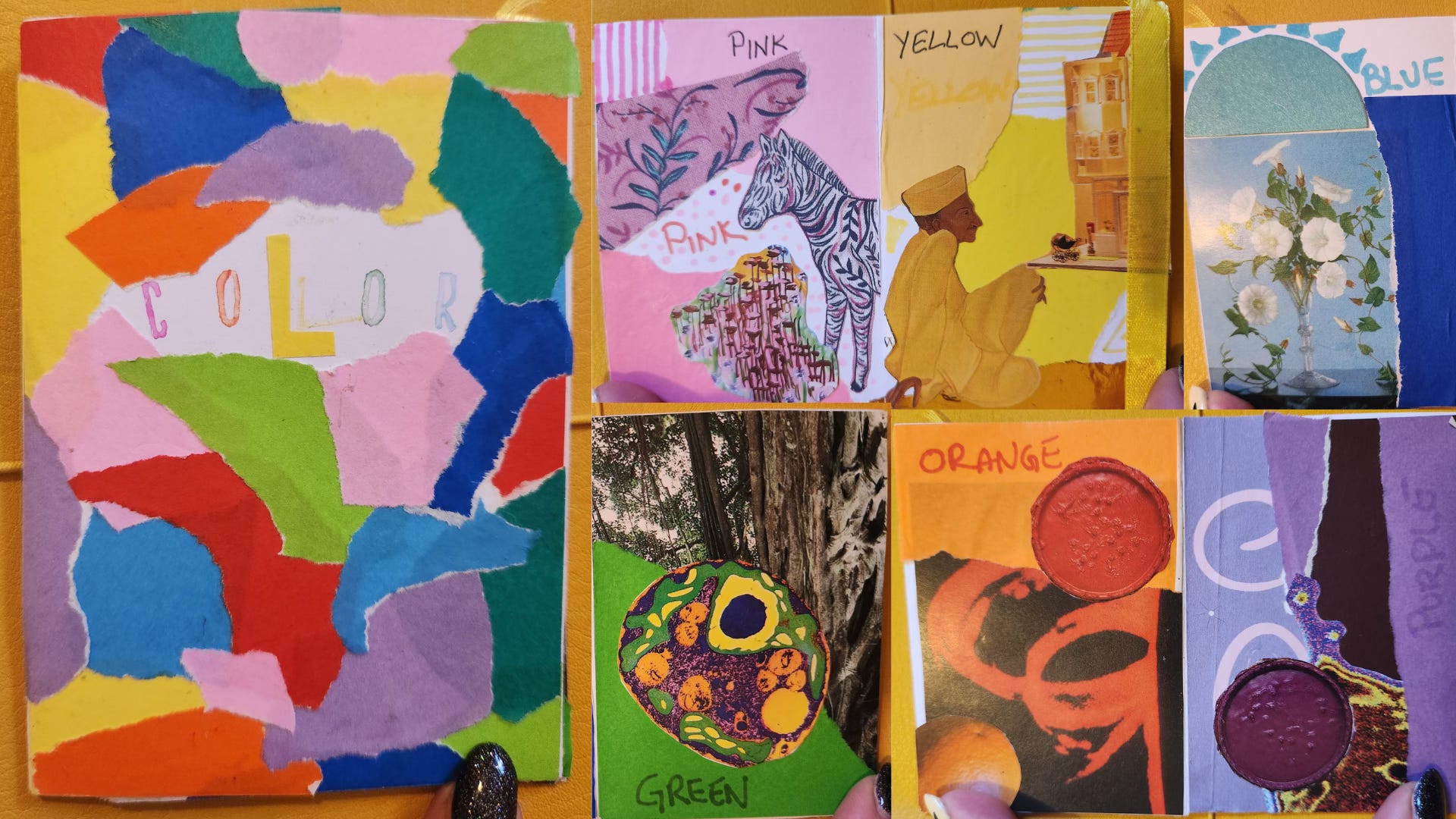
In Bad Zine Club, Leif walked us through the process of folding a mini zine, while also encouraging us to embrace intuitive making and imperfection. Starting with a prompt to scribble all over our paper before folding, gave us each individual marks to build on in our mini zines. I am a big perfectionist, so really tried to lean into the imperfection (unperfection, nonperfection) of it all and just make something quickly without overthinking it. It just started with drawing a little guy hanging off my scribble, and soon the pages were filled with little guys doing things! What does it mean? Nothing! Who cares? Was it fun to make? Absolutely! I was also able to spend some time finishing up a colour themed collage zine I started in the Intro to Zine Making session, while chatting away with the other club members. As someone whose main creative practice is writing - it never occurred to me that you could chat and make at the same time - but when you’re doodling/collaging/scribbling you can! It really did mimic the vibe you get just sitting around in-person with a group of friends, gabbing away while all engaged in some small task.
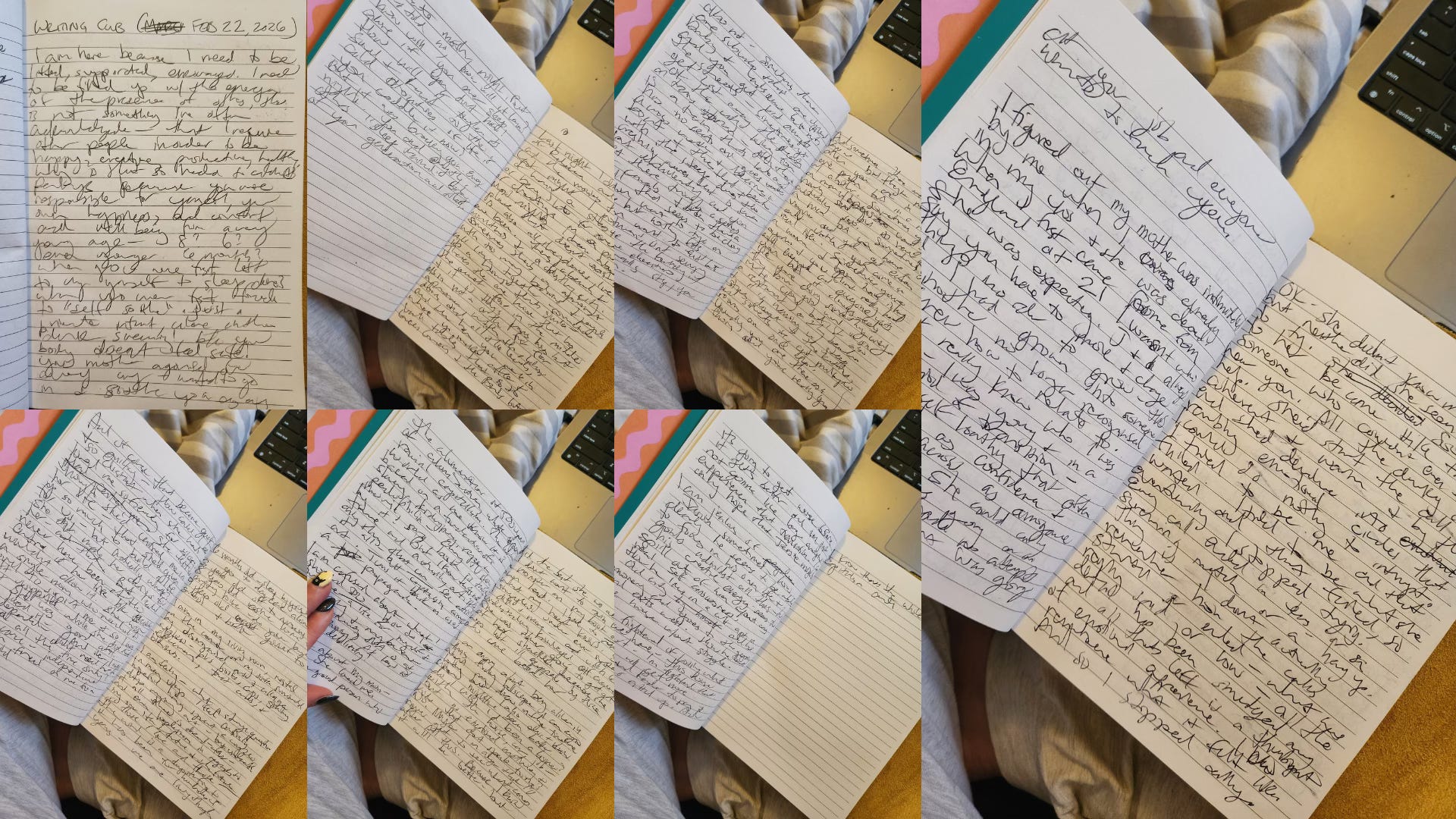
Writing Club was the one I was really scared of, because writing is ‘my thing’ and I have been letting it hibernate over the winter. This meeting was my first foray back into writing after a couple months, and that is always daunting! Luckily, Ashleigh facilitated such a gentle space that I eased right back into it. They offered many generative and supportive prompts that allowed me to keep writing even when my focus waned. I was mostly just automatic writing, warming up the muscles again, and when we came to the final chunk of writing time, I felt like I was probably done, and wouldn’t write anymore. But Ashleigh shared some interesting prompt questions that re-engaged me, and I could easily move onto a new question when I ran out of steam for one. As expected, the Writing Club vibe was less chatty than some of the other clubs, but was equally warm, inviting, and supportive. I really felt able to relax into the time given and felt good about all the pages of chicken scratch I walked away with. I look forward to seeing my practice wake up for the spring as I continue to engage in this space.
All this to say, as the one who is usually managing the clock, the tech, the slides, questions, emotions and expectations, it was an incredibly powerful experience to be able to sit back and actually be held by others. I am so grateful to all the NQC facilitators mentioned above who have built these containers, and for the fact I am able to be a part of them.
No matter how much I tell other people that creativity thrives in community - I often struggle to take my own advice. Of course other people should seek out support, but not me. I am the kid that came home to an empty house every day. Who sorted their own breakfast and lunch and laundry. Surely, I don’t need anybody! But we all do. We all need people. We all need someone to meet us where we are. To sit with us while we figure out the difficult task.
KR Moorhead (they/them) is an AuDHD and gender non-compliant writer and educator who has been teaching creative writing for over 15 years. Their novella, The First Law of Motion, was published in the US by St. Martin’s Press in 2009. From 2009 to 2023, they lectured in Creative Writing at the University of East Anglia where they earned an MA in Creative Writing: Prose Fiction in 2007. KR also has a Post Graduate Certificate in Higher Education Practice and a Post Graduate Diploma in Education Practice and Research.
They have facilitated for Writers in Bloom, Beyond Form Creative Writing, Devotion Workshop, Norwich School of Creative Writing, and Oxbridge Academic Courses, and currently teach a variety of courses for City Lit, and on The University of Hull's online, part-time Creative Writing MA.
Originally from so-called Philadelphia on the unceded land of the Lenni Lenape people, KR now lives in Norwich, UK with their partner, step-kid, and three cats. KR is the initiator and administrator of NQC
All NQC monthly clubs are hosted via our Skool platform. Skool is free to join. Become a premium member for £18/$24 a month and get access to all four monthly clubs. Subscribe to only one or two clubs by visiting the Neuroqueer Creative website.
1st Sunday of the month: Queer Book Club
2nd Sunday of the month: Bad Art Club
3rd Sunday of the month: Bad Zine Club
4th Sunday of the month: Writing Club
1 Club = £6 per month
2 Clubs = £11 per month
Comments
Nothing yet. Say the first thing.
Sign in to join the conversation.