
We started the conversation in Part 1 of this series, where we reflected on the patterns of behaviours in couples that could threaten relationships. We talked about the impact this may have on families and parenting. Delayed recognition of neurodiversity in parents can negatively impact a neurodiverse child, especially children with ADHD or ASD. In this section, we will discuss ways to address these behaviors.

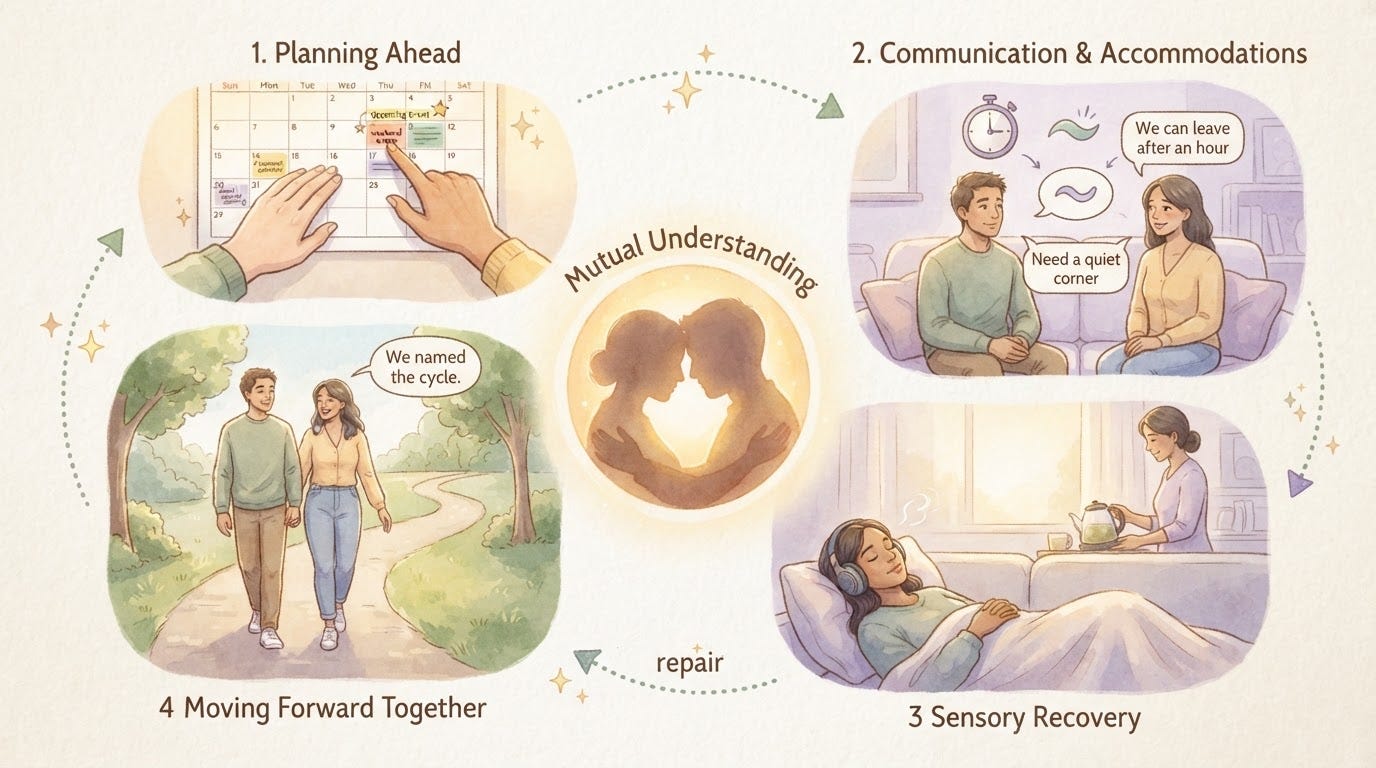
Replace “You are antisocial” with a neutral sequence: “Before family events, you become tense. At the event, you withdraw. I feel alone and begin prompting you. You feel watched and withdraw further. We argue on the way home.”
The cycle is the shared opponent.
Try three sentences:
· “I believe you did not intend to embarrass me.”
· “The comment still had an impact, and I felt exposed.”
· “Next time, I need us to agree on a signal and step outside before either of us becomes overwhelmed.”
This protects accountability without assuming malice.
State requests directly. Agree who is doing what and by when. Put plans in a shared calendar. Write down changes. Use reminders, checklists and visual schedules. External systems reduce the number of occasions on which love is tested through memory.
Discuss duration, transport, quiet space, food, likely guests, recovery time and an exit plan. The sociable partner can attend some events alone without treating that as betrayal. The less sociable partner can participate in selected, meaningful ways rather than being pushed into every event or withdrawing from all.
Give advance notice where possible. Use a ten-minute warning before leaving. Decide which plans are fixed and which are flexible. If lateness is a repeated trigger, work backward from departure time and assign concrete tasks rather than shouting reminders.
Identify early signs of overload. Choose a word or gesture that means “pause.” Decide how long the pause lasts and when the discussion resumes. During the break, reduce stimulation rather than rehearsing arguments by text.
Do not recruit the child as witness, messenger, or judge. Do not debate the child’s diagnosis in front of them. Use a shared response for common flashpoints, and hold the parenting discussion later.
Generic couple advice can fail if a therapist interprets literal communication, shutdown, memory difficulty, or sensory overload only as lack of care. Ask whether the practitioner understands adult autism, ADHD, masking, executive function, sensory processing and mixed-neurotype relationships. Good work should still address responsibility, power and safety.
Consider a conversation with a GP or qualified specialist when there is a lifelong cluster of relevant traits, significant impact on relationships, work or daily life, and a desire to understand or access support. Childhood history matters, even if difficulties became obvious only when adult demands increased. Screening questionnaires can start reflection but cannot confirm a diagnosis.
Assessment should be chosen by the person being assessed. A partner can share observations and explain the impact on the relationship, but should not corner, diagnose, or publicly label them.
Other explanations also need consideration, including anxiety, depression, trauma, sleep problems, substance use, physical illness, personality, cultural communication styles, and relationship incompatibility. More than one explanation can be true.
Relationship preparation often covers money, sex, faith, family expectations and conflict. Neurocognitive differences deserve a place too. The goal would not be screening every couple for a disorder. It would be teaching every couple to ask useful questions:
· How do you each communicate distress?
· What happens when plans change?
· How much social contact and recovery time do you need?
· How do noise, touch, clutter and interruption affect you?
· How do you remember and organise shared responsibilities?
· What does emotional support look like to each of you?
· How will you repair after conflict?
· How will you respond if a child has additional needs?
Counselors, faith-based marriage groups, family services and parenting programs should recognise that equal commitment does not always look like identical behavior. They should also know when to refer for specialist assessment and when a safety issue takes priority over couple work.
“Is your partner neurodivergent?” is a powerful series title because it opens a neglected conversation. Inside the conversation, the better question is more careful:
Could a difference in how one or both of us process the world be contributing to this repeated cycle?
That question does not absolve anyone. It does not turn a spouse into a patient. It asks the couple to replace accusation with observation, to make hidden needs speakable and to build systems that fit the brains actually living in the home.
Understanding may not save every relationship. Some relationships are unsafe; some are incompatible; some end despite insight. But where two people still have goodwill, recognition can change the argument from “Why are you like this?” to “What happens to us here, and what can we do differently?”
That is a much stronger place to begin.
No posts
Comments
Nothing yet. Say the first thing.
Sign in to join the conversation.