
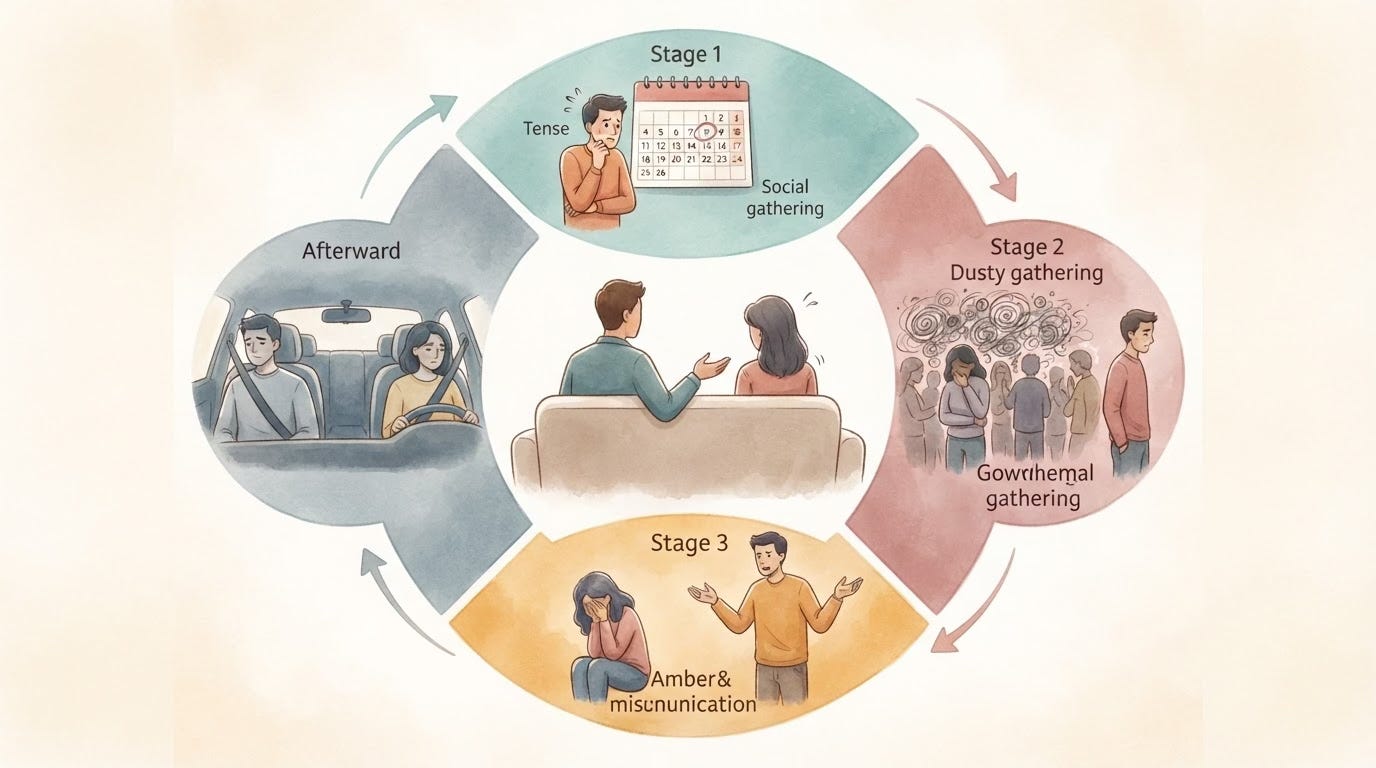
One partner is excited about a family gathering. The other has been dreading it all week.
They arrive late because getting out of the house took longer than expected. One partner is already tense. At the gathering, that partner speaks very little, misses a social cue, makes a comment that lands badly, or disappears into another room. On the journey home, the argument begins.
“You embarrassed me.”
“I came, didn’t I?”
“You made it obvious you didn’t want to be there.”
“Why are you making such a big issue of this?”
Both people feel injured. One felt abandoned in public. The other felt pushed into a draining situation and then criticised for failing to perform correctly. The disagreement becomes evidence in a much older case each partner has been building: You do not care about me. You never understand me. Everything must be your way.
For some couples, this is ordinary incompatibility or a relationship that needs repair. For others, the repeated pattern may partly reflect unrecognised neurodivergence in one or both partners.
That possibility deserves discussion, particularly in families raising a neurodivergent child. Autism and ADHD run in families. A child’s assessment can be the first time a parent recognises parts of their own childhood, sensory profile, attention, social experience or need for predictability. The discovery may bring relief, grief, defensiveness or a sudden re-reading of the marriage.
The aim is not to turn every difficult spouse into a diagnosis. It is to replace moral judgement with careful curiosity, while keeping responsibility and safety firmly in view.
Couples rarely argue only about the visible event. They argue about the meaning attached to it.
If one partner avoids gatherings, the other may hear: “Your family does not matter to me.” The avoiding partner may be experiencing noise, crowded conversation, unpredictable questions, unfamiliar food, pressure to make eye contact, or exhaustion from monitoring every response.
If one partner insists on leaving at exactly 9 am, the other may experience control and impatience. The first partner may have built a precise mental plan to contain uncertainty. A delay can produce genuine anxiety and a rapid loss of emotional regulation.
If a partner gives a factual answer when comfort is expected, that can feel cold. The speaker may believe that solving the problem is an act of care and may not recognise the unspoken request for reassurance.
If a partner forgets an agreed task, the other may conclude that the task, and therefore the relationship, was not important. ADHD-related working-memory and executive-function difficulties can make intentions unreliable unless they are externalised through reminders and routines.
The impact remains real. Embarrassment is real. Loneliness is real. Overload is real. The problem is that each partner may be explaining the other’s behaviour with the wrong story.
For years, autistic people were often described as having a one-sided empathy deficit. The double-empathy account offers a more useful relational lens: people with very different experiences and communication styles may struggle to read one another in both directions.
The non-autistic partner may miss the intensity of sensory or cognitive overload. The autistic partner may miss an indirect social message or the emotional meaning attached to an action. Both can feel unheard. Both can believe they have communicated clearly. Both can leave the same conversation with different understandings of what was agreed.
This does not mean every misunderstanding is equal, nor that harmful conduct should be overlooked. It means that repair must involve translation in both directions. Asking only one partner to become “more normal” is unlikely to create genuine intimacy.
No single item proves neurodivergence. Look for clusters that are longstanding, appear in more than one setting and cause significant difficulty or require great effort to conceal.
A partner may avoid gatherings, need long recovery afterwards, prefer one-to-one contact, struggle in group conversation or appear disengaged when overloaded. Another person may enjoy people but interrupt, speak impulsively, become intensely animated, lose track of conversational turns or agree to too many social plans.
The key question is not “Are they sociable?” Autistic people can be warm, funny and socially motivated; people with ADHD can also experience rejection, overwhelm and social exhaustion. Ask what social contact costs, what makes it easier and what happens before and after it.
One partner may interpret language literally, communicate very directly or need the request stated explicitly. The other may depend on tone, implication and shared social assumptions. “It would be nice if the kitchen were tidy” may be intended as a request but heard as a general observation.
Conflict grows when one person believes they were obvious and the other believes no request was made.
Unexpected visitors, a last-minute change of route, moving house, a holiday with no itinerary or a child changing the plan can produce disproportionate distress. The behaviour may look rigid from the outside. Internally, predictability may be the structure that keeps anxiety and overload manageable.
Conversely, an ADHD partner may crave novelty, act spontaneously, underestimate time or change plans in search of stimulation. A couple can therefore become trapped between “You control everything” and “You make everything chaotic.”
Forgotten appointments, unfinished household tasks, unopened messages, clutter, lateness, impulsive spending or difficulty starting routine jobs can place a heavy load on the other partner. Over time, that partner may become the household manager. The neurodivergent partner may feel constantly supervised and criticised. Intimacy then gives way to a parent-child dynamic that neither person wants.
An explanation is useful only if it leads to shared systems and accountable change. “My brain works differently” should open a problem-solving conversation, not close it.
Noise, touch, smells, bright light, crowded rooms and children’s constant movement can be physically and emotionally overwhelming. A parent may retreat, become irritable, stop speaking or react strongly after apparently coping all day. The household may read this as rejection.
Sensory overload is not the same as disliking one’s family. Yet shouting at family members is still harmful. The solution is to plan earlier: reduce exposure, share childcare, use quiet recovery time, change the environment and agree on a safe signal before overload becomes an explosion.
Some adults move quickly from manageable frustration to shouting, tears, panic, impulsive words or withdrawal. Others need much longer to identify what they feel and may return to the issue hours later. When the couple expects immediate resolution, a shutdown may be mistaken for punishment and a demand for answers may intensify overload.
A pause can be helpful only when it has a return time: “I cannot continue safely right now. I will come back at 7.30 pm and we will talk for 20 minutes.” Disappearing indefinitely is not repair.
Deep interests can be a source of expertise, pleasure and identity. Hyperfocus can also make a partner feel invisible when bids for connection are repeatedly missed. A highly cautious person and a novelty-seeking person may disagree about travel, money, careers and parenting. These differences need negotiation, not a verdict about which personality is superior.
Many adults develop effective ways to manage life before children. They choose predictable work, recover alone after social demands, control their environment, rely on a partner for organisation or mask their difficulties in public.
Parenthood removes much of that control. Babies interrupt sleep. Toddlers are noisy and unpredictable. Schools send multiple messages. Appointments multiply. A neurodivergent child may need additional structure, advocacy and emotional support. The strategies that once kept an adult functioning may no longer be enough.
This is also when differences in parenting philosophy become visible. One parent may prioritise rules and consistency because unpredictability feels unsafe. The other may value flexibility and worry that the child is being controlled. One may recognise the child’s distress because it resembles their own. Another may minimise it for the same reason: “I was exactly like that and nobody made allowances for me.”
Parents can disagree about assessment, medication, school support, discipline, bedtime, screen use and what counts as deliberate behaviour. If these disagreements become contemptuous or explosive, the child lives inside the conflict.
Children notice tone, tension and alliances even when adults believe an argument is private. A child may learn that their needs cause parental conflict. They may conceal difficulties, take sides or try to regulate a parent’s emotions. A neurodivergent child may be especially affected by shouting, uncertainty and inconsistent expectations.
The child also receives competing explanations of who they are. One parent may frame the child as overwhelmed; the other as disobedient. One may support adjustments; the other may regard them as indulgence. Consistent, evidence-informed parenting matters more than identical personalities.
The aim is not for parents to agree on every detail. It is for them to create a common formulation: What does our child find difficult? What need sits beneath the behaviour? Which boundaries are necessary? Which adjustments help? How will we respond without contradicting or humiliating one another in front of the child?
Late recognition can bring compassion. It may explain why certain situations have always been unusually difficult. It can help a person stop viewing themselves as lazy, cold, unreliable or defective.
It can also destabilise a relationship. The non-neurodivergent partner may fear that their pain is being erased. The neurodivergent partner may hear every concern as criticism of their identity. Couples need two truths at once:
1. A behaviour may arise partly from neurodevelopmental differences.
2. Each adult remains responsible for the effect of their behaviour and for participating in repair.
Accommodation is not one person endlessly absorbing harm. It is an agreed change that makes participation more possible without sacrificing another person’s dignity or safety.
No posts
Comments
Nothing yet. Say the first thing.
Sign in to join the conversation.