
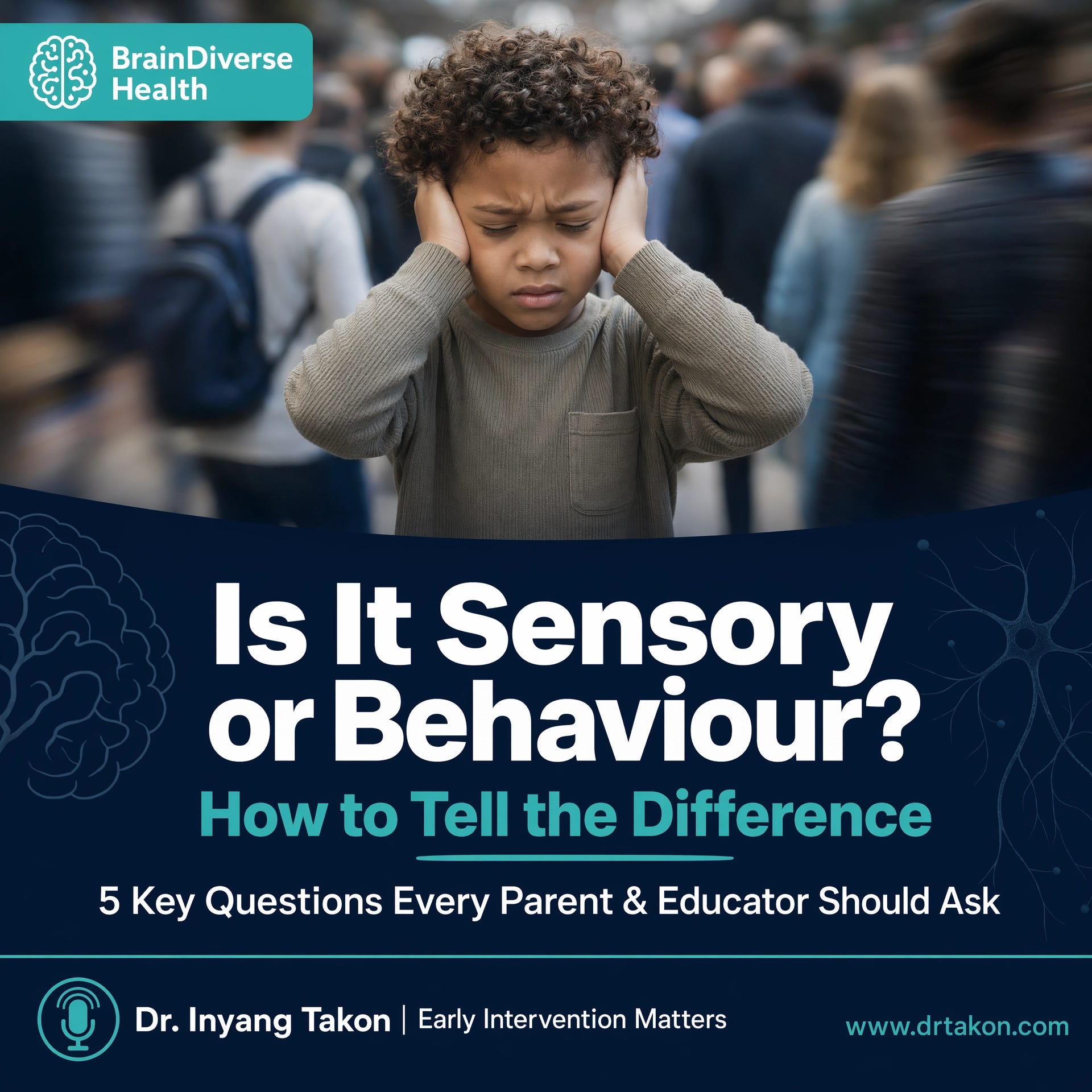
Your child is melting down in the supermarket. Refusing the school uniform, again. Screaming the moment a hairbrush comes near. You have tried reasoning. You have tried consequences. You have tried rewards but Nothing sticks.
Underneath the exhaustion is a question I hear from parents and teachers almost every week: is this behaviour, or is something else going on?
As a Consultant Neurodevelopmental Paediatrician, one of the most consequential misunderstandings I see in clinic is a child’s sensory processing differences being mistaken for deliberate misbehaviour. The child who will only eat beige food gets called “fussy.” The child who lashes out when touched unexpectedly gets called “aggressive.”
These children are not being naughty, and they are not manipulating anyone. Their nervous systems are responding — urgently — to experiences that feel genuinely overwhelming. The trouble is that sensory responses and goal-directed behaviour can look almost identical from the outside, and sometimes the two co-exist in the same meltdown. Telling them apart is hard, even for experienced adults.
Here are the five questions I walk parents and educators through.
Start with what happened in the moments just before the distress began. Sensory-driven responses usually have a clear — if subtle — antecedent involving a sensory experience:
Visual: a sudden change in lighting, harsh fluorescents, bright sunlight
Auditory: an unexpected sound, a loud environment like a school canteen, even a low-level hum others don’t notice
Tactile: a tight waistband, an itchy fabric, a scratchy label, an unexpected touch
Routine or environmental: a different route to school, a new classroom
Behavioural responses, by contrast, more commonly follow a social antecedent — being told “no,” being asked to stop something enjoyable, seeking attention, testing a boundary. If the distress followed a demand or a denial, it likely leans behavioural. If it followed an environmental shift, it likely leans sensory.
A hallmark of a sensory response is that it doesn’t change depending on the audience. If a child’s nervous system can’t tolerate the noise of the school canteen, that’s true on a Monday and a Friday, with a parent, a teacher, or a teaching assistant standing there. The sensory input itself is the trigger, and the reaction is automatic.
Behaviour that’s highly context-specific , happening only at home, or only with one particular parent more likely has a motivational or relational component. That doesn’t make it less real or less worth addressing. It just points toward a different kind of support: consistent boundaries, or working through anxiety in that specific relationship or setting.
Watch what happens when you ask. Many children with sensory differences find it genuinely difficult to say what’s going on for them in the moment. Sensory experiences are often visceral and pre-verbal — when the nervous system is in fight, flight, or freeze, the brain’s language centres are effectively offline. A child might manage a brief “it hurts” or “it’s too loud,” but rarely more than that, and rarely a negotiation.
Children engaged in more goal-directed behaviour tend to be better able to state what they want, even in the heat of the moment: “I don’t want to do homework.” “I want the iPad.”
This is often the clearest signal of all. Offer a sensory regulation strategy — a weighted blanket or deep pressure, a quiet dimly lit space, noise-cancelling headphones, a movement break like jumping or swinging — and watch what happens. If the child calms significantly, that strongly suggests sensory overwhelm was the root cause.
If the distress is more behavioural, sensory tools might offer some general nervous-system support, but what tends to help most is connection: consistency, predictability, and co-regulation. A clear, empathetic boundary “I know you want the iPad, but it’s dinner time now” — paired with emotional warmth does more than any sensory tool in that scenario.
Sensory responses are highly predictable once you know the triggers. Behavioural responses shift depending on the child’s goals or the social context.
I recommend a simple two-week observation diary. A notebook or a notes app works fine. For every difficult moment, jot down three things: what happened just before (the antecedent), what the child said or did (the behaviour), and what helped or didn’t (the consequence or intervention). Patterns tend to surface quickly such as meltdowns that always follow assemblies, or refusals to get dressed that only happen with certain fabrics.
Labelling a sensory response as “attention-seeking” or “manipulation” causes real, lasting harm. When a child who is genuinely overwhelmed is punished for a neurological response, their distress increases and their trust in the adults around them erodes. They learn that their sensory experience is shameful, and that their environment isn’t safe. Left unaddressed, this can lead to severe anxiety, school avoidance, and shutdown.
When we lead with curiosity instead of judgement asking what does this child need right now to feel safe? we tend to find answers that actually help.
If you are seeing consistent patterns of distress across multiple environments, and the usual parenting or teaching strategies aren’t working, it may be time to seek a neurodevelopmental assessment. Children deserve to be understood, not just managed.
Dr. Inyang Takon is a Consultant Neurodevelopmental Paediatrician specialising in ADHD, autism, tic disorders, FASD, and developmental conditions in children . She is the host of the Early Intervention Matters podcast.
If this was useful, consider sharing it with a parent, teacher, or carer who may benefit from this advice.
No posts
Comments
Nothing yet. Say the first thing.
Sign in to join the conversation.