
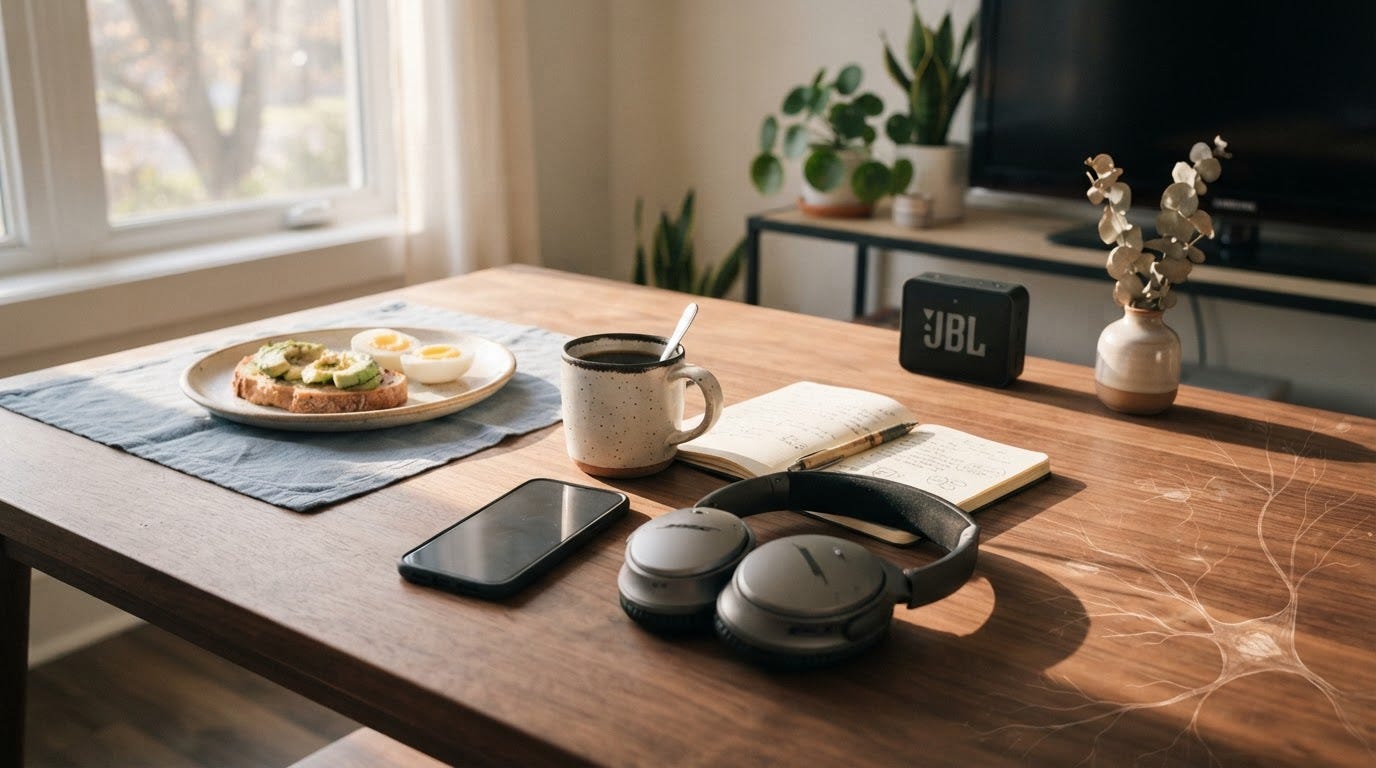
There used to be small parts of the day where nothing was happening.
You drove somewhere without a podcast. You cooked without a video playing nearby. You waited in line without headphones. You showered without listening to anything. You walked for ten minutes and simply heard whatever was around you.
Those empty moments are disappearing.
Now it is easy to move from one stream of input to another without ever noticing the transition. Music while getting ready. A podcast in the car. YouTube while eating. A show while cleaning. Short videos during a break. Another podcast during a walk. Something calming in the background while falling asleep.
None of these things are bad on their own.
The problem begins when the brain rarely gets a moment where it is not receiving something new.
Because background stimulation still counts as stimulation.
Even when you are not actively paying attention, the brain is still deciding what to notice, what to ignore, what might matter, and whether the sound deserves a response.
That quiet processing adds up.
You can become used to background noise, but your brain does not simply switch it off.
It continues monitoring.
A voice changes tone. Music becomes louder. A new topic begins. Someone says something emotionally interesting. A notification sounds. Your name is mentioned. A sentence catches your attention.
The brain is constantly deciding whether the background should become the foreground.
That requires attention.
You may feel as though you are doing one thing, but part of your brain remains available for whatever is playing behind it.
This is why working with a familiar instrumental playlist may feel very different from working with a fast podcast or a video full of conversation. Language competes more directly with the same mental systems you may be using to read, write, plan, or think.
The brain can manage it.
But managing something is not the same as it being free.
Most people notice distraction when it is obvious.
A phone rings. Someone interrupts. A message appears.
Background stimulation is different because the interruption can be subtle.
You are writing, but a sentence in the podcast catches you.
You return to the document.
A few minutes later, another part catches your attention.
You return again.
The switches may only last seconds, so you barely remember them. But every switch asks the brain to rebuild the context of what you were doing.
What was I trying to say?
Where was I?
What comes next?
The cost is small once.
Repeated dozens of times, it becomes mental friction.
By the end of the day, you can feel unusually tired even though nothing seemed particularly difficult.
Your brain was not only doing the task.
It was repeatedly protecting the task from competing input.
Working memory is the small mental workspace you use to hold information while thinking.
You use it when you follow an argument, solve a problem, organize a sentence, remember instructions, or compare two ideas.
That space is limited.
When spoken background content is present, some of that capacity may be pulled toward understanding language, even if you are not consciously trying to remember it.
This is one reason silence can suddenly make complicated work feel easier.
Nothing magical happened.
There is simply less competing for the same mental space.
You may notice ideas become easier to hold. Reading feels smoother. You stop rereading sentences. A thought can stay in your mind long enough to develop instead of being repeatedly replaced by something new.
Sometimes concentration improves not because you added a productivity technique.
You removed something.
There is another cost that is harder to measure.
When something is always playing, your brain spends less time hearing itself.
That sounds abstract, but think about where some of your clearest thoughts appear.
In the shower.
While walking.
Driving alone.
Lying in bed.
Cleaning.
Waiting.
These are moments when the brain is not being forced toward one external stream of information. Attention loosens, and the mind begins making its own connections.
You remember something.
An idea appears.
You understand why a conversation bothered you.
A solution arrives without being forced.
You suddenly realize what you actually want.
This kind of thinking needs room.
If every empty moment is immediately filled with somebody else’s voice, your brain receives a lot of information but gets less time to organize what it already knows.
You consume more thoughts.
You may produce fewer of your own.
We usually treat boredom like a problem that should be fixed immediately.
The second nothing interesting is happening, the phone appears.
But mild boredom can be a useful transition state.
It is the point where external stimulation drops and the brain begins looking inward for something to do.
At first, this can feel uncomfortable.
You become aware of restlessness. You notice how quickly your hand wants to reach for something. The mind starts searching for novelty.
If you do not immediately solve that discomfort with more input, something often changes.
The mind begins wandering.
And mind wandering is not always wasted time.
It can help connect memories, imagine possibilities, rehearse future situations, process emotions, and generate ideas that would not appear while attention is tightly occupied.
You do not need hours of boredom.
But your brain may benefit from a few parts of the day that are not already filled before they begin.
Sometimes we keep something playing because silence feels uncomfortable.
A podcast keeps us company.
Music changes the mood.
A video stops the room from feeling too empty.
There is nothing wrong with using sound this way.
But sometimes constant input becomes a way to avoid noticing what the nervous system is carrying.
When the noise stops, you notice the tiredness.
You remember the conversation.
You feel the tension in your body.
You realize you are sad, frustrated, lonely, anxious, or simply overloaded.
So the sound goes back on.
The content is not necessarily the problem.
The question is whether you are choosing it because you enjoy it or because you no longer know how to sit in a room without escaping your internal state.
Silence can feel louder when your mind has been postponed all day.
This is important.
The goal is not to turn your home into a silent retreat.
Some people genuinely focus better with steady, predictable sound. Music can improve mood. Familiar audio can make repetitive tasks more enjoyable. A podcast can make a commute meaningful. Sound can create comfort and connection.
The issue is not background audio itself.
It is never turning it off.
There is a difference between choosing music because you want music and automatically pressing play because silence has become unfamiliar.
One is enjoyment.
The other can become dependence on stimulation.
The brain benefits from variety.
Sometimes stimulation.
Sometimes conversation.
Sometimes music.
And sometimes nothing.
You do not need a digital detox.
Try something much smaller.
Choose one ordinary part of the day and leave it empty.
Make breakfast without playing anything.
Drive ten minutes without a podcast.
Take a shower without your phone nearby.
Walk around the block without headphones.
Clean one room without a video in the background.
At first, the quiet may feel surprisingly uncomfortable.
You may reach for your phone automatically. Your brain may start inventing reasons why you should listen to something useful.
Stay with it for a few minutes.
Notice what eventually appears.
Maybe nothing profound happens.
That is fine.
The goal is not to have a breakthrough every time the room becomes quiet.
The goal is to remind your brain that it does not need to be entertained, educated, distracted, or emotionally managed every minute of the day.
We have become good at turning every empty minute into an opportunity.
Learn something while driving.
Listen to a book while walking.
Watch something while eating.
Reply to messages while waiting.
There is value in using time well.
But there is also value in leaving some of it unused.
The brain needs periods where nothing new is arriving.
Moments where it can sort instead of collect.
Connect instead of consume.
Notice instead of react.
A quiet ten minutes may look unproductive from the outside.
Inside the brain, it may be the first part of the day where attention is not being asked to go anywhere.
The mental cost of always having something playing in the background is easy to miss because no single podcast, playlist, or video feels harmful.
The cost comes from never closing the stream.
Your brain keeps monitoring.
Attention keeps switching.
Working memory keeps sharing space.
Your own thoughts keep waiting for an opening.
And eventually silence starts feeling uncomfortable simply because you have stopped practicing it.
You do not have to give up music, podcasts, videos, or anything you enjoy.
Just leave a few spaces unfilled.
Let the shower only be a shower.
Let the walk only be a walk.
Let breakfast happen without another person talking from a screen.
Let your brain finish a thought before somebody else begins one for you.
Sometimes the mind does not need better content.
It needs a little less content.
NeuroNotes
No posts
Comments
Nothing yet. Say the first thing.
Sign in to join the conversation.