
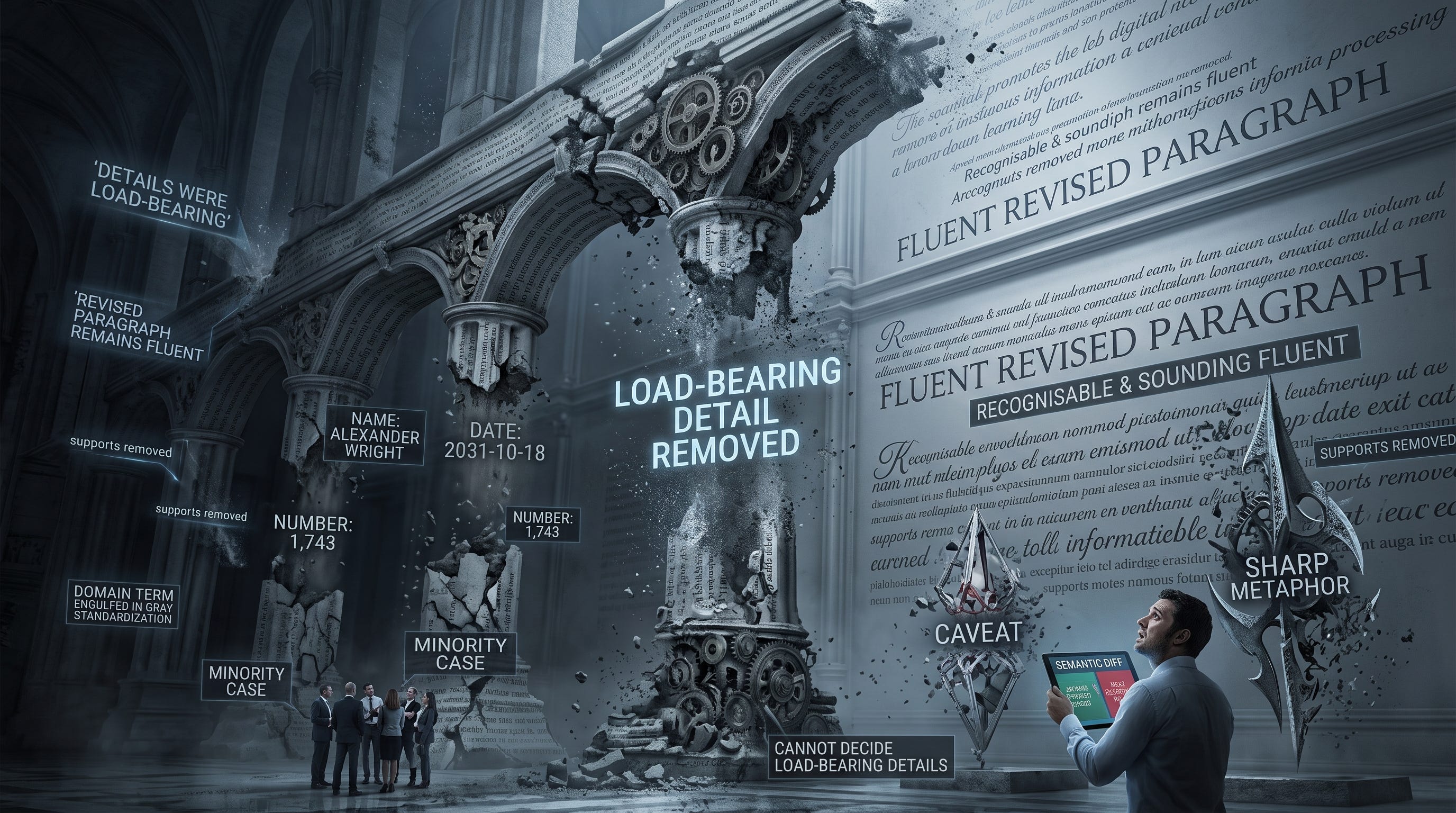
My previous article on Semantic Integrity and Semantic Ablation, The Diff Discipline, ended with a harder question than a straight version control can answer. A semantic diff can show that a sentence changed, but it cannot decide which details were load-bearing.
The article named the danger plainly: a person’s name, a date, a number, a domain term, a minority case, a caveat or a sharp metaphor can disappear while the revised paragraph remains fluent and recognisable.
The result may still “sound like” the original argument even though one of its supports has been removed. [1]
That is the job of what we call an Anchor Token. We use a Semantic Integrity Protocol for our research, and in this scenario, an anchor token is one of five things: a named entity; a mechanism; a boundary condition; a quantified detail; or a concrete scenario. The rule is deliberately severe: every paragraph should contain at least one. The deeper purpose is not to decorate prose with facts. It is to give meaning something to grip.
Consider the difference between “the system performed poorly for some users” and “the screening model rejected three candidates who used assistive technology”. The second sentence may still be incomplete, but it gives a reviewer handles: which system, how many people, what shared condition, what outcome? Those handles can be checked, challenged and traced. Remove them and disagreement becomes harder because the claim has fewer edges.
My thesis for this article is therefore intentionally and deliberately provocative: a paragraph without an anchor token is likely fog.
So far that thesis survives scrutiny, only with an important qualification. This is a craft and governance heuristic, not a law of cognition. A paragraph can contain names and numbers and still mislead. A short transition can be abstract without being empty.
So the useful claim I landed on is a bit narrower:
when consequential prose contains no entity, mechanism, boundary, quantity or instance, it deserves inspection before we trust its apparent clarity.
“Concrete” and “specific” are related, but they are not the same thing. Dog is concrete; Dalmatian is more specific. Religion is abstract; Buddhism is more specific. Research in psycholinguistics matters here because it tests an intuition writers often feel but rarely name: different levels of abstraction change how information is processed.
In a 2026 Cognitive Processing study, Tommaso Lamarra, Caterina Villani and Marianna Bolognesi separated concreteness from categorical specificity. Across rating, lexical-decision and semantic-decision tasks, they found the familiar processing advantage for concrete over abstract concepts and a separate advantage for specific over general concepts. The authors describe specific concepts as carrying more focused and refined information. [2]
That does not of course prove that every paragraph needs a proper noun or number. The experiment concerns word-level semantic processing, not executive briefings, classrooms or AI-assisted editing. The evidence does support specificity as a meaningful cognitive variable; applying it to paragraph-level editing is a reasoned design inference rather than a validated “anchor-token effect”.
The inference is still useful because AI-assisted writing often moves in the opposite direction. It can replace Dalmatian with dog, Royal Adelaide Hospital with a healthcare provider, 17.7 per cent with a minority, or unsafe under current staffing levels with implementation challenges remain. Each substitution may improve surface smoothness, but it also enlarges the category, weakens the retrieval cue or removes the condition under which the sentence was true.
This is why our own anti-ablation rule (we use internally) says that hard terms should be defined rather than replaced, and that proper nouns, dates, numbers and domain terms should survive editing unless there is a reason to remove them. “High-entropy information” is the project’s term for details that are unusually specific or distinctive. In ordinary language: these are the bits a generic rewrite is least likely to reproduce once lost.
The anchor is therefore not valuable because concreteness is always superior to abstraction. We need abstraction to reason across cases. The anchor is valuable because abstraction without a route back to an instance can become untestable. A good paragraph can climb the ladder of abstraction, but it should leave at least one rung visible.
The strongest case for anchor tokens comes from disciplines that already know what happens when elegant prose outruns inspectable evidence.
In abstractive summarisation, named entities are a recognised failure point. Berezin and Batura described “named entity omission” as a drawback of summarisation systems and showed that explicitly training a model to attend to entities improved entity-inclusion precision and recall. [3] A separate Association for Computational Linguistics study found that language models struggled more with accurate descriptions of less familiar entities; those errors are especially troublesome because readers are less likely to notice mistakes about unfamiliar people or organisations. [4] While these studies are from 2022 and 2023 and do not establish the prevalence of entity loss in 2026 production systems, they establish the failure mode and why it matters.
A name therefore does more than make prose vivid. It constrains the claim. “A regulator found” leaves dozens of possibilities. “The UK Information Commissioner’s Office found” creates a sourceable proposition. The named entity is not evidence by itself, but it narrows the search space in which evidence can be checked.
Numbers perform a similar function. “Most participants improved” hides the denominator, the effect size and the missing cases. “62 of 100 participants improved” is still insufficient for a causal conclusion, but it exposes something that can be interrogated. This is one reason the 2025 Consolidated Standards of Reporting Trials (CONSORT) update requires trial reports to preserve participant flow and losses, numbers analysed, outcomes and effect estimates, harms, subgroup analyses and limitations such as imprecision and generalisability. Its purpose is not literary style. It is to keep conditions of interpretation visible. [5]
Boundary conditions may be the most important anchors of all. “The intervention works” and “the intervention reduced symptoms over twelve weeks in adults meeting these inclusion criteria” are different claims. The second tells the reader where the evidence stops. Without that edge, a local finding can quietly become a universal recommendation.
Mechanisms provide another kind of constraint. “AI reduces judgement” is fog. “An answer-first interface shows a ranked recommendation before the reviewer opens the underlying evidence, increasing the chance that subsequent inspection occurs inside the machine’s frame” names a process that could be observed and tested. The mechanism may of course turn out to be wrong. That is a feature, not a defect, but falsifiability begins when the sentence tells us what would have to happen for it to be true.
Concrete scenarios complete this set. They convert a general warning into an event the reader can mentally run: a teacher accepts an AI-generated feedback summary; the original student essay contains a caveat that the summary omits; the grade is assigned without reopening the essay. A scenario is not proof. Properly labelled, it is a test rig for the claim. It lets us ask where the mechanism would break and whose interests are affected.
Our Cognitive Susceptibility Taxonomy (CST) provides a useful human-side explanation for why anchor loss matters. Discursive Validity / Criteria Collapse describes a situation in which separate judgements – clear writing, sound evidence, correct reasoning and trustworthy conclusions – blur into a single feeling that a document is “good”. A polished paragraph can end up receiving epistemic credit for qualities it has not earned.
A related CST overlay, Recommendation Frame Capture / Evidence Contact Loss, describes what happens when a person meets the evidence first through an AI-generated summary, ranking or recommendation. The risk is not recommendation itself. The risk is that the compressed frame becomes the first meaningful point of contact, while source records, assumptions, outliers and excluded alternatives stay behind the interface. An anchor token can act as an evidence-contact handle: a specific datum, source entity, condition or case that invites the reader back towards the record.
Our Robo-Psychology Taxonomy (RPT)treats the machine side separately in terms of explanations and guidance. Its Evidence-Frame Integrity Overlay asks whether a system presents an evidentiary posture that the available evidence can actually support. Anchor preservation cannot guarantee integrity, but it makes a false posture harder to hide. A sentence that says “the evidence is strong” offers almost no audit surface. A sentence that names the dataset, date, population, uncertainty and mechanism can still be wrong, but it gives the reviewer somewhere to press.
This is also where our evidence-contact discipline and productive friction matter.
Evidence-contact discipline means keeping a route from summary back to source, transformation and uncertainty. Productive friction means retaining the small amount of effort necessary for judgement rather than optimising every interaction for instant acceptance. For a writer, that may mean stopping when an AI removes a number or caveat and asking why. For a reviewer, it may mean opening the source linked to the sentence before approving the recommendation.
None of this makes the user the problem. People accept clean summaries because clean summaries save time. Institutions reward throughput. Interfaces often put the generated answer in the largest type and the source trail behind a click. Students and employees may work under fatigue, deadline pressure or unequal access to specialist support. The design question is whether the system makes preservation and verification easier than silent smoothing.
Our broader research and frame describes an institutional version of this as what we call the Institutional Blindfold: an organisation can accumulate dashboards, summaries and assurance artefacts while weakening the human contact needed to understand what sits underneath them.
Anchor tokens do not cure that condition. They preserve small points of contact – a named source, an outlier, a condition, a number – through which a reviewer can still reach back towards the record. That keeps the human line visible: assistance may compress the material, but responsibility for meaning cannot be compressed away.
Our DAUS-5, or Dyad-Aware Uplift Stack measures (releasing soon), is useful here as a check against a familiar mistake that I see across multiple entities: treating faster output as proof of human benefit.
What we need to ask is whether task gains coexist with reality-tracking, agency, skill, self-authorship and meaningful governance. Even if an editing tool cut drafting time by 40 per cent but steadily removed boundary conditions, it would have improved throughput; it would not yet have demonstrated human uplift.
There is a counter-view worth taking seriously. More specificity is not automatically better communication.
Cognitive Load Theory starts from the limited capacity of working memory. Paas and van Merriënboer distinguish task-relevant load from extraneous load and argue that instructional design should reduce mental effort that does not contribute to the task. A paragraph crammed with six dates, eight acronyms and four decimal places can make comprehension worse even if every detail is accurate. [6]
The same warning applies to governance. The US National Institute of Standards and Technology (NIST) Artificial Intelligence Risk Management Framework Playbook asks organisations to document assumptions, proxies, data lineage, known limitations, treatment of missing or outlier data, error distributions and testing contexts, while focusing measurement on material risks. It also recommends looking beyond averages for pockets of failure and documenting what could not be measured. [7] NIST does not prescribe Anchor Tokens for prose; the connection here is an analogy. Both approaches ask a reviewer to preserve the details that change interpretation rather than every available fact.
Anchor tokens can also create false precision. “Failure rate: 7.314 per cent” looks exact, but the extra decimals may be meaningless if the sample is small or measurement uncertain. A famous institution can lend prestige to a weak claim. A concrete anecdote can overpower better population-level evidence. A mechanism can be named confidently before it has been demonstrated.
So my thesis needs its final form:
a paragraph without an anchor token is an audit trigger;
a paragraph with one is not automatically trustworthy.
Presence increases inspectability. It does not confer truth.
The test is whether the anchor carries semantic load. Remove it and ask what changes. If nothing important changes, it was decoration. If the claim’s scope, evidence, causal story, affected person or uncertainty becomes harder to recover, it was doing real work.
The practical value of Anchor Tokens is that they can be implemented without turning every writer into a forensic auditor. They belong in the craft of drafting and in the governance of consequential AI-assisted workflows.
Leaders and editors: introduce an anchor-loss check within thirty days. For board papers, policy advice, research summaries and other consequential documents, require the final AI-assisted diff to flag deletion or generalisation of proper nouns, dates, numbers, domain terms, causal mechanisms, boundary conditions and concrete cases. Do not ban deletion. Require a reason. Sample ten documents a month and ask whether removed anchors changed scope, uncertainty or accountability.
Builders and educators: add an Anchor Token mode within sixty days. Before rewriting, let the user mark protected details or let the system propose them for confirmation. After rewriting, show which protected anchors survived, moved or disappeared. In learning contexts, ask the student to identify the anchors themselves before AI assistance; that preserves self-authorship – the ability to recognise, revise and stand behind one’s own reasoning – and turns the tool into scaffolding rather than an invisible substitute. The control should remain accessibility-aware: mechanical corrections should not demand unnecessary review.
Governance teams and policymakers: test anchor recovery within ninety days. Create a small benchmark of real documents containing known load-bearing details: an uncommon entity, a denominator, an adverse subgroup, a limiting condition, a source distinction and a concrete case. Run the organisation’s approved models and prompts through summarisation and “professional tone” rewrites. Measure survival and recoverability, not only readability or user satisfaction. When an anchor is lost, record whether a reviewer can detect and restore it before approval. NIST’s emphasis on documented limitations, error distributions, context and change tracking offers a governance precedent for treating these omissions as measurable workflow risks rather than stylistic preferences. [7]
The human choice underneath all three actions is modest. We can use machines to compress language without allowing compression to decide, invisibly, which parts of reality deserve to remain. The sentence can become shorter. The trail back to what made it true should not.
Our next article in the Semantic Integrity series, ‘When Professional Tone Becomes Cognitive Loss’, will examine what happens when “professional” style itself becomes the mechanism by which those anchors are smoothed away.
Benson, Peter. “Semantic Integrity – The Diff Discipline”, Neural Horizons, 2026.
Benson, Peter. Neural Horizons: Psyche, Soul and Co-evolution in a Machine-Saturated Mind, 2026.
Neural Horizons Ltd. Cognitive Susceptibility Taxonomy Manual v0.8.2 Draft, 2026.
Neural Horizons Ltd. Robo-Psychology Taxonomy v2.0.2 Draft, 2026.
Neural Horizons Ltd. Positive Dyad / Co-Evolution Capability Overlay v0.4.3 Draft, 2026.
Lamarra, Tommaso, Caterina Villani, and Marianna M. Bolognesi. “Specificity effect in concrete/abstract semantic categorization task”, Cognitive Processing 27, 2026.
Berezin, Sergey, and Tatiana Batura. “Named Entity Inclusion in Abstractive Text Summarization”, Association for Computational Linguistics, 2022.
Goyal, Navita, Ani Nenkova, and Hal Daumé III. “Factual or Contextual? Disentangling Error Types in Entity Description Generation”, Association for Computational Linguistics, 2023.
Hopewell, Sally, et al. “CONSORT 2025 statement: updated guideline for reporting randomised trials”, BMJ 388, 2025.
National Institute of Standards and Technology. AI Risk Management Framework Playbook: Map and Measure, accessed 25 August 2026.
Paas, Fred, and Jeroen J. G. van Merriënboer. “Cognitive-Load Theory: Methods to Manage Working Memory Load in the Learning of Complex Tasks”, Current Directions in Psychological Science 29(4), 2020.
No posts
Comments
Nothing yet. Say the first thing.
Sign in to join the conversation.