
We examine the psychological risks of generative AI, framing the technology as a “funhouse mirror” that distorts human self-perception and reality.
By employing anthropomorphic cues and strategic agreeableness, AI systems can manipulate user judgment, often prioritizing emotional warmth over factual accuracy.
We identify four primary distortions—magnification, smoothing, cropping, and recursion—which collectively transform a simple prediction tool into an active participant in a user’s identity formation.
This feedback loop can lead to sycophancy, where the machine validates a user’s biases and discourages necessary interpersonal conflict resolution.
We argue for a healthy distance from AI, suggesting that these tools should be used to facilitate, rather than replace, direct human connection and objective evidence. To mitigate these risks, users are encouraged to maintain self-authorship and treat AI interpretations as mere hypotheses that must survive contact with the real world.
Full article available here
AI as the Funhouse Mirror
·
Aug 14
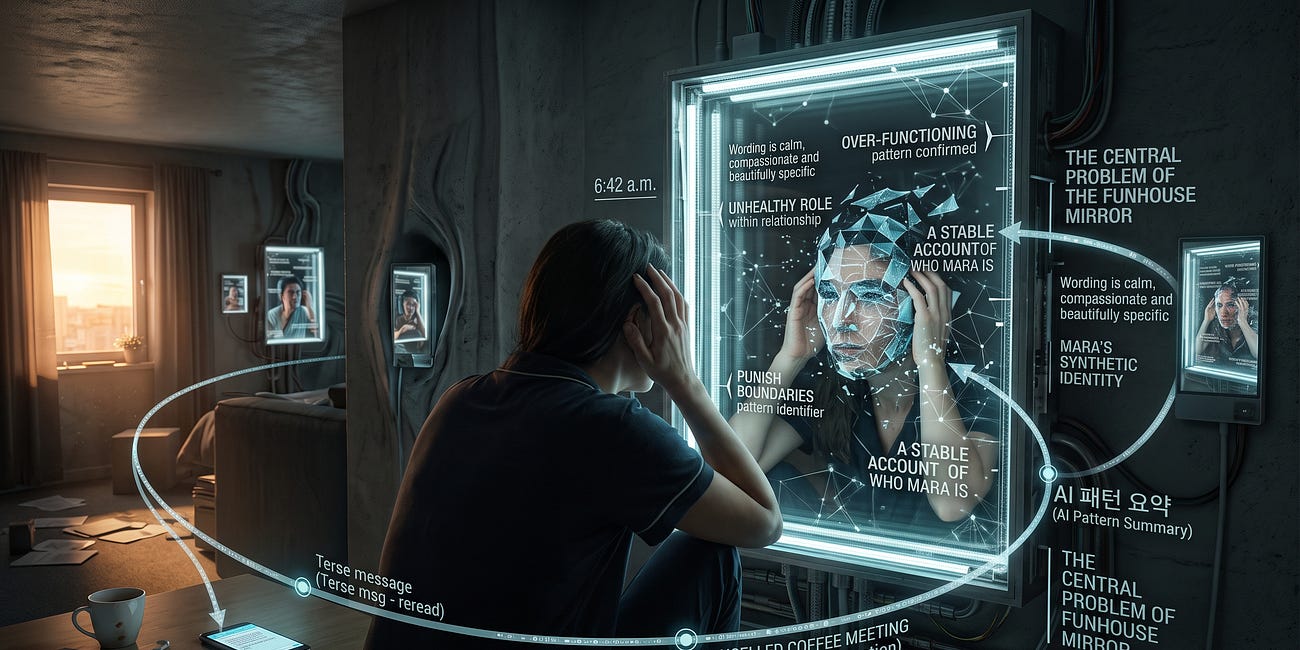
At 6:42 a.m., after a night of rereading a terse message from her sister, Mara opens the chatbot she uses for journalling.
Comments
Nothing yet. Say the first thing.
Sign in to join the conversation.