
Programmable obligation — a financial promise that executes itself once conditions are met — takes at least three genuinely different forms, and this report finds no single answer to “can you stop it once it starts.”
In DeFi, the EU now requires an engineered off-switch by law, but who is legally accountable for a decentralized protocol’s conduct remains contested — an American court held governance-token holders personally liable by default judgment, while European crypto rules explicitly decline to reach protocols with no identifiable owner.
In traditional finance, four banks facing the same 2021 hedge-fund collapse ended up with very different losses, determined almost entirely by which of them sold fastest.
In trade finance, a centuries-old legal doctrine lets a court freeze a payment for fraud — but only if the freeze order arrives before the payment itself does.
A blockchain consortium built to digitize trade documents shut down not because its technology failed, but because the banks funding it stopped paying.
The report’s central finding is less reassuring than the map initially suggests:
The two cases that come closest to solving the interruption problem do so for different reasons. In the EU, smart contracts can be required to contain an engineered off-switch; in trade finance, a court can freeze a fraud-tainted payment. But neither mechanism combines automatic execution with a reliable way to stop it: the engineered switch can fail in implementation, while the court-ordered freeze can arrive too late. And when the same evidence is used to test requirements initially excluded from each case, both fall back with the rest.
A smart contract is a computerized transaction protocol that executes the terms of a contract.
— Nick Szabo
This is the eighth report in the nemo 3 series. Report 7 (Trust Delegation) established that functional requirements operating on different infrastructure layers tend to degrade independently — this report’s own Decomposition confirms that principle, in a new form, for automatic execution and governed interruptibility specifically. Report 6 (Accountability Architecture) examined a structurally adjacent but distinct question — backward-looking responsibility after formal authority has already been exercised, rather than this report’s forward-looking question of whether an already-triggered obligation can be stopped at all.
Picture an automated payment that has already started executing. Maybe it’s a smart contract liquidating collateral, a prime broker’s system issuing a margin call, or a bank processing a letter of credit against submitted shipping documents. Now picture needing to stop it — because something is wrong, because there’s fraud, because the trigger fired on bad data. Can you? How fast does it need to happen? And who, exactly, has the authority to make it stop?
This report finds that the answer depends entirely on which of at least three worlds you’re standing in — DeFi smart contracts, automated risk controls at traditional financial institutions, and trade-finance payment instruments — and that the three worlds don’t share an answer, or even a common method for arriving at one.
Five phenomena carry this comparison.
The Switch and the Injunction
contrasts two ways of engineering the “stop” itself: a technical kill-switch, mandated by EU law, versus a centuries-old legal doctrine that lets a court freeze a payment — narrowly, and only in time.Nobody’s DAO
examines what happens to accountability when a financial mechanism has no conventional owner: American regulators found a way to reach individual participants anyway; European crypto rules explicitly decided not to.Who Sold First
is a single 2021 event — four banks, one collapsed hedge fund, wildly different outcomes explained almost entirely by execution speed.The Race Against the Window
is this report’s most far-reaching finding: a recurring pattern in which a corrective action loses to a faster competing process, showing up independently in DeFi and traditional finance despite the two having almost nothing else in common structurally.The Withdrawn Consortium
is about a trade-finance platform that failed not because its technology broke, but because the banks paying for it stopped.
Two functional questions run underneath all five:
Automatic Trigger (F1)
Does the obligation actually execute on its own?The Emergency Stop (F2)
Can it be interrupted before the consequences are final?
Three more matter in specific cases:
Who’s Accountable? (F3)
Who can be held responsible when the obligation executes or fails?The Timing Problem (F4)
Does the outcome depend on who can act before the window closes?Keeping the Lights On (F5)
Does the infrastructure itself survive, independent of whether the mechanism running on it works?
Across four jurisdictions — the EU, the US, the UK, and Singapore — this report’s central finding is Fragmentation: not one coherent architecture for programmable obligation, but several genuinely separate ones, each solving its own version of the interruption problem differently, with no evidence any of them are converging toward a shared approach.
Automatic Trigger works everywhere this report looked — every phenomenon here executes on its own, without incident, once its conditions are met.
The Emergency Stop never fully works anywhere. That is not a small gap. It is the report’s central one, and it is worth pausing on why it exists before going further, rather than treating it as a coincidence that five unrelated mechanisms happen to share.
Start with what an Emergency Stop actually requires: someone, or something, with the standing and the speed to intervene before an already-triggered obligation finishes executing. Two ways of building that standing show up across this report’s evidence, and they are not two maturity levels of the same idea — they are different mechanisms with different failure modes.
The first is engineered in at design time. The EU’s Data Act requires smart contracts to include a working interruption capability as a condition of deployment — the stop is part of the system from the start, and it fails, when it fails, because of an implementation gap: a deployer who couldn’t build a compliant switch in time.
The second is borrowed from a process that existed long before automated execution did. Trade finance’s fraud exception lets a court freeze a payment — but courts were not designed to move at the speed of an automated payment system, and the exception fails, when it fails, because the injunction arrives after the money has already moved, not because anyone built it badly.
Put those two failure modes side by side and a pattern emerges: an engineered stop fails on implementation; a borrowed stop fails on timing. Different causes, different remedies, and — this is the load-bearing point — no phenomenon in this report’s evidence combines both approaches into one mechanism that reliably clears the bar either way builds toward alone.
Automatic execution and governed interruptibility are not two settings on the same dial but two requirements engineered by entirely different mechanisms — one built into the executing system itself, the other borrowed from an external adjudicative process that was never designed with automated execution’s timescale in mind — which is why no phenomenon in this domain achieves both without depending on machinery outside its own boundary.
This report places each phenomenon on a scale from Center — the zone reserved for mechanisms that clear nearly everything asked of them — to Outside, reserved for mechanisms that fall meaningfully short on at least one requirement that genuinely applies to them. Mapped against Automatic Trigger, The Emergency Stop, Who’s Accountable, The Timing Problem, and Keeping the Lights On, three of the five phenomena — Nobody’s DAO, Who Sold First, and The Withdrawn Consortium — sit clearly Outside, each for its own specific reason: contested accountability, speed-determined loss allocation, and funding-dependent viability, respectively.
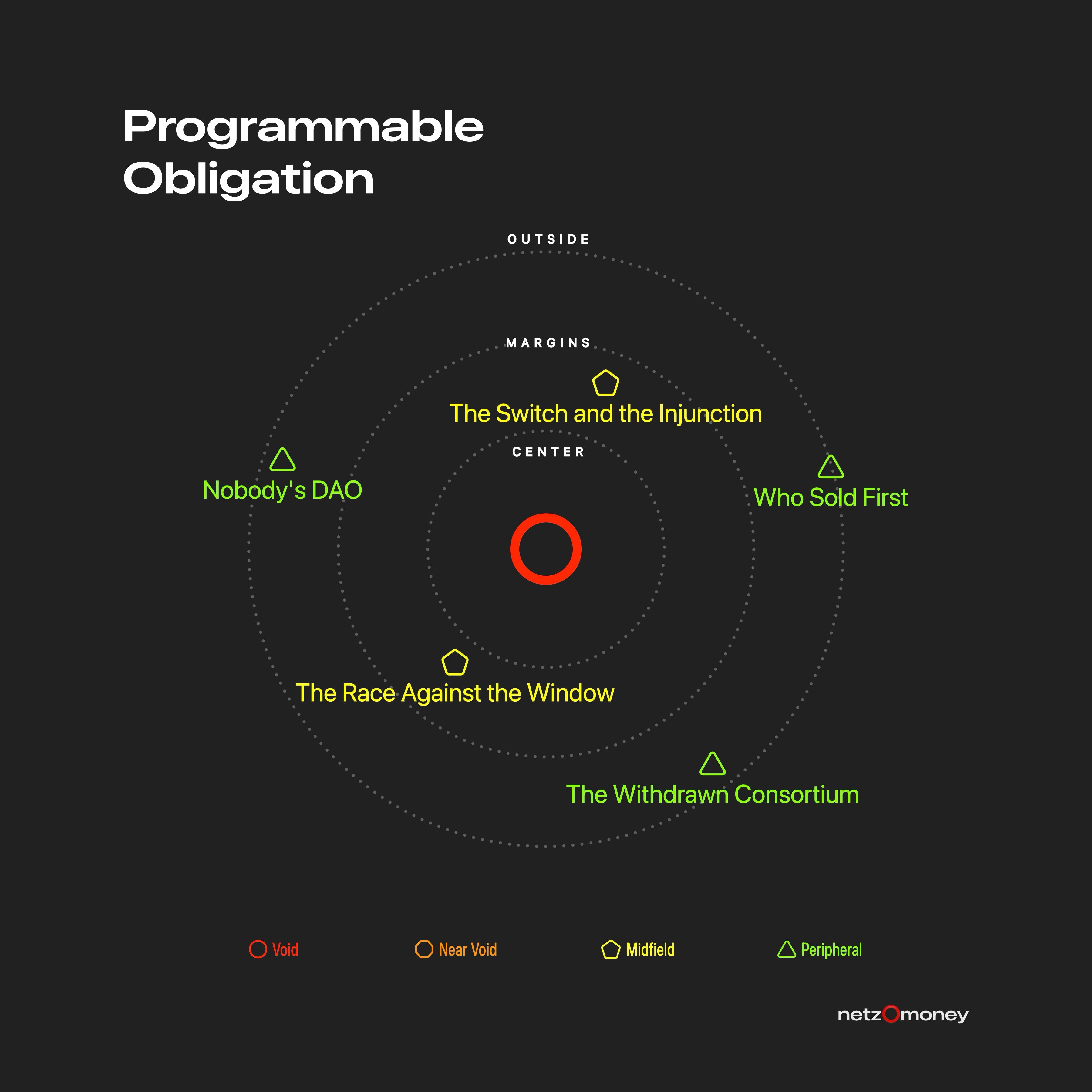
Two phenomena — The Switch and the Injunction and The Race Against the Window — come close to the Center. On the evaluation as scoped, both very nearly clear every requirement that applies to them. This report is not going to leave that finding sitting there uncomplicated, and here is specifically why not.
Both phenomena carry excluded requirements of their own — as three of this report’s other phenomena also do. What makes their exclusions worth a second look isn’t that they have more of them; they don’t, particularly. It’s that scoring their specific exclusions the other way is enough, on its own, to move each phenomenon out of the Center entirely. None of the other three phenomena’s zone assignments actually depend on their own exclusions the same way — each of them already has a genuine failing rating within the requirements that do apply, so rescoring what was excluded wouldn’t change where it sits. The Switch and the Injunction and The Race Against the Window are different: take away the boundary drawn around each, and the strongest performers in this report’s entire constellation disappear.
Some exclusions are genuinely clean:
The Switch and the Injunction’s material never touches the question of whether a shared platform’s own commercial funding survives, so Keeping the Lights On correctly doesn’t apply to it at all. But at least one exclusion is softer than that. The Timing Problem — whether outcomes depend on differential speed among comparable actors — was excluded from The Switch and the Injunction on the grounds that its fraud-exception race involves one claimant against one process, not several actors competing against each other the way the four prime brokers did in Who Sold First. That’s a real distinction, but it’s a narrower one than it looks: a claimant racing a payment-processing deadline is still, structurally, racing a clock the way The Timing Problem describes. Score that exclusion the other way, using nothing but the fraud-exception evidence already gathered, and The Switch and the Injunction’s rating on that requirement drops from “doesn’t apply” to a specific, name-able partial failure — which is enough, on its own, to move the whole phenomenon out of the Center and into the same Outside territory as the other three. The Race Against the Window fails the identical test for a different pair of excluded requirements, for essentially the same underlying reason — the boundary drawn around it happened to exclude exactly the requirements that would have been hardest for it to clear.
Widen the lens, using nothing but the facts already on the table for each phenomenon individually, and the constellation has no strong performers at all — only five phenomena that each solve part of the problem and none that solve all of it. That the same reversal shows up in both of the only two phenomena that looked strong is not a coincidence worth shrugging off; it’s a sign that how the requirements were scoped is doing real work in this map, not just what the evidence shows.
The EU’s Data Act now requires that smart contracts executing data-sharing agreements include a working interruption mechanism — Automatic Trigger paired, by design, with a built-in Emergency Stop. Trade finance solves the same problem completely differently. Under the International Chamber of Commerce’s rules for letters of credit, a bank’s obligation to pay is deliberately insulated from the underlying dispute — payment happens regardless of what the buyer and seller are arguing about, because the whole point of a letter of credit is that a seller can rely on payment without having to litigate the underlying sale first. The one exception is fraud, and even then, a court has to grant an injunction before the payment itself processes. The 2020 collapse of Hin Leong Trading, an oil trading firm later accused of large-scale fraud, produced exactly this kind of race in Singapore’s courts: could a freeze order arrive before an already-triggered payment did? The litigation that followed didn’t just test whether fraud could be proven — it tested whether the exception could move fast enough to matter once it was.
Jurisdictional posture: the EU’s material here is the most engineered of the four jurisdictions studied — built in at design time. Singapore’s, like the UK’s trade-finance-adjacent statute, is adjudicated — recognized after the fact, by a court, not by the system itself. Put next to the Decomposition above: this phenomenon is, on its own, a working illustration of both failure modes at once — an engineered switch that can fail on implementation, sitting alongside a borrowed exception that can fail on timing, inside the same evaluated phenomenon.
In 2023, a US court held that Ooki DAO — a decentralized lending protocol with no corporate structure — could be treated as an unincorporated association, exposing the people who voted with its governance tokens to personal liability. It was a default judgment; Ooki DAO never showed up to contest it, which matters — a theory that wins because nobody argued against it is standing on thinner ground than one tested in a real fight. Meanwhile, the EU’s crypto-asset regulation, MiCA, takes the opposite approach: protocols that are genuinely, verifiably decentralized — no identifiable person or company running them — fall outside its scope entirely. One regime reaches in where there’s no clear owner; the other declines to.
Put those two side by side and the divergence isn’t just an inconsistency sitting on a shelf — it’s a live incentive. A protocol facing both regimes at once has a specific, actionable design response available: push governance token distribution and voting as diffuse and anonymous as possible, and it moves closer to qualifying for MiCA’s carve-out on the EU side while simultaneously making itself a harder target for the CFTC’s identifiable-participant theory on the US side. The same design choice — maximal diffusion — helps against both regimes at once, which is exactly what makes this a jurisdiction-shopping incentive rather than just two rules that happen to disagree.
There’s a second thing worth naming here, because it recurs later in this report. Ooki DAO was, at the same time, one of the most connected actors in this whole phenomenon — more of its evidence runs through Ooki DAO than through any other single object in it — and one of the least institutionally grounded, given no corporate structure ever backed it. Central to the system, and not backed by the kind of legitimacy that usually comes with that centrality. Hold that pairing in mind.
Jurisdictional posture: US enforcement theory versus EU regulatory carve-out, aimed at structurally similar targets, pointed in opposite directions — and, per the incentive just described, not a stable opposition so far as this report’s evidence shows.
When Archegos Capital Management defaulted on margin calls in March 2021, four prime brokers holding overlapping exposure to the same stock positions had to liquidate collateral into a falling market. Two of them — Goldman Sachs and Morgan Stanley — sold quickly: Goldman took no material loss at all, and Morgan Stanley’s came to under $1 billion. Two others — Credit Suisse and Nomura — sold more slowly and absorbed far more: roughly $5.5 billion at Credit Suisse and $2.85 billion at Nomura, figures that both banks initially understated before revising upward as the full position was unwound. Total losses across the banking sector exceeded $10 billion. The difference wasn’t how much each bank was owed. It was how fast each bank moved: Archegos’s own cash reserves were exhausted by whichever counterparties called first, which meant the banks that acted fastest weren’t just luckier — they were racing a clock that the slower banks had already lost by the time their own calls came due.
Here is the second half of the pairing flagged in Nobody’s DAO. Archegos itself was, like Ooki DAO, one of the most connected actors in its own phenomenon — this entire deep dive runs through what happened to and around it — and, also like Ooki DAO, carried no institutional backing once it defaulted: a family office with none of the regulatory infrastructure a bank or broker-dealer would have. Two unrelated sub-domains, two actors that were simultaneously load-bearing and ungrounded, arrived at independently. That is not a single coincidence this report treats lightly — how central something is to a system and how much legitimate institutional standing it has turn out to be separate questions, and a mechanism can score high on one while scoring low on the other.
Jurisdictional posture: entirely a US story in this report’s evidence — a single event, one jurisdiction, no cross-border comparison to draw.
This is the pattern that ties the other four together without any of them actually connecting to each other. In DeFi, a liquidation can be delayed if someone is willing to pay to manipulate transaction ordering before it executes — the delay works specifically because the pending transaction is visible in the public mempool to anyone watching for it, which means the same visibility that makes a blockchain auditable is also what makes this particular attack possible. In traditional finance, pre-trade risk controls required by both EU and US rules can be outrun by market conditions moving faster than the controls can react — a genuinely different mechanism (no public visibility involved at all), arriving at a structurally identical outcome: the corrective action existed, and lost the race anyway.
This report classified that recurrence as evidence for Fragmentation — proof that these sub-domains remain separate even when they happen to share a vulnerability. That’s a real reading, but it isn’t the only one available from the same fact, and it’s worth saying plainly rather than picking a side silently: if the same underlying weakness shows up independently in systems that share almost nothing else structurally, that recurrence could instead be evidence of something common underneath all of them — a property of automated correction generally, not a coincidence specific to DeFi and TradFi separately. This report’s own map takes precedence when a finding like this could be read either way, which is why Fragmentation remains the stated conclusion — but the tension itself is not resolved by the evidence gathered here, and treating it as settled either direction would overstate what’s actually been shown.
Jurisdictional posture: the clearest example in this report of a shared structural gap that manifests through entirely different regulatory philosophies — EU and US automated-control rules, and DeFi’s own transaction-visibility problem, arriving at the same vulnerability independently.
Contour, a blockchain platform built to digitize letter-of-credit processing, shut down in 2023. Its technology worked — nothing in this report’s evidence points to a technical or legal failure. What it didn’t have was enough transaction volume to justify the banks funding it continuing to fund it, and when they stopped, the platform had no independent revenue model to fall back on. That’s a different kind of failure than any of the other four phenomena show: not a broken switch, not a lost race, not a legitimacy gap — a platform that depended entirely on voluntary participants agreeing to keep paying for it, and stopped existing the moment enough of them decided not to.
Jurisdictional posture: an international consortium story, not tied to any single jurisdiction’s regulatory posture — its vulnerability was commercial, not legal, which is precisely why none of the other four jurisdictional postures in this report apply to it.
Automatic Trigger is a solved problem in this domain. The Emergency Stop is not — not in DeFi, not in traditional finance, not in trade finance.
Not even in The Switch and the Injunction or The Race Against the Window, the two phenomena that looked closest to solving it — rescore what their evaluations excluded using the same evidence already gathered, and both fall back with the rest.
That is this report’s Fragmentation finding in concrete terms: three structurally different worlds, each handling interruption its own way, none of them transferable to the others.
Two things are worth watching, for different reasons. A contested — not merely default — ruling on governance-token liability would sharpen Nobody’s DAO considerably, one way or the other, and would also test whether the jurisdiction-shopping incentive described above actually survives contact with a real fight rather than an uncontested one. And any evidence that DeFi network congestion and traditional-market volatility actually co-occur in the same events would do something more specific than just adding data: it would start to resolve the open question raised in The Race Against the Window’s own deep dive — whether this pattern’s independent recurrence reflects a shared underlying cause or genuine coincidence. Right now, this report’s evidence supports either reading, and says so rather than picking one.
This report does not claim these three sub-domains should be unified, or that Fragmentation itself is a problem needing a fix — the evidence supports observing the pattern, not prescribing a cure. It does not claim any of the five mechanisms studied here is fixable, or unfixable, in principle.
For a reader operating across more than one of these three worlds, three implications follow directly from the evidence above, not from general priors about how automated finance works. Execution speed is a real, quantifiable risk factor in a crisis — not a tiebreaker, but in Who Sold First’s own evidence, close to the entire explanation for who lost more and who lost less. Structural centrality does not track with institutional legitimacy: Ooki DAO and Archegos, in two sub-domains that share no other structural connection in this report’s evidence, were both simultaneously load-bearing to their own phenomenon and institutionally ungrounded once things went wrong — a pattern worth checking for directly in any counterparty this central, rather than assuming centrality implies staying power. And infrastructure that depends on voluntary, revocable funding carries a viability risk that has nothing to do with whether the underlying technology or legal design is sound, as Contour’s own working technology and failed business model showed independently of each other.
This report maps five phenomena across DeFi smart contracts, traditional-finance automated risk controls, and trade-finance payment instruments against five functional requirements (F1-F5) derived from this domain’s own evidence.
Bridge: evidence and claim are connected through a formal structural model and pattern register before any interpretive lens is applied, so findings trace back to cited sources rather than general knowledge.
This report is a structural and interpretive analysis, not investment, legal, or policy advice, and does not recommend action by any actor.
Epistemic Boundary Statement: findings are bounded by evidence gathered as of the analytical date (2026-08-12); where evidence was thin, this report says so rather than filling the gap with general knowledge. Two claims specifically: the exact regulatory boundary of MiCA’s decentralisation carve-out rests on a single compliance-consultancy source, not yet corroborated against an ESMA guidance document or MiCA recital; and the specific mechanics of DeFi gas-limit-flooding delay tactics rest on a single vendor-educational source, not yet independently corroborated. Neither claim is load-bearing for this report’s Distance or Zone findings on its own, but neither should be treated as settled either.
Geographic scope: European Union, United States, United Kingdom, and Singapore are treated in direct comparative detail.
Zone assignments: The Switch and the Injunction and The Race Against the Window sit near the Center — though both fall to Outside under an equally evidence-grounded, more inclusive scoring of requirements this report deliberately excluded from each; see The Cartography above. Nobody’s DAO, Who Sold First, and The Withdrawn Consortium sit Outside. No phenomenon in this report reaches Margins.
Zone migration: none of the migrations discussed above is predicted with better than low probability.
Method: Phenomena were constituted through a nine-lens framework spanning seven perspectives — Cognitive Architecture, Competing Powers, Technical Architectonics, Mutual Autonomy, Mediated Markets, Financial Cycles, and Temporal Dynamics. Override Architecture and Polycentric Plurality jointly explain The Switch and the Injunction’s engineered/ adjudicated contrast; Legitimacy Gap, shared across two phenomena, grounds the structural-centrality-without-institutional-backing pattern running through Nobody’s DAO and Who Sold First; Synchronisation Windows and Timescale Stratification, coupled with Observability Reach, jointly explain the recurring race-against-a-window logic at the heart of this report’s central finding.
F1-F5 shorthand is used throughout; reader-facing names and full definitions appear in The Vocabulary above.
Understanding Key Metrics:
Distance measures how close a phenomenon is to performing all applicable requirements at Full.
Zone (Center/Margins/Outside) is the category Distance maps into; transition probabilities are qualitative ordinals, not numbers, each with a stated prerequisite and obstacle.
This report combines work from a human sponsor and an AI system executing this project’s own structured research protocol. The sponsor set the initial scope, confirmed the research brief and the audience it was written for, and made two decisions at the Discovery stage that shaped everything downstream: which of this project’s own inherited findings this report was and wasn’t obligated to test, and how to resolve a gap in the record left by an earlier report’s handoff.
Before Interpretation began, the sponsor reviewed and confirmed four specific determinations the AI could not finalize on its own: the report’s central Fragmentation finding; every phenomenon’s position on the map, including the two whose closeness to the ideal turned out to depend on how narrowly they’d been scoped; the sentence explaining why automatic execution and governed interruptibility can’t be achieved together; and the analytical vantage point the report is written from. The AI carried out every stage of research, structural modeling, and drafting; the sponsor’s own role was concentrated at these specific decision points rather than spread evenly across the whole process.
Two rounds of independent review after the first full draft caught real gaps and are both reflected in the version above: one found the narrative wasn’t showing its own reasoning clearly enough in several places; a second found the reference list wasn’t grouped the way this project’s own protocol requires, and that this report was missing the series context its predecessors have carried.
References are grouped by lens, per this project’s own protocol.
U.S. District Court, N.D. Cal. — CFTC v. Ooki DAO, Order Granting Default Judgment (2023)
https://www.cftc.gov/media/8736/enfookidaoorder060923/download
[accessed 2026-08-12]
Grounds the default-judgment liability theory central to Nobody’s DAO’s contested-accountability finding.U.S. Senate Committee on Banking, Housing, and Urban Affairs — Brown Presses Banks for Answers on Risky Trades and Recent Market Turmoil (2021) https://www.banking.senate.gov/newsroom/majority/brown-presses-banks-for-answers-on-risky-trades-and-recent-market-turmoil
[accessed 2026-08-12]
Grounds the official congressional inquiry into Archegos’s prime brokers — the institutional-oversight side of Who Sold First’s legitimacy-gap pairing with Nobody’s DAO.
Global Trade Review — Exclusive: Contour to shut down as bank shareholders pull funding (2023)
https://www.gtreview.com/news/top-stories/exclusive-contour-to-shut-down-as-bank-shareholders-pull-funding/
[accessed 2026-08-12]
Grounds the funding-withdrawal mechanism at the center of The Withdrawn Consortium’s single-point-of-failure finding.Ledger Insights — Blockchain trade finance network Contour to shutter (2023) https://www.ledgerinsights.com/contour-blockchain-trade-finance-network-shutter/ [accessed 2026-08-12]
Independent corroboration of Contour’s closure and its place in a wider pattern of consortium-platform failures.
arXiv — SoK: Consensus for Fair Message Ordering (2024) https://arxiv.org/pdf/2411.09981
[accessed 2026-08-12]
Grounds the transaction-ordering mechanism that makes DeFi liquidation delay possible in the first place.Chainlink — Front-Running in DeFi: Mechanics, Risks, and Solutions https://chain.link/article/front-running-defi
[Live — accessed 2026-08-12]
Grounds the specific gas-limit-flooding tactic used to exploit that visibility.
Securities Finance Times — Understanding Archegos (2021)
https://www.securitiesfinancetimes.com/editorspicks/editorspick.php?editors_picks_id=199
[accessed 2026-08-12]
Grounds the risk-management failure that let Archegos’s margin shortfall widen before Credit Suisse’s own calls came due.Reuters (via Business Standard) — Global banks may lose more than $6 billion from Archegos Capital fallout; UBS, Nomura push global banks’ Archegos losses beyond $10 billion (2021)
https://www.business-standard.com/amp/article/international/global-banks-may-lose-more-than-6-billion-from-archegos-capital-fallout-121033000104_1.html [accessed 2026-08-16]
Grounds the final bank-by-bank loss figures showing execution speed, not exposure size, explains the outcome.
ICC Academy — Documentary credits: Rules, guidelines & terminology https://academy.iccwbo.org/international-trade/article/documentary-credits-rules-guidelines-terminology/
[Live — accessed 2026-08-12]
Grounds the independence principle and fraud exception at the center of trade finance’s adjudicated interruption mechanism.UK Government — Electronic Trade Documents Act 2023, Explanatory Notes
https://www.legislation.gov.uk/ukpga/2023/38/pdfs/ukpgaen_20230038_en.pdf [accessed 2026-08-12]
Grounds a second, independent governance regime applying to the same banking actors UCP 600 governs.UNCITRAL — Model Law on Electronic Transferable Records (2017)
https://uncitral.un.org/en/texts/ecommerce/modellaw/electronic_transferable_records [Live — accessed 2026-08-12]Grounds the international model the UK’s own statute implements, completing the multi-framework-convergence picture.
ESMA — Markets in Crypto-Assets Regulation (MiCA)
https://esma.europa.eu/esmas-activities/digital-finance-and-innovation/markets-crypto-assets-regulation-mica
[Live — accessed 2026-08-12]
Grounds MiCA’s regulatory scope and its decentralisation-related exclusions.European Parliament (OEIL) — Digital finance: Markets in Crypto-assets (MiCA) https://oeil.europarl.europa.eu/oeil/en/document-summary?id=1741664
[accessed 2026-08-12]
Independent legislative-record corroboration of MiCA’s subject matter and scope.Hacken — MiCA Regulation: What Crypto Projects Must Know in 2026
https://hacken.io/discover/mica-regulation/
[Live — accessed 2026-08-12]
Grounds the specific decentralisation-carve-out claim exploited by the jurisdiction-shopping incentive described in Nobody’s DAO — Thin signal, flagged; independent primary corroboration recommended before this claim is treated as settled.
European Parliament and Council of the European Union — Regulation (EU) 2023/2854 (Data Act) (2023)
https://eur-lex.europa.eu/eli/reg/2023/2854/oj/eng
[accessed 2026-08-12]
Grounds Article 36’s smart-contract kill-switch mandate — the engineered half of The Switch and the Injunction’s central contrast.Reed Smith LLP — Reckless Indifference: A New Chapter in the Fraud Exception for Letters of Credit in Singapore (2024) https://www.reedsmith.com/en/perspectives/2024/09/reckless-indifference-new-chapter-fraud-letters-credit-singapore
[accessed 2026-08-12]
Grounds the adjudicated half of that same contrast — a court-ordered interruption, recognized after the fact rather than built in.Essex Court Chambers — Singapore Court of Appeal decision on letters of credit (2023)
https://essexcourt.com/singapore-court-of-appeal-decision-on-letters-of-credit/
[accessed 2026-08-12]
Independent corroboration of the fraud exception’s actual scope in Singapore courts.
CFTC — Federal Register Vol. 78, No. 177 (2013)
https://www.cftc.gov/sites/default/files/idc/groups/public/@newsroom/documents/file/federalregister112415.pdf
[accessed 2026-08-12]
Grounds the automated pre-trade risk-control mandate whose latency vulnerability defines the TradFi leg of The Race Against the Window.European Commission — Commission Delegated Regulation (EU) 2017/589 (RTS 6), Article 15
https://service.betterregulation.com/document/273579
[accessed 2026-08-12]
Grounds the EU’s parallel pre-trade control mandate, independently arriving at the same latency vulnerability.Finanssivalvonta — Thematic assessment on pre-trade controls implemented for algorithmic trading
https://www.finanssivalvonta.fi/globalassets/fi/tiedotteet-ja-julkaisut/valvottavatiedotteet/2025/teema-arvioraportti_tee-2024-03-en.pdf
[accessed 2026-08-12]
Independent regulatory corroboration of how RTS 6’s controls actually operate.
Espeo Software — Blockchain in trade finance: what changed and what works in 2026
https://espeo.eu/content/blockchain-trade-finance-what-changed-what-works/
[Live — accessed 2026-08-12]
Grounds the observation that Contour’s failure operated on a commercial timescale distinct from any of this report’s other phenomena.
༺⭕️༻
Comments
Nothing yet. Say the first thing.
Sign in to join the conversation.