
This is Part 2 in my series Less is More. Part 1 is Earth Abides by George R. Stewart. Part 3 Days of Perky Pat by Philip K. Dick
All three are based on works I read several years ago, and have never forgotten.
You may think the vision in this article is too dark. It may be. But I strongly believe we need to imagine the worst as part of our mental preparation for influencing the future we want to build.
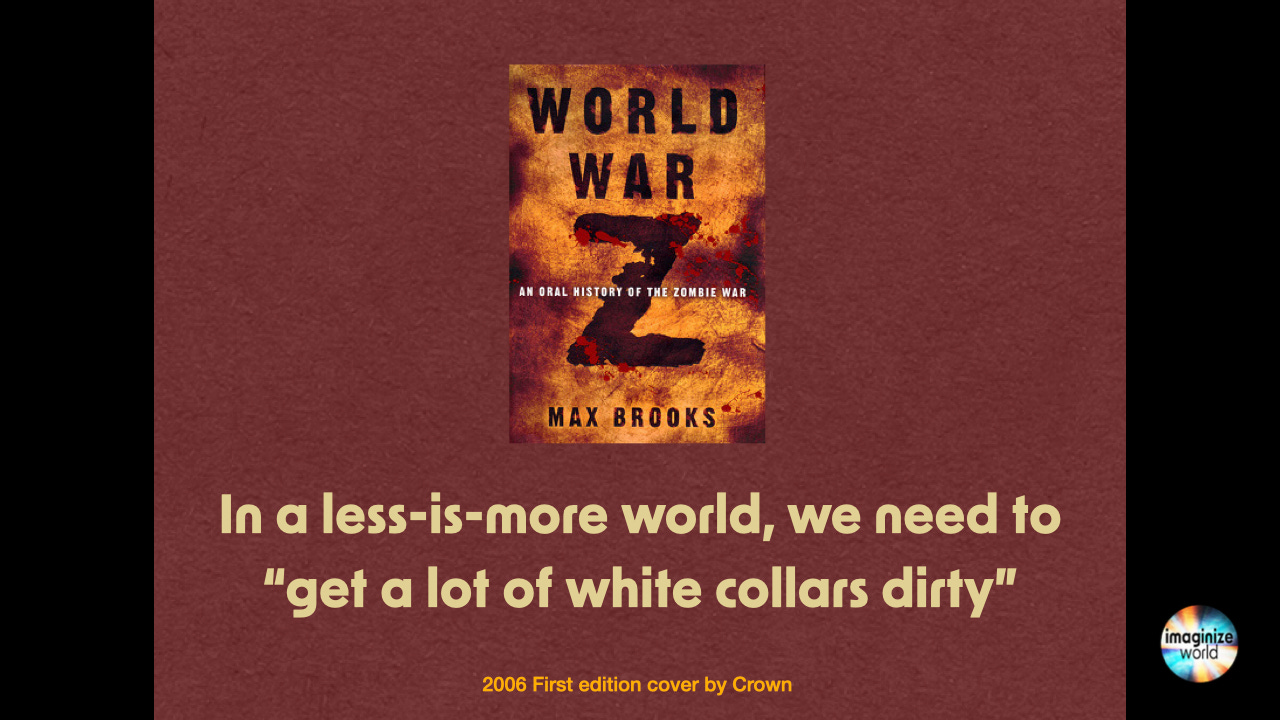
Along the idea of a simpler world, we have World War Z: An Oral History of the Zombie War by Max Brooks where a zombies plague has affected the world, destroying much of the way people live. The idea of zombies seems far-fetched, but as you get into the book, the obstacles, actions and results of people around the world fighting or protecting themselves from the zombies takes on a present-future time feeling.
Among the strong ideas in the book, we must avoid suicidal ignorance that comes from not knowing the basic survival skills. The section about life in the US after the zombies reverses common ideas about work.
As people had to find ways to survive, many office workers discovered the emotional satisfaction of doing physical labor.
The skills of newly-arrived immigrants were highly valued. In job retraining programs they were the instructors because they knew how to live with very little and improvise with what they had.
This book, which takes us around the world, is a massive accomplishment and deals with fears and uncertainties in realistic ways we can easily imagine living today.
“We needed to get a lot of white collars dirty”.
“A great many of our instructors were first-generation immigrants. These were the people who knew how to take care of themselves, how to survive on very little and work with what they had. These were the people who tended small gardens in their backyards, who repaired their own homes, who kept their appliances running for as long as mechanically possible.
It was crucial that these people teach the rest of us to break from our comfortable, disposable consumer lifestyle even though their labor had allowed us to maintain that lifestyle in the first place.”
…
“I met one gentleman on a coastal ferry from Portland to Seattle. He had worked in the licensing department for an advertising agency, specifically in charge of procuring the rights to classic rock songs for television commercials. Now he was a chimney sweep. Given that most homes in Seattle had lost their central heat and the winters were now longer and colder, he was seldom idle. “I help keep my neighbors warm,” he said proudly. I know it sounds a little too Norman Rockwell, but I hear stories like that all the time. “You see those shoes, I made them,” “That sweater, that’s my sheep’s wool,” “Like the corn? My garden.”
…
The Zombie War described by Brooks, forces us to see how our past life of working to move up, make money, free ourselves from manual work led to a whole new world. Think about it. Do you see signs of it today?
A world of role reversals. Power shifting upside down. A world where we need new survival skills.
I believe we need to think about these fundamental changes as real possibilities in our world today. Look around us at the conflicts - real physical ones - wars some small, some larger. Look at the enormous differences in basic comforts between the global North and the global South. Look at the climate disasters happening more and more often.
What direction do you think things are moving? Please share your thoughts in the comments.
Extracts World War Z (p. 138-139).
Comments
Nothing yet. Say the first thing.
Sign in to join the conversation.