
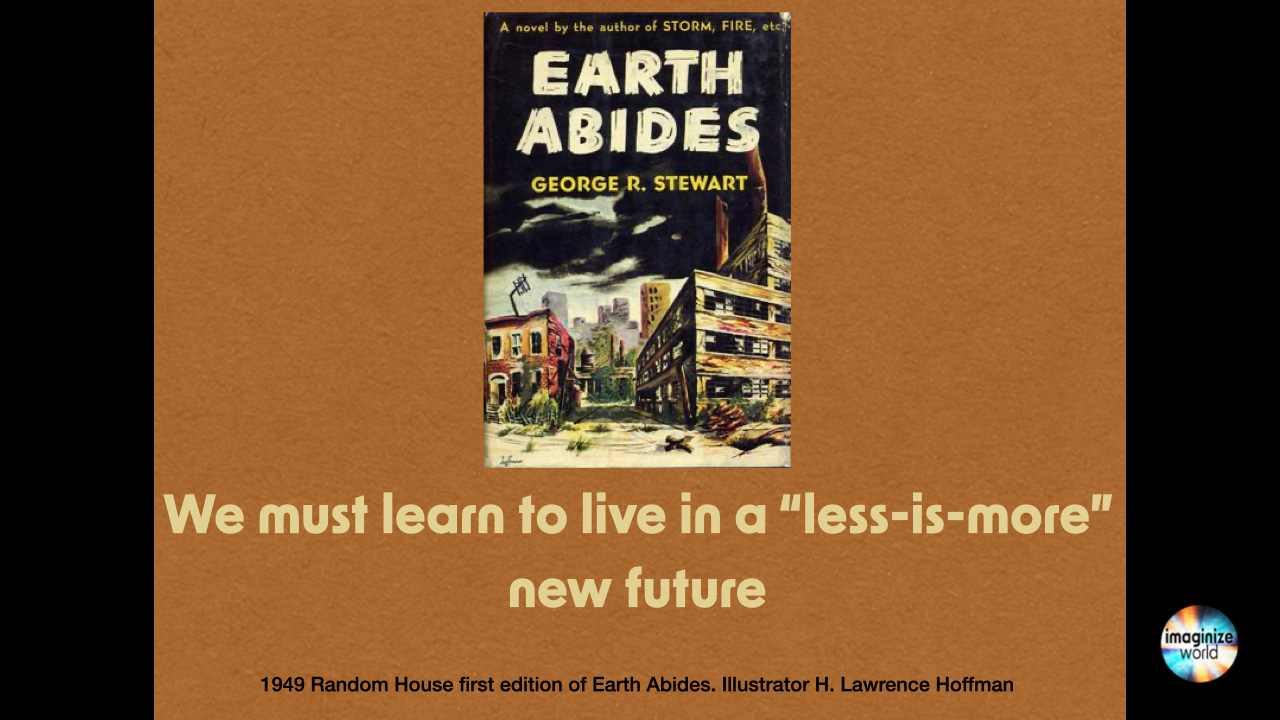
1. Earth Abides by George R. Stewart, 1949.
2. World War Z: An Oral History of the Zombie War by Max Brooks, 2006.
3. Days of Perky Pat by Philip K. Dick, 1963.
In my Imaginize.World podcast conversation with Chris Luebkeman, he asked the question “will future generations live with less?” He continues “I do believe the next generations are going to have to understand how to deal with so much less.” (link below)
In a similar vein, Debbie Urbanski wrote a stunning short story “An Incomplete Timeline of What we Tried” in 2017 where she takes a backwards flow from “human extinction” to today’s world of “turn off the lights when you are no longer in the room.” Much later, in our Imaginize.World conversation in 2023, she projected we have to make choices in our world of diminishing plentifulness and climate change disasters, choices that will save humanity or save our planet. It’s a choice. (link below)
I want to share some clues we have in Science Fiction.
Let’s start with Part 1!
In Earth Abides, written by George R. Stewart in 1949, there is a global-wide fall of civilization from a deadly disease. It eliminated most of humanity. A small group of people attempt to build a new culture and succeed. A new culture develops with simpler tools and where highly skilled specialists will not survive. The novel reverses our thinking about how to survive if civilization is rebooted.
The main character is Isherwood Williams, a survivor of the plague because he was bitten by a rattlesnake in a cave and now had immunity. He returns from the cave and finds everyone dead. Except a few. The children have easily adapted to the new world of simpler tools and survival skills, all of which became a game
The title comes from Ecclesiastes 1.4: “Men go and come, but Earth abides”. To abide means to endure, wait patiently, remain in place. That’s what the earth does with or without us.
The book makes you think about leadership, beliefs, law and order and societal norms when all sense of community is gone. In fact we discover there is nothing but a small tribe of which Isherwood becomes the de facto leader.
1 - What is change?
“(Isherwood) had thought of change itself—how sometimes it comes from the inside of a man, reacting outward against the environment, and how sometimes the environment presses in against the man, forcing him to change. Only the unusual man perhaps was strong enough to press outward against the world.”
2 - What is civilization?
The book covers three post-plague generations. Civilization depends on memory, memories of a lot of people. A small number of survivors is not sufficient. Civilization needs to start again.
3 - What is family?
“(Isherwood) thought the family was the toughest of all human institutions. It had preceded civilization, and so it naturally survived afterwards.”
4 - Where does superstition come from?
This is the trickiest one!
Quote from Earth Abides: “Twenty-two years later, the community flourishes, with the younger generation adapting easily to the more traditional world. They come to have a better grasp of the natural world than the adults, and when running water fails, the younger generation comes to the rescue, knowing where flowing streams may be found. Ish turns his attention from ecology to his newly forming society, and he notices that the children are becoming very superstitious. One day Ish asks for his hammer which he habitually carries around, and finds the children are afraid to touch it as it is a symbol to them of the old times; the long-dead “Americans” of the old world are now viewed like gods, including Ish.”
Please read Earth Abides. You won’t forget many scenes, written over 70 years ago, that still reflect our present-day emotions and concerns, even possibly more so than back then.
Might we become part of a global group of small tribes with de facto leaders. Is it starting already today?
I think it is. I’d like to know what you think.
World War Z: An Oral History of the Zombie War by Max Brooks, 2006.
Days of Perky Pat by Philip K. Dick, 1963
You might enjoy reading about my personal less-is-more experience, written when I was in a near-evacuation area during major fires in 2025 in the South West of France.
“Fire evacuation prep was mental prep for a new, simpler life for me.” https://netjmc.substack.com/p/fire-evacuation-prep-was-mental-prep
https://imaginize.world/2040-path-future-luebkeman-simunich/
https://imaginize.world/debbie-urbanski-after-world-portalmania/
https://www.vice.com/en/article/an-incomplete-timeline-of-what-we-tried/
Comments
Nothing yet. Say the first thing.
Sign in to join the conversation.