
The internet loves its buzzwords, but some terms are more than passing trends—they’re the foundation of how societies learn, adapt, and evolve. Welcome to “Terms That Define the Year 2025,” where we break down the key concepts shaping today’s digital world. Our spotlight this week is on collective intelligence—a shared pool of knowledge that has driven human progress for generations but now faces serious threats from algorithmic suppression and other threats.
Humans have never advanced by working alone. Take the invention of the computer, for example. It wasn’t created in isolation—it emerged from centuries of shared knowledge: from the development of mathematical logic, to mechanical calculators, to breakthroughs in electrical engineering and programming. Each advancement built on the last, paving the way for a technology that has transformed how we live, work, and innovate. This cumulative exchange of knowledge across generations is our true superpower.
We see a different form of collective intelligence reflected in other species. While bees, ants, and even some fungi don’t build on knowledge across generations, they excel at real-time collective collaboration and adaptive problem-solving. Bee colonies find the best new hive by comparing scouts’ discoveries and participating in collective decision-making. Ant colonies build complex nests and practice agriculture, cultivating fungi, which produces their food source, and gathering resources by communicating through chemical signals, not centralized commands. Even fungal networks, like mycorrhizal fungi, form vast underground webs—sometimes referred to as the “Wood Wide Web”—that help forests share nutrients and warnings, sustaining entire ecosystems over time.
But what happens when invisible barriers disrupt that flow?
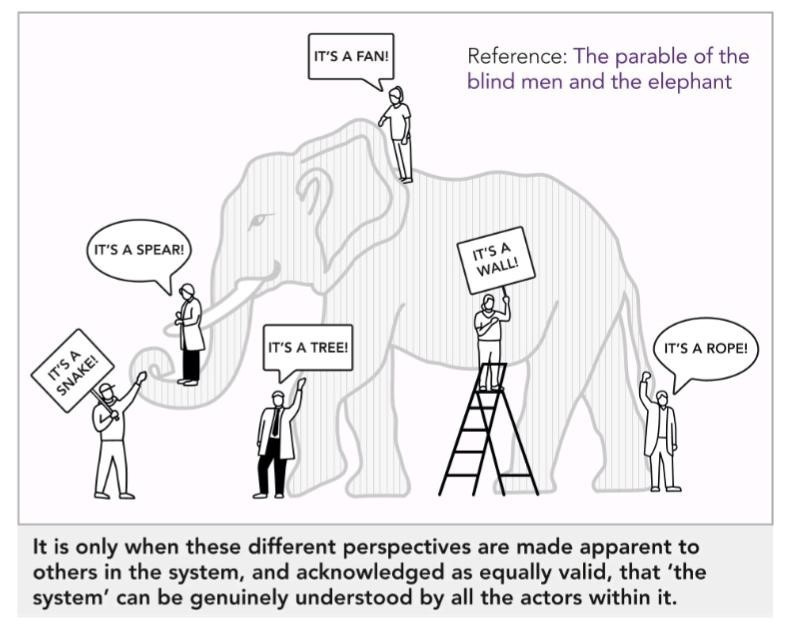
Social platforms have the potential to supercharge our collective wisdom—but too often, they do the opposite. Take Meta’s 2024 policy on Instagram, for example. According to Accountable Tech, it caused a 65% drop in reach for accounts sharing credible news and advocacy by limiting “political” content.
Gatekeeping: Topics like climate change and voting rights get flagged as “political,” making them disappear from your feed.
Overrides: Even when users choose to see more political content, the platform can quietly reset their preferences.
Vagueness: Creators are left guessing what counts as “political,” leading many to self-censor to avoid penalties.
When critical conversations vanish, fewer people can participate, collaborate, or find solutions.
Collective intelligence isn’t just an academic theory—it’s the driving force behind solving real-world challenges. When it’s compromised, we all suffer. Innovation stalls as open debate is stifled, leaving potentially transformative ideas undiscovered. Democracy weakens when citizens lack access to reliable information, limiting the effectiveness of their civil engagement. Meanwhile, misinformation flourishes where credible voices are buried, creating space for rumors and sensationalism. Most concerning, marginalized voices disappear, as communities relying on digital platforms for advocacy lose their ability to reach broader audiences.
By undermining these essential components of collective intelligence, algorithmic suppression and other barriers erode our capacity to share knowledge, solve problems, and make progress together.
So how can we keep knowledge flowing freely? Let's look to nature for a clue.
Thomas Seeley’s research shows that honey bees make surprisingly sophisticated collective decisions—no small feat for insects with tiny brains. A swarm of 10,000 bees must choose among multiple potential nest sites, yet they consistently pick the best option. Here’s how:
Scouts Investigate:
A few hundred bees explore different sites. Decentralizing the search ensures many options are discovered.
Waggle Dances & Quorums:
Scouts return and perform waggle dances to advertise findings, with stronger dances for superior sites.
Rather than wait for total consensus, bees move once a quorum—a sufficient number of scouts—gathers at the best site.
Continuous Feedback:
As more bees join in the voting, interest in weaker sites dwindles.
By the time the swarm flies, it has overwhelmingly converged on the highest-quality location.
Much like these bees, we can benefit from decentralized information flows, multiple perspectives, and adaptive feedback loops.
So what practical steps can we take to safeguard our own collective intelligence?
Demand Transparency – Insist that platforms clarify how content is ranked or suppressed.
Reassert Control – Hold platforms accountable for keeping your feed settings intact rather than silently resetting them
Support Decentralized Platforms – Seek out or build networks that distribute power rather than hoard it.
Invest in Public Interest Tech – Back tools and organizations that place social well-being above profit margins.
Practice Digital Literacy – Learn to verify sources, spot misinformation, and share credible content.
Yet even if social media became perfectly transparent, other forces could still throttle our collective wisdom.
Algorithmic suppression is just one piece of a larger puzzle. E-commerce and streaming algorithms narrow our view, steering what we see, hear, and buy, while self-censorship stifles innovation as people fear backlash. Media literacy gaps make things worse: when many can’t distinguish credible sources from falsehoods, even the truth struggles to be heard. Government and corporate censorship can erase entire narratives, and research agendas often reflect narrow worldviews.
Until the 1990s, medical research treated men’s bodies as the default, excluding women from clinical trials. The impact? Women are more likely to die from heart attacks because their symptoms—like nausea, fatigue, and jaw pain—don’t fit the “classic” male symptoms. Studies by the European Society of Cardiology show that within 30 days of a heart attack, 11.8% of women die compared to 4.6% of men.
Together, these forces shrink the range of perspectives, stifle problem-solving, and weaken innovation—ultimately harming society as a whole.
Collective intelligence is humanity’s superpower—and we can’t afford to lose it. From climate action to scientific breakthroughs, the ability to share knowledge freely is what fuels real progress. But that future isn’t guaranteed. Algorithmic suppression, censorship, and digital gatekeeping put our greatest resource at risk. The good news? We have the tools to fight back.
At Oak, we believe knowledge should belong to everyone—not be buried by algorithms or controlled by a few. That’s why we’re building tools that give power back to you, the people creating, consuming, and sharing information.
VibeCheck is one of those tools. It shows you how others feel about the policies shaping your online world—so you can navigate it with awareness and make informed decisions.
Together, we can create a world where knowledge flows freely—fueling innovation, inclusion, and collective progress.
Start exploring VibeCheck today
Accountable Tech (2024). Meta’s Political Content Limit Causes Steep Drop in Reach for Accounts.
Seeley, T. D., Passino, K. M., & Visscher, P. K. (2006). Group Decision Making in Honey Bee Swarms. American Scientist, 94(3), 220.
Seeley, T. D., & Visscher, P. K. (2004). Quorum sensing during nest-site selection by honey bee swarms. Behavioral Ecology and Sociobiology, 56, 594–601.
Comments
Nothing yet. Say the first thing.
Sign in to join the conversation.