
There’s a word Sukanya (half of the genius behind Upstairs) used to describe her relationship with classical music while I fangirled around her a couple weeks ago, and in its stark simplicity, I caught a whiff of what everyone else—myself included—had been getting wrong for years.
She’d said—‘I grew up with music so close to me, it was my normal’. Having grown up around her mother and a world of musical luminaries within the timeless walls of the AIR office, Sukanya’s entire world was classical music, its practice and performance—and this was neither grand nor extraordinary. I realised, while talking to her, that I was also afflicted with the mundanity of it all, as I was with the ailment on the flipside. When the bulk of your childhood is spent in rooms tuning tanpuras, fetching cha-shingara and running the 100-odd chores it takes to set up what you only think of as a small musical gathering in your living room, it is easy to forget that these rooms are guarded by heavy doors that many would like to see open. And, as Sukanya put it, when the only window one has into the world of classical music is through public concerts in grand spaces—especially if you’re entirely uninitiated—‘then it’s a very snooty and insular community to try and become a part of.’ So people tend not to.
Upstairs was born in 2018, partly from Sukanya and Tejas’s intent to open the doors of these insular drawing rooms to all who wanted to listen. Etymologically, and historically, a baithak is just that—a cozy living room (which your grandparents perhaps still call a baithak-khana or baithak-ghar), where music flows uninhibited among a little cozy huddle of musicians and audiences, punctuated, delightfully, with conversation. And tea, of course, or whiskey if your host is so inclined. In this little melee, often semi-circular or circular in arrangement, expertise and awe each melts into fun, because normally, there’s only enough floor in a drawing room to seat the host’s very close few. In the NCR, however, one is likely to come across exceptional hosts these days with large hearts and the coziest drawing rooms.
In the last couple of years, my feed has been blessed with videos of golden rooms with honeyed music from the capital and its flanks, and every single video has thawed in me what years of doomscrolling and margarine music had frozen. Fairly young ventures, all, that host classical musicians from across subcontinental traditions, modes and gharanas, and, what is visibly a very diverse audience. Spread across the map of the NCR, each of these have their own language and their own modus operandi, but I found in my conversations with all a common, central tenet that drives their efforts despite the obvious inconveniences of hosting an artist, their team, and anywhere between 30 and 65 strangers (largely) in their homes — that classical music must be made accessible to all.
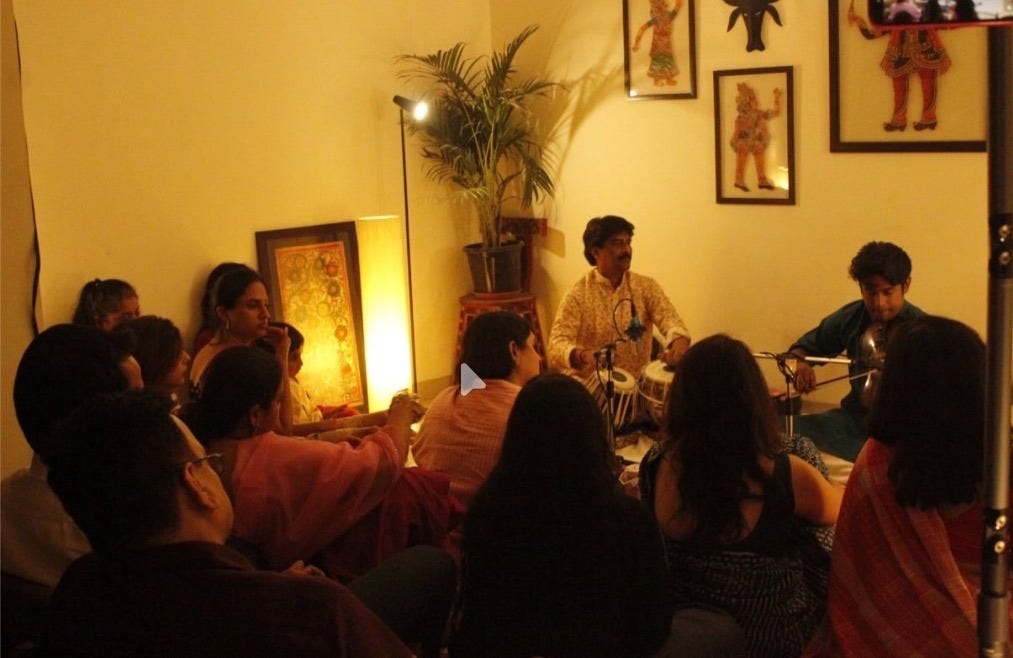
Having been introduced to the world of metal by Tejas as a young adult, Sukanya made note of the huge turnouts at metal gigs, which are enabled primarily by the permission existing setups grant one to get into metal at any stage in their life, which is almost the very opposite of classical music. The general perception, she says and I agree, goes along the lines of having to wear kurtas, having to sit on the floor and having to be inducted into the tradition at infancy (if not birth) to even enjoy, let alone understand, such music. Those who’ve braved the great divide know this last one to be untrue — one might ask Prashant and Mona, the lovely folk at Tehzeeb ka Aangan, who only began formal schooling in classical some six years ago, in their fifties. The rest, my guru might argue, is sealed in stone. I remember having gone to class in jeggings once when I was 12 and those infernal things were considered cool. That was one of the few times this soft, patient, wonderful man I think of as my proxy-grandfather truly seemed to find common ground with the bulls at Pamplona. For the rest of the world, though, this wall is, as Sukanya puts it, ‘a PR problem. So we decided to solve it with a PR solution’.
In Upstairs’s case, this was doubling down on the coziness of the baithak-khana. Sukanya is a Marketing and PR professional, who has been able to package her baithak as an ‘unmissable’ quintessential in the ‘Delhi scene’ — and although the Upstairs Instagram makes it look like this effort took off immediately, it has taken years of polishing and one Covid-era regroup to build what looks so happening in 2026. It is now one of the hottest gig scenes in the city, with 65 tickets selling out within a couple hours, at most of their drops. This is, in fact, the first time I’ve been able to respond in time and grab one for myself.
Nivriti operates differently. Dr Preeti, an Intensive Care specialist and the heart behind this lovely baithak, wants to recreate in her space the opulence and regality of the baithaks of kings and zamindars of yore. ‘Nivriti’ literally means the ‘pathway to bliss’, and at this South Delhi baithak, one is very likely to find the same. I will be honest, this baithak I’d interacted least with, and I did wonder whether this meant the renegation of the kind of cozy drawing-room comfort that Tehzeeb or Upstairs were working with to the backseat, and boy, was I off track. In this aside from her very demanding career, Dr Preeti strives to soak her guests with the love she grew up with — for music, primarily, and also for her food. She says, with clear-eyed confidence, ‘I’m a great cook’, and the way her sessions have been going since September 2025, one had best believe this to be true.
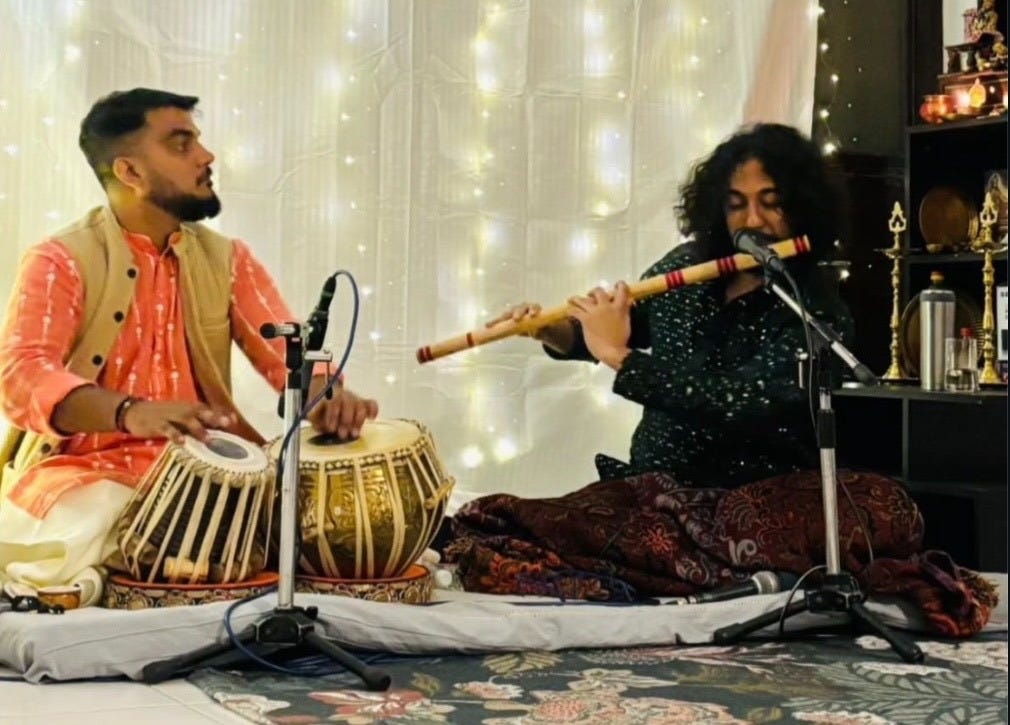
In fact, in the entire matter of creating this space of comfort for the uninitiated, food plays a rather large role. Just this afternoon, I came across a supper club reel (and these are doing superbly in Kolkata), which took a step apart from the whole awareness-campaign aspect of social media marketing to actually just talk about how quintessential a role food plays in creating homes out of strange rooms. At each of the three baithaks I’ve interacted with, food is the Lebowskian rug. Nivriti and Upstairs do lovely home dinners — both Sukanya and Preeti cook themselves and thoroughly enjoy cooking for as many guests as they have that evening. As a very amateur cook myself, I hope someday to get where they are, but for now, find myself in agreement with Prashant, who mentions very candidly — ‘the cooking thing is a bit of a pain’. For Tehzeeb, the chai-nashta window is the buffer time they offer to their guests to trickle in and get settled before the music begins. Similar, functionally, to Upstairs’s dinner window, which keeps guests from jumping on the cab-apps during a set. To a new shastriya-head though (definitely do throw me in jail for coining that horrid term but keep in mind, the alternative was shastriya-sangeek), this little bite is a very vital slat in the rough bridge across the gorge of wonder.
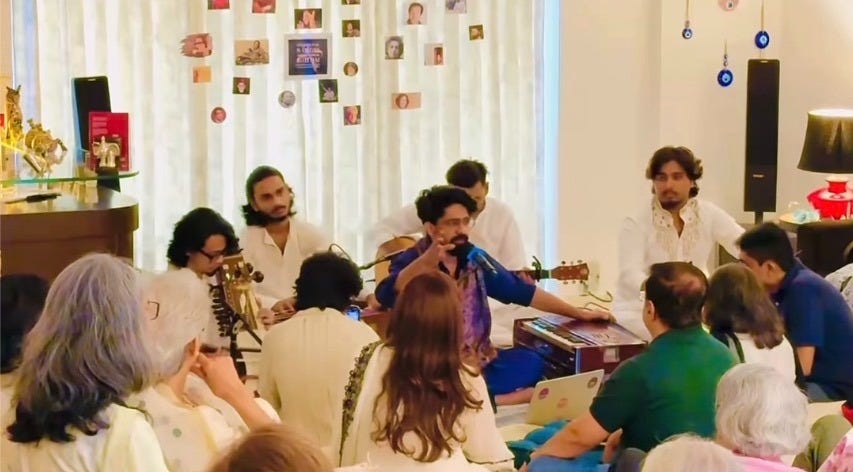
Each of these efforts has their own modules for the rest of the slats. At Upstairs, for instance, Sukanya spends the first leg of the show explaining to her guests what they’re about to listen to. She says, ‘All the knowledge that exists around classical music is intended to create a performer. There is very little educational material that caters to someone who aspires to be a listener’, which is the gap they’re trying to bridge with what we can only very accurately call adda at Upstairs. Tehzeeb, on the other hand, tries to ease the new listener in. I was at their baithak featuring Mazhar Hussain in July, where the audience was largely neighbours and family friends. In what seemed to be perfect, unspoken harmony between the host and the artist, the operating pattern was established to be the slow escalation of songs from the recognisable and somewhat mainstream to the intense. Of course, this was where the artist was most comfortable, and not a single guest was even jittery.
This is the success of the quaint little baithak. By the end of an evening in one of these drawing rooms, the grand ice wall that keeps the uninitiated away from classical music melts into, if anything, the comfortable mundanity of a family home. So comfortable, in fact, that one is able to access emotions that are hard to even scratch at Chaudaiyya Hall or Kamani Centre. Dr Preeti mentioned one of her guests at her baithak featuring Dhruv Bedi, who felt safe enough to only weep for nearly twenty minutes.
Comments
Nothing yet. Say the first thing.
Sign in to join the conversation.