
[…] society can only be understood through a study of the messages and the communication facilities which belong to it; and that in the future development of these messages and communication facilities, messages between man and machines, between machines and man, and between machine and machine, are destined to play an ever increasing part. (Wiener, 1950)
In this little primer, I’ll be taking on the labor of explaining Norbert Wiener’s seminal yet nevertheless arcane work “Cybernetics: Or Control and Communication in the Animal and the Machine.” Rather than expound, I’ll do my best to distil and to clarify. I’ll address each chapter in its own Substack article, beginning with our first chapter: “Newtonian and Bergsonian Time.”
Do note that I try to capture the essence of the arguments Wiener gives, forgoing evaluation or critique of the text. If you find something objectionable, that’s good: it’s ultimately more efficient to understand something fully before you expend energy on criticizing it!
As a foreword, let me take a moment to address what seems like the book’s broad subject matter. One of the great challenges in understanding Cybernetics is that it was written without any consideration for what one might say is appropriate subject matter for a mathematical treatise. Cybernetics is remarkably loose and free-flowing, sometimes merely suggestive of an answer to the question it’s addressing. Wiener’s writing will often land somewhere between mathematical treatise, philosophy, and social polemic. This is in part because it was written prior to what we might call today’s ‘successful marketization of academia.’ As competition increases and the amount of possible ‘economic value’ to capture decreases, finding niches or specializations becomes a matter of career survival. In such a climate, a scientist who aspires to escape her niche and thereby answer the big questions will certainly face suspicion— at the very least, she’s stepping on someone else’s toes by depriving them of a thesis topic. Contrary to that, Cybernetics is decidedly broad in its scope.
Accordingly, those who are reading Wiener for the first time might be surprised to find how explicitly political Wiener can be in his writings. Scientific writing as a genre is often expected to be unconcerned with matters of how we are to act in society; either in the sense of being above such vulgarities, or in the genuine conviction that politics are a thing of the past. In contrast, Wiener makes his indignation felt when he discusses missiles and bombs1, the philosophical ramifications of von Neumann’s game theory, or “the Lords of Things as They Are.” Wiener is therefore perhaps somewhat old-fashioned in a sense: he seems to feel that if science is rational and interested in pursuing the truth of the world, it must tell us something about how we must live in that world2.
Cybernetics is therefore chiefly a philosophical work, as interested in questions of science as it is in what science tells us about ethics. One should keep that in one’s mind when reading Cybernetics.
“Information is information, not matter or energy.” (182)
With that out of the way, let’s move on to the first big question of Cybernetics: the question of time. In the chapter’s title, Wiener mentions “Newtonian” and “Bergsonian” time; this is in reference to Isaac Newton and Henri Bergson. For those unaware of the content of this dichotomy, a “Bergsonian” approach thinks of time as the product of immediate experience and intuition while the “Newtonian” notion of time as a fundamental scalar quantity is rational and mechanistic. Bergson’s concern was determinism; put rather crudely, if time is categorically nothing like the rational notion of space, then determinism is impossible. Wiener attempts to dissolve the dichotomy: both machine and organism alike exist in a system of information exchange, therefore the question is not determinism but the tendencies of a system in which objects constrained by energy exchange information.
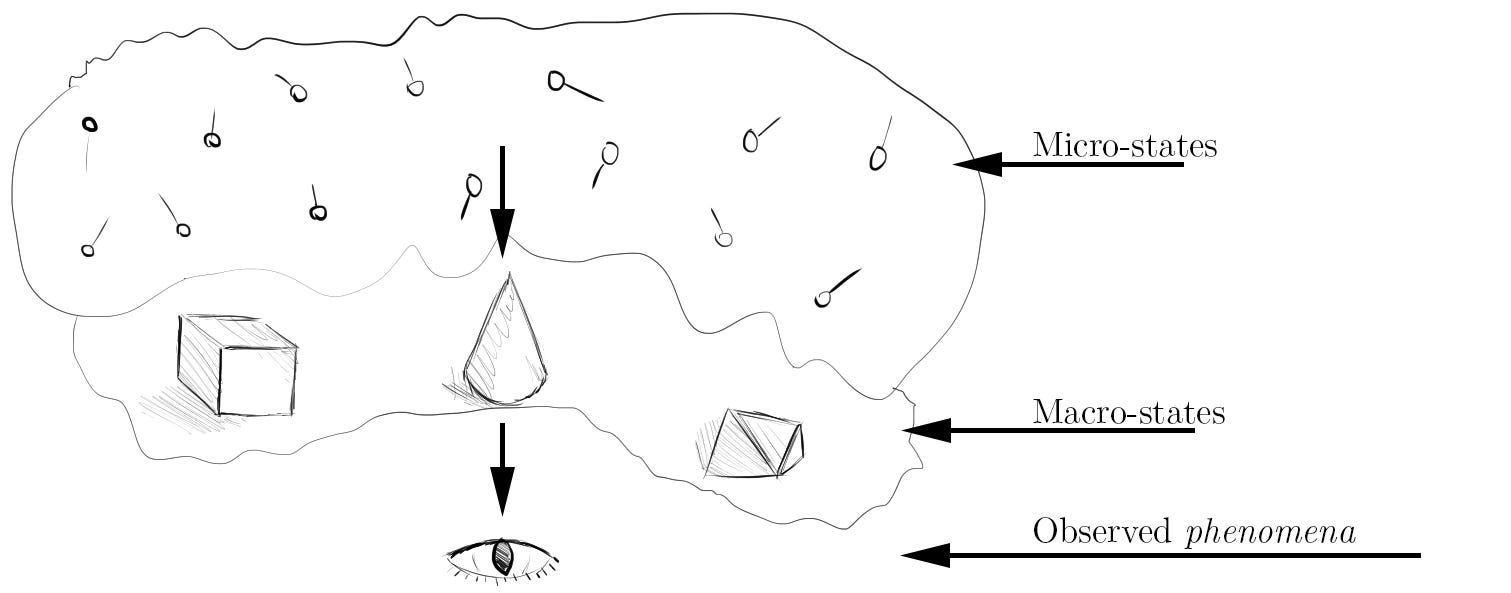
Wiener begins his sketch by contrasting two strongly-related sciences: astronomy and meteorology. He argues that the former is concerned with idealized bodies which behave well according to fundamental laws of mechanics, while the latter is concerned with understanding patterns and making predictions about atmospheric phenomena over a particular scale. I use phenomena here as a technical term: meteorologists are indeed interested less in the physical atoms and more in the situations and events they cause by force or otherwise. Each phenomenon represents a certain system in which one larger macro-state denoted by a phenomenon such as the tornado is an epistemic object— the tornado is something which gives us information about the thousands of smaller systems causally related to the tornado. Changing the epistemic object to a phenomenon of a different scale in time or space tells us something different about said thousands of smaller systems, such that we gain a larger understanding of what we might call the tendencies of the system being studied. In the case of the weather, studying the phenomena of winds, tornados, rain, etc. gives us a general sense of what the statistical tendencies of the weather could be independent of what actually constitutes the weather.
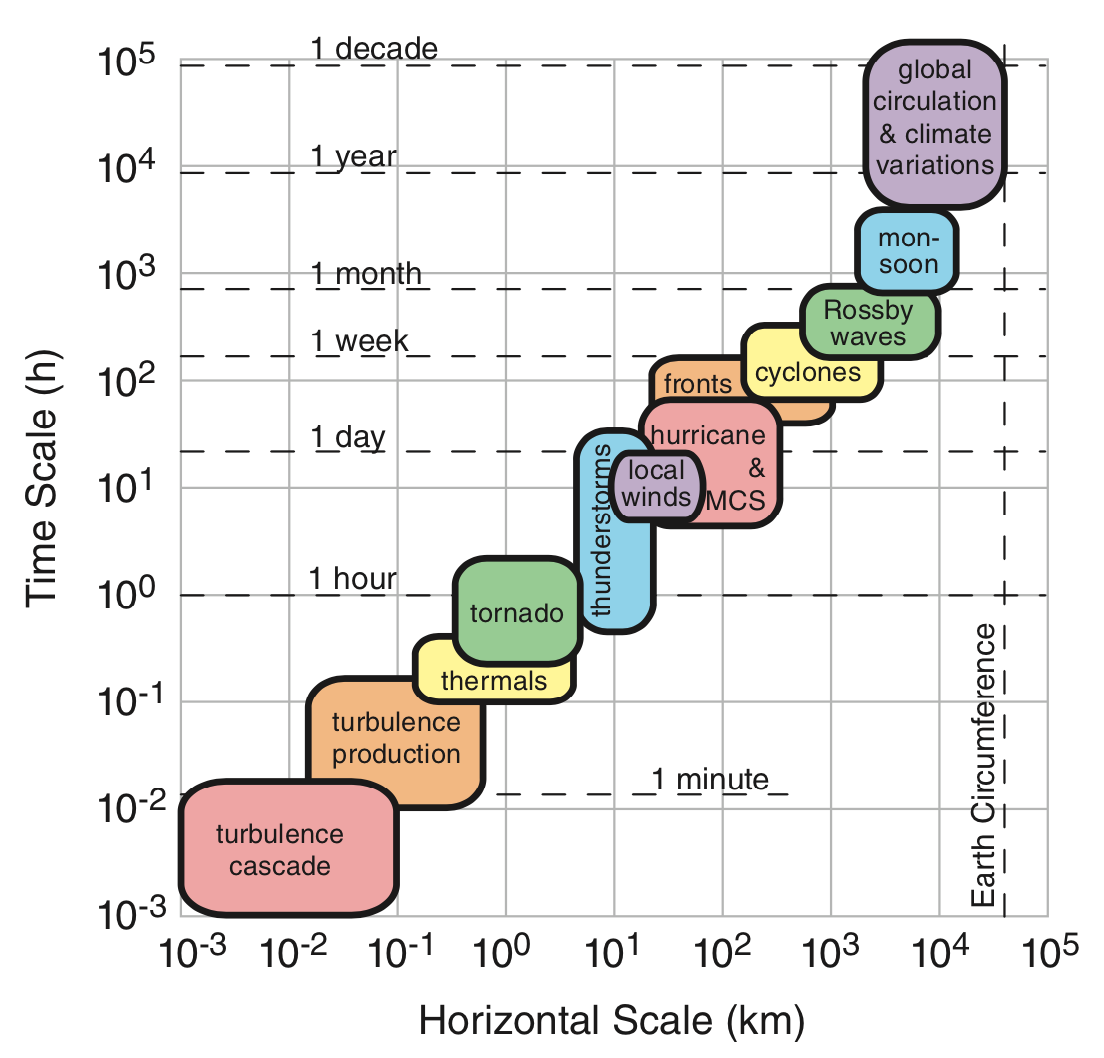
This leads us to our first conceit: the phenomenon of time is a property of this grand system we call the universe. We present the notion of time as the direction in which free energy is spent and cannot be recovered. Free energy spent either goes out as work or produces entropy— work here means energy transferred by a force acting through a displacement, distinct from energy transferred as heat. Recall the description I’d given earlier: a system in which objects exchange information. When objects exchange information, time marks the direction in which free energy is spent and cannot be recovered.
Our student Nano asks: “if time is the direction in which free energy is spent as either work or entropy, how does information become involved? What is the connection between work, information, and entropy?”
There’s indeed a connection between information, or that which reduces uncertainty, and the transfer of energy from one thing to another. One elegant demonstration is Landauer’s principle: given a temperature, there’s a minimum amount of energy transfer necessary to produce one bit3 of irreversible change in information given some computer4:
\(E \geq k \cdot T \cdot \ln 2\)
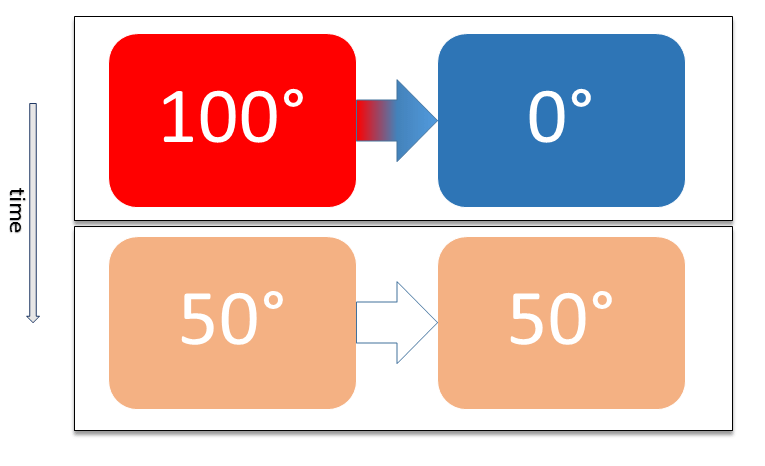
This suggests that information, or reducing uncertainty, costs work or time— at least when it comes to irreversible reductions of uncertainty. This should not be too surprising; work requires thermodynamic free energy and maximum entropy is the state of full thermodynamic equilibrium where no free energy is available. We can understand this principle with a simplified demonstration: imagine two glass jars connected by a tube with a valve. If one glass jar has water heated to 100° and the other glass jar chilled to 0°, we have an opportunity for work— we can cool down one jar by heating up the other jar. Now imagine the jars after they’ve both cooled to 50°: since they’re both the same temperature, there’s no opportunity for any exchange of energy since we have a full equilibrium. At that point, we have maximum entropy; accordingly, if no exchange of energy can happen, there’s no opportunity for an exchange such that we might reduce uncertainty. So if work is the transfer of energy, and information exchange at the very minimum implies work, time marks the direction of change from one state of entropy to another which decreases the energy available for work. We might say that free energy is the capacity to reduce uncertainty, and its expenditure is the reduction, and that time marks the direction in which that capacity is spent.
We’ve got a clearer idea about the work of exchanging information, but what about the system aspect? What do we mean when we say “both machine and organism alike exist in a system of information exchange?” Here we return to our earlier discussion about the differences between astronomy and meteorology. Wiener suggests that given Bergson’s objection to understanding time in terms of Newtonian mechanics, we may take time itself to be a phenomenon which can be understood through its tendencies rather than some deterministic mechanism.
Here by phenomenon, we don’t mean just situations and events as we experience them. Rather we mean time is a phenomenon in the same sense that a tornado is a phenomenon— time is an epistemic object, a representation of a macro-state that is informative of the micro-states causally relating to time. Said situations and events are not therefore best understood as deterministic mechanisms existing in quantifiable time, predictable and reversible from cause to effect. Rather they are best understood as statistical constructs given some scale. In ergodic terms, an average of a quantity measured along a model system’s history equals its average over the ensemble of all micro-states compatible with the macro-state. This allows us to shift from following one system through time to describing statistical ensembles, but at the cost of details about the micro-state detail which might distinguish one history from another.
Nano interjects: “statistical ensembles?”
A statistical ensemble is precisely the sort of epistemic object we’ve discussed so far: it is the probability space of a system where we imagine every single physically accessible micro-state in order to study the macro-state of the system, given we keep energy constraints in mind. A statistical ensemble helps us understand thermodynamics by giving us an abstract idealization of the possible states of a system where we consider the virtual state of every particle. In such an abstraction, time is not the universal clock as it is in classical mechanics nor a fourth dimension representing intervals relative to light as it is in theories of spacetime.
Rather, time is an expression of the tendency of a system as it changes. Without change, there’s no meaning to ‘time’ in a system’s equilibrium state; in terms of describing states, the average state would be the same at t = 1 as it is at t = 1,000,000. And though we can trace a change in a system from one state to another in Newtonian mechanics through today’s language of calculus and reverse it without loss of information, we cannot do the same for statistical constructs with states we can describe only in the aggregate as that information is lost. Therefore time, in this statistical context, marks the direction in which information is lost. When work is done and therefore there is a change in state, we mark the direction of time as the direction in which entropy increases.
However, Wiener admits, time being reversible doesn’t imply symmetry in said change of information. Indeed, Newtonian time still depends on a certain asymmetry in information such that time moves from its past towards its future. That is indeed the principle of cause and effect. To make an experiment connecting a cause to an effect is to fix a certain quantity, and to observe the results of said experiment. This principle is not reversible— we cannot take an effect and find out its antecedent conditions by merely knowledge of the effect alone. If you doubt that, imagine closing your eyes, catching a ball, and then guessing where the ball was thrown from; it would be nothing short of a miracle if you’d guessed correctly. However, throwing the ball gives you a good sense of where it might land; especially if you have a little knowledge about its physics. Therefore, even when time is reversible, it is still asymmetrical because a change from one state to another doesn’t necessarily tell you about how to return to the previous state.
Taking the idea to the extreme, we could understand time as the arrow moving towards what you might call ‘the heat death of the universe—’ a state of total entropy in which no state is more probable than any other state in the system we call the universe. At this point, no more work is possible as all free energy will be exhausted; the classic definition of complete entropy. Time in the sense we’ve described so far essentially ceases to exist, as there can be no exchange of energy and therefore no change. And therefore, no information!
That is in summary what we might call the bottom-up argument for Wiener’s conception of time; using the language of thermodynamics, we’re giving a rational picture of time which does not imply any mechanistic determinism given a macro-state. The individual micro-states which cause the macro-states of the phenomenon of time may be deterministic, but we ultimately have no knowledge of these micro-states because the experience we refer to as the phenomenon of time is a macro-state. And as we’ve tried to show, Wiener is giving us reasons to believe that the phenomenon of time implies a loss of information about the micro-states which cause time.
Wiener moves on to give us what we might call a top-down argument that relies on an epistemological argument, rather than an argument from thermodynamics. The nature of information raises the interesting matter of learning and observation. Wiener argues that if we perceive outgoing light but not ingoing light, it must mean that the thermodynamics of whatever we perceive is similar to our own. Even if there are things in the world which behave contrary to our thermodynamics, our perception is inevitably rooted in time as we’ve described it such that what we perceive travels through time just as we do. Therefore, anything we can learn by perception travels through time just as we do. Given that communication is an exchange of signals, the same applies to communication; as Wiener writes, “(w)ithin any world with which we can communicate, the direction of time is uniform.” (50)
To sum up what we’ve discussed so far, Wiener has given us his case for an alternative to what we’ve described as Newtonian and Bergsonian time. At the closing of the chapter, Wiener makes clear his intention to dismantle what he calls the “mechanist-vitalist controversy.” The upshot of his argument is time as the macro-state of an epistemic object; as time goes forward, work is necessary for the irreversible transfer of information from one state to another. And ultimately, Wiener’s motivation here is to give a theory of time as a phenomenon such that we may derive a rigorous definition for communication between humans and automata that builds upon what we’ve learned about thermodynamics so far.
Nano might interject: “why would we need a rigorous definition of communication between humans and automata?”
The issue of communication between humans and non-humans might seem a trivial concern at first, as it appears to be a mundane fact of life. Indeed, contemporary communication is constantly mediated by machines such that even my communication to you, dear reader, occurs through a machine. However, a key word there is mediated— my intentions in my communication to you are mediated by the machine, such that the machine is the medium through which I impart my intentions. We measure the success of the machine by its fidelity to communicating my intentions; if my message to you came out mangled, we’d both be frustrated by the machine. Now if the machine proper wished to communicate its own intentions, it would be very hard to imagine what that would look like. Even if the machine could communicate something not instructed by human intention, it is unlikely we’d be able to understand the machine anyway as its ‘form of life’ is very different to our own. Indeed, the question of how signals communicate intentions, information, or anything at all is far from a trivial question.
Wiener’s strategy is to denaturalize communication, to conceptualize it as a causal process along with control which allows for the sort of homeostatic environments in systems we’re interested in theorizing about. This gives us rigorous grounds for which to argue that communication between human and non-human is akin to the communication which occurs between neuron and cell, or the communication which occurs between actor and network. The intent5 of the signal between channels is pushed to the background in favor of the role the signal plays in the homeostatic environment of the system. This is desirable because when it comes to human communication, the intention of the human communicating the signal seems quite important. However, when it comes to communication between neurons and cells, the intention behind the signals becomes unclear. The neuron certainly signals to the cell in order to cause a functional effect, but ultimately we don’t know if the neuron intends to maintain homeostasis in the brain when it signals to cells. Even if neurons are capable of intentions, it’s unclear how we’d understand their intentions— even between humans, discerning intent can be a difficult task. Ergo, Wiener’s strategy to step away from intent in communication has its appeal.
Nano retorts: “but if we don’t know what the neuron intends, how can we talk about function or dysfunction? If a neuron doesn’t intend to maintain homeostasis, how can we say it’s wrong when it doesn’t?” This is in fact a good question. We assume homeostasis is desirable for biological creatures such as ourselves because it enables us to reproduce and spread our genes; this is the etiological picture of why our bodies seek homeostasis. But of course, since we got rid of intentions in the first place, we can’t say that the neuron intends to help us reproduce and spread our genes. So we can say that systems use communication for homeostasis— however, the role intent plays in said systems remains an open question.
We’ll put a pin in the concept of communication for now. Following Wiener’s discussion of experience, he argues that most of the sciences lie between Newtonian astronomy and meteorology. However, Wiener points to what he believes is a common thread connecting the contemporary sciences such as modern genetics and tidal evolution— we study phenomena and use the language of statistical tendencies to describe directional patterns. If these directional patterns are informative, they exist in asymmetrical time because of the work of energy transfer.
With that point belabored, Wiener goes on to argue that the sciences have shifted steadily away from the deterministic atomism of Newtonian time to the statistical and the probable6. His case study is on what he calls the “dynasty of Darwins,” by which he intends to demonstrate that “(t)here is not a single science which conforms precisely to the strict Newtonian pattern.” (51) Rather, Wiener argues that science is steadily developing towards the study of phenomena by statistical tools— precisely those of the sort we’ve discussed so far.
The first two examples presented by Wiener are tidal evolution and biological evolution— a legacy of Erasmus, Charles, and George H. Darwin. In the former, tidal effects affect the secular evolution of the spin and the orbit of a planet, such that the entire solar system is influenced. Different methods of inference are used to make order out of the irreversible, turbulent dissipations of tidal evolution. Wiener finds this analogous to biological processes: birth does not reverse death, anabolism does not reverse catabolism, and the fossil record moves from simple patterns to complex systems. For Wiener, Darwin and Wallace demonstrated that random individual variation, with some traits propagated more than others through differential survival, is the cause of directed evolutionary change. Brownian motion becomes an irreversible pattern through the dynamic system which is the evolutionary environment.
Wiener goes on to argue that even physics shifted from the study of objects as deterministic mechanisms to that of statistical systems. He cites as examples Maxwell, Boltzmann, and Gibbs who all reduced thermodynamics to statistical mechanics. By virtue of statistical mechanics, heat became the phenomenon of the tendency within a dynamic system. When this notion failed to explain high-frequency radiation spectrum, Planck’s quantum theory and the Rutherford–Bohr model caused a clash with classical mechanics. Heisenberg’s matrix mechanics (1925) resolved the conflict, and his indeterminacy principle (1927) established that “the complete collection of data for the present and the past is not sufficient to predict the future more than statistically.” (54)
Having made his case, Wiener moves on to a curiously Hegelian point: the transition from Newtonian reversible time to a Gibbsian, irreversible time marks the beginning of “the age of communication and control.” (56) Wiener argues that the “thought of every age is reflected in its technique,” (54) and proceeds to give us a small genealogy of technique up to our present moment:
“The civil engineers of ancient days were land surveyors, astronomers, and navigators; those of the seventeenth and early eighteenth centuries were clockmakers and grinders of lenses. As in ancient times, the craftsmen made their tools in the image of the heavens. A watch is nothing but a pocket orrery, moving by necessity as do the celestial spheres; and if friction and the dissipation of energy play a role in it, they are effects to be overcome, so that the resulting motion of the hands may be as periodic and regular as possible. The chief technical result of this engineering after the model of Huygens and Newton was the age of navigation, in which for the first time it was possible to compute longitudes with a respectable precision, and to convert the commerce of the great oceans from a thing of chance and adventure to a regular understood business. It is the engineering of the mercantilists.” (54-55)
Wiener’s diction here is atypically poetic. We don’t know if he was influenced by Hegel, yet nevertheless the line of thought is familiar— he presents ‘technique7’ as the development of mastery over the world, and the resulting material culture and means of production as an Entäusserung8 of how technicians project their rationality onto the world. Wiener’s description of the task of navigation as “[converting] the commerce of the great oceans from a thing of chance and adventure to a regular understood business” reveals a view of history in which the rational is in conflict with the world as it is lived through. Here, ‘technique’ becomes a means by which order (such as the sort necessary for mercantilism) is imposed onto the bundle of phenomena we call ‘the great oceans.’ The upshot is clear: through feasible techniques, engineering produces the epistemic objects necessary for something such as mercantilism to be possible.
Moving from the age of navigation to modern times, Wiener identifies the present as “the age of communication and control.” Before the age of communication and control, tremendous effort was expended to secure and produce continuous energy on a large scale. At first, it was necessary to struggle over trade routes and supply lines as needs grew beyond wood and food. Then as the demand for energy grew during industrialization, nations went to war to secure coalfields, iron ore, and oil. And today, over the course of the 20th century up until present day, we’ve seen the complete electrification of the world. As our usage of electricity has become more subtle, in large part due to the growing ubiquity of the computer, society has become increasingly involved in the management of energy and mass communication.
This supports Wiener’s understated projection that the shift from a concern for the economy and distribution of large amounts of energy to a concern for communication is a shift towards the concern for “the accurate reproduction of a signal.” (56) This concern is not merely a concern for fidelity for its own sake, but indeed a concern for maintaining a homeostatic state. And what we might call the ‘technique’ of cybernetics is the usage of information in mechanisms of control in order to maintain said homeostatic state. And the epistemic objects necessary for these mechanisms of control are systems through which complex phenomena are understood in terms of information, behavior, and organization.
As a consequence, the distinction between the living organism and automaton collapses; both are different substantiations of phenomena attempting to maintain homeostasis through communication and control, we just might use different epistemic objects to understand a phenomenon such as a human or a machine. And indeed the same principle applies to the larger-scale phenomena which are constituted by humans, animals, or machines such as societies, ecologies, and networks— ditto for smaller-scale phenomena constituted by neurotransmitters and hormones9. In the age of communication and control, matter ceases to be a resource of inexplicable worth to be extracted and exploited. Rather, matter becomes organization; it must be maintained and managed through information which permits control at the cost of increasing total entropy. To follow Wiener’s construction: it is the engineering of the manager and the industrialist.
In this first chapter of ours, Wiener restrains his worries about the disenfranchisement of labor and the violence the age of communication and control portends. In fact, he would devote an entire book to the subject two years after publishing Cybernetics entitled The Human Use of Human Beings. Nevertheless, Wiener does conclude the introductory chapter of Cybernetics by discussing the ‘automaton’ as a reflection of the ‘technique’ and its historical context we’ve discussed earlier. When our understanding of matter was magical, which is to say matter was understood through the context of communal ceremony and performance, automata were creatures given life through religious ritual and the misuse of the power of GOD. In Newton’s time, automata were clocks— Descartes and Leibniz refer to nature or the very universe itself being compared to clocks10. And in contemporary times, we speak of automata as agents which communicate to you through the computer.
Though the automata throughout the ages differ wildly in their physical ascriptions, one historical constant has been the concern with the role of automata in matters of the soul and the divine. Given recent advances in LLMs, there’s been much consternation about whether the automata substantiated by computers might be ‘conscious,’ which is in no small part motivated by an ancient association between the mind and the soul that has existed since at the latest the dialogue Phaedo. This association has been hard to shake: just a little less than four-hundred years ago, Descartes argued in his Treatise on Man that everything in the body had a mechanistic explanation except for consciousness which is a matter of the soul. Ergo for Descartes, to be human is to be conscious and everything which is not conscious as man is conscious is akin to automata and thereby soulless. Ultimately, Wiener finds Descartes’ causal picture lacking— the details of what role the divine plays in our conscious experience remains underdeveloped in Descartes’ philosophy. Wiener is more impressed by Leibniz, for whom the matter of everything existed in a harmony so miraculous it must be divine. Leibniz’s theory is, for Wiener, at least contending with the role that the mechanism might play in GOD’s plan.
The philosophical status of the automaton changed greatly in the nineteenth century with the publication of Darwin’s On the Origin of Species (1859); evolutionary biology gave a systematic picture of the living organism that spoke of the human not in divine terms but in the language of the automaton. Living organisms became metabolic producers of heat, burning substrates to produce carbon dioxide, water, and urea. Wiener goes further and argues that the human body is no mere metabolic engine producing power but indeed an autonomous and decentralized system that senses and processes signals to take action. We have organs which detect impressions, both external and internal, and send messages across the cardiovascular and nervous systems to other organs which process the information and produce the appropriate response through control; we would call this the feedback loop. And though the body does this to maintain homeostasis, it is not conservative with regards to what that homeostasis is. Indeed, all living organisms demonstrate a remarkable plasticity as learning and natural selection continually shift the conditions for homeostasis. Therefore, the human body itself is the prototype for cybernetics systems involving communication and control. And perhaps due to the advances in physiology and medicine, the human body has become the epistemic object by which the world might be understood.
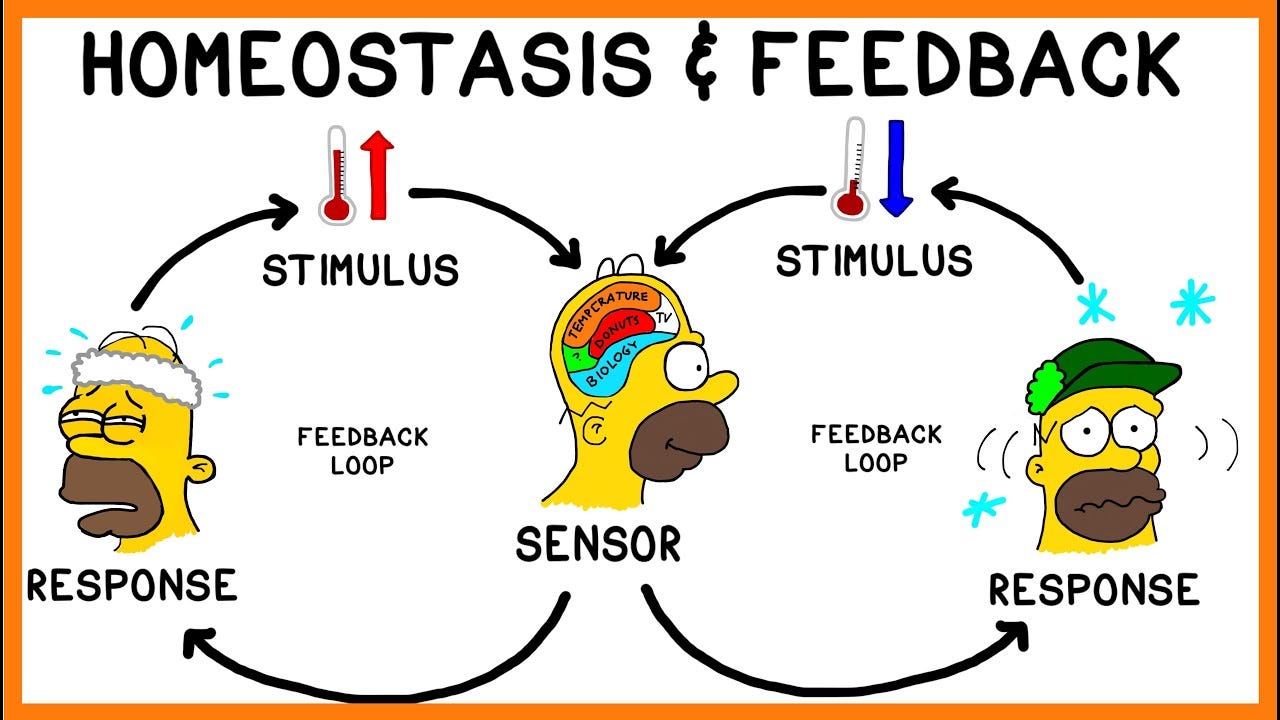
Accordingly, it is no wonder that the automata we see in the age of communication and control reflect a desire to understand and control these aspects of the human body. One must remember that Wiener wrote Cybernetics in 1948, when the notion of a world connected through mass communication grids and administered by computers was a fanciful science-fiction. In present day, systems of communication and control are ubiquitous such that they’ve become white noise. We are reminded of Wiener’s observation that the “thought of every age is reflected in its technique—” contemporary life is under the constant duress of mass communication seeking to influence our behavior, and the modern human is preoccupied with algorithms that may allow her to enact greater control over her own life.
And as living organisms in the age of communication and control, we see ourselves as Gibbsian statistical creatures abstracted into an aggregate model that takes an entire class of inputs. We see this method in behavioral psychology and economics; there are individuals and there is the abstract ‘Man’ which we learn about through repeated observations over a population. And we hold that this abstract ‘Man’ is the appropriate epistemic object by which to understand individuals proper because it is the epistemic object that best respects the ‘techniques’ of the age of communication and control.
Wiener ends the chapter by presenting the upshot of everything we’ve discussed so far: the dichotomy drawn by ‘materialism’ and ‘vitalism’ is meaningless when we conceive of both living organisms and modern automata as resisting the forces of entropy and expending their limited energy on the maintenance of homeostasis. Both living organisms and modern automata are subject to those processes of matter which exist in time; irreversible and subject to constant change, experienced by us humans as an arrow with a fixed trajectory pointing towards decay and death. And we’ll see in the chapters going forward that Wiener’s rejection of this dichotomy supports a materialist holism in which everything is unified by systems of organization not describable by their constituent parts.
And these systems — whether they are organic or nonorganic, concrete or abstract — sense and produce signals which give their form a function in the environment they exist in. The rest of Cybernetics consists of case studies to which Wiener applies this principle. His case studies include the mathematics of groups and statistical mechanics, the role played by feedback and oscillation, computing machines and the nervous system, Gestalt and universals, and ultimately the place of such systems in society. For each case study, Wiener will make the same inquiry: what is the organization at play, what signals sustain it, and what happens when the feedback loop fails?
In summary, we’ve covered Chapter I of Wiener's Cybernetics entitled "Newtonian and Bergsonian Time." We’ve developed time as a statistical macro-state, where direction fixed by irreversible free-energy expenditure and information loss. We’ve tried to defend this view of time by giving both a thermodynamic argument and a epistemological one, along with a sketch of modern science moving away from the deterministic atomism of Newtonian time. Towards the latter half, we discussed ‘technique’ as the expression of an age: navigation as the engineering of the mercantilists, cybernetics as the engineering of the manager and the industrialist. And we concluded on the automaton as a reflection of the ages and the dissolution of what Wiener believes is the mechanist–vitalist controversy.
That’s all for Chapter I. I hope that this primer has been instructive.
Wiener, N. (1950). The human use of human beings: cybernetics and society. Houghton Mifflin.
“A certain blend of wheedling, bribery, and intimidation will induce a young scientist to work on guided missiles or the atomic bomb.” (222)
This is not a biography on Wiener, for that you can refer to Wiener’s own Norbert Wiener—A Life in Cybernetics, but it certainly bears mentioning that Wiener believes he came from a Jewish background full of scholars— this includes Rabbis Akiva and Maimonides; wow!
Important to note that there’s a strong conceptual distinction between bits in the information sense and the binary bits of a computer. Bits here is meant to mean the probability of one series of binary states over another, such that 1 bit of maximum entropy represents two states which are equally probable. An exercise to the reader: under which circumstances does the 10 binary bits of a computer not equal 10 bits of maximum entropy?
Where k is the Boltzmann constant and T is absolute temperature.
Intentionality is also not a trivial subject by any means. For our purposes, let’s say that intention in a signal between people is when a person has some mental representation or content in mind when they signal something.
The ‘statistical’ and the ‘probable’ being the science of induction and deduction about the state of the world given some evidence.
We might interpret this as the ‘τέχνη’ of Aristotle, which is the activity of the rational in production.
Entäusserung— meaning ‘the making one’s inner self outward or giving up something of oneself to the outside world’ in Hegel’s philosophy.
No doubt it is unsatisfactory to leave it there but explaining that principle is indeed the entire thesis of Cybernetics.
Part 4, 203 of Descartes’ Principles of Philosophy and pg.4 of the Leibniz-Clarke Correspondence (1715–1716) respectively.
No posts
Comments
Nothing yet. Say the first thing.
Sign in to join the conversation.