
Hi everyone,
My family and I are still in the honeymoon phase with Alaska, which is not to say that everything’s blissful so much as it’s all new and coming fast. Lately I’ve learned the names of a lot of new plants. I realized toads really do live this far north. And out behind the house I found the dipstick—the long, slender pole you drop into the subterranean fuel tank out back to make sure there’s enough heating oil to last you through the first part of winter. Alaska people know all this stuff already. For us, each day brings new discoveries and the learning curve sometimes feels like dropping into a half pipe. This letter is about that. It first appeared earlier this week, as my final post at the Last Word on Nothing.
Two days after I moved with my family to the middle of Alaska I learned about the earthquakes.
Every 15 minutes or so, monitoring stations in the state detect one. Most aren’t large, or even felt far beyond their epicenters. Some begin far out to sea and appear as barely more than a little spike on a chart somewhere. Often they occur in the southeast, hundreds of miles from the small town near Fairbanks where we now live. In a very active period, tens of thousands of quakes may register, and in 2018—a banner year—the Alaska Earthquake Center recorded 54,000. On Monday, the day before my sons started classes at their new school, there were at least 28.
All this seismic action is generated by subduction, the process by which one of the earth’s massive crust plates slowly slips beneath another. In Alaska’s case, it’s the Pacific Plate pushing under the North American Plate, which is happening more or less under Alaska. This movement isn’t smooth but stubborn and sticky, calling to mind—on a far small scale—the jerky work of trying to force open a swollen old window frame. Tension builds where surfaces touch, and when this pent-up energy is released it pulses through your elbows or the earth, sometimes close to the surface but often deeper down, near bone.
In Alaska, several of this week’s quakes were detected more than 50 miles underground, within the region of relatively solid rock called the mantle. Many others were triggered much nearer to daylight. The particular quake I’m thinking of happened just 3 miles below the surface, and less than 10 miles from my house.
When the quake struck, the five of us had just returned from an ice cream social at my sons’ school. This visit, on the evening before their first day, had caused tremors of its own. For one thing, there wasn’t any ice cream, and this was bad enough. But the visit also brought home to the kids what was really happening, which is to say they finally grasped that we were not going back to Brooklyn anytime soon.
Here were their smiling teachers, their classrooms clean and bright. Here were their names, written neatly on cards at the tops of their desks. And here were crowds of other students, too, most of them striding down the hallways with the confidence of those who’d returned, not the hesitant half-step of the newbie. At a certain point my middle kid turned to me and said with an adult’s firmness, I am not coming here tomorrow.
These were the waves in which my partner and I were adrift at about around 6 p.m. We were kneeling on the floor, dividing up packs of crayons and colored pencils, erasers and scissors and boxes of Kleenex?—all the stuff you need these days for a successful elementary school education. The middle kid stomped toward the stairs of our rented house. You could feel him coming, a little Godzilla, his mood rippling through the floor, rattling the joists. I looked at our neat little piles and feared for their destruction. But he ignored them and just growled. I’m not going. Then he ran into the family room where his aftershocks disappeared into thick carpet pile, the kind laid down against long, cold winters.
I felt for him. A few months earlier he’d been a pre-K kid in the New York public school system. Zohran Mamdani was his mayor, the Knicks were his team. He’d been loved. Embraced. That was bedrock, or at least it felt to him unshakable. Now he knew not a single classmate. Silly pigeons had been replaced by huge, hulking ravens. And he was suddenly surrounded not by buildings but by more trees than he’d ever seen in his life.
Where were the people, the subways, the sirens? Where were his friends? Why was no one walking anywhere? Why had we done this?
Somewhere below us the earthquake’s waves shuddered past. We didn’t notice. The world was already spinning.
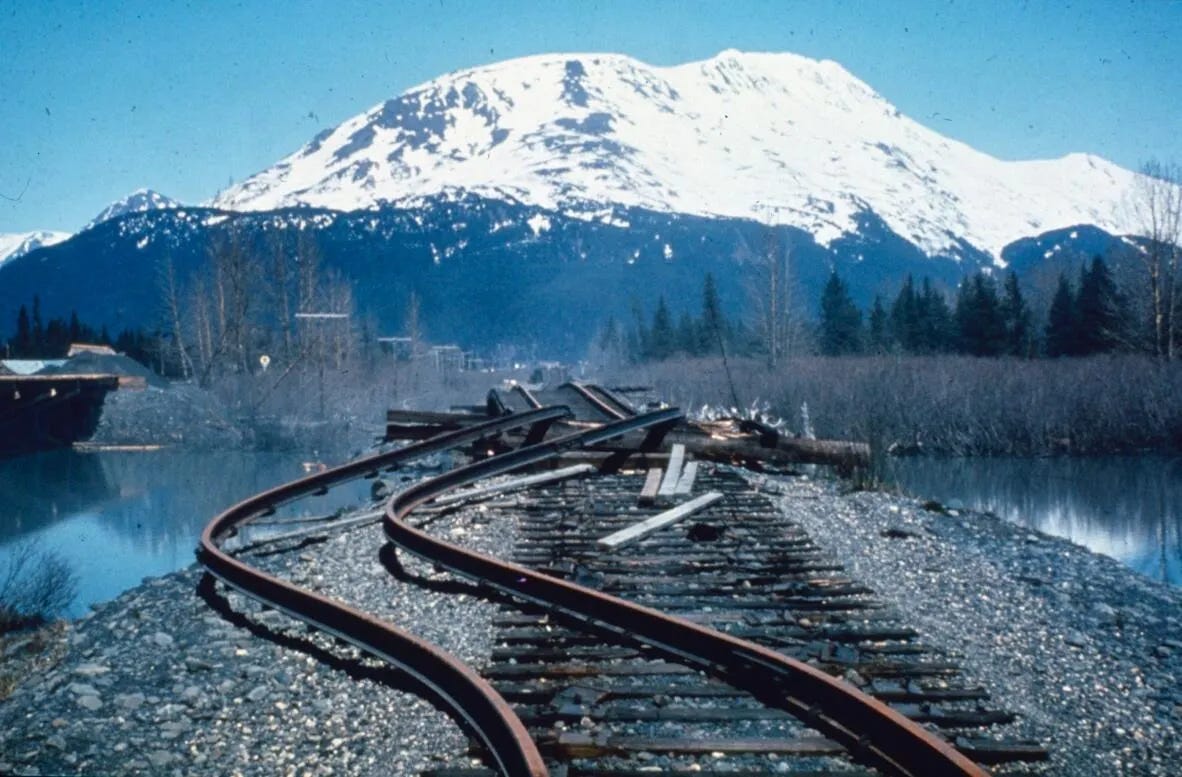
The real power of an earthquake is measured in magnitude. The higher the magnitude, the stronger the quake, though strength doesn’t necessarily equal destructive power. In 1964, the Great Alaska earthquake registered a magnitude of 9.2. It shook the ground for nearly five minutes and generated an enormous tsunami, which killed more than 100 people. The quake’s energy then spread through the crust and around the world, raising waves and sinking small boats as far away as Louisiana. There has never yet been a quake so powerful, though we’ve seen many deadlier, including those earlier this year in Colombia and Venezuela, which together killed several thousand people.
The quake that happened near our house was a baby, comparatively, registering at just 0.7 magnitude. Not long after it ended the Alaska Earthquake Center posted a few details about the event. I noticed, near the center of the page, a prominent clickable button that read, Did You Feel It?
By then the kids were in bed and the day was done, though the aftershocks of our evening and our cross-country move were still rolling in, still shaking our home and our hearts. For a moment I let my mouse hover over the button, then I swiped it away.
No posts
Comments
Nothing yet. Say the first thing.
Sign in to join the conversation.