
There’s a video going round that picked up eleven thousand views in its first few days. It tells professionals that LinkedIn has thrown out its algorithm and replaced it with AI, that impressions no longer matter, and that LinkedIn’s share price goes up when you post good content.
I’m not picking on the chap who made it. He gets several things right. But it’s a lovely example of what happens to a technical document on its way to people like us: it passes through four hands, and each one quietly sands off a corner to make the advice easier to sell.
The document he’s summarising is real. LinkedIn’s engineering team published it on 12 March, and after 35 years in IT I can tell you it’s the least exciting thing you’ll read all year. It’s also the most useful, if you put video on LinkedIn.
Strip out the engineering and the whole thing comes down to one idea.
LinkedIn now writes a short description of every post, and a short description of every member. Then it matches them up.
The description of your post contains the format, your name, your headline, your company, your industry, roughly how well the post is doing, and the words you actually wrote.
The description of a reader contains their profile, their skills, their work history, their education, and a list of what they’ve stopped to read lately.
Both descriptions go to a language model, which converts them into numbers. Posts whose numbers land close to yours turn up in your feed.
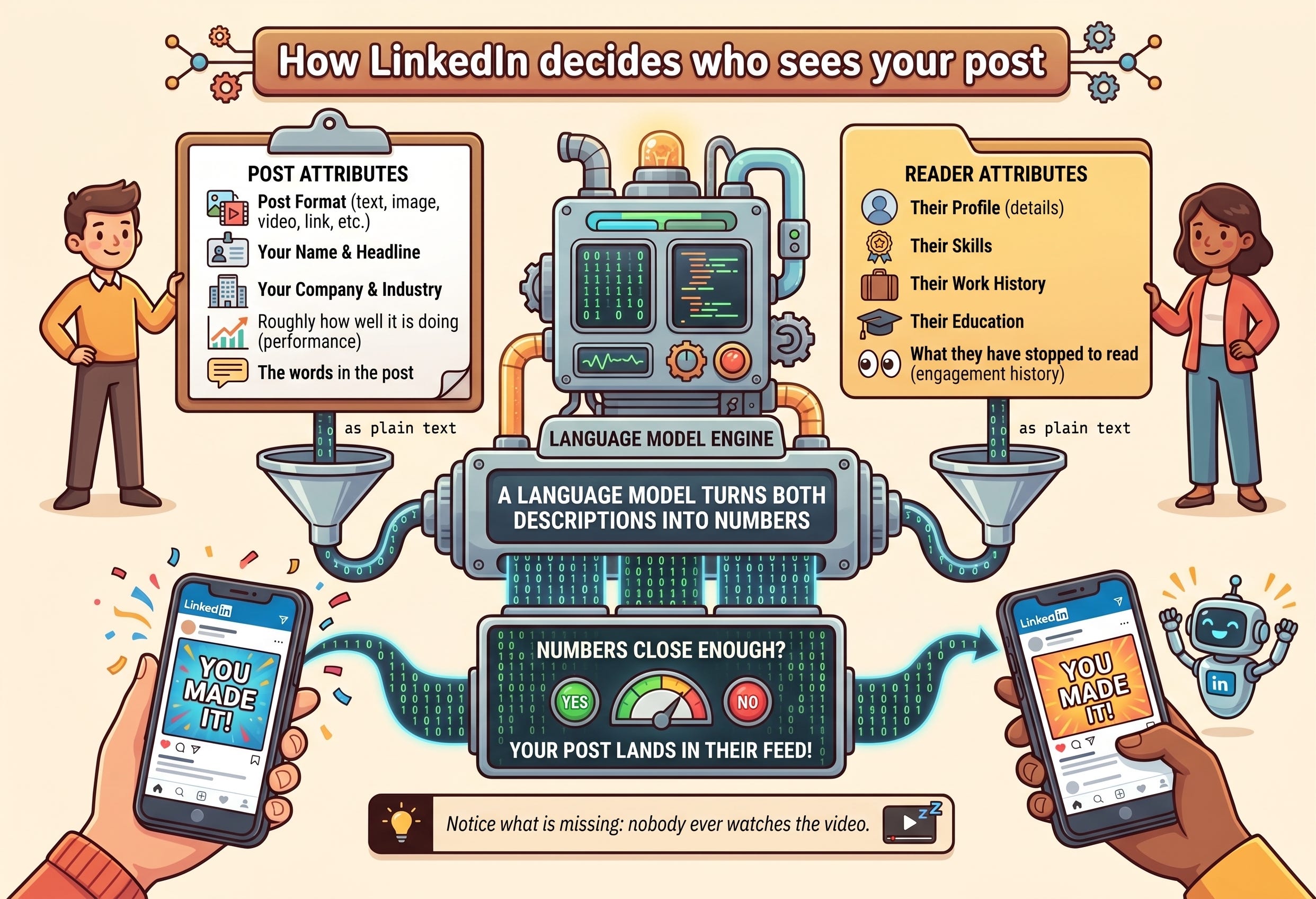
That’s it. That’s the update everybody’s shouting about. Underneath the GPUs and the acronyms, the most advanced system on the platform is a very fast reader who has never seen your face.
Two things fall straight out of that, and they’re the rest of this article.
One: it never watches your video. It reads about it. Anything you didn’t write down, it can’t use.
Two: your headline is part of the description. Not for humans. For the matcher. It goes in on every single thing you post.
A live stream is the hardest possible thing to hand a reader.
At the moment you press Go Live there’s no transcript, no engagement numbers, and a video nobody can watch. Just whatever text you remembered to attach.
LinkedIn writes these descriptions “within minutes” of something being created. Perfectly fine for a text post that’ll sit in the feed for two days. Not much use to a 40-minute broadcast that’s half over by the time anyone’s been matched to it.
A scheduled LinkedIn Event hands the same reader a title, a description, a date and a host with a headline, all of it sitting there being read and matched before you go anywhere near a camera.
This is the important point. You can still create that event ninety seconds before you go live - LinkedIn explicitly allows it. So this was never really a scheduling rule. It’s a text rule. It forces every broadcast to turn up with a title and a description attached. Which means doing the bare minimum satisfies the rule and gets you almost none of the benefit.
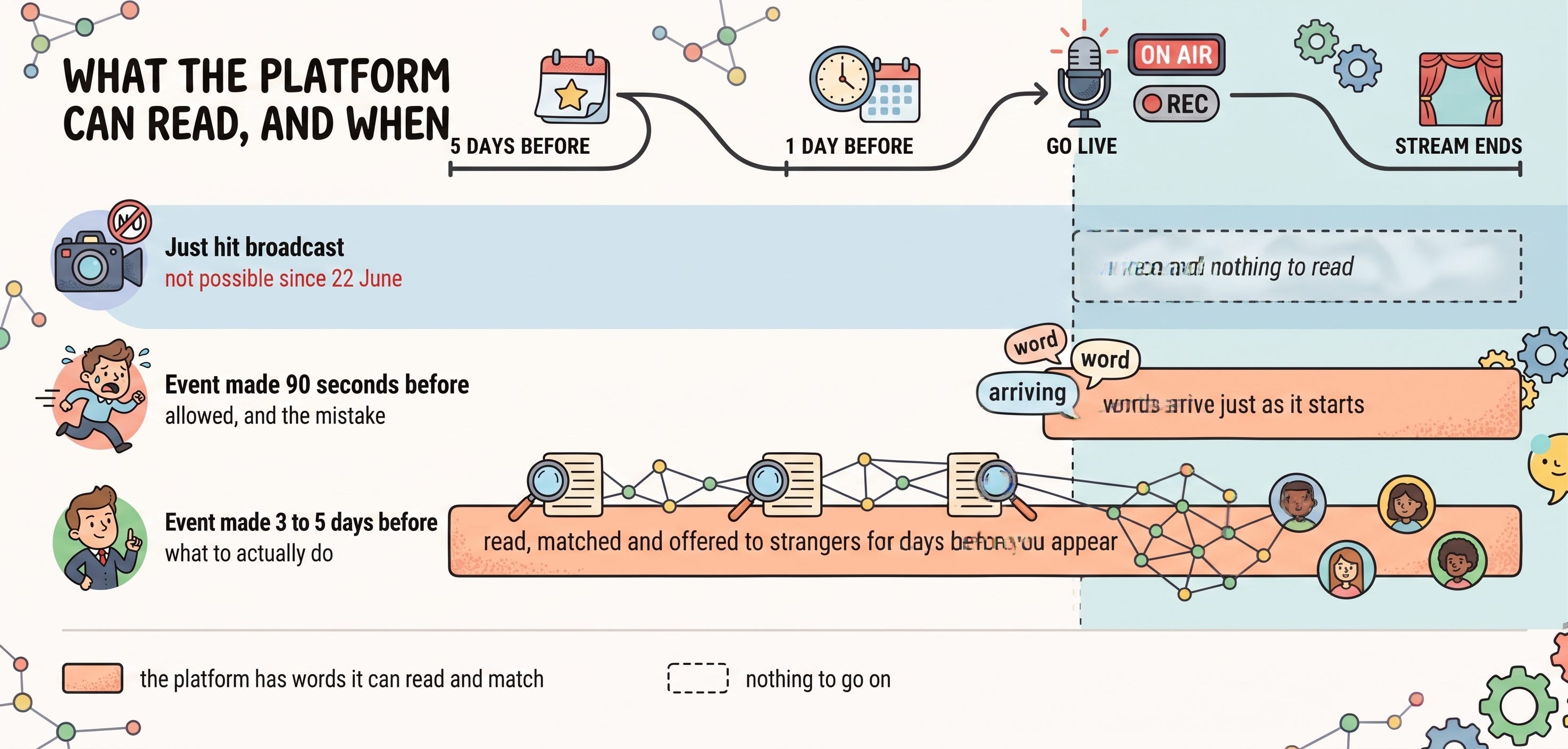
LinkedIn announced the change on 29 March, seventeen days after that engineering post went up. The company has never said the two are connected and I’m not going to pretend it did. But its own stated reason was discoverability, surfacing broadcasts in feeds ahead of time, notifying people before it starts. Which is a fairly polite way of saying the same thing.
Buried in the ranking section is a list of the things the model learns from: long dwells, likes, comments, shares.
Long dwells. How long someone stopped and stayed. The system now predicts both kinds of behaviour - passive ones like click, skip and long dwell, and active ones like like, comment and share. Not one instead of the other. Both.
For years, the people you most want in the room have been invisible to the platform. The managing director who watches your entire stream and never types a word. The head of department who reads every line of your post but would rather her boss didn’t see her liking it.
The old feed read that silence as absence. This one counts it.
And there is nothing you can put on LinkedIn that produces more dwell than a live show. A text post buys you a few seconds of someone’s attention. A well-run 40-minute broadcast buys you people who stay.
You’ll see a lot of posts this year telling you impressions no longer matter and you should stop looking at your numbers.
The document says the opposite, and says it loudly.
When the engineers first tested the new system, they found a correlation of minus nought point nought nought four between how popular a post was and who it got matched to. That’s a statistician’s way of saying “none whatsoever.” They call that result “alarming” — their word, not mine — and rebuilt the way the system reads numbers to fix it. The correlation improved thirtyfold.
Popularity isn’t something the new feed ignores. It’s something they went back and deliberately engineered in. Reach and fit both count, and anyone telling you to stop looking at your numbers is selling you comfort.
Write the event description as though the only person who will ever read it cannot watch the stream. Because for the purposes of being found, that is exactly who reads it.
Not “Join me for a chat about content.” That tells the reader nothing about who it’s for.
Try this instead: “For finance directors at mid-sized manufacturers who’ve been asked to present at board level and hate being on camera. Forty minutes, three fixes, live Q&A.”
Same show. One version can be matched to a human being. The other can’t.
Then create the event three to five days ahead rather than ninety seconds ahead. Ecamm Live, StreamYard and Riverside all still connect exactly as they always did, the only change is that the event has to exist first. Give it a few days to sit there and be read.
Back in June I wrote about LinkedIn ending spontaneous livestreaming, and I told you it was about advertising. I still think that’s part of it.
Having read what the engineers actually built, I think there’s something simpler going on as well. The platform can only recommend what it can read. A broadcast that turns up with no words attached gives it nothing to work with.
Which I find oddly encouraging. It means the thing standing between your live show and the right audience isn’t a bigger following or a better camera. It’s twenty minutes of planning and a description written for one specific person.
You already know who that person is. You’ve been advising them for years.
Are you running live shows on LinkedIn yet, or still circling it? And if you’re circling, what’s the thing that’s actually stopping you? Drop a comment, I read every one.
And if you’d like a second pair of eyes on your setup before your next broadcast, a 30-minute call is usually enough to sort it out.
Cheers,
Neil.
Comments
Nothing yet. Say the first thing.
Sign in to join the conversation.