
This is a sister piece to the Four Elements Epistemic Framework, particularly meant for those who are familiar with Ken Wilber’s Four Quadrants or who are curious of the prior work that inspired the model (see below from Finding Radical Wholeness).
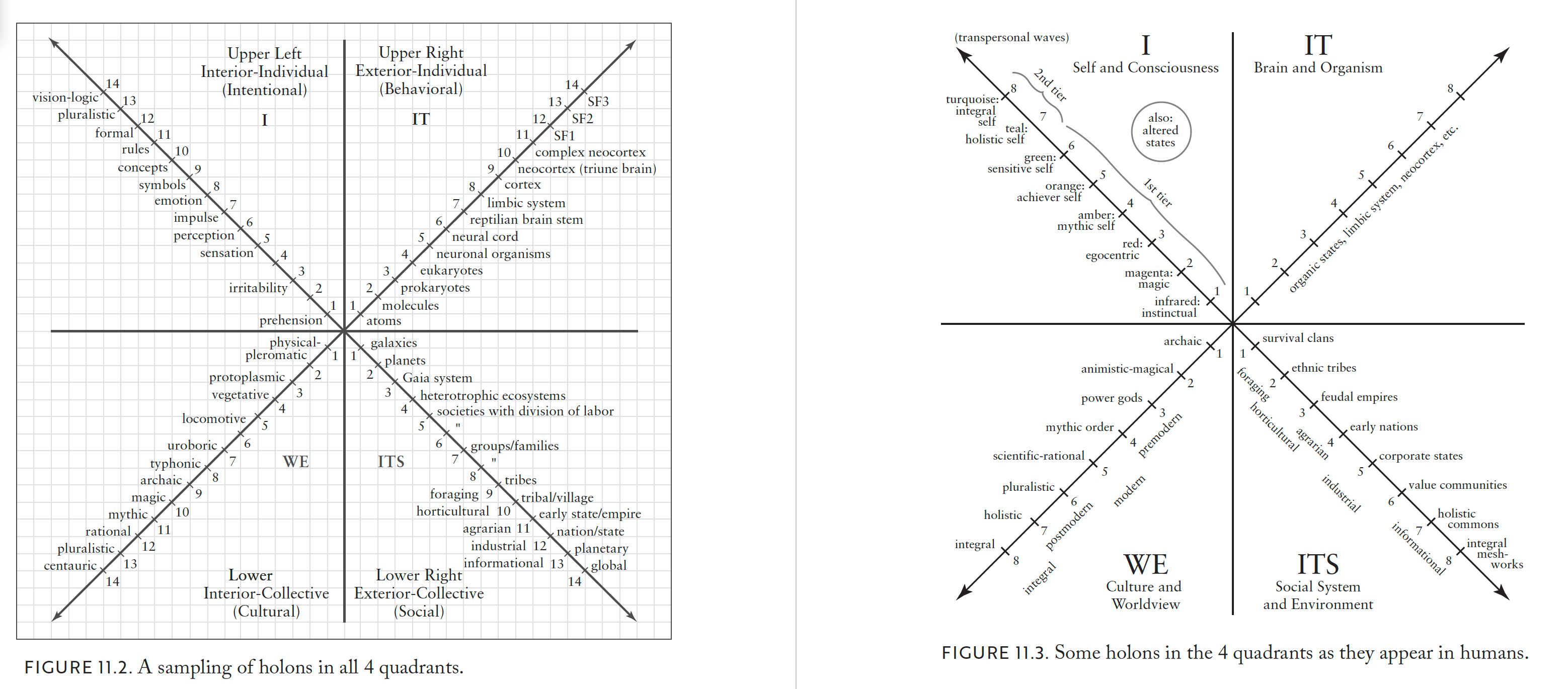
We are explicitly building on the work of Ken Wilber, a leading integral theorist, for several key reasons. First, Wilber has long sought to create frameworks that bridge epistemic divides, particularly between spiritual/religious/contemplative ways of knowing and objective/secular/scientific ways of knowing. His life’s work toward helping different groups understand their complementary strengths provides a valuable starting framework.
Second, Wilber’s four quadrants—and particularly the two key polarities he identifies: individual/collective and interior/exterior—provide a solid representational starting point for an epistemic model. These dimensions map the complementary strengths and limitations of different ways of knowing, with spiritual ways of knowing mapping onto “interior” dimensions and objective ways of knowing mapping onto “exterior” dimensions. Beyond that, there is clear recognition of the value of distinguishing between individual and collective frames.
To provide a sense of Wilber’s quadrants, consider this image (above) from his book Finding Radical Wholeness. For now, focus on the labels of each quadrant and the vertical and horizontal axes without attending to the diagonal lines. The key labels for each quadrant are:
Upper-Left = Interior-Individual, the “I” or “Subjective”
NOTE: This secondary label “subjective” appears in variations of this model. We will add these complementary labels used in other variations as the final quadrant descriptor.
Upper-Right = Exterior-Individual, the “It” or “Objective” Quadrant
Lower-Left = Interior-Collective, the “We” or “Intersubjective” Quadrant
Lower-Right = Exterior-Collective, the “Its” or “Interobjective” Quadrant
This structure provides powerful scaffolding for integrating different perspectives. However, we propose several key shifts to develop a refined model better aligned with providing an epistemic framework that helps people navigate across differences in ways of knowing.
The type of space is what we have been seeking to cultivate both in my classes and in this podcast space, via the introductory rules Eric established in episode 1:
No-Pressure Zone: Good-faith conversations only. Jedi mind tricks not included (but wouldn’t that be cool?).
Consent Over Consensus: We don’t need to agree on everything, just enough to keep talking without wanting to throw a chair.
Play Freely, Conclude Carefully: Big questions deserve both playful curiosity and careful thought. And, of course, a well-timed joke when you can pull it off.
Situate in Space & Time: Context matters. Since we’re located in the U.S., these ideas are drawing from that center of gravity, though we do seek wisdom and connection with other traditions globally.
Honor Different Ways of Knowing: Science, spirituality, and Indigenous wisdom all have something to bring to the table—let’s not pretend otherwise.
Given this, we are not emphasizing the developmental facets of this model (The diagonal lines and circles in the images above.) We will return to those later, but these aspects are not relevant to this proposed evolution of the quadrants frame and, in particular, the focus on articulating a purely epistemic framework.
Given this shift towards a more purely epistemic model and not one that is also useful for knowing in relation to developmental maturity aligned with Wilber’s broader work, we propose three refinements grounded in contemporary neuroscience, contemplative epistemology, and philosophy of science that make the framework more precise and useful for bridging the science-religion-Indigenous divides.
Here is the visual (note that this has been updated from the original post, based on feedback from Durwin Foster (see comments below; thank you for your feedback!).
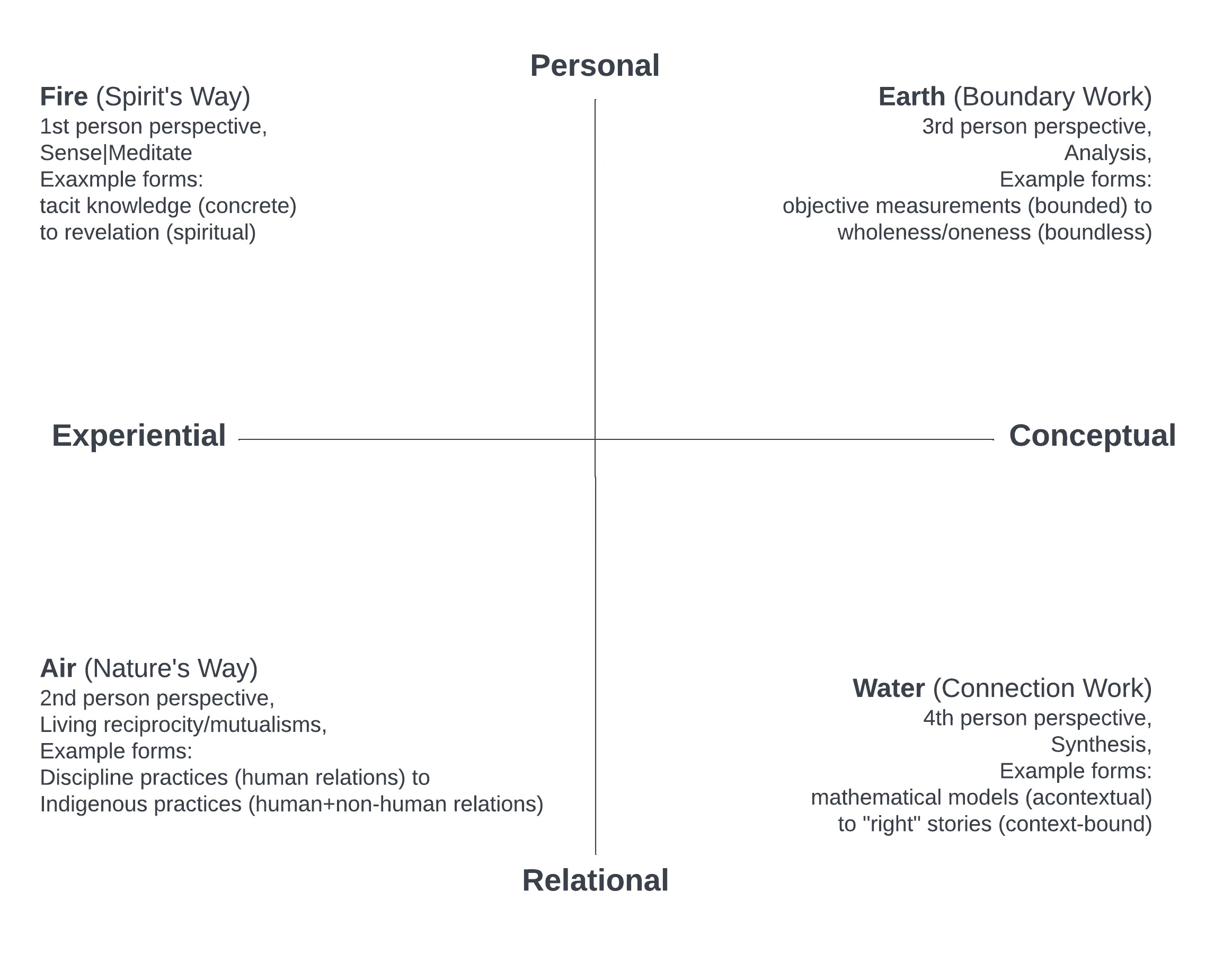
Please see the sister piece for the full framework and exploration of all of these elements including hypotheses around critical issues like adjudicating truth claims within and between quadrants. This piece is focused primarily on justifying shifts from the Wilber “Showing up” grid shown above. Critically, none of this is meant to negate the value and importance of Wilber’s model; indeed, we see immense value it and building up it. What we are trying to do is leverage it for a more targeted and focused model meant to support a key goal: cultivating spaces that can hold our disagreements, hence the orientation towards this as an epistemic model primarily.
The first refinement replaces Wilber’s interior|exterior distinction with experiential|conceptual. Three independent lines of inquiry converge on why this matters:
Neuroscience perspective (Lisa Feldman Barrett): Contemporary neuroscience, particularly the work of neuroscientist Lisa Feldman Barrett, who is internationally recognized as a leader in her field, reveals that sensory and conceptual knowing are not separate systems but complementary aspects of a dynamic feedback loop (described at length in her books Seven and a Half Lessons About Your Brain and How Emotions Are Made, and summarized in Episode 4 of this podcast). Our brains continuously receive sensory input through interoceptive (internal body states), proprioceptive (body position/movement), and exteroceptive (external world) sensing—and possibly other “sensory” capacities described in meditative traditions. Simultaneously, our predictive minds organize these raw sensory experiences through concepts—learned/evolving categories that enable efficient “body budgeting” and action. Critically, concepts shape what we experience (predictions influence constructed habits of perception), while sensory experience refines concepts (prediction errors update constructed categories). This is not a hierarchy but a non-dual whole: we cannot have experience without some conceptual organization, and we cannot develop concepts without perceptual sensory/experiential grounding. This dynamic enables both stability (concepts allow efficient response) and adaptability (experience can update concepts when predictions fail).
Meditative perspective (Dalai Lama): In The Universe in a Single Atom, the Dalai Lama articulates why certain fundamental questions require experiential rather than conceptual methods. Building on his friendship with philosopher Karl Popper and drawing from Buddhist practices, he refines falsification arguments to show that the appropriate method depends on the phenomenon’s nature. Conceptual knowing—whether through reductive analysis or systems modeling (right-side quadrants in the Wilber model and in the refined model below)—works by creating boundaries, separating phenomena into parts, and mapping relationships between distinct elements. But some phenomena, particularly wholeness, oneness, and transcendent qualities like unconditional love, cannot be observed through methods that require separation. Analysis, by definition, takes things apart; it cannot observe “one” because the method itself creates “many.” Thus, many key phenomena central to spiritual traditions—transcendence, unconditional love, external witnessing, bliss, boundlessness /timelessness, and non-dual wholeness—by their very phenomenological nature, cannot be “observed” using methods that begin with analysis and separation.
As described across wisdom traditions and summarized in works by Wilber and others, including Finding Radical Wholeness, while these phenomena can be partially described and conceptualized using conceptual tools (the provenance of the right-side quadrants), they can never be fully observed using those approaches.
[NOTE: Interesting emerging philosophical and scientific domains are shifting from focusing on the variables within mathematical models to focusing instead on the constants in those equations. This approach is being explored in contemporary philosophy by Philip Goff (see Why: The Purpose of the Universe) and Philip Palmer (see The Primacy of Doubt). For this discussion, the key point is that historically, any ways of “measuring” wholeness/oneness or attributes of what different spiritual traditions might label “God” were outside traditional scientific practice, as there was no formal way to measure “absence” when the phenomenal condition is hypothesized to be omnipresent.]
However, contemplative traditions across Buddhism, Christianity, Yogic practices, and others have developed replicable practices with clear predictions: if one commits to specific meditative / prayer disciplines, one can experientially know transcendent peace, love, wisdom, and oneness. These are not vague aspirations but testable claims with a “measurement strategy”—first-person experiential observation of presence or absence (feeling peace versus not feeling peace). This offers a pathway to knowing that complements rather than competes with conceptual analysis.
To recognize this possibility, we orient this side of the horizontal polarity as experiential rather than sensory. The logic here is that even with full recognition of the critical conceptual/sensory feedback within our brains, these meditative traditions—over thousands of years and across cultures—have developed different forms of meditation, prayer, or contemplative practices appropriate to each culture’s inheritance (see Barrett’s work and Episode 4).
Returning to Wilber’s developmental orientation and particularly “growing up,” there are claims that over time one can cultivate experiential knowing that, in the words commonly used in the integral community, “transcends and includes” these conceptual tools while reducing reliance upon them. As described to us in a recent course with Thomas McConkie and John Kesler from their Integral Polarity Practice Institute, one can think of this as re-cultivating the full experiential knowing state of a newborn child who has not yet formed conceptual boundaries distinguishing self from other. As one integrates life experiences and histories, the assertion is that one can cultivate a non-dual experiential awareness that transcends and includes all conceptual developmental work, benefiting from these conceptual tools for creating useful distinctions and relationships. To acknowledge this possibility—particularly in creating an epistemic model that invites curiosity, humility, compassion, and interest in different ways of knowing—we suggest this left side of the horizontal axis be labeled neither “interior” (which orients toward meditative ways of knowing and is problematic for the shift from collective to relational, a point I will return to) nor “sensory” (which would be more accurate based on neuroscience but, if used alone, would marginalize the deep experiential knowing realizations that spiritual traditions articulate).
Philosophy of science perspective: Anchoring in the work of philosopher-scientist Michael Polanyi, his seminal work Personal Knowledge articulates that all conceptual knowledge—including the most rigorous science—ultimately rests on experiential foundations. The scientist creating concepts, measurements, and theories is always grounded in lived experience of conducting observations, what Polanyi labeled “tacit knowledge.” There is no “view from nowhere.” Even the choice of what to measure, what boundaries to draw, what questions to ask emerges from relational experiential engagement with the world. This means attempts to privilege “objective” conceptual knowledge over “subjective” experiential knowledge are philosophically confused. Both are real, both are necessary, both have appropriate domains in the conversation of knowledge.
This is also a key reason why we avoid the terms “subjective” and “objective.”
For better or worse, current Western culture has a strong implicit bias favoring “objective” over “subjective.” There is likely good reason for this, particularly from a historical perspective—foundational scientists like Galileo sought to articulate a domain of knowing, namely “objective knowledge,” that would not be the provenance of the Roman Catholic Church in Europe (see both Goff’s book, Galileo’s Error and historian Tom Holland’s book Dominion for historical review). This created the possibility for the Enlightenment and, ultimately, the scientific revolution. At the time, it was required to enable correction of excessive power for defining what is good, true, and beautiful (the anchoring values of the Enlightenment) within the Roman Catholic Church (and note, this is focused primarily on the evolution of the religion and is not focused on the teachings of Jesus Christ). Arguably, the pendulum has now swung too far toward favoring objective ways of knowing (the right quadrants), marginalizing experiential ways of knowing to our peril.
We include these philosophy of science critiques as an invitation, particularly to those in the scientific community strongly committed to atheism and secular humanism, to invite curiosity and humility about the ways humans—as the foundational agents who do science—conduct science and how what manifests is influenced by their personal experiential and relational knowledge (both individual histories and cultural inheritance.) For interested secular humanist readers, we suggest Michael Polanyi’s Personal Knowledge and Philip Goff’s Galileo’s Error.
Synthesis: These three perspectives—from neuroscience, contemplative traditions, and philosophy of science—converge on the same insight: experiential and conceptual knowing are complementary, they co-arise, with experiential being foundational but conceptual being necessary for sharing, cumulating, and building on knowledge across individuals and generations.
Using “experiential” and “conceptual” rather than “interior” and “exterior” clarifies the how of knowing (direct experience versus organized constructions) rather than implying a spatial where. Wilber’s “1st person” and “3rd person” language helpfully captures the perspective shift, but “experiential” and “conceptual” more precisely describe the methodological difference. This language better captures the dynamic, non-dual relationship and makes visible why both objective science (primarily conceptual) and contemplative practice (primarily experiential) are essential.
Moreover, this framing illuminates why the science-religion divide is so intractable: each tradition has developed extraordinary sophistication in one mode while sometimes dismissing the other. Particularly in Western/Christian culture, this could reflect multigenerational trauma from the power-over structures of the Roman Catholic Church and its dominance at the start of the Protestant Reformation and then the Enlightenment, as explored in episode 1. Recognizing them as complementary rather than competing ways of know creates space for integration. The feedback loop also establishes “response-ability”—both individuals and communities can consciously influence this dynamic by cultivating experiential knowing (through contemplative practice) and by critically examining the strengths and limitations of available concepts, adapting them when contexts change (as discussed in Episode 4).
A note on ontology: Whether this complementarity reflects something about the fundamental structure of reality (ontology—the study of what exists) or merely describes how human consciousness operates (epistemology—the study of how we know) remains an open question beyond this framework’s scope of inquiry. The framework takes no position on whether reality itself is fundamentally experiential, fundamentally conceptual, both, or neither. It claims only that human perception involves both dimensions in dynamic relationship.
The second refinement replaces “individual” with “personal” and “collective” with “relational.” The vertical axis—from personal to relational—captures a second fundamental dynamic: consciousness can be understood both as arising from individual loci and as emerging through connection and interdependence.
Personal knowing refers to knowledge arising from or pertaining to an individual perceptual event the “I” that experiences, thinks, observes, and acts. This includes first-person embodied phenomenological action inquiry, individual analysis and reasoning, personal contemplative practice, or observational experience; any knowing where the individual serves as the primary unit or source. We choose “personal” both because it resonates with spiritual ways of knowing—connecting through personal experience to the transcendent—and in honor of Polanyi’s choice to label this “personal knowledge” in his book.
Relational knowing refers to conditions that emerges through pluralizing distinctions; connection, exchange, and interdependence—patterns and understanding that exist only in relationship and cannot be reduced to singular individual components. This includes collective wisdom arising from sustained community relationships, ecological intelligence embedded in systems of reciprocal exchange, and emergent properties of coordinated interaction.
As with the horizontal axis, these are not separate categories but complementary aspects of a unified whole. We are always simultaneously individual selves and selves-in-relation, as discussed across episodes 2, 3, and 4 of the podcast. The question is which aspect we emphasize and for what purpose.
The choice of “personal” rather than “individual” or “self” is deliberate, though all three terms point toward related phenomena. Several converging perspectives inform this choice:
From psychology and neuroscience: The personal perspective designates the locus from which all epistemic actions emerge. There is always an “I” that experiences, observes, analyzes, relates. This “I” is the psychologically useful organizing center of experience, even as neuroscience reveals it to be constructed rather than given, distributed rather than localized, and far more fluid than common sense suggests.
From contemplative traditions: Yogic traditions and practices like those of Self-Realization Fellowship understand “self” explicitly as existing on a continuum—from the small ego-bound self of everyday consciousness to the infinite Self that is one with universal consciousness. The spiritual journey involves recognizing that what appears separate and bounded is actually continuous with the whole. Similar concepts appear in Buddhist teachings on emptiness (which does not deny the functional self but reveals its constructed, impermanent nature) and in Christian mystical traditions distinguishing between ego-self and true self in God.
From panentheistic theology: Panentheism (literally “all-in-God”) is the view that the divine permeates all of existence while also transcending it—like how wetness permeates a sponge while water is more than the sponge itself. Traditions explored in works like John Philip Newell’s Sacred Earth, Sacred Soul, which describes Celtic Christian traditions (more closely aligned with Indigenous sensibilities), understand the divine not as separate from creation but as both immanent within all things and transcendent beyond all things. Every particular self participates in and arises from the divine source. This represents a “both-and” rather than “either-or” understanding of self and whole, conforming with the non-dual hypotheses from other traditions like Yogic and Buddhist practices.
From panpsychist philosophy: Building on Philip Goff’s work in Galileo’s Error and Why? The Purpose of the Universe, some contemporary philosophers explore the possibility that consciousness exists on a continuum rather than being an all-or-nothing property emerging only in complex brains. Panpsychism—the view that consciousness is a fundamental feature of reality present at all levels—suggests that if consciousness is fundamental, “personal” might be understood as any locus of consciousness capable of some form of distinction from other loci, ranging from the simplest boundary-awareness to complex human self-consciousness to cosmic or divine consciousness itself.
From Indigenous epistemologies: Many Indigenous traditions understand the boundaries of the personal as inherently malleable and relationally constituted, resonant with contemporary neuroscience (see episode 4). The personal self is not fixed and separate but fluid and contextual, defined through relationships with land, ancestors, other beings, and the more-than-human world. Identity emerges from and is maintained through these relationships.
Framework position: The framework takes no ontological position on these deeper questions about the nature of self or whether consciousness exists on a continuum. These are ontological questions beyond an epistemological map’s scope. This is a key reason we avoid using “self”—that word carries stronger ontological implications. We do not think making ontological claims serves the purpose of articulating an epistemic model that enables groups using different ways of knowing to approach other ways with humility, curiosity, and perhaps appreciation. We wish to support spaces that enable ontological discussions, which sets up a need to seek an epistemic model that can enable these ontological discussions to take place in a healthy, productive way.
The framework uses “personal” to designate the individual aspect through which knowing arises while remaining agnostic about whether that locus is ultimately real, illusory, fixed, fluid, separate, or continuous with larger wholes.
What matters epistemologically is that some knowledge is distinctly personal—first-person experience, individual analysis, personal revelation, object distinctions—even if the person having that experience is understood differently by different traditions. “Personal” captures this functional role while remaining open to diverse ontological interpretations.
Moving down the vertical axis toward “relational,” we encounter knowing that arises through dia-logic itself—not aggregation of individual knowledge but genuine reciprocal emergence of patterns, properties, and understanding that exist only in relationship.
This possibility was distinctly absent from Wilber’s work, but as described by others in the Integral community—particularly Said Dawlabani in his book Second Sapiens—this is a glaring omission, particularly as humanity leaves the relative comforts of the Holocene and enters the Anthropocene. As Dawlabani argues, humanity must learn to re-attune to natural intelligence instead of solely abstracted human intelligence. Critically, Wilber and other foundational developmental thinkers—particularly Clare Graves, Don Beck, and Wilber building on their work—articulated developmental models from a largely humanistic perspective. That orientation, given current planetary pressures upon life (described in episodes 2, 3, and 4), requires robust updating.
Critically, much of this relational knowing has been undervalued and likely misunderstood in both Western culture (with its orientation since the Enlightenment toward ever-greater refinement in “objective ways of knowing”—the right-hand quadrants) and Eastern culture (with its orientation toward meditative practices—the upper left quadrant). Wilber’s work and the broader Integral community, save perhaps Dawlabani’s pivotal contribution, has grown out of and centered ways of knowing from an approach seeking to integrate East/West traditions, all while continuing to, at best, give lip service to—but more commonly marginalize—Indigenous knowledge traditions and their rich practices and histories of living in right relation in a consciously place-based, contextually implicated way.
To begin correcting this and to create clearer understanding of what the lower quadrants offer as ways of knowing, we propose using “relational” as a valuable heuristic for understanding the strengths of both the bottom left quadrant—with its orientation to experientially living in mutualisms and right relationship (an implicit orientation throughout this podcast)—and the bottom right quadrant—what can be effectively mapped and understood through, at its most basic level, stories, and with greater conceptual precision, systems science.
To illustrate this shift, consider the following areas relevant to relationality:
Emergent phenomena in nature: A flock of birds in murmuration (the spectacular coordinated flight patterns starlings create) generates patterns that exist only in the relationships between birds, not in any single bird. The pattern is real, can be studied and modeled (e.g., via agent-based models, a useful tool from the lower right quadrant), but is fundamentally relational. Similarly, neural networks produce cognition through relationships between neurons; no single neuron “thinks” (as described in Barrett’s work). Ecosystems develop resilience through relationships between species; no single species embodies ecosystem health (as described in Rob Dunn’s work, highlighted in episodes 3 and 4). These are not metaphors but literal examples of properties emerging from relationship.
Indigenous relational epistemology: Many Indigenous traditions understand knowledge itself as fundamentally relational. Robin Wall Kimmerer’s work on Braiding Sweetgrass describes learning through reciprocal relationship with plants—not extracting information from them but entering into a gift economy of ethical respect and mutual exchange. Knowledge emerges from sustained, accountable relationship with time, land and its inhabitants. This is not simply accumulating observations but developing ongoing relational understanding and accountability that transforms both knower and known.
Collective sense-making and coordination: Human communities develop shared understanding through sustained interaction that exceeds pooling individual perspectives. Jazz musicians improvising together create music that emerges from relationship—no single musician could produce it alone, and the group’s music is not simply the sum of individual contributions. Research teams develop shared expertise that exceeds any individual member’s knowledge. These represent genuine relational knowing.
Relational ontologies: Some philosophical traditions, particularly process philosophy and certain interpretations of quantum physics, suggest that relationship might be ontologically prior to that what we call “things” are actually patterns of relationship all the way down. While the proposed epistemic framework takes no position on such clearly observed ontological claims, it recognizes that if relationships are indeed fundamental, then relational knowing would have access to demonstrated aspects of reality that personal knowing alone does not produce and cannot reach.
Returning to Wilber’s original framework and the label “collective” for the lower quadrants, “relational” better captures several key aspects:
First, “collective” suggests aggregation—many individuals coming together—which subtly privileges the individual as more fundamental. “Relational” implies and transcends personal, emphasizing emergence and interdependence without presuming individuals are prior to relationships.
Second, “relational” captures the dynamic, ongoing nature of this knowing. “Collective” suggests a static group; “relational” suggests active exchange and dynamic reciprocity.
Third, “relational” better honors Indigenous epistemologies that explicitly frame knowledge as arising from relationships rather than from individuals or groups.
Fourth, “relational” connects more clearly to ecological and systems thinking, where relationships and interactions are primary objects of study, as discussed in Episodes 3 and 4.
The vertical axis captures a complementarity as fundamental as that of the horizontal axis: we are always simultaneously personal and relational. Neither pole is more “real” or “fundamental.”
Personal pole: Every experience is someone’s experience. Every observation is made by an observer. Every knowing involves a knower. Even the most relational, distributed, or collective knowledge is encountered by individuals who must integrate it with their own understanding. The personal locus cannot be eliminated without eliminating knowing itself.
Relational pole: Yet no person exists in isolation. We are born into relationships, shaped by relationships, dependent on relationships for survival and flourishing. Our concepts and categories are inherited from communities. Our perceptions are trained by [nested] culture[s]. Our very sense of self is relationally constituted. Knowledge transmitted across generations is fundamentally relational. The relational context cannot be eliminated without eliminating the conditions that make knowing possible (or as Barrett says, “our nature is nurture.”
Both-and structure: Just as we simultaneously experience and conceive, we simultaneously arise as individuals and emerge through relationships. The framework does not claim to resolve the philosophical puzzle of how this works—whether individuals or relationships are ontologically prior, whether self is ultimately real or illusory, whether consciousness is individual or collective. These are ontological questions beyond the framework’s scope.
The purpose here is to offer a map of epistemological territory, not a detailed description of the territory itself. This representational tool needs to be simple enough to be useful while comprehensive enough to guide people toward meaningful action. What matters epistemologically is recognizing that different questions call for emphasizing different poles:
Questions about subjective experience, personal meaning, and individual freedom require emphasizing the personal pole
Questions about collective patterns, systemic dynamics, emergent properties, accontability and responsibility require emphasizing the relational pole
Most complex questions require both
Contemporary polarization often reflects overemphasis on one pole: radical individualism that denies social embeddedness versus collectivism that erases individual agency. Both positions are partial. Integration requires honoring the complementarity.
This distinction clarifies the difference between individual contemplative practice quadrant—1st person experiential knowing of wholeness through one’s own consciousness) and relational wisdom practices quadrant—2nd person experiential knowing of wholeness through lived relationship with others and nature). Both access the same fundamental reality—oneness, interconnection—but through different doorways. Similarly, it distinguishes individual measurement and analysis (3rd person conceptual knowing through bounded objects) from systems modeling of relationships (4th person conceptual knowing through patterns between elements).
Grounding in Specific Practices
Finally, the third refinement grounds each quadrant in concrete epistemic practices and traditions, making the framework immediately usable rather than leaving it as abstract categories. This also connects the framework to the widespread cross-cultural recognition of four fundamental elements (Earth, Air, Fire, Water), providing metaphorical anchoring in ancient wisdom while filling it with contemporary epistemological precision.While this facet of the work extends beyond the scope of this linked to the Integral community, it is a key area I (Eric) hope to further express and explore in later audio episodes. For now, we note that this model, as hypothesis, provides pointers toward where one might seek to learn more about these key quadrants of knowing: upper left—look toward meditative traditions; upper right—look toward reductive scientific practices; lower right—look toward both storytelling from Indigenous practices (such as that described in Tyson Yunkaporta’s Right Story, Wrong Story) and systems science; lower left—look toward Indigenous practices (such as Narvaez and Four Arrows’ Restoring the Kinship Worldview).
The Result: An Integrated Framework
These refinements create a framework that:
Honors Wilber’s decades of development (and those he built upon, such as Graves and Beck) while addressing limitations in the original terminology and separating this epistemic facet from developmental work that risks undermining deliberative space that can hold disagreements without collapsing into subtle or overt deference to authority
Integrates insights from neuroscience, contemplative traditions, and philosophy of science
Provides precise language that can facilitate dialogue between scientific and spiritual communities
Grounds abstract epistemology in concrete practices anyone can engage with
Reveals why the science-religion divide persists (overemphasis on conceptual, undervaluing experiential, which could be viewed as an embedded multigenerational trauma that is still actively being processed within Western/Christian cultures that emerged, not from the core teachings for Jesus Christ, but, instead, from the human-created Religions that could both produce great beauty and great harm, as described in Dominion) while showing a path toward integration
Operates as a heuristic tool for dialogue rather than making ontological claims about reality’s structure (thus enabling the space for ontological discussion between different communities that orient to different ways of knowing).
The framework positions all four ways of knowing as essential and complementary. None is “better” or more “true”—each reveals different aspects of reality, each has distinctive strengths and limitations, each is necessary for navigating complex challenges that require multiple perspectives.
For details on the full framework, please go here:
Comments
Nothing yet. Say the first thing.
Sign in to join the conversation.