
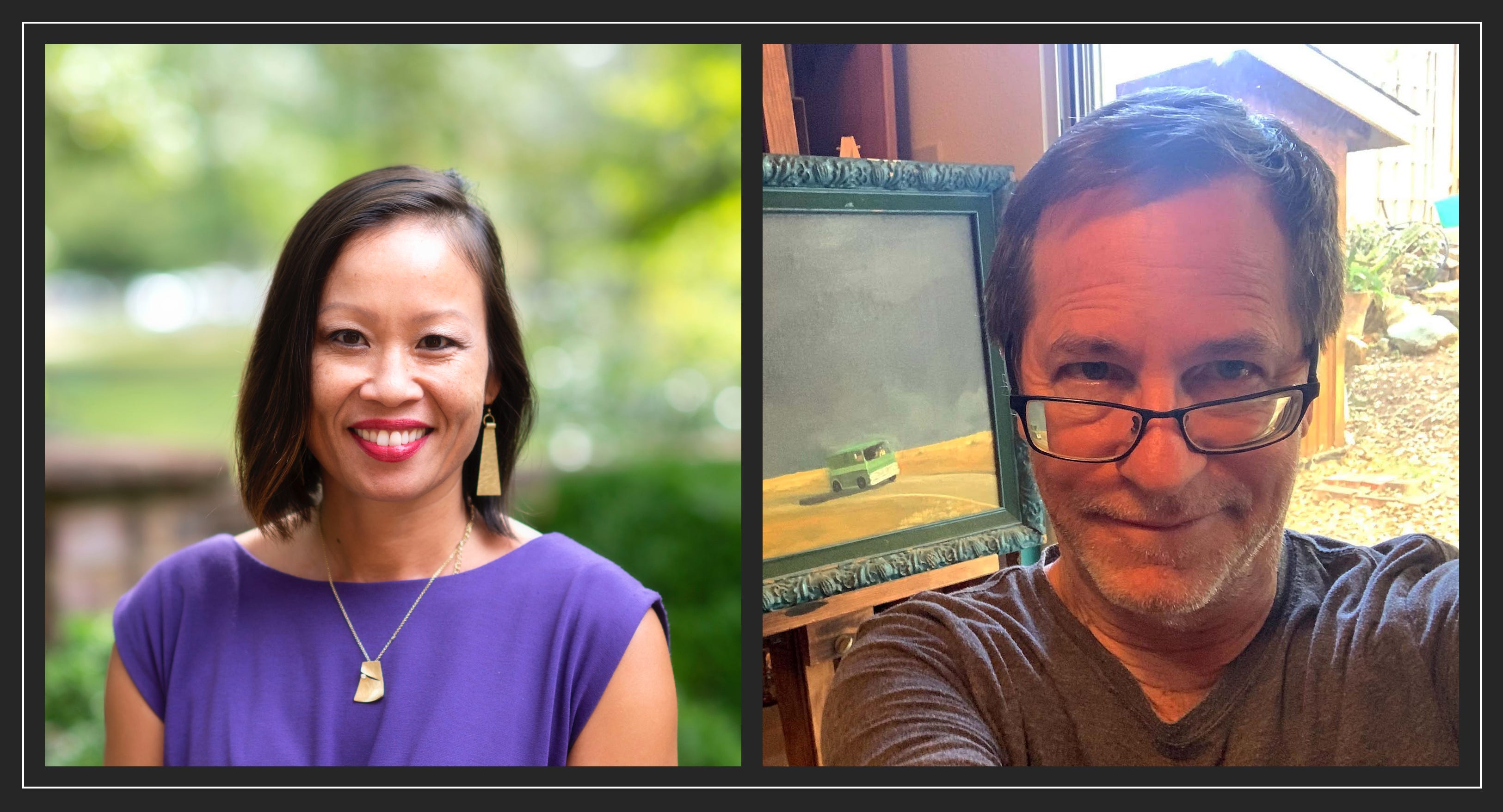
In this rich conversation, Drs. Mai Nguyen and Keith Pezzoli join me to explore how urban planning shapes our communities - and how communities can shape back.
Mai opens with a stark truth: American cities were designed from their inception to discriminate and segregate. The first zoning ordinances around 1908 in LA, for example, weren't just about separating residential from industrial uses - they were explicitly crafted to exclude minorities from certain neighborhoods and concentrate wealth in single-family zones where white families lived.
This historical legacy continues today through exclusionary zoning practices that perpetuate wealth inequality. However, Mai points to hope: cities like Minneapolis eliminated single-family zoning in 2018, sparking a movement toward understanding how land use policies concentrate power and wealth.
Keith, with his four-decade perspective, traces the evolution of planning theory from rational comprehensive planning through incremental planning, advocacy planning, feminist planning, and now emerging approaches like bioregional planning. He emphasizes how planning theory has evolved alongside broader theories of development - from modernization theory to dependency theory to what he is advocating for, bioregionalism.
The conversation reveals how the field of planning is evolving away from its historical roots in top-down, expert-driven approaches toward more participatory methods that recognize community knowledge and agency that both honor people (Mai’s work) and ecology (Keith’s work).
Mai explains how design thinking brings crucial elements often missing from traditional planning: authentic community engagement, prototyping solutions that might not have existed before, and designing WITH communities rather than FOR them. She contrasts this with traditional planning processes that often discourage community engagement by making processes longer and more complex.
Keith introduces the concept of bioregional planning as a "third attractor" beyond both the Expert-driven Modern Globalization Movements and now the reactionary nostalgic backlash. As climate change forces localization of food, water, and energy systems, Keith share’s his vision on how bioregional approaches may be a key approach to help bridge current urban-rural divides and restore care economies of mutual benefit.
He shares examples from water infrastructure, contrasting expensive centralized systems (desalination, massive reservoirs) with localized alternatives like rainwater harvesting and greywater recycling that connect people more directly to their resources.
Mai emphasizes that planning is inherently political: "Everything we do is shaped by politics. You can go through the most rigorous planning process using the best technology, the best data, provide recommendations to your city council. And then they go with something completely different... because they have a constituency that wants something else."
This political dimension requires understanding that markets aren't neutral or free - they're designed by some people with some others in mind and, often, this sets up responses, whether done intentionally or not, to exclude others and to set them up as being in a structural disadvantage in a given market. With this, Mai is advocating for us to deconstruct and reconstruct our perspective and approaches to markets.
Both guests emphasize authentic community engagement that listens to meaningfully learn with communities rather than extracting information from them. Mai shares examples of communities that have reversed gentrification, shut down harmful policing programs, and built affordable housing with wraparound services by leveraging community talents and abundance.
The conversation concludes with hope grounded in education and the next generation. As educators, both Mai and Keith see their role in equipping students with skills to dismantle harmful systems while building more just alternatives.
Keith and Mai both highlight strengths and areas that need additional discussion in their review. Keith highlighted the ways in which the fictional story of Lyla helped to illustrate a wide range of concepts that were in resonance with bioregionalism and the ways in which we are linked together. Mai found the general structure and ways of recognizing the ways in which our contexts influence as valuable but also cautioned us not to forget that all of these urban landscapes are social realities. They are made up by us and thus can be changed by us, but it requires different ways of engaging in discussions and re-imagining our futures together that will likely require us to de-construct some critical elements of the past. With this, I then offered the broader framework of Life Breathes, Islands Sculpt, and Beings Adapt and flagged how, for me, all six words are needed to actually have a good understanding or the nature of reality. With this, many of the elements Mai was asking for will be coming up in the next episode, which was foreshadowed a bit during this interview discussion as well as quick narrative discussion about my intentionality on how I saw these creating a view of reality that is emergent and, I hope, larger than the sum of its parts (but still requiring each of the parts to be worked through).
Urban planning's legacy of exclusion requires active dismantling, not just good intentions
Design thinking emphasizes prototyping and community co-creation over expert-driven solutions
Bioregional approaches offer alternatives to both globalism and reactionary nostalgia
Authentic community engagement means planning WITH people, not FOR them
Political realities shape planning outcomes more than technical expertise alone
Hope lies in educating changemakers and supporting community-driven solutions
And, in line with the intentions and overall thrust of Season 1 of this podcast, we need to be able to recreate our stories, explanations, and approaches, recognizing both guidance for how life systems and ecosystems actually work while also recognizing that we have the super power of inventing social realities to do it.
The episode challenges listeners to see cities not as neutral spaces but as actively sculpted landscapes that both shape and are shaped by the communities within them - making the question of who gets to do the sculpting a fundamentally political and moral one.
Extended Urbanisation: Tracing Planetary Struggles Edited by Christian Schmid / Milica Topalovic
Down to Earth: Politics in the New Climatic Regime by Bruno Latour
Creation Stories Landscapes and the Human Imagination by Anthony Aveni
Decolonizing Design by Elizabeth Dori Tunstall
Abundance by Ezra Klein & Derek Thompson
Comments
Nothing yet. Say the first thing.
Sign in to join the conversation.