
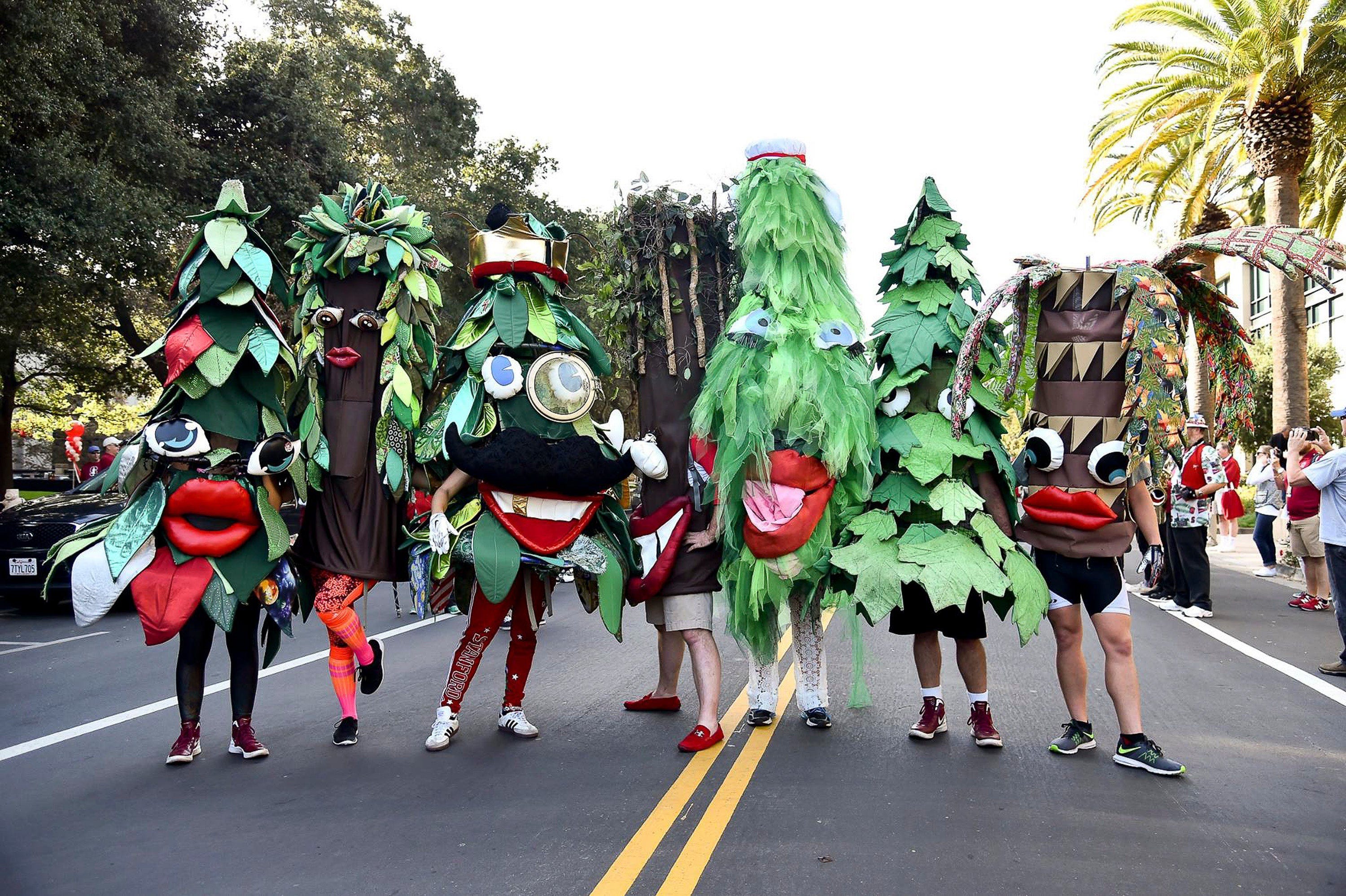
Last Sunday, I gave the Stanford Economics Department commencement address, grounding my remarks in a survey of graduating students on their views on the country, AI, and the American Dream.
I called graduating students the Scout Generation: Clear-eyed about the challenging terrain, but equipped with the curiosity, skills, and values to chart a path forward. Sharing my remarks and survey results below.
Good afternoon. I’m Neale Mahoney, professor of economics here at Stanford.
Classes wrapped up last week, which means I’ve been reading my student evaluations. One of them caught my eye. It said: “Professor Mahoney, if I had fifteen minutes left to live, I’d want to spend them in your class … because fifteen minutes in your class feels like a lifetime.”
So today I’ll keep my remarks to seven minutes — which, by that student’s count, is roughly half a lifetime.
To our graduates: congratulations. Today is an important milestone on a remarkable journey. To the parents, families, and friends here: welcome, and congratulations to you too. You are the foundation and the springboard for everything your students have and will accomplish.
I want to start with an image. When a group has to cross new ground — to traverse fresh terrain — they send someone ahead. A scout. The scout isn’t necessarily the strongest member of the group. They may not have the most endurance. But they’re the one who is most adept at spotting the dangers, finding the path, and leading everyone safely through.
Class of 2026: I’ve come to think of you as scouts. Let me tell you why.
Two weeks ago, I sent you a survey. I am, after all, an economist. (Shoutout to Jaxon Gonzales and Karsen Wahal, who helped me design and administer it.) I asked how you see the world, and benchmarked your answers against national sentiment.
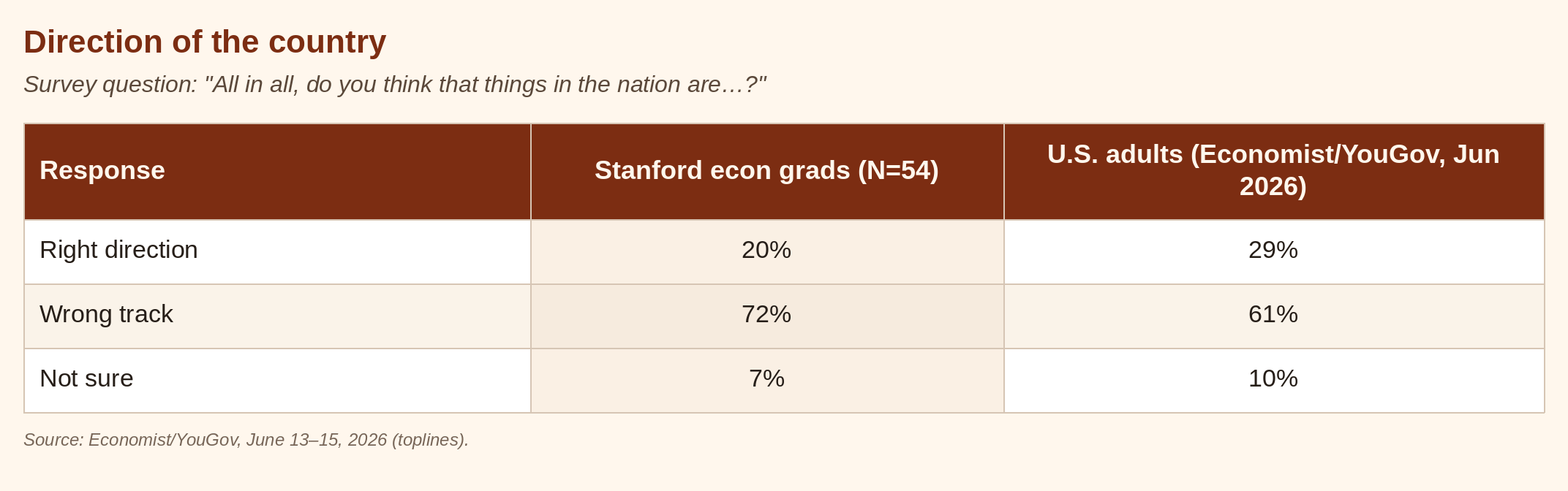
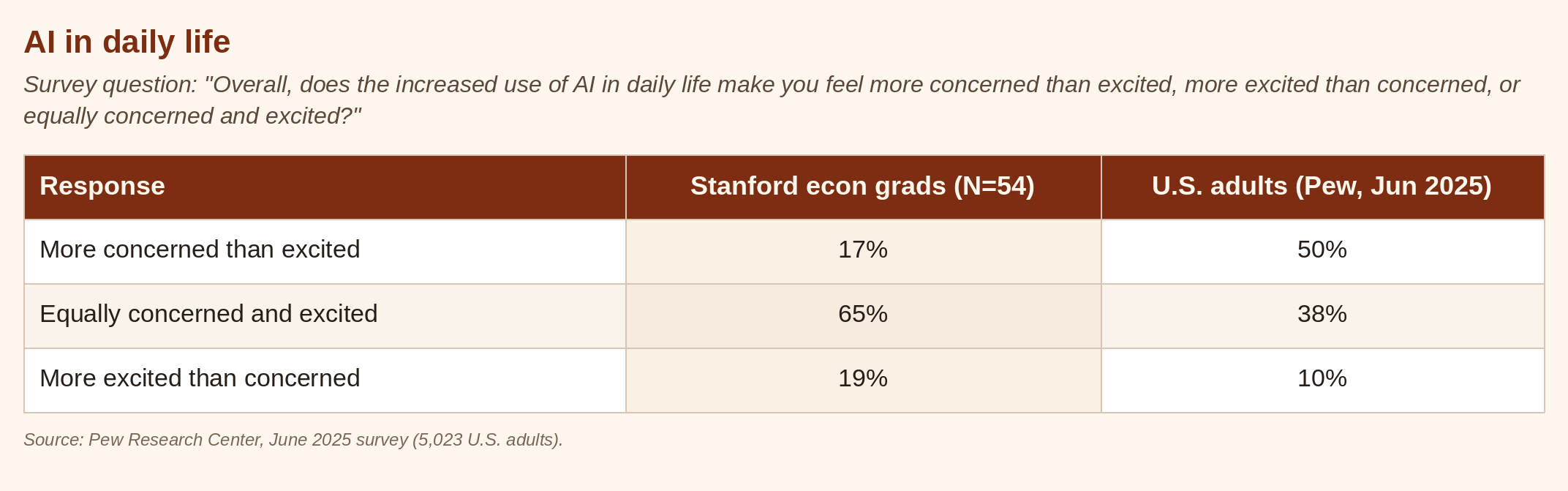
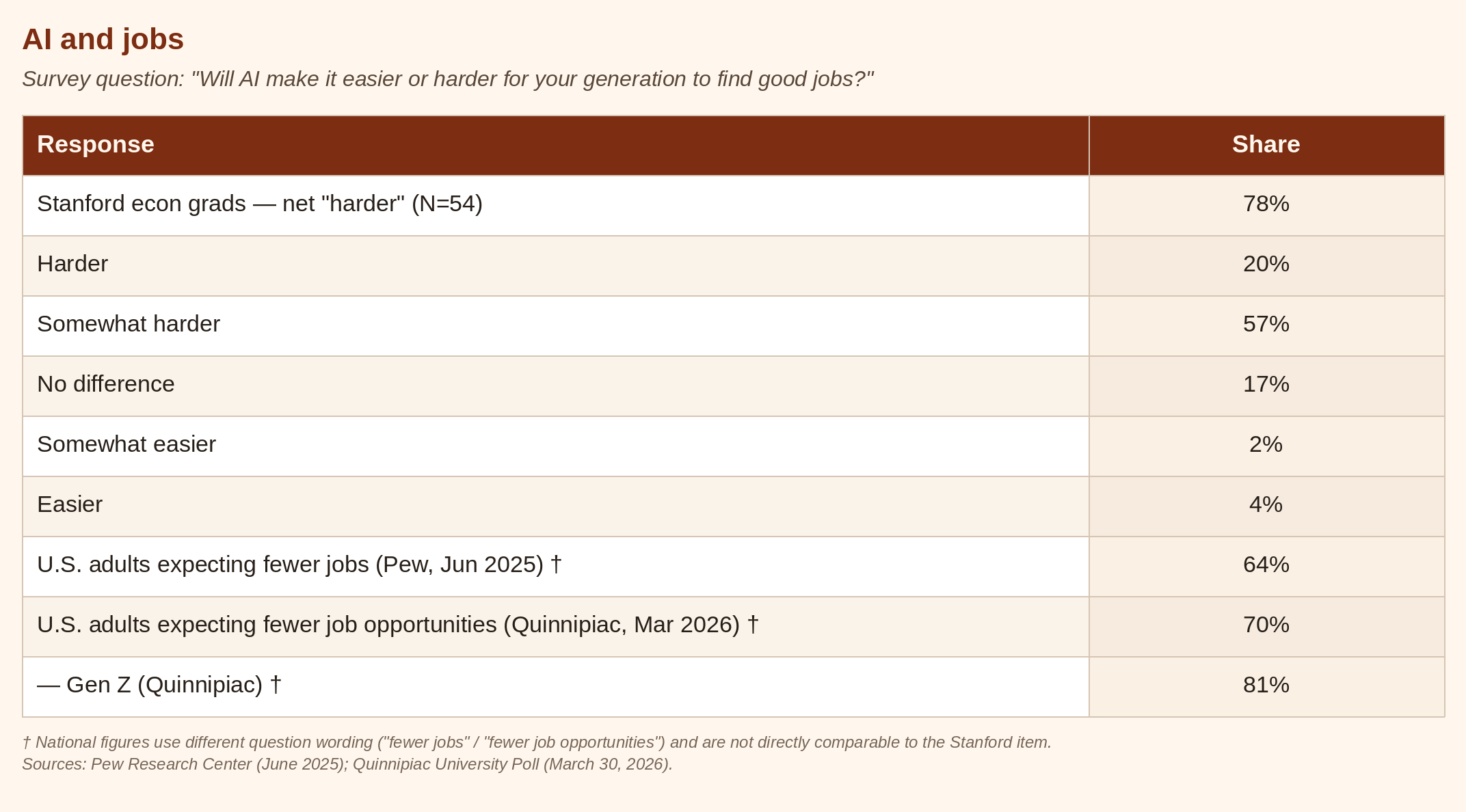
On some questions, you shared the same concerns as our nation at large. When asked the classic right-track, wrong-track question, nearly three-quarters of you said our country is on the wrong track — in line with national surveys. Almost 80 percent of you said AI will make it harder for your generation to find good jobs — again, in line with the nation.
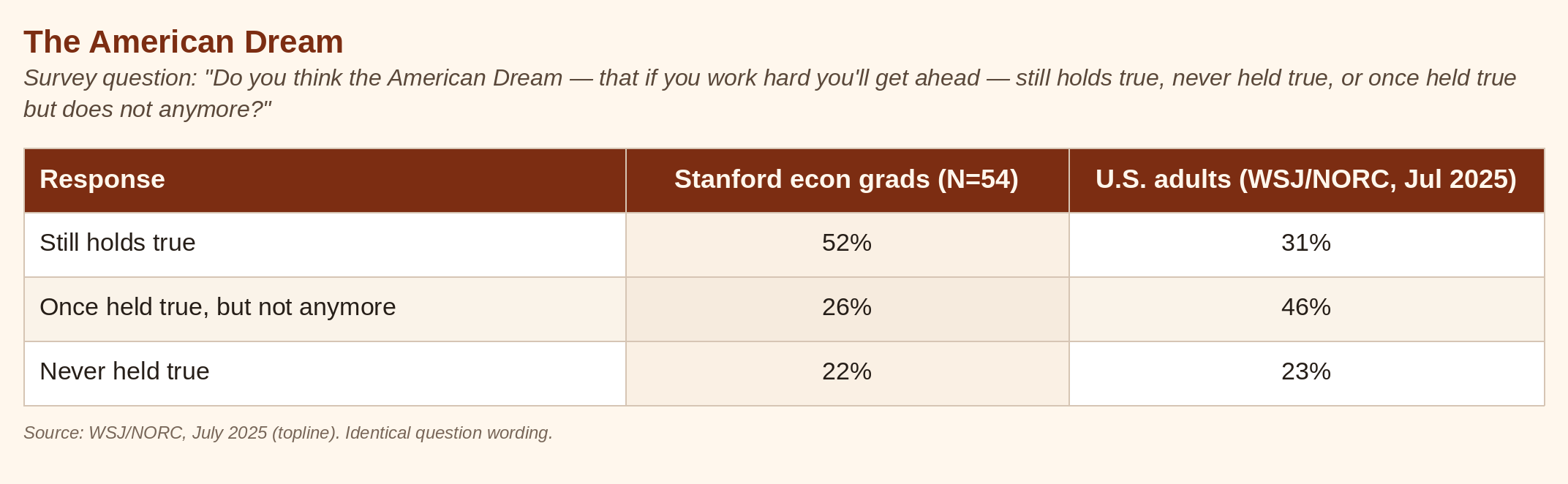
But on other questions, you broke from the pessimism. Nationwide, the belief that if you work hard, you’ll get ahead has crumbled from 70 percent when I was a kid to 25 percent today. You’re more hopeful: a slim majority of you believe the American Dream still holds. On AI, Americans are anxious, with those who are concerned outnumbering those who are excited by a factor of five to one. You’re balanced — split evenly between concern and excitement.
Like a good scout, you’re realistic about the dangers, but optimistic about finding a path.
And why not? Navigating new landscapes is nothing new to you. You’re the first generation to start dating in the era of likes and DMs. Your formative years in high school and college were disrupted by a once-in-a-century pandemic. And you started looking for your first job exactly when AI threatens to rearrange the labor market.
People call your generation fragile. I disagree. The challenges you’ve navigated — and your training at Stanford, including in economics — make you a perfect scout.
So what makes you good at finding a path?
First, curiosity. Why did the bear go over the mountain? To see what he could see. Like the bear, you want to know what lies ahead. I see this most clearly in your research — so let me brag about my students for a moment.
Katja: You wanted to know how panic buying affects allocation and welfare in gasoline markets. Dante: You wanted to know how market size and the returns to surgical volume affect the quality of hip and knee replacements. Nick: You wanted to know how rental assistance programs deliver an insurance benefit to the people who receive them. And Maya: You wanted to know how path dependence shapes the direction of scientific research. Nobody assigned you those questions. You went looking.
Second, agility. As in life, there’s no cookbook for doing economics — no recipe to follow mindlessly. What we aspired to teach you was a way of thinking — frameworks, methods, data — that lets you answer new questions, understand new markets, and solve new problems as you go out into the world.
And third — most important — I hope we taught you to keep your eye on what matters. Economists are accused of knowing the price of everything and the value of nothing. That accusation is wrong. You’ve learned how investment spurs innovation and growth, how competition delivers surplus to consumers, how a safety net protects the vulnerable and the unfortunate — and how we can design our markets and shape our economy to deliver what our society truly values.
No generation chooses its terrain. Mine didn’t. Your parents’ didn’t. Your grandparents’ didn’t. The path ahead is uncertain. But you’ve crossed hard ground already. You’re curious. You have the skills. And you know what matters.
So go ahead of us. Use your skills and your experience to help us find the path into our brave new future. We know you can do it. And we will follow you.
Congratulations, Class of 2026.
The survey was fielded from June 3-9 to Stanford economics department graduates. N=54 of ~150 graduating students completed the survey. The survey was determined not human subjects research by Stanford IRB and was cleared by SDOC. Results tabulated by Claude and double-checked by me.
No posts
Comments
Nothing yet. Say the first thing.
Sign in to join the conversation.