
Over the next few weeks I will be sharing a three part discussion about musical time and interpretation. I originally wrote about this topic a few years ago and am sharing again!
Today, we have part one:
I think a lot about time.
I mean, alot.
Musical time, scheduling time, running time, writing time, practicing time, sleeping time, coffee time...time is constantly on my mind.
For years I thought about temporality in music on a micro level. I even wrote a doctoral document on the subject. (See research here!)
Recently, however, I’ve been obsessed with the ideas of tempo, time, and pacing and how they differ. I went on a quest to define the three and have my students do so as well. It is after all, audition season for many students. I’ve been prepping my high school students for school auditions, All-State auditions, Youth Orchestra Auditions, and Summer Camp auditions. Student audition season is in full swing in my studio.
The results of talking about musical time have been amazing, and I’ve been really impressed with how my students have changed their relationship with these concepts. Their playing has become more nuanced, and their understanding of musical time has expanded.
Before we make it to this abstract nuanced conversation, we have to get one very important conversation out of the way: the difference between metronome markings and tempo.
One of my peeves is when I ask a student: “What is the tempo?” Then, they spout off a metronome marking.
This drives me absolutely nuts. Metronome markings do NOT = tempo.
The reason this gets to me, is because the metronome as we understand it, was not patented until around 1815. Beethoven is credited as being one of the first composers to place a metronome marking in his music. So, when a student tells me that a Bach Suite movement has a metronome marking, my hand goes up in pause. I stop them, and we have a conversation about music history, music editing, editions, interpretation, and how metronome marking and tempo are two entirely different things. It is a good learning moment that opens the door to a nuanced conversation about musical terms, tools, expression, interpretation, and creativity.
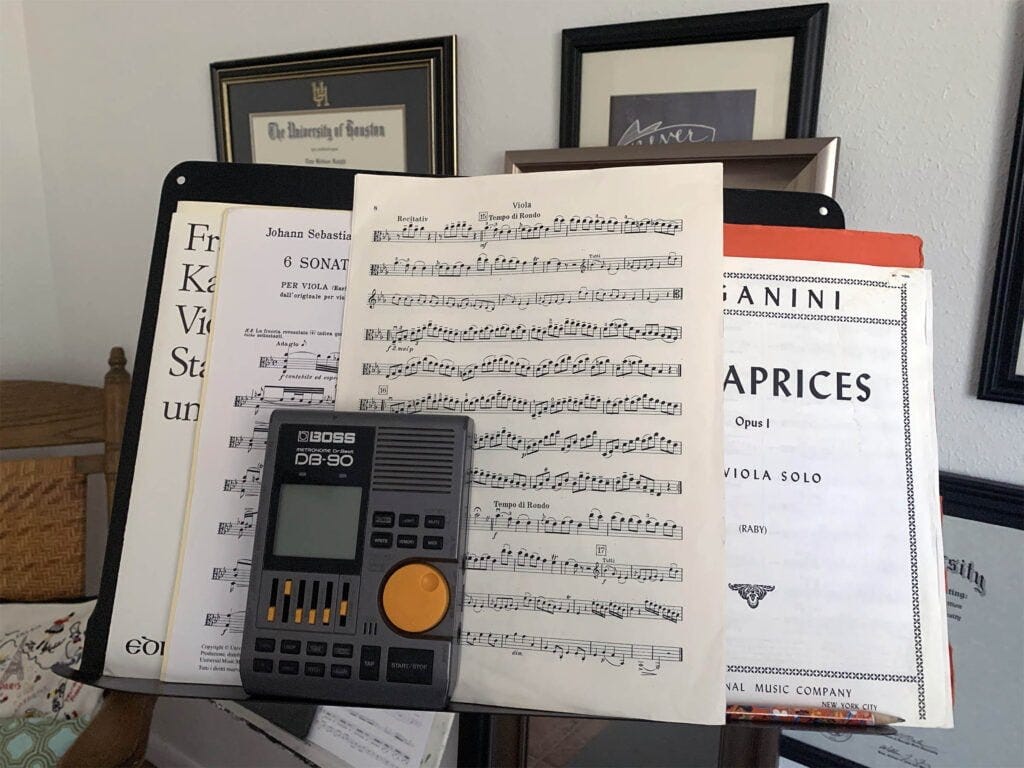
metronome on top of music with a variety of markings
Here are some of the things we talk through in this conversation about musical time and tools.
Metronomes are tools to keep a musician steady. Metronome markings are editorial guides for how fast or slow a piece of music should be.
Tempo markings indicate the speed, mood, the feel of a piece, and serve as a guide for musical speed and interpretation.
Once we get the metronome conversation out of the way, we move on to an even more abstract conversation: the difference between tempo, pacing, and timing.
Defining Tempo, Pacing, and Timing
Below is the most basic way I think about it:
Tempo: the overall speed (big picture, the musical speed limit, mood, sets the tone)
Pacing: the pace of that speed (in focus, changes, medium picture, flexible)
Timing: the placement of particular notes, phrases, cadences, and musical gestures (small picture, can change by moment, mood, interaction, planned out very specifically, but is flexible).
While these are my working definitions of these terms, I always ask students what they think as well. By making distinctions between the three, performers of all levels can experience music time in meaningful and expressive ways.
Over the next few weeks, I will delve more into how to interpret tempo, pacing, and timing, how I teach it, and how I approach it as a performer using specific examples in music.
Thanks for reading (a)musing tales ! This post is public so feel free to share it.
No posts
Comments
Nothing yet. Say the first thing.
Sign in to join the conversation.