
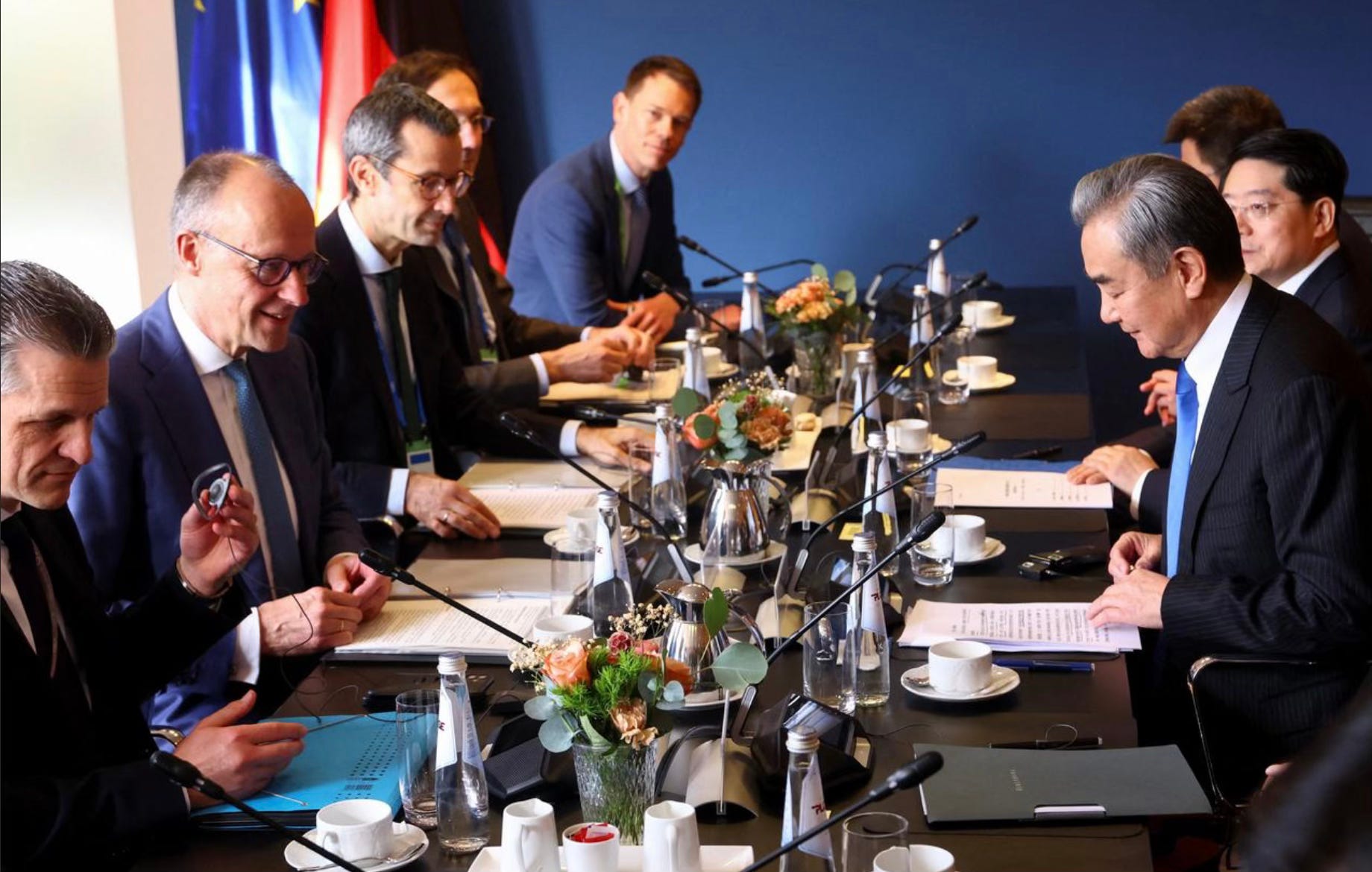
China is pressing Germany to support the idea of a free trade agreement between the European Union and China when Chancellor Friedrich Merz makes his first visit to Beijing next week. There are no signs that Merz will accede to the Chinese request, which German officials believe comes from the very top of the Chinese leadership. But the pressure from Beijing, which officials say has increased in recent weeks as preparations for the trip intensified, shows how intent China is to co-opt Germany in papering over European concerns about an increasingly imbalanced trade relationship, and bypass the European Commission, which has responsibility for trade policy and opposes the idea of an FTA.
“The Chinese are pushing hard for an FTA. They want Germany to throw its weight behind this idea,” one German official involved in the preparations for the trip told me. “It has really picked up recently. It’s clearly coming from the top.” Berlin sees the request as an attempt by Beijing to keep the EU market open to China at a time when the bloc is discussing new local content and cybersecurity rules that could sharply restrict China’s access in critical sectors. “The view is that an FTA is no longer in our interest,” the official said. “China sees the ‘Made in Europe’ debate and they want to preserve their market access.”
In recent weeks, German officials say they have also declined Chinese requests for an MOU on reviving the Angela Merkel-era Comprehensive Agreement on Investment (CAI) and a joint statement in support of Xi Jinping’s Global Governance Initiative (GGI). A handful of other MOUs will be signed, but the German side is playing down the significance of them ahead of the trip, which will include a stop by Merz in Hangzhou as well as Beijing.
The visit has been in the making for months. Merz, who took power in May 2025, had planned to travel to China late last year as part of a two-stop visit to Delhi and Beijing. But coordinating a visit between the two Asian giants proved impossible. The chancellor ended up traveling to India in January and will leave for his two-plus day visit to China on February 24th.
He will be traveling with a 30-strong business delegation, the largest since the Merkel years. For the first time since 2018, a bilateral industry forum that includes the leaders and CEOs of both countries will take place. Another Merkel-era construction, the German Chinese Dialogue Forum, that includes parliamentarians, academics and think tankers from both countries, will meet for the first time since 2019 . Ahead of the trip, German officials have been at pains to downplay the significance of the business delegation and the revival of these old formats.
They say no business deals or investments will be announced. And they draw a clear line between the Merz trip and recent “reset” visits by Britain’s Keir Starmer and Canada’s Mark Carney. “China’s ultimate objective is quite clear – to portray the sequence of recent visits as a rejection of the US and a recognition of China as a guarantor of stability,” a second German official told me. “This is not our objective.” In other words, don’t expect a “Starm offensive” from Merz.
German officials expect the deepening economic imbalances in the relationship, which we documented in a Rhodium Group note last week, to dominate the closed-door discussions between Merz and China’s leadership, which will include separate meetings with Xi and Premier Li Qiang.
German exports to China have plunged 23% since their peak in 2022, led by a 66% collapse in car exports. The profits of German firms operating in China have been hit as competition with Chinese firms has intensified. And Chinese firms are seizing market share from German rivals in third markets in sectors like power generation equipment, machinery, cars and chemicals. These woes have been exacerbated by a decline in China’s currency against the euro, and by the diversion of Chinese exports from the US to Europe and other markets.
Merz and his entourage have no illusions about the Chinese leadership’s readiness to address the yawning trade imbalance and an industrial competitiveness gap which is driven by a variety of factors, including a Chinese manufacturing ecosystem that allows firms to produce more cheaply but also years of top-down industrial policies, underpinned by government subsidies, preferable treatment of local firms and a variety of other non-tariff barriers. I don’t expect public warnings from Merz about Europe’s determination to restrict China’s access to the European market – like the ones we heard from French President Emmanuel Macron after his visit to Beijing in December.
“Chinese overcapacities will be a key theme, but we don’t expect anything to change on the Chinese side,” the first German official said. “It is up to us to respond.” The second official said concrete actions taken by the German government once Merz returns from China would be far more important than the messages he delivers in Beijing. “If you look at the trade figures, they are disastrous,” this official said. “In the end, we will need to protect our industry as well as promote it. Our credibility with China will depend on our willingness to take action.”
Other themes that German officials expect Merz to touch on in his meetings in Beijing include China’s support for Russia’s war in Ukraine and growing tensions around Taiwan. In past years, Chinese leaders refused to go into depth with foreign visitors on Taiwan because they saw it as a domestic issue. But that has changed over the past year, with Chinese Foreign Minister Wang Yi raising the issue in every recent meeting with European counterparts.
At the end of his appearance at the Munich Security Conference last week, Wang launched into a nearly three minute tirade against Japan and its Prime Minister Sanae Takaichi for her remarks on Taiwan last November. German officials expect the Chinese side to raise the issue during the Merz visit. The chancellor is expected to make clear that Germany opposes any change to the status quo in the Taiwan Strait by force or coercion, and that a conflict would have significant consequences for German and European interests.
Merz did not dwell on China in his speech to the Munich Security Conference, but he did give hints about his approach in a separate piece in Foreign Affairs, in which he spoke of managing the relationship in a “more mature fashion” and engaging with Beijing based on “principled realism”. See the full China passage below:
“Germany is also updating its relationship with China. It would be a fallacy to believe that decoupling is the right path. Decoupling would enhance neither our security nor our prosperity. But we will manage our relationship in a more mature fashion. Above all, we will further de-risk by reducing dependencies. We will work hard to ensure fair competition and level playing fields for both sides. And we will shape a more united European approach. As we progress, we will engage in dialogue with Beijing with principled realism, mindful of the fact that China is here to stay as one of the great powers shaping the new era.”
What does this mean in practice? Some might interpret “principled realism” as a sign of acquiescence and accommodation in the face of a rising China and crumbling transatlantic relationship. But it could also mean that a new German government will talk less about China and do more to rally Europe behind a set of forceful de-risking and economic rebalancing policies, in coordination with allies in Asia and North America. This hasn’t happened in Merz’s first nine months in office. If his China trip serves as a trigger for a more robust policy agenda, then it will have been worthwhile.
No posts
Comments
Nothing yet. Say the first thing.
Sign in to join the conversation.