
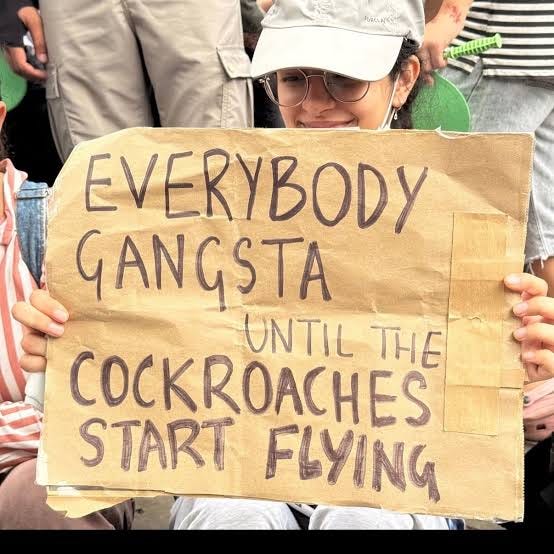
The only thing they don’t know how to handle is non-violence and humor. - John Lennon
It took merely 36 days for young roaches storming through the heart and heat of India’s capital to bend the mighty government of the mother of democracy.
The students, protesting against the recent leak of one of India’s most competitive entrance exams for medical colleges and government jobs, demanded one clear thing: Dharmendra Pradhan, the education minister, should hand in his resignation papers. And they stayed put until he did.
It all started in June with a parody account on Instagram, born out of the unholy union between a judge and a joke.
As the Chief Justice of India, Surya Kant, compared some unemployed youth who became media figures or activists to “cockroaches,” sparking an uproar online, Boston University communications graduate Abhijeet Dipke felt compelled to launch the now well-known Cockroach Janta Party (CJP) by accident.
In June, the online parody page swiftly turned into an on-the-ground pressure group as Dipke returned to India from the States. A few hundred joined him at Jantar Mantar in New Delhi to ask for Pradhan’s resignation.
While the CJP was the movement's pioneer, its catalyst was Sonam Wangchuk, the prominent educator and engineer who went on a hunger strike in support of the students.
He didn’t eat a crumb for 26 days to make the Hindu nationalist government in power listen, surpassing Mahatma Gandhi’s longest fast of 21 days during British colonial rule.
The tides turned when the police forcibly transferred Wangchuk to a hospital in Delhi over the weekend, driving thousands onto the city’s streets in solidarity.
The protests sprawled across the country, and the roaches finally took over.
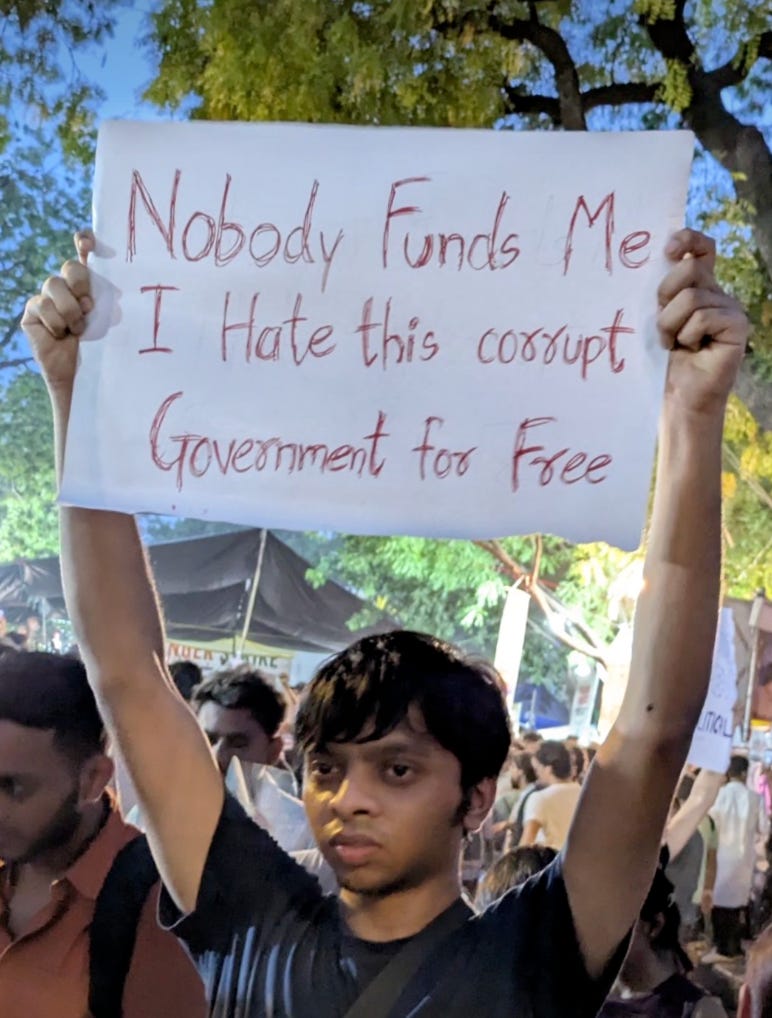
When I picture a cockroach, one word comes to mind—dheeth, roughly translating to stubborn, brazen, unflinching. It’s a bug, a marvel of nature that has survived biological pandemics and major catastrophes.
That is exactly how I know my fellow Gen Zers, who are survivors of a pandemic, a crumbling job market, and an AI-obsessed world, no less than a catastrophe.
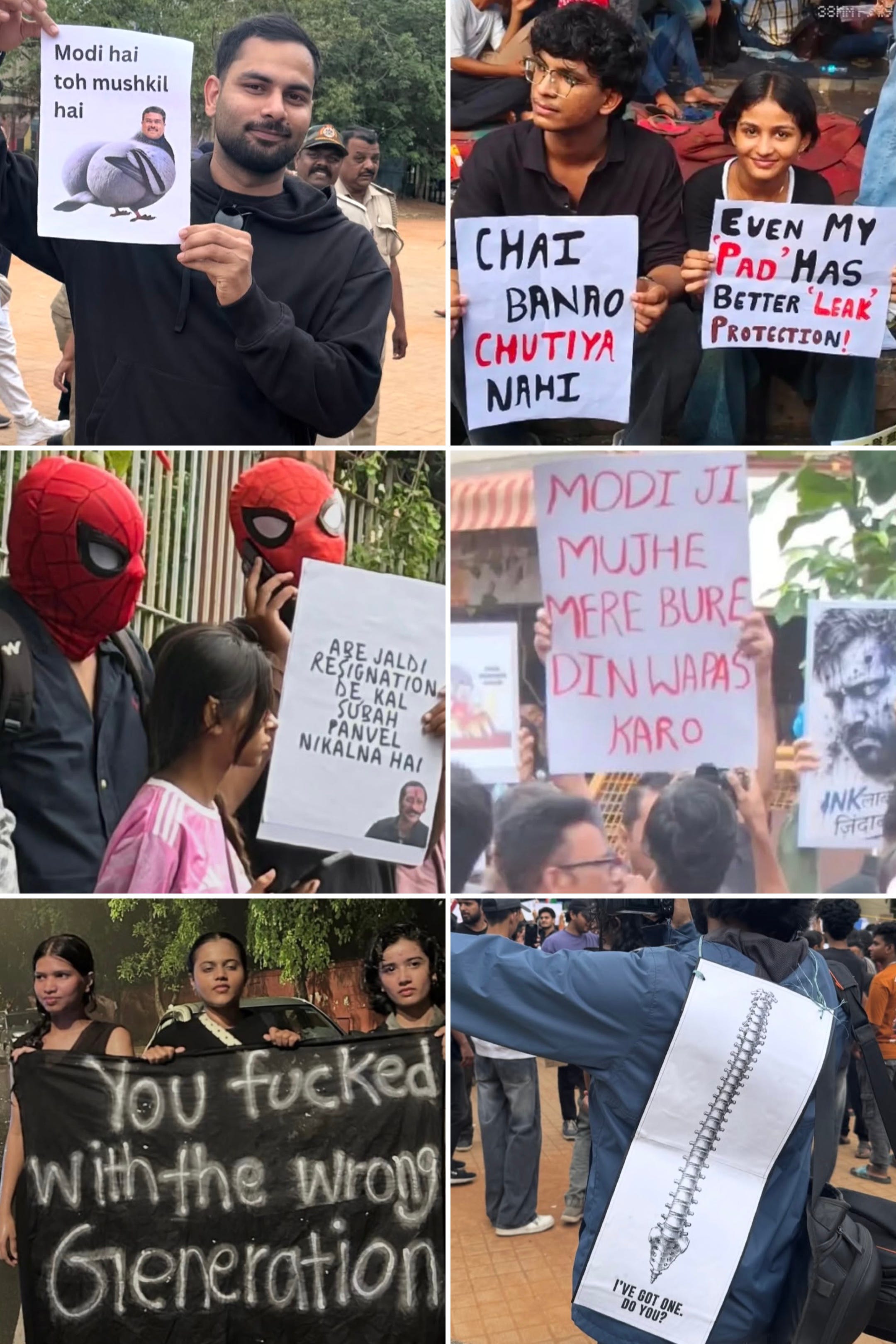
So, naturally, at the protest site, the dheeth showed up in full: mind, body, soul, style, all combined.
In the face of Delhi police’s lathi-charge, threats, and batons, the young chose the weapons they wield best: crass, blunt humor and some gall.
They made “get ready with me” reels and “fit check” posts for the protest, dressed as Spider-Man and Batman, rain-danced under water cannons, kept their Strava running streaks alive, played the Subway Surfers tune during their police chase, and posed for photos while being detained.
They tuned into Faiz’s poetry, Divine’s rap, and Rang De Basanti’s album. Joy was their act of dissent.
For once, the mainstream media narrative of “tukde tukde gang,” “violent protesters,” and “anti-nationals” failed because it could not fathom nor control the Gen Z counter of plain, harmless mockery.
The solidarity was felt beyond borders. Those who couldn’t join the main Jantar Mantar protest found creative ways to contribute. Some ordered food through Zomato, Swiggy, and other food-delivery apps; rickshaw and cab drivers ferried students to the site for free; others brought bottled water, medicines, and even power banks.
A Sikh and a Muslim man were cooking together for the protesters; doctors were treating injured kids for free; lawyers were taking their cases pro bono; independent journalists were holding the fourth pillar upright on their own.
Now, in Gandhi’s country, how long could one ignore such camaraderie?
On July 25, the government conceded. The students’ demands were met, and the minister resigned.
As a young journalist, I’ve witnessed and reported on more than a dozen protests, most of them in the nation’s capital. But not once have I seen the government compromise its high ground and accept all demands of a protesting group within a few weeks.
This is also, by no means, the first time such a large-scale mobilization has unfolded under the Modi administration. In 2020-21, the farmers’ movement grew into one of the largest protests in human history.
After more than a year of public pressure, the government met the key demands and repealed the new farm bills. It took a long time, and no minister took direct accountability or resigned.
In fact, resignations have been as scarce as logic is in superstition since Modi became prime minister. The last and only other one during his tenure was in 2018, when MJ Akbar, the then Minister of State for External Affairs, resigned amid India’s #MeToo allegations.
So, why did this protest find relatively quicker success? What was different this time?
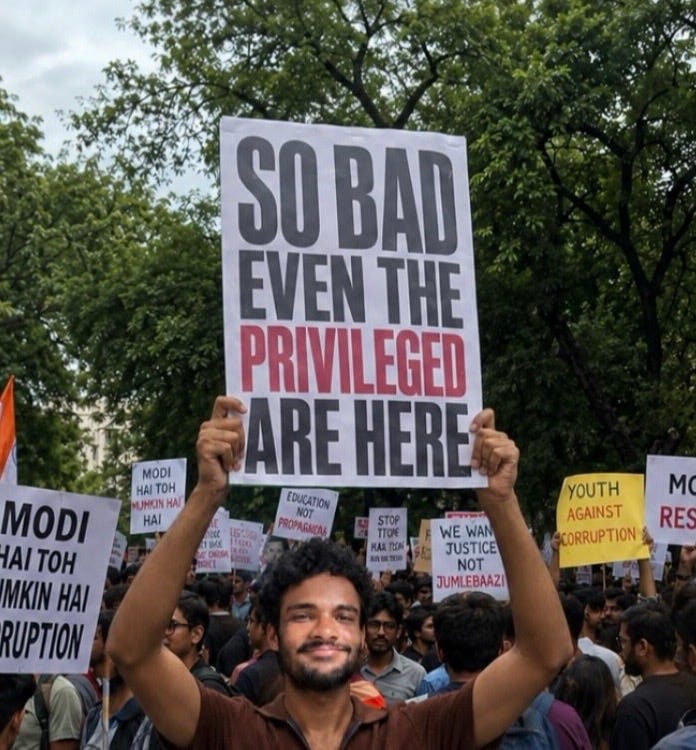
Perhaps, it was the unusual origin story of a movement erupting from sarcasm, or that the issue of education and crushed accountability measures had brought the urban elite, the middle class, and the die-hard Modi fan out on the streets too.
What is pertinent now is the next step for CJP and for those watching this closely. Will the members enter party politics, raise more democratic questions, and demand other resignations? We can’t ascertain yet.
The power of the people is much stronger than the people in power. -Wael Ghonim
But what this protest has done impeccably is prove loudly that no government is infallible or invincible or above the people it serves. That in a democracy, the elected are not godly, and are simply those answerable to the electorate.
25 July, 2026. It’s a day to remember, to behold, and to be inked into India’s history. Why?
Not because of one minister’s resignation letter. Because, in the mother of democracy, people care. Despite the batons and lathis, despite the internet shutdown and the metros closed, people care. They care enough to show up.
The roaches are here to stay.
No posts
Comments
Nothing yet. Say the first thing.
Sign in to join the conversation.