
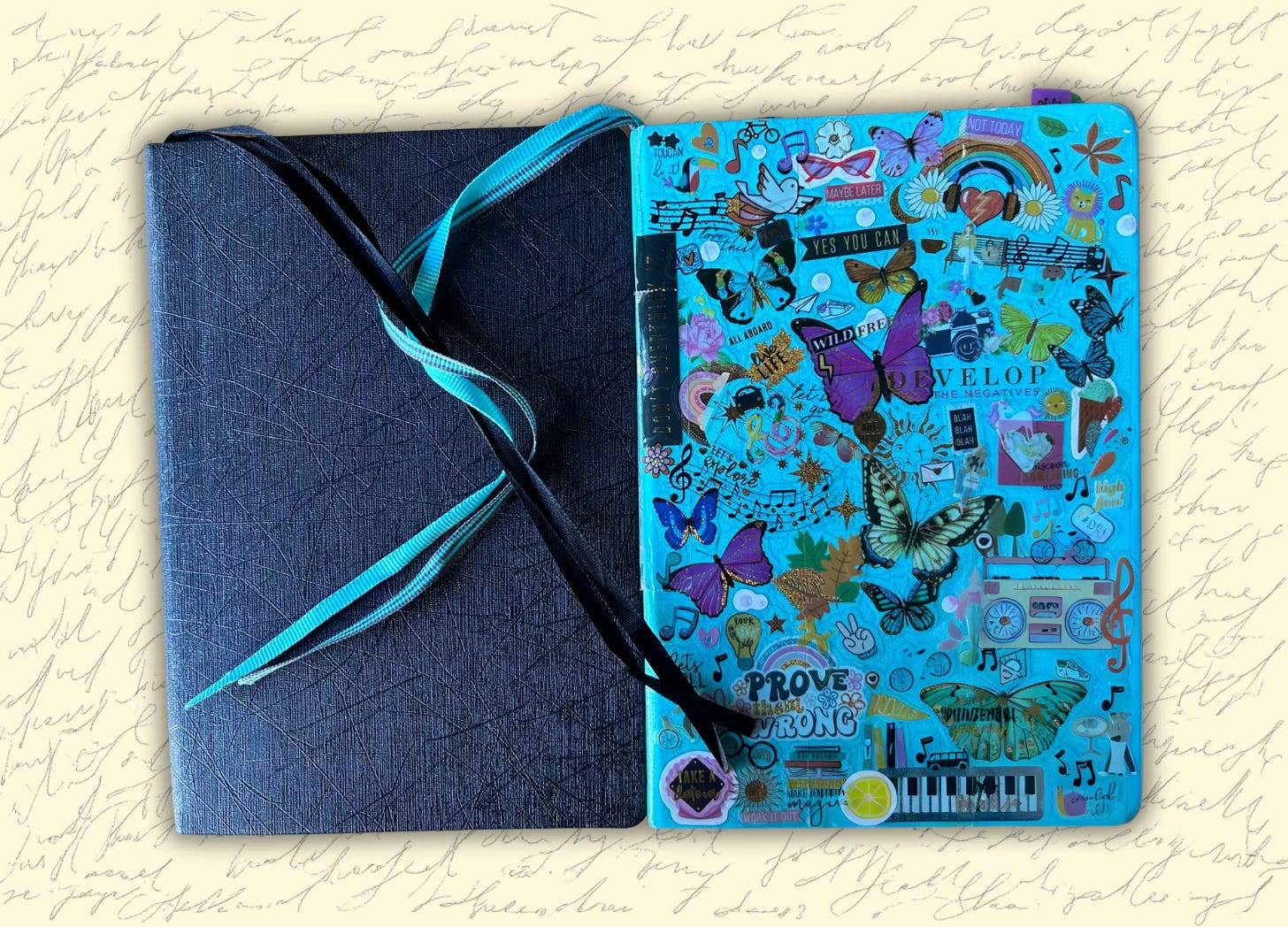
For decades, I maintained two separate personal writing systems: a planner for tracking tasks, and a journal to record my experiences. The journal was self-care — a way to listen to myself and my body. The planner was for keeping myself accountable.
Each notebook served its purpose, helping me progress toward goals and practice self-compassion. However, because the planner only looked forward while the journal looked back, the tools did not speak to each other.
The result was day-to-day decisions made in blind limbo. Unexpected developments or internal states could thwart my plan, yet I had no mechanism for using these experiences to improve my planning.
Happily, in this past year the two systems have merged.
Here’s my newly integrated approach, why I love it, and suggested practices for closing the gap between these two systems.
My current process is synched to my hormonal cycle, but this approach could work equally well as a monthly or quarterly ritual.
At the start of each new cycle, BEFORE PLANNING, I complete three exercises in my journal:
Big-Picture Reflection. Where am I relative to the major milestones ahead, like graduations, retirement, and multi-year projects? Are things still on track?
Micro Evaluation. How did this latest cycle go? Was the plan I crafted realistic? How am I feeling about what happened?
Cycle Harvest. Here’s the real magic. I read back through everything I wrote in my journal during that cycle and harvest any actionable insights.
Only then do I determine my expectations (plans) for the next cycle.
With separate systems, my planner took an idealized view of the future, whereas my journal held messy encounters with reality. The journal did nothing to bring insight to the plan, nor did planning offer structure to the journal.
Now, by engaging a recurring process of harvesting insights, each cycle becomes a feedback loop rather than a reset. Expectations are informed by what actually happened, not just what I hoped for or worried about.
On a practical level, this process has improved my calibration. Planning had become more realistic. I can reliably distinguish the “non-negotiable” tasks from the “also worthwhile” and ensure my plans are centered on the former.
In terms of my mental health, the difference is stark. My attention has pulled back from the future. Instead of projecting months ahead — anticipating problems I might encounter, rehearsing outcomes, and reacting to imagined constraints — I stay tuned to the present cycle. I know the best indicator of what comes next is what’s currently happening, and I use real-time inputs to revise my expectations.
I do acknowledge a risk to operating on a short reflection cycle. It is tempting to overreact to one-off events and restructure my planning as though one anomaly is the new normal. My countermeasure is the “Big Picture” reflection that initiates the planning process. Beginning with the long horizon restores context, ensuring I don’t turn short-term disruptions into signals to overhaul the system.
If this way of working resonates, here are a few experiments to play with closing the gap between journaling and planning.
I began reading (and shredding) my stockpile of journals a few years ago. At first it was a frustrating cringe-fest, but soon I saw recurring patterns in what affected me and how I reacted. My journals have now become my greatest source of intel on what works for me personally, what sets me off, and which seemingly reasonable strategies backfire in practice.
Pick up an old journal — a recent one or an early edition — and see what it wants to teach you.
My planning horizon has steadily shortened. First, reading the 12-Week Year pulled me back from annual goal-setting to quarterly cycles. Last year, Lucy Peach’s Period Queen helped me leverage the distinct phases of the menstrual cycle.
If you’ve been planning in annual or 6-month windows, try reducing the time scale. Shorter cycles create faster feedback and make it easier to revise plans without interpreting change as failure.
Particularly in times of transition and uncertainty, it’s crucial to limit the number of developments you are tracking. Editing these down is a type of nervous-system hygiene. Rather than forecasting outcomes in every domain of life, identify the top three to five long-term goals that really matter to you (e.g. kids graduate high school, marriage healthy, retirement savings intact). Limiting your expectations to true North Stars creates room for serendipity, growth, and evolution.
Instead of only evaluating my performance against the plan, I’ve learned to invert the question.
Assuming you did the best you could under the circumstances, how did the plan hold up? Did it underestimate time or complexity? Did it overestimate energy or other people’s cooperation? What would a better-designed plan have accounted for?
Taken to the extreme, this line of inquiry could become an excuse for procrastination, but without any skepticism about the plan it’s easy to get stuck in unrealistic expectations and unwarranted self-criticism.
Getting things done is a win. So is learning more about myself, my limits, and reality.
Don’t get me wrong, I’m still Type A. I want to check off all the boxes. But I have a larger goal of being in partnership with life as it continues unfolding.
Try giving yourself two pats on the back in your journal today: One for a task you got done, and one for a realization you had about why something didn’t happen.
For most of my life, I treated planning as a discipline and journaling as a refuge. But with intention and reflection combined into one process, I’ve become more honest about what I have time for. I say “no” much more than I used to.
I won’t pretend this short-cycle planning process has made life any more predictable, but it does help me accept how little I know of the future. Acknowledging that uncertainty helps me stay available to changing needs and circumstances. And when I’m open to the unexpected, I become more alive to the present moment.
In the end, that’s the outcome I care most about.
For a structured introduction to journaling, check out my 21-Day On-Ramp.
Thanks for reading The Navel Gazette! This post is public so feel free to share it.
No posts
Comments
Nothing yet. Say the first thing.
Sign in to join the conversation.