

Journaling, in some circles, has a reputation for encouraging one to wallow in complaints and bitterness. Many who tried journaling as a teen did so for this purpose, escaping into a notebook to vent their grievances. The stream-of-consciousness “Morning Pages” tradition explicitly condones this practice, and with good reason: Dumping emotional sludge into your journal can clear space for more creative thought.
While I stand by the value of the written purge, and often use it, I’m equally committed to offering complementary techniques. Whereas the free-writing approach transcribes internal chatter, revealing the mind’s habitual fixations, journaling prompts instead intentionally self-direct attention. In this way, prompts offer doorways into lesser-traveled psychic corridors.
We can use journaling prompts, for example, to reach for inner guidance, explore a range of futures, decode frustration and resentment, or gather wisdom from our dreams.
For those who have only journaled with the sludge-dump method, using prompts can be a welcome uplevel. I often hear in my 21-day journaling course, “I didn’t know journaling could be so effective for positive thinking.” As one participant commented, “My biggest take-away is how different journaling is with prompts than the stream-of-consciousness, ‘morning pages’ style of journaling I've done most of my life. It's helped me get more specific in reflection and the specificity has led to clarity on a number of issues.”
“My biggest take-away is how different journaling is with prompts than the stream-of-consciousness, ‘morning pages’ style of journaling I’ve done most of my life. It’s helped me get more specific in reflection and the specificity has led to clarity on a number of issues.”
This article provides a primer on how to journal using prompts. Whenever you’re ready to get started, check out the many 10-minute prompts I post in my Substack Notes. I frequently share fresh journaling ideas there.
A prompt is a starting point for a journal entry. I think of it like an ice breaker, getting the conversation flowing. It can take any number of forms, such as:
Question — What’s your ideal weekday afternoon?
Fill-in-the-blank — I’ve had a great afternoon when I …
Memory triggers — Call to mind a typical afternoon in high school.
Descriptive cues — Describe the environment you inhabit most weekday afternoons.
Inventories — List your usual afternoon activities.
Prompts can be light and gentle or deep and probing. I love using practical prompts like “What’s the next obvious thing I need to do?” or “I would gladly turn this task over to someone else, so long as they ______ .” On other occasions I’m eager to spelunk my soul with questions like, “When did I come to believe this about myself?”
Free-writing can be a wonderful release and remains my go-to when my mind is spinning, my heart is aching, or a nascent idea begs to be hatched. But while brain-dumping lets me see what is now present, prompts allow me to shift my state, unearth deeper knowledge, or reveal new possibilities I’d like to explore.
One straightforward example is the gratitude list. Arguably the opposite of the wallow, this technique focuses the mind on the good and helpful things that have come your way. If this is your first time using prompts, it’s a great place to start. Give yourself five minutes and keep listing things you are grateful for until the time is up.

Right away, you’ll notice a change in how you feel. We can use prompts to direct ourselves toward any desired state, like reverence, trust, eagerness, or courage. We can also gain clarity by posing questions like, “What am I ready to say ‘no’ to?” and “What would I love to experience?” Prompts can help us brainstorm, play devil’s advocate, work through a problem, or recall memories we’d like to preserve.
Essentially, prompts let us choose the direction of our thinking.
Writing prompts are not quizzes. You cannot fail a prompt. There are no right, wrong, better, worse, or universal answers. You don’t need to write “well” or clearly, follow rules of grammar or composition, or even make sense. This is for your eyes only. No one else would write what you write. That’s the whole point.
This is for your eyes only. No one else would write what you write. That’s the whole point.
Prompts are also not requirements. If you don’t like a prompt, don’t use it (though it’s worth noting some course participants get the most value out of prompts they initially resisted). You are free to amend any prompt. Please do! Make up your own.
Finally, prompts are not guaranteed revelation-inducers. You might have an “aha” moment; you might not. It’s best not to expect a breakthrough in any single session.
Over time, however, you can absolutely look forward not only to gaining mental clarity but also to experiencing measurable health benefits. Among the many documented effects of journaling are reduced inflammation, improved immune response, and even positive changes in blood pressure and lung and liver function.
Journaling is much like meditation or exercise in this way. One session will likely leave you feeling a bit better — which could mean more calm, uplifted, or grounded, depending on your starting point — and over time, the benefits radically compound.
You do not need any special tools, just something to write with and something to write on. Although some writers are very happy to journal digitally, I always recommend at least trying the longhand approach. Writing by hand has documented cognitive benefits, anchors you in the sensory experience of the present, and slows you down in a way that supports reflection.
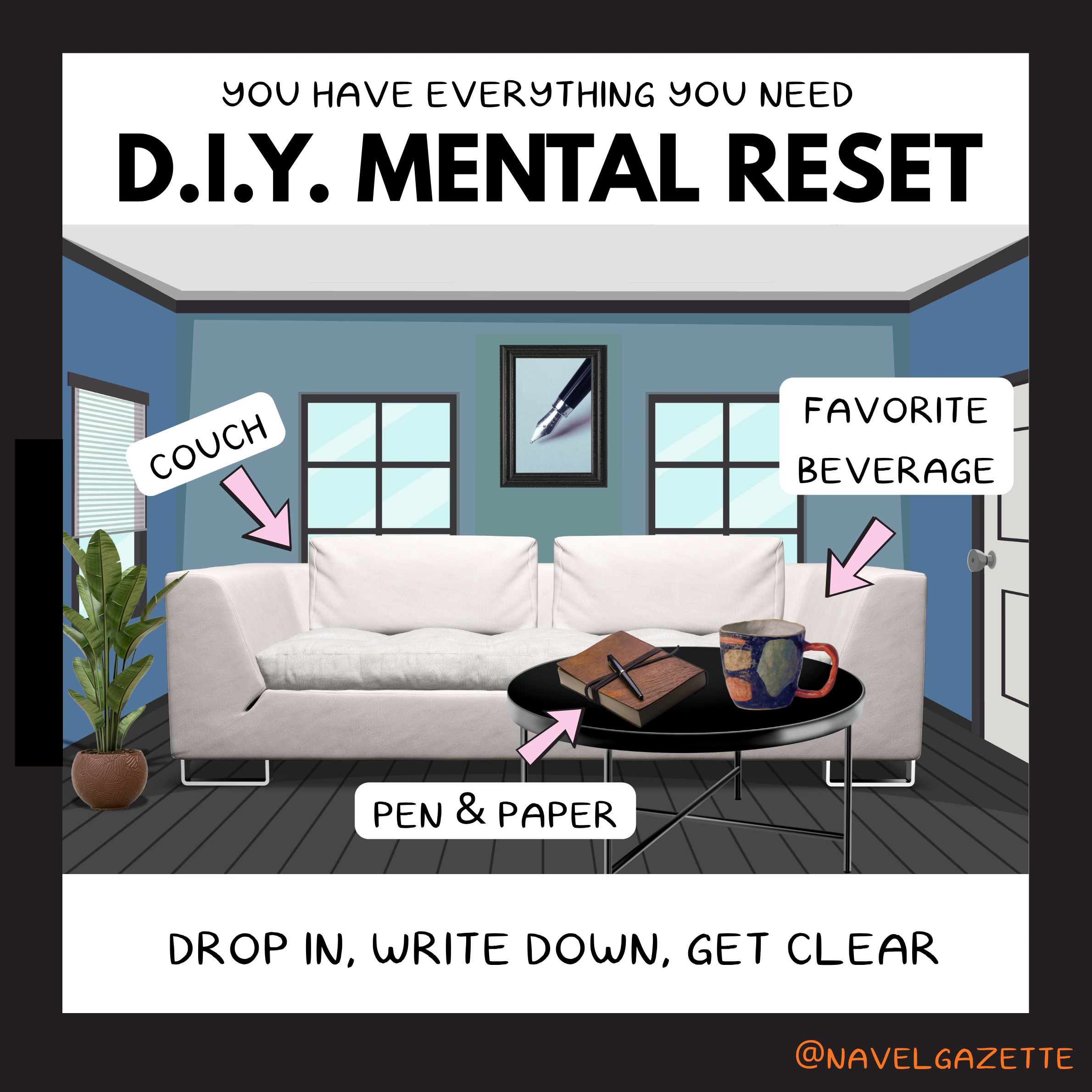
While any pen and paper will do, decades of journaling have led to some principles of journal selection that may be helpful as a guide. At a minimum, I suggest:
Ruled (lined) pages that suit the size of your handwriting
Pages that lay flat when open
Robust paper to prevent pen marks from bleeding through
Cream or white paper that’s easy on the eyes
Once you have your supplies and a space in which you won’t be disturbed, I strongly suggest setting a timer. Ten minutes is enough; most research documenting the benefits of journaling uses 15-minute sessions. The timer keeps the commitment manageable while helping sustain your focus.
Turn off all notifications. Treat yourself to a steadying breath or two. Arrive.
Begin by writing the prompt at the top of the page. From there, all you need to do is keep writing. Whatever answer, reaction, or idea arises in your mind, write that down.
One way to engage is to imagine someone you love and trust inviting your reflections. How would you respond if your best friend brought this up over a relaxed coffee on a bright morning or a cold beer on your back porch?
How would you respond if your best friend brought this up over a relaxed coffee on a bright morning or a cold beer on your back porch?
That said, if it helps you feel comfortable, qualify your writing however you want: “I’m surprised that I’m thinking … This feels awkward/cringe/pointless … I hate to write this, but … I can’t believe this came into my mind.”
You can even reject the prompt after writing it down: “Instead of answering that, I’m thinking about … ”
Keep in mind that no one else is ever going to read this. You can shred the page when you’re finished if you like.
You really couldn’t screw this up if you tried. In a weird way, the worse it is, the better, because the goal is to experience something outside the approval structure of the external world.
Per my journaling philosophy, prompts are merely ways to get the pen moving. You can stay focused on the prompt for however long you like or wander off onto another topic. One of my core tenets of journaling is “Make room for the muse.” If you are pulled to write about something else, by all means do so.
If you go blank, first of all take a moment to experience the rare gift of a quiet mind. What’s it like to be without thought? Linger in that gap while it’s open.
Thoughts will rush in, I guarantee it. Whatever comes, that’s what you write. This could be:
“Nothing is coming to me.”
“I don’t know what to say about this.”
“This prompt makes me feel … ”
“I wish I had a better answer, but … ”
“I have no idea where this came from … ”
Trust what comes through.

Before returning to the outer world and all its pressures, take just a moment to sit with what you wrote. Notice its effect on your mood and energy. You might want to read back through your entry and underline anything that feels particularly potent.
If you liked the experience, this is also a good time to schedule your next journaling session. Like a dream that fades on waking, you will likely forget just how easy and impactful that short session was. Again: 10 minutes is sufficient. Like just about every health-promoting activity, incremental and consistent practice is far more transformative than rare bouts of long duration.
If you read this far, you are definitely ready to give this a go. Try just 5 minutes.
Grab any pen and paper.
Set a timer for five minutes.
Pick one of these prompts:
I’m grateful for …
If I could have any three wishes granted this week, they would be …
I think journaling might be a good idea because …
Don’t stop writing until the timer goes off.
Pause and notice. What shifted? How do you feel?
There is no wrong way to get started, but if you’d like a structured introduction providing a range of techniques and approaches, check out my 21-Day On-Ramp.
Thanks for reading The Navel Gazette! This post is public so feel free to share it.
No posts
Comments
Nothing yet. Say the first thing.
Sign in to join the conversation.