
Despite the recent cold weather, it’s been good to get out and about to see some of winter’s natural spectacles. February of course is a good time to see snowdrops and the occasional clear night has given the chance to see a phenomenon that has been widely trailed in the media: a planetary alignment.
One of the pleasures of seeing snowdrops is that it’s an early sign that spring is on its way and the UK’s snowdrop festivals give a good idea of when peak viewing times may be. In Scotland, the Scottish Snowdrop Festival runs from late January to early March, with many gardens and country parks opening up especially for the event, while in England, Wales and Northern Ireland the National Garden Scheme offers similar opportunities too.
Another way to check timings is to look at the Woodland Trust’s Nature’s Calendar website, which tracks key happenings during the year for a wide range of species, including trees, birds and flowers. This winter, the first snowdrop sightings were reported in December and were well underway by mid-January, with the most recent ‘live map’ showing sightings from Cornwall to Shetland.
In the right setting, snowdrops are quite photogenic too but I’ll freely admit that the image below is just a quick snapshot; last year’s post ‘Photographing snowdrops: how hard can it be?’ gives some insights into how to do better!
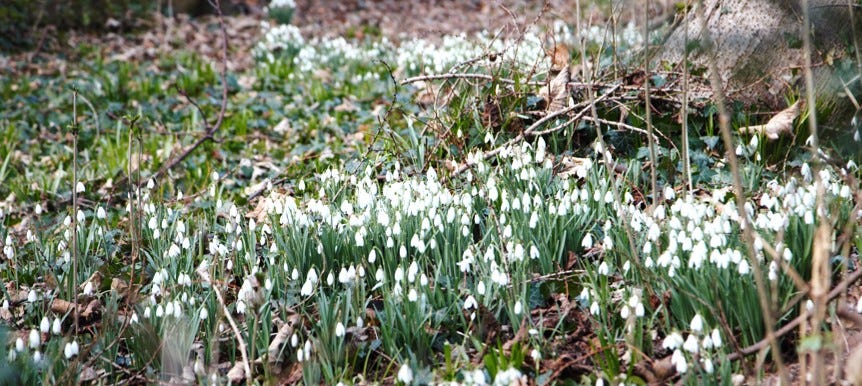
First snowdrop sighting of the year in a local wood
Looking skyward now, the recent cloudy nights haven’t been a great help with stargazing, but last month we had our first taste of the ongoing planetary alignment. Heading out on a whim at about 6pm, quite by chance Saturn was cradled in the moon’s crescent, with Venus shining brightly beyond. Looking more to the south, both Mars and Jupiter were visible higher in the sky. Within half an hour, though, they were already being covered by an incoming layer of high cloud.
While it’s not unusual to see individual planets, what makes a planetary alignment special is the chance to see several at once. The best viewing time is anticipated to be soon after dark around the date of the next new moon (February 28th), with all seven planets visible at the same time, or eight if you count our own.
The best dates/times depend on your location so search online for advice on when and where to look and/or use a stargazing app. One tip is that they should be aligned along an arc stretching across the sky so, once you’ve spotted two or three, the others should be easier to find.
You will probably also require binoculars or a telescope to see Neptune and Uranus, and spotting Mercury could be more challenging too. However, ignore the graphics you may see showing the planets all in a perfect straight line stretching out from the sun as the reality will appear less orderly than that.
If you’ve enjoyed reading this post, please do share it with anyone you think might be interested to read it. Thanks!
Comments
Nothing yet. Say the first thing.
Sign in to join the conversation.