
Welcome to the November issue of Nature’s tidings, with news of autumn leaves, a supermoon and geese migrations.
Autumn colours are still in evidence around here, which is perhaps not so surprising due to the unusually warm and sunny summer we had. The first widespread displays began last month, with the change occurring quickly; for example, on trips in southern England, the Lake District and Scotland just a month ago, the only signs were for a stand of acers (maples) in an arboretum, which are often one of the first to turn.
Admittedly, though, that’s based just on my impressions and the fabulous Woodland Trust’s Nature’s Calendar site gives a much more complete picture, reporting first sightings of ‘full autumn tinting’ in the UK on about 6 October for field maple, 7 October for ash and 16 October for the common oak.
In Japan, online reports suggest that colours have recently appeared there too, including for the ancient ginkgo tree – also known as the Maidenhair tree - in local parks. Other star autumnal species in Japan include rowan, elm, maple, beech, birch and oak. However, in the USA, fall foliage maps suggest that things are further advanced, and are already past peak colours in the north, although still to emerge fully to the south.
Looking to the skies, despite the good weather cloud cover defeated my attempts to see two notable astronomical events in the past few weeks. One was of a rare total lunar eclipse and the other was billed as the largest supermoon of the year.
The word ‘supermoon’ of course is not an astronomically precise term, but its introduction has helped to widen interest in astronomy, which can only be a good thing. They occur when a full moon occurs closer to the earth than usual, so that it appears slightly larger than normal, with most definitions suggesting that three would occur this year (but with some more than that).
The last will be in early December, so check online for local timings, such as from the excellent www.timeanddate.com. This full moon is widely known as the cold moon for obvious reasons, and as usual the best sightings should be just as it rises above the horizon. This is due to an optical illusion called the ‘Moon Illusion’ which makes the moon look larger when close to the horizon. Next morning, you should have another opportunity as the moon sets.
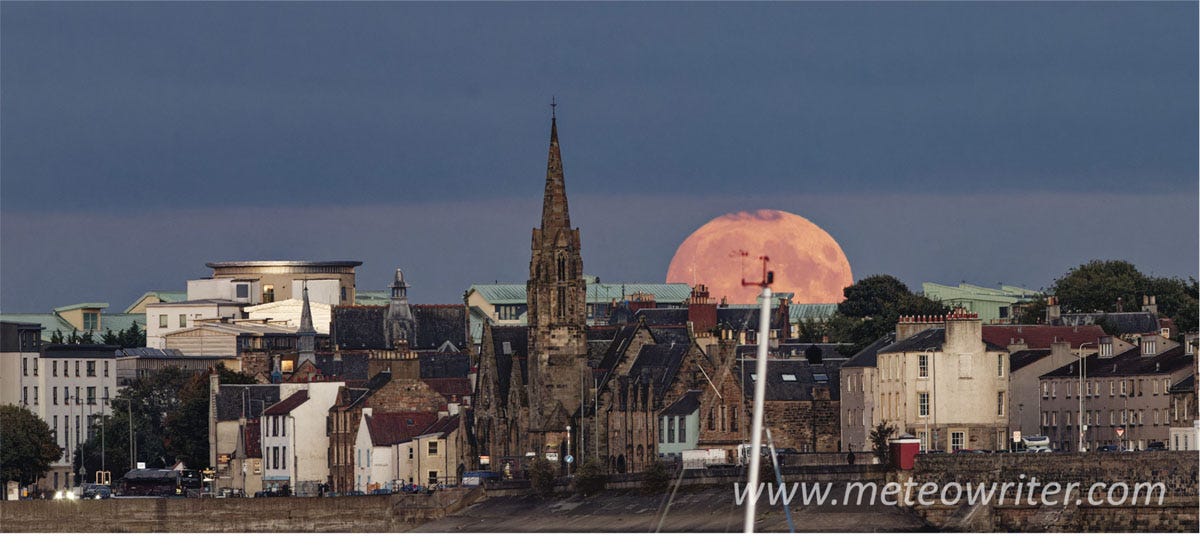
A supermoon rising last September
If you would like to take one of those classic photographs with an interesting monument, tree or other landmark silhouetted against the moon, you’ll need to do some research first with a compass and map (or online equivalent) to decide where best to wait, and be prepared to move quickly if your calculations are out. If this is your first attempt, one option is to go out the night before to practice with camera settings etc., although bear in mind that the time and location at which the moon rises above the horizon varies significantly each day. Of course, no amount of planning can get around skies being cloudy on the night…
This autumn, another welcome sight has been that of the huge skeins of geese that have returned for the the winter from colder climes. Indeed, a loudly honking group flew over the house at the weekend just after sunset, returning to the safety of coastal waters after feeding inland all day.
In the UK, some of the largest numbers are for pink-footed geese, particularly in Scotland and around the Wash in Norfolk. The Scottish Wildlife Trust’s Montrose Basin reserve sees some of the earliest arrivals and this year reported the first in early September, and more than 40,000 by the end of the month. Numbers here peak at more than 70,000 in some years.
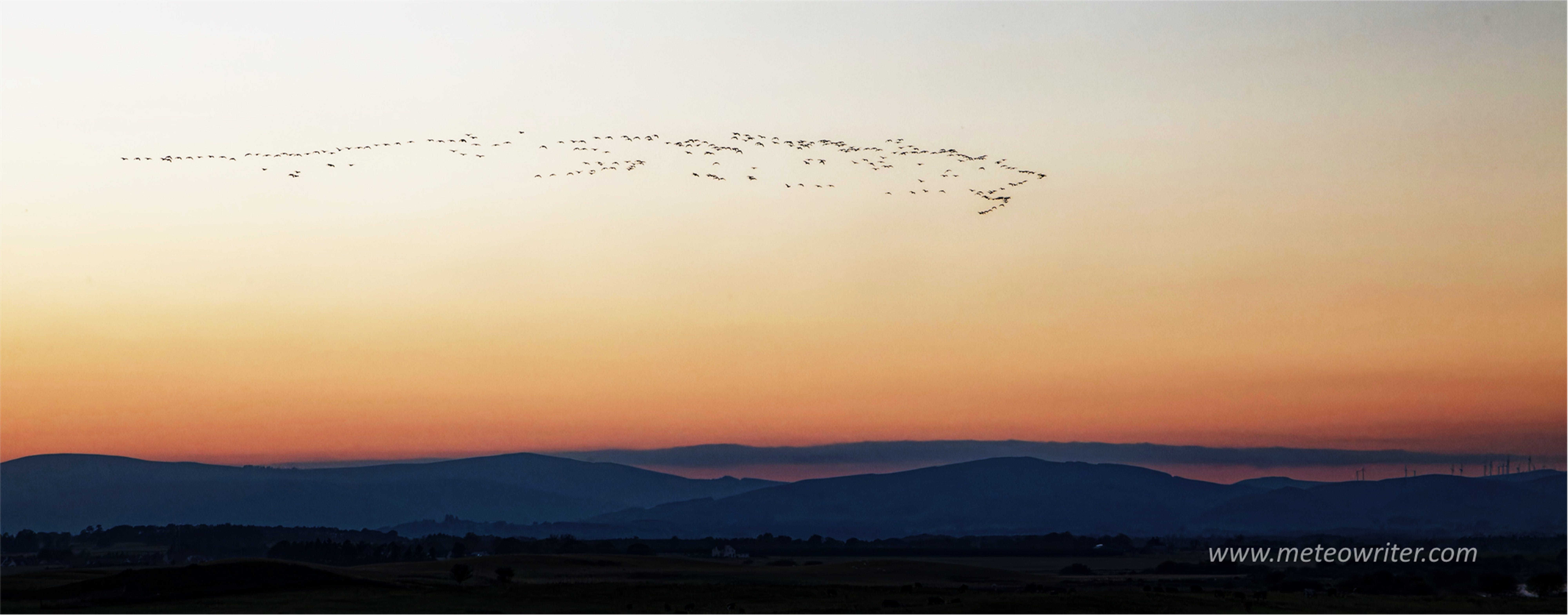
Geese arriving at Loch Leven(October 2025)
Last month, as the light faded we were lucky enough to see a group fly into another Scottish nature reserve - the RSPB reserve at Loch Leven. It was getting a bit dark to be certain but some looked as if they were whiffling; a strange but aerodynamically sound behaviour in which they momentarily shed lift by rotating their bodies and outstretched wings while keeping their heads level and facing steadily forward.
Of course, many other species of birds migrate in autumn too, and the BirdCast project in the USA , which analyses weather radar outputs to track bird movements, recorded a remarkable new record last month with 1.25 billion birds in flight to their wintering ground during a single night.
So, that’s a just a flavour of autumnal spectacles and I’ve not even mentioned rutting deer, leaping salmon, starling murmurations, or grey seal pups.
Nature’s tidings will be back early next year with a refreshed format, including more information on weather and tidal phenomena, but still discussing wildlife, space and other natural spectacles. In the meantime, I hope you enjoy any sightings you make too.
Further reading
Pink footed weather forecasters A previous post giving more insights into geese migrations, including how geese make use of favourable weather conditions when deciding when to fly.
Pink footed weather forecasters - link
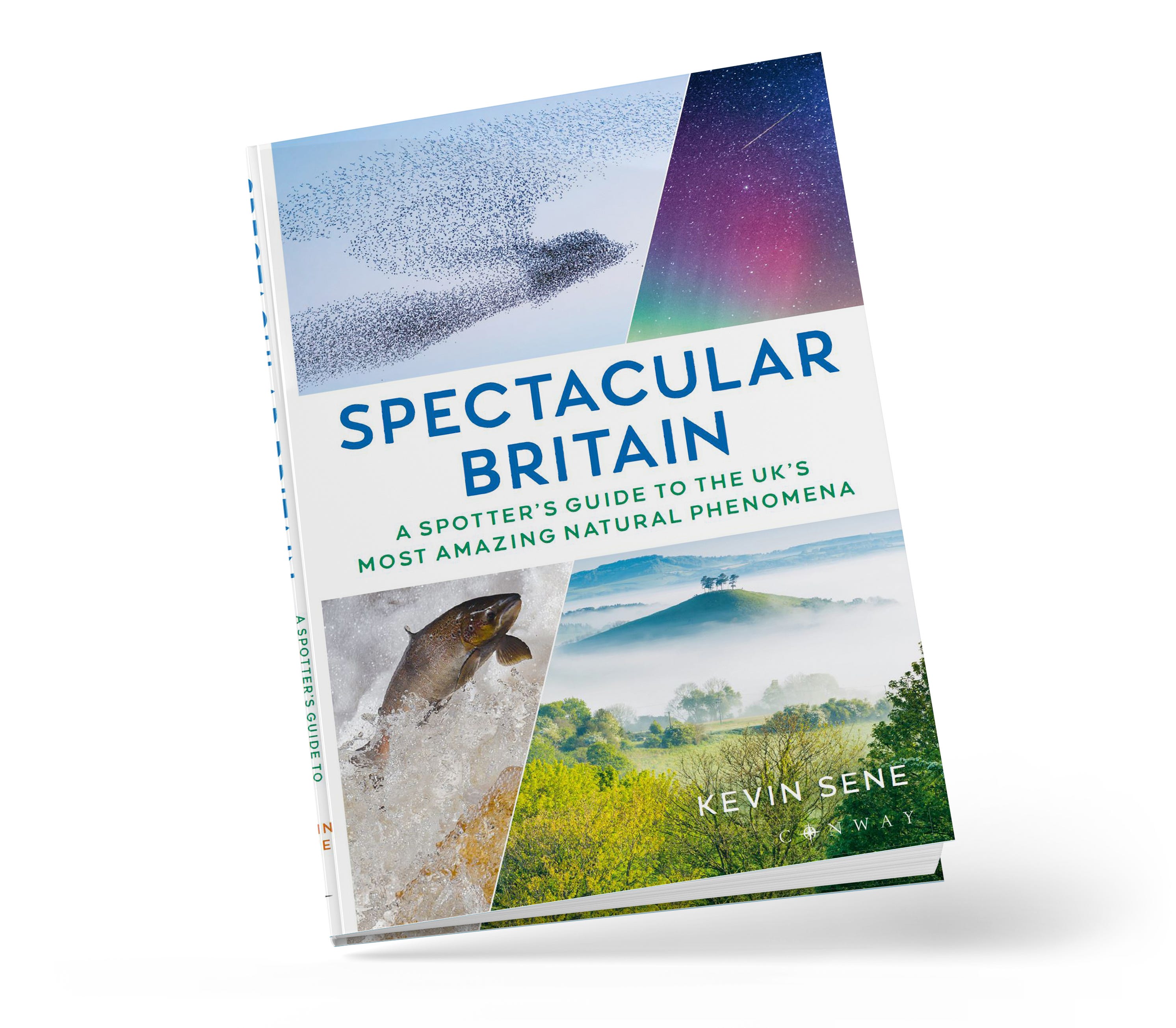
Spectacular Britain: A spotter’s guide to the UK’s most amazing natural phenomena: Kevin Sene, Bloomsbury, 2024. For further insights into autumn leaves, supermoons, geese migrations and more than ten other space, weather, tidal and wildlife phenomena.
https://www.bloomsbury.com/uk/spectacular-britain-9781844866342/
If you’ve enjoyed reading this post, feel free to share it with anyone you think might be interested. Thanks!
Comments
Nothing yet. Say the first thing.
Sign in to join the conversation.