
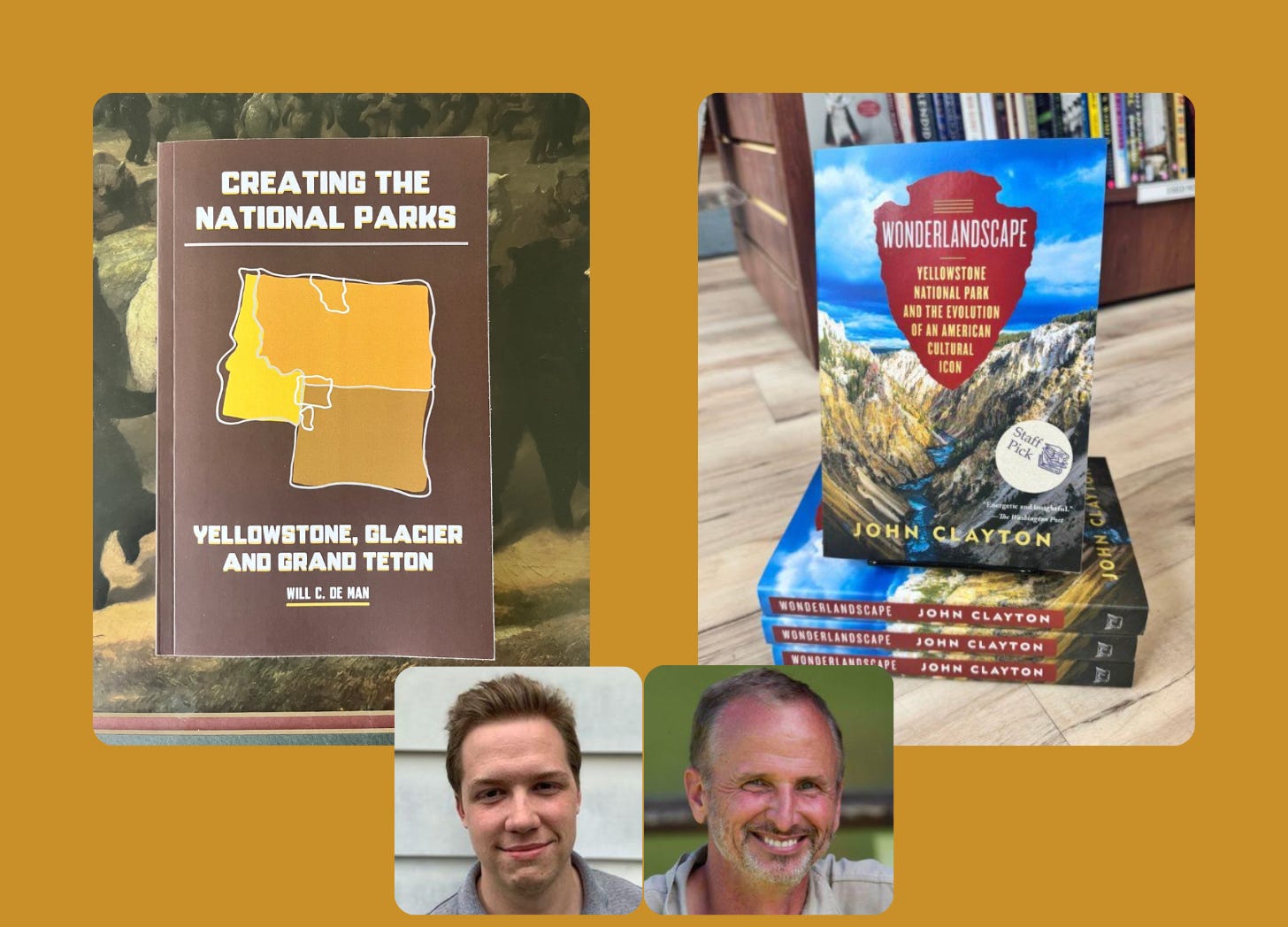
John Clayton: Welcome, readers, to something a little different: Will C. De Man and John Clayton have both recently published books about the history of Yellowstone National Park, and the books are similar-but-different. So we decided to have a conversation about it, and share that conversation in each of our email-newsletters simultaneously. Let me start, Will, by asking you: What made you want to write this book?
Will De Man: In my day job, I’m a middle school history teacher. I love my job, but a majority of what a teacher does in a day has less to do with the content you’re delivering and more to do with the humans you’re developing. You’re managing their schedules and absences, catching up some students, giving extensions to others. Setting classroom policies. The history content I teach has to be tortured and reshaped into something that a twelve-year-old with minimal life experience and world context can make meaning out of.
This is really fulfilling work, but it’s not the discipline of history—which I love just as much as teaching in the classroom. Writing a book is a way for me to practice the art and science of what I’m hoping my students are learning to love. I like to think of myself as a grounding example of a historian. My students think of historians as old, dusty library- and museum-type people. As a goofy 20-something teacher, I provide a contrast to the stereotype that I hope encourages them to pursue their interests in the topics I teach.
John, your background is in journalism. I definitely see that play out in the way you’re able to find a unique frame for a topic, and also in the rigor of your research and precision of language. I first discovered your writing through your book Natural Rivals. Did it feel like a natural leap to move from journalism to book-length history writing?
John: In high school, I did sports journalism because it combined my passions for writing and basketball. In college, I started doing more news and features because I was curious why things were the way they were. In class, we tried to answer that question through economics or policy or psychology. At the paper, we just asked people to tell their stories and wrote down those (fact-checked) answers. As I wrote those stories, I came to see the power of – in today’s trendy word – “narratives.”
I wrote Natural Rivals because I wanted a narrative to answer the question, “Where did public lands come from?” I wrote Wonderlandscape because I wanted a narrative to answer the question, “Why is Yellowstone famous?” I enjoyed the questions because they seem simple, we think we know the answers, but the stories behind them have the power to surprise.
Your questions were more about the idea of national parks, yes?
Will: My book projects actually started very similar to the question that spurred you to write Natural Rivals. I remember standing in Fruita at Capitol Reef National Park. I thought to myself, “Who was it that first saw this place and thought to themselves ‘every American has to see this!’” It turns out that the answer wasn’t that far away—my wife and I later hiked to the Hickman Bridge, named after one of the Utah state politicians who led the charge to protect the Waterpocket Fold. They originally wanted to call it the “Wayne Wonderland,” which is such a charming and silly name to me.
In all the work I do as a storyteller of the past—whether it be in writing or in the classroom—I think I’m always trying to communicate that history isn’t actually just a series of events and actions. It’s all about internal motivations and beliefs. My original research question began as “who” and has certainly transformed more into a “why did someone see this place and want it to be protected?” I think the answer to that question is fascinating, which is why I’ve focused my research on the origin stories of national parks.
John: I love Capitol Reef! My cousin used to be a ranger there, and many years ago when I was writing a guidebook for National Geographic, he gave me like a three-day tour—which I had to distill to like a single paragraph in the book.
Can we talk about communication formats? I’m in awe of your social-media skills. You have large, well-deserved followings on Substack, Instagram, Threads, and probably elsewhere too. Yet you’re committed to books. I can’t believe that books are the best way to monetize that audience—so can you talk about what books mean to you?
Will: Social media is fun, but it essentially functions in the opposite of history as a discipline. Social media is about quick hits. History is a slow burn. Social media rewards rage-bait. History requires nuance. Writing books is certainly not a lucrative way to monetize an audience, but I view it as an extension of my teaching profession. I’m trying to pique the interest of my audience by being informative and accurate on social media, with the hope that they’ll want to learn more.
As you note, I’m pretty committed to longform writing. As a result, I feel like I’m coming up with new book ideas constantly—which is a little silly when I’m still in the early stages of trying to sell my most recent book. Is that something you can relate to?
John: Oh, totally! I’ve already submitted a draft manuscript for my next book, but it won’t be out until 2027 so I really shouldn’t talk about it now. And although I should be helping my publisher sell Wonderlandscape to readers, I keep getting distracted by thinking about how to sell the next project to the next publisher.
When it comes to selling a book to readers, I think it really helps to start in the present. Whenever we talk about history, we’re trying to explain a present moment. I tend to think about present culture, like the “Yellowstone” TV show. And you’re really good about present politics, including the dispossession of Indigenous lands. That focus leads me to a question: How do you define success for your book?
Will: For me, success is found in the opportunity to open or complicate someone’s perspective through education. Since you mentioned the dispossession of Indigenous Americans (which is a focus of Creating the National Parks), I’ll use that as an example. “America is stolen land” is a pretty ubiquitous phrase these days, and when checked against what I understand to be true of American history, I’ve always agreed. However, it wasn’t until I started digging into the history in the book that I really started to understand the depth of truth behind that concept. “Stolen” isn’t just a buzz-word; it’s a literal, accurate description of what took place. Though I agreed with the concept, I didn’t fully understand the truth of it until I dug more deeply into the past.
One of my hopes for Creating the National Parks is that it will give people the opportunity to gain a similar understanding. Historical discourse–especially on social media—is fairly shallow and sensational. For me, success means providing a resource via books that can hopefully bring both nuance and complexity to how people understand the history of our national parks. In the classroom, I’m always pushing my students for more depth and detail in how they understand the past. That’s my goal in writing about national park history as well.
Of course, writing is a side-gig for me, so the stakes aren’t quite as high. What does success look like for you, as a full-time professional writer?
John: There’s a money component: I need to make enough to pay the mortgage and buy a microbrew on Friday night. There’s also a quality component: I want to write a really good book. And call me a capitalist, but I find some correlation between the two: If the book is good enough, people will pay for it.
Yet more deeply for me, success—fulfillment—is in process. I love the process of compiling words into sentences, and sentences into stories. So one form of a book’s success is when it puts me in the financial or reputational position to write another one. Another form of a book’s success is the hours/days/years I spend lost and fulfilled in the process of creating it.
Thanks for joining me in this conversation! How should we end it?
Will: This has been super-fun, thanks! Maybe we end with: “Read books. Learn history. It’s fun”?
John: Perfect!
John Clayton’s book Wonderlandscape: Yellowstone National Park and the Evolution of an American Cultural Icon has just been reissued in paperback with a new afterword. You can read more of his stuff at the Substack Natural Stories. Will De Man’s latest book is Creating the National Parks: Yellowstone, Glacier, and Grand Teton.You can read more of his stuff at the Substack National Park History.
Comments
Nothing yet. Say the first thing.
Sign in to join the conversation.