
The day in March 2020, when the reality of COVID-19 hit my classroom, is impossible to forget. I was a public school teacher in California, and stories were already circulating about local schools shutting down and sending students home—L.A. County first, then Long Beach.
During recess, talking to my colleagues in the teacher’s lounge, I felt certain that our school would close. By lunchtime, we were texting back and forth from our classrooms while we refreshed the news. Then, only an hour before the end of school, a member of the office staff walked from room to room and told us to check our email. The message said the school would be closing for two weeks.
Most teachers didn’t send anything home with the kids. I had a strong feeling it was going to be longer and more serious than two weeks, so I made sure my students took some of their belongings with them that day.
I was one of the more fortunate teachers, working at a school where we had already adopted Google Classroom. I never imagined that, after 25 years of teaching, I would one day conduct my job from home while my students learned from theirs.
They told us it would be two weeks. I began messaging families, promising to stay in touch and explain next steps.
Those two weeks stretched into a year and a half of teaching from my house.
Many students lost touch immediately; they never logged in after the initial period. The technology proved difficult, especially for small children on Zoom calls, struggling to focus amid household stress. On Facebook, I saw some parents at the beach with their children, and I didn’t blame them for seeking normalcy in the chaos. Yet I knew those students were falling far behind. As a single parent with an elementary-aged daughter of my own, I struggled to manage her schooling alongside my teaching. I couldn’t fathom how families with multiple children coped.
The next Fall, students faced two options: hybrid (two days in-person, three on Zoom) or fully virtual academy. I enrolled my daughter in hybrid, wanting her to have face time with her teacher and friends, while I chose to teach the virtual academy.
Teaching online was surreal. It was the first year I never raised my voice. It was the first time I didn’t know most students’ voices or faces. Some disappeared for weeks or months; others showed up faithfully in quiet corners, ready to learn—though few completed full assignments, which we had already modified. Many turned in partial work, often supervised by siblings who were themselves missing school.
On a brighter note, I met everyone’s pets, glimpsed their homes, and shared a few Friday “lunch bunches” eating together on Zoom.
Looking back, history will likely judge prolonged school closures as a grave mistake. I would have returned full-time in person if given the choice. I was far more concerned about student achievement than about getting sick—I am healthy and middle-aged.
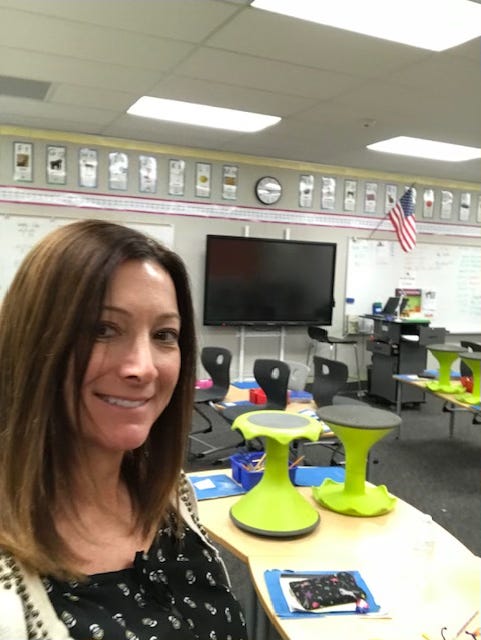
When I did walk in to my school, during that year when my daughter was engaged in “hybrid learning,” it felt foreign. There were plastic barriers standing between the teacher’s desk and the students’, with individual shields on every kid’s surface. They had to sanitize their hands constantly, and could not share materials. Group work? Forget it. Lessons happened at an arms-length away, no pats on the back, no hugs when tears came. The place looked sterile, hospital-like—cold, institutional, stripped of warmth. I was almost glad that I was teaching from home.
A neighbor, who teaches special education in a nearby district, shared early research suggesting it could take up to six years for students to catch up.
Even the younger students I teach today are not the same as pre-COVID kids. Families have been forever changed: screens have replaced game nights and movie nights; many endured divorce, job loss, or addiction. Behavioral issues and mental health challenges among young people are at an all-time high.
I didn’t used to be political at all. I was a registered Democrat because that’s what my Mom was. By early 2020, I hadn’t voted in the last two presidential elections, didn’t know who Joe Biden was, and felt frustrated that no president ever seemed to get much done or keep their promises. I was completely disengaged.
Early in the Summer of 2020, a neighbor sent me a link to an interview with Steve Bannon. I didn’t know who that was, but I watched the video. This was in the early days of the “Make America Great Again” effort, when Bannon was helping shape the policy side of Trump’s campaign, and laying out populist policies. One of the positions that immediately hit home for me was the rejection of endless foreign wars.
I had been married to a Marine for fifteen years. In just eight of those years he did six combat deployments. He came home with severe PTSD, and that PTSD ultimately destroyed our marriage. We divorced. Around the same time we had bought our house, near the peak of the market. When the 2008 crash hit, we lost a significant amount of money.
Those experiences—watching someone I loved get broken by war, then watching our financial stability get wiped out—made the populist message feel personal rather than abstract. Today, as a mom, a teacher, a second-time ex-wife, and someone still living in California, those same policy instincts continue to resonate with me.
By 2024, I was helping a neighbor run for school board. We knocked on doors, made phone calls, and wrote letters. I find congressional hearings fascinating now and can name most of the big players in government. I never imagined I’d care this much.
As a teacher, the pressure to take the mRNA vaccine was intense. For me the pressure didn’t just come from the district, but also and especially from my very Democratic elderly mother. She couldn’t wrap her head around why I wouldn’t get the shot, or why my politics were shifting so much. We had heated arguments, and sometimes went weeks without speaking. It hurt deeply.
We’re on better terms now, but our talks stay surface-level. We avoid anything deep or meaningful to keep the peace. I’m still shocked at how fast conversations can turn toxic and how hard it is for people to just listen, stay open-minded, and respect different views.
I didn’t take the mRNA shots. I settled for the Johnson & Johnson one. I’m not an anti-vaxxer, but I’ve become deeply skeptical of medical interventions rushed without long-term safety testing. When my daughter goes for checkups now and they ask about the flu shot or Gardasil, I decline.
I tried to keep things as normal as possible for my daughter and me during the Covid years. Lucky for us, California’s mild weather lets us spend most of our time outdoors—riding bikes, hitting the beach, swimming in the pool. We also took several trips, to Dinosaur National Park in Utah, and to Disney World in Florida. I remember thinking Florida would feel so much freer there than in California, but it didn’t, not then. All the restaurants in the hotels were closed, so food had to be ordered through an app and eaten outside, where there were designated “quarantine areas” where you could finally take your mask off to eat. Employees were quick to remind guests that there was to be no lowering of masks in line, even just to sip a drink or take a bite. It wasn’t the escape I’d pictured.
Still, those outdoor adventures and family trips kept things feeling somewhat normal for the kid—and for me.
There were bright spots, too.
I live in a community next to the bay in Newport Beach. Right out front, we have a grassy area with a perfect view over the water. During Covid, we started a weekly tradition: dragging out lawn chairs, tables, and snacks to meet up with neighbors. The goal was simple—get the kids out of the house and let the adults chat.
It quickly grew. People started inviting neighbors they’d never even met before. New friendships formed right there on the lawn. When the pool area finally opened, we took it further—hosting our own barbecues and pool parties. There was nowhere else to go anyway, and being outside felt like the safest option.
Our kids played and laughed nonstop. And we tried hard not to let the shutdown of the outside world creep into our little protected bubble.
No posts
Comments
Nothing yet. Say the first thing.
Sign in to join the conversation.