
It’s felt like a bit of a task to write lately. I’ve found that as I try to balance part-time work with writing, it’s always the latter that is compromised. The work that is less ‘productive’ in the capitalist sense of the word, the unpaid work. If we aren’t earning, then what does value mean in the world in which we live?
It isn’t so much the time to write that suffers—I find myself with plenty of that—rather, it is the energy. It takes a lot out of me to transition from my job—which involves looking at data, attending meetings, assessing programs—to a space of creativity. In my paid work, I operate within neat categories: scoring programs against clear rubrics or specific definitions of what qualifies a child as a reader or able to do math.
Writing, meanwhile, operates on the other end of the spectrum. I think the best kind of writing comes from blurred lines that allow the reader to ask better questions instead of providing answers. I heard Katie Kitamura speak recently; when she was asked what the point is of writing in a world replete with authoritarianism and oppression, she answered that she writes to complicate instead of simplify. To resist the idea that things should be neatly classified or labelled; that there is no True story, rather there are multiple truths with each added perspective. Complex characters are the ones that compel me the most; my artist bio talks about how I like to write characters made up of both light and darkness, not as opposing forces, but two sides of the same coin, destined to co-exist, richer for doing so.
This inability to devote enough time and energy to writing is not a new problem both for writers in general and for myself specifically. I’ve always felt like my right and left brain are in balance, that I enjoy logic and creativity in equal doses. With paid work, I allowed my left brain (the logic and analytical thinking side) to thrive, while my right brain (the creativity and emotion side) suffered. And so diving into the writing was an attempt to rebalance that, to try and satisfy both parts of me.
For paid work, it works fine: I can neatly shelve that part of me away. But I keep my creativity constrained, too, caged, forced to operate within a predefined timeslot. I find myself unable to access the deepest parts of my imagination, unable to reach flow state—which is always coveted, and always rare, but now feels impossible.
Instead, I’ve been spending my time finalizing pieces I’ve already written (until this week when I’ve run out of these) or researching for the book I am to write. It is a change in how I usually operate, but not necessarily an unwelcome one. The research is something I can do when I’m tired, especially as someone who is a trained researcher; it activates the same left brain part of me that is methodical, that approaches it with a plan, even if I try to go into the research with curiosity and questioning. And the research is teaching me so much about my own ancestry.
Let me backtrack a bit. Over the last several months, I’ve finally felt ready to begin working on the novel that prompted my writing journey in the first place. For those who are new here or who may not remember, my genesis as a writer (in this form of making conscious space for it) emerged from unanswered questions I had around my own history. Five generations ago, my ancestors sailed from India to Tanzania for economic opportunities. They started a new life in a strange continent, established roots, shifted their definition of home. I often wonder what they lost in the bargain. My ancestors slogged to ensure their families survived; they had no time to tell their stories, I know about their past in fragments. Even less about the women in my lineage, the ones who absorbed so much that remained unspoken (I’ve written about these women in my own history before). Now, generations later, I feel the weight of their muted voices, even as their inheritance flows through my veins. They are part of my origin story—both in terms of my entry into the world, and also as a writer; it is uncovering these histories that has propelled me to turn to writing.
And so, I’ve begun the research to tell this tale, that of the Indian-Tanzanian migration over five generations. Every week, I’ve been going to the Library of Congress—which is the largest library in the world, containing over 181 million items in its collections, and all for free—to read about my own history. There’s some incredible resources that aren’t available elsewhere: books of oral histories, recipe books, newspaper clippings. But I’m also hoping to dig into research in unexpected places: to fully call forth my ancestors, I’m also keen to look at photographs, listen to gossip, conduct interviews. I’m trying to go into this with an open mind, to dismiss my own preconceived notions, to read what’s there and what isn’t there. To seek out all the different perspectives available.
In so doing, I’ve come across some pretty glaringly racist passages written by British officials or civilians in East Africa, see below.
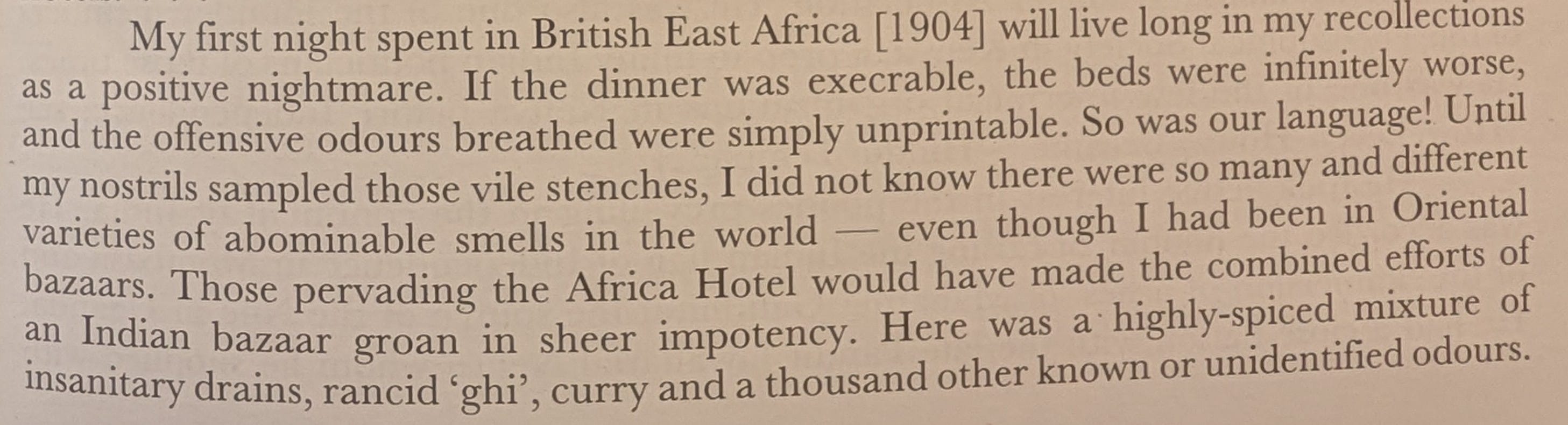
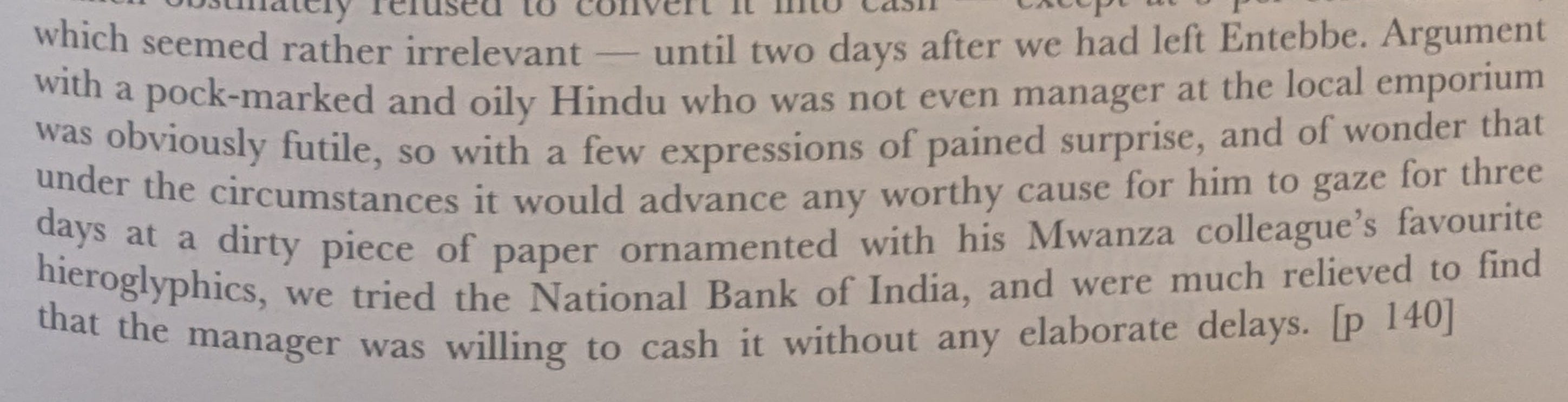

I refuse to analyze these excerpts in any more detail or tell you where you came from; they deserve no focus. As I’ve read these accounts, I feel my blood boil and my drive to write about my own history emerge even stronger. Because if these racist accounts are published, if they are allowed to live on in posterity, then why shouldn’t my story—which has been erased time and again, which even I have to open a history book to understand—get to exist too? These accounts that so callously paint my people in broad brushstrokes have a space in this world; meanwhile, I spend hours painstakingly thinking about representation, about how I’m telling my stories and whether it respects those who lived their realities (or at least a similar reality, as my tale will be fictionalized). I spend time thinking whether anyone would be interested in the tale I want to tell.
I think about my friend, G, who has told me in these moments of self-doubt, “I wish you could be a bit more like Trump; the man has no credibility to his name but believes in himself unabashedly anyway”. Those who have had power have always wielded it uncaringly, never questioning whether their stories are worth telling, whether someone will find them worthy of existing in the world. They just do it anyway. And seeing these racist passages makes me believe that my story, too, is worth writing.
Because we need counternarratives, ones that allow us to see people in their wholeness, in their full complexity. That allow people to exist not as a model representation of a population, but in their humanity, their flaws and all. As Katie Kitamura highlighted, to resist the urge to simplify; to complicate as much as possible.
I’m not sure how I went from not having enough time to write and access creativity to how racism is powering me to tell my story. But perhaps the connection is simpler than I think: energy to write doesn’t have to come intrinsically. Perhaps what I’ve needed all along to push me into writing my novel is the right kind of motivation, the kind that comes from both interest in my own history, but also anger at what has been allowed to be written. Writing is a kind of activism too, and I recently read someone talk about how it is impossible to be an activist when you are too pessimistic or too optimistic—in the former case, you think nothing needs to be changed; in the latter case, you think everything is unchangeable. To commit to activism, you must exist in the in-between. I cannot stop thinking about that.
So here I am, committing to writing in the in-between. To making space for writing. To allowing my right brain to fully express itself. Here I am, writing.
Comments
Nothing yet. Say the first thing.
Sign in to join the conversation.