
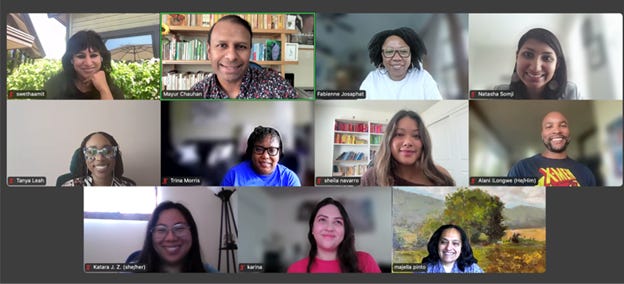
Oof it’s been a long time since I last posted. I’ve felt like I’ve wanted to write on here again, but the longer it’s been since I published a post, the harder it felt to get back to it. What’s motivated me to return today is what I experienced last week at the Voices of Our Nations Arts (VONA) summer workshop.
Let me backtrack a little. Back in April, I was accepted as a 2025 VONA Fellow in the wonderful Fabienne Josaphat’s Fiction as Resistance: Writing Against the Grain class. I had been eyeing the fellowship for a while as a space for BIPOC writers to learn, to establish community, to grow in our craft. I tentatively applied thinking there was no way I would be accepted. I mean, I hadn’t even been published yet. I had just received a slew of rejections, nothing more. And so, when the acceptance came, I was ecstatic. And I also thought they had made a giant mistake.
As the weeks wound down, I felt an excited apprehension. I was thrilled to be participating, but also the familiar ‘not enoughness’ was there in the background, waiting to sink me. I went in hungry, ready to absorb the pearls of wisdom from faculty and students. And seven days later, I walked out transformed.
There were gems, yes, plenty of them. But there was so much more. There was joy, there was community, there was safety. There was the sense of being enfolded. There was a space, full of BIPOC writers, with whom you didn’t need to explain yourself, you just had to be. And here, within these sacred (figurative) walls, I felt myself break through a cocoon and emerge. I began to believe in the power of my words. I began to believe in my ability to craft stories that linger. I began to trust myself, my voice.
I’d say that each of us felt this power, this magic. I’d say that it felt impossible to say goodbye. Now, as I try to integrate the last week into my life, as I try to hold onto what I felt, I am writing myself a letter with the things I want to look back on, the gems from the last week that I want to hold onto.
Dear Future Me,
There are so many gems that I want you to remember from the VONA workshop. That week that felt sacred. That helped you see yourself for the writer you are.
First, on rejection. Remember, not everything needs to be for the marketplace. Sometimes you create for yourself, to express, to work through an idea, to experiment and play. Sometimes what you write is too sacred for it to be shared with anyone else; sometimes, its just yours alone. Even what is created for the marketplace doesn’t need to always be created for the most elite marketplace. Don’t be discouraged when you’re rejected from top-tier literary magazines. Submit to different tiers of journals. Publishing is white anyway, and comes with pre-defined notions of what constitutes a good story. It doesn’t always seek to be disruptive. Most of all, don’t measure yourself against metrics you didn’t invent - of what good writing is, of acceptance.
Also, remember, you are not writing for other people. You are not writing to prove yourself, to prove your existence. You are not writing to defend yourself against the critics. You are not writing in reaction. Claim your space, clame your turf. State who you are for yourself. Determine what you want to write, and write it. Don’t let anyone else talk for you, don’t let them dictate what you write because you are constantly trying to prove your worth.
Remember, your heritage makes you who you are. Seek out the stories of your ancestors, even the myths and lore that you may not believe, the ones you may have dismissed but are truths unto themselves. They were real for your ancestors who believed them, and anything real is worth writing about. What we think of of magical realism as a genre was real for the people who lived through it. Listen not to correct or dismiss, but to hear what your kin, your ancestors are really trying to say. So much of writing is about listening. And look for these histories in unconventional places - in gossip, in mythology, in old photographs. Also, remember, that history isn’t always a universal truth; sometimes it is individual. People remember in different ways. There are 10,000 ways to recreate your great-grandmother’s recipe that was never written down, depending on whose memory we access.
Seek out the stories that have been erased from history. The ones who never got to exist. Perhaps they were wiped because they challenged the system too much. Perhaps it was because they were viewed as lesser in the eyes of the imperialist. Perhaps they were on the ‘losing’ side. They are the stories that matter. Their acts of resistance - large or small - are missing histories that change our understanding of reality. Think of yourself as a spell breaker - you are breaking the spells cast by institutions. You are calling them out. And you can be a spell weaver too, casting new spells that speak to a different way of being.
Resistance in storytelling is not just about who you choose to write about. It’s also in how you tell the story. Don’t be afraid to break out of Western forms of storytelling. Stories don’t need to be linear; they can, instead, be defined by cause and effect. They don’t need to have a three-act structure, they don’t always need to show and not tell. Break out of what you think you know about what ‘good’ writing looks like. Remember, literature that lingers makes you question your perception of reality. Think about techniques like the story within the story that disrupts the reader’s certainty about what’s real and what’s not.
Time is also something worth playing with. Think about the three definitions of time when reading - the narrator’s time that is mostly concerned with understanding and interpreting events and may or may not proceed linearly; the character’s time that occurs chronologically; and the reader’s time which may be the same as either the narrator or the character’s time, but also entirely different i.e. the order in which something is written on the page is how the reader perceives it. Play with these as you craft story; they help create stories that linger.
And when you read something that’s particularly good, a text that you can’t stop thinking about, use it as a way to generate your own prompts. Think about what is causing it to linger for you, and then create a prompt for it that can kickstart new ideas, new ways of writing.
Most of all, remember the community you have - your VONA family, the wealth of resources that exist, the fellowships and residencies and awards and grants. Put yourself out there, don’t be afraid to use them. Use your community as accountability partners or to help you say no to things that creep into your writing time. But through it all, remember the only voice worth listening to is the one that says you are worthy, you are enough, your words deserve to be heard.
With love,
Me
Comments
Nothing yet. Say the first thing.
Sign in to join the conversation.