
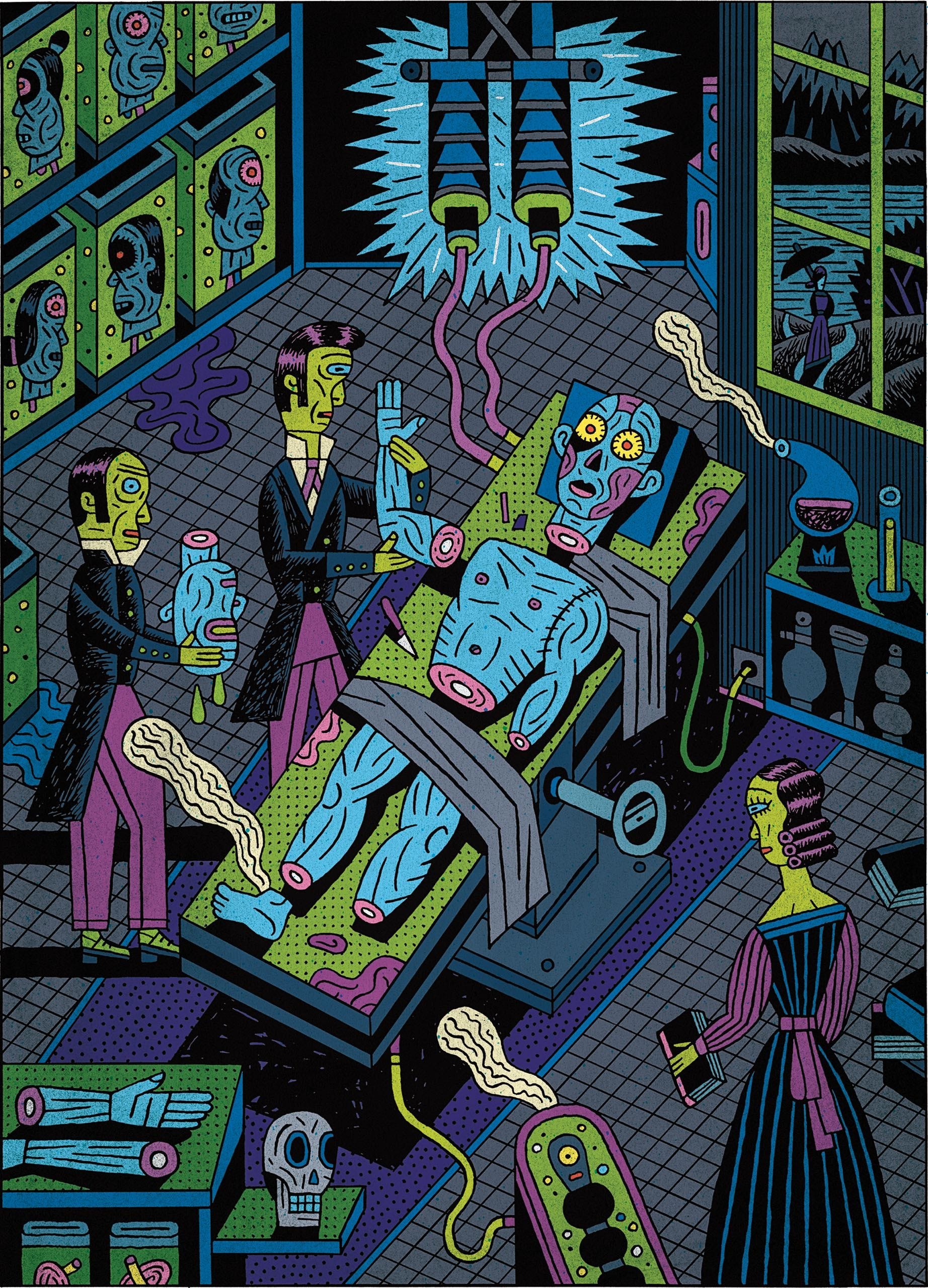
It seems fitting that, in the month that has become synonymous with Halloween, I’ve been thinking about monsters. As costume parties abound and orange decor adorns DC neighborhoods—pumpkins and ghosts and skeletons emerging from their cobwebbed corners—my mind, too, has drifted to focus on scary beasts.
I suppose this started before October, when I applied to and became a Prose Reader with Rawhead, a new literary journal named after a folkloric bogeyman used to frighten children into obedience. Of course, that is exactly what the journal aims to resist: in its (web)pages, you can find writing from those who dare to use their words as a way to counter systems of oppression. (I may be biased, but I think Rawhead publishes some pretty darn good writing—I highly encourage you to read).
In my application to be a Prose Reader, I talked about how I want to see the journal publish work that “includes monsters that may show up as systems designed to oppress or monsters that emerge as a result of these systems”. And that latter part speaks to the complexity of monsters: how they aren’t birthed in a void, but rather are a response to their context, oftentimes a response to another monster, such as an oppressive system. That’s what I can’t stop thinking about—the cycle of monsters creating monsters.
Don’t get me wrong: it is the most natural thing in the world to respond to a monster by becoming a monster. To respond to hate with hate, fear with fear. When livelihoods are threatened, when people’s very bodies are put in the way of danger, how can we not give in to our anger, our rage, and turn ourselves into something threatening? There are myriad examples of this in history: for example, a Reuters article in January of this year reports that Hamas has added 15,000 fighters to their ranks since the genocide began, and it is well-known that ISIS arose, at least in part, in reaction to US imperialism. New monsters birthed to counteract a threat from another monster.
I want to be clear on two points. First, I am not saying that when we are faced with systems of oppression we should not fight back. Indeed, we shouldn’t be bullied into submission; fighting is a form of resistance. Rather, I am questioning where this reaction comes from. We all want to slay the monster, but the reason why is what concerns me here. Is it because of the destructive force of desiring vengeance in response to another monster? Or is it because of something else, something that nurtures, that gives?
Second, becoming a monster in response to a system of oppression is not something I’m judging. I am guilty of this too, these days, more often than not. I’ll never forget going to the Unexploded Ordnances (UXO) museums in Cambodia and Laos, the two most heavily bombed countries in history per capita (by the US). There, I learned how nearly one-third of UXOs dropped on both countries during the Vietnam War didn’t detonate on impact, meaning that many are still buried under the earth, with people—often children—still picking them up or stepping on them only to find themselves mutilated. In fact, between 2012-2021, in Laos, nearly 60% of casualties from UXOs were children.
When I learned all this, I felt rage. Both at the absolute disregard for human life, but also at the lack of consequences. It felt so unjust that I, as a US citizen, could simply saunter into both these countries so easily. That there was only warmth and hospitality directed at me, despite my citizenship. (Of course, there’s a large degree of power dynamics involved as both Cambodia and Laos are amongst the poorest countries in Asia, so they are not in the position to not welcome US citizens in. But even so.)
There are many other instances where I have felt vengeful toward the monsters, where I cannot comprehend how the people who have suffered the most at their hands can simply choose to move on. (It is probably precisely because they know what it means to suffer—this is something we heard time and time again in Bosnia, for example, where the younger generation who did not live through a genocide, are much more vengeful than their parents, who just want to forget.) The angry part of me wants revenge.
But then, I think about Nelson Mandela, the man who was imprisoned for 27 years for his beliefs in equality. The man who emerged from prison and just four years later took up the highest position of power in his country: president. He could have used his position to enact retribution; instead, he decided to put an end to the cycle of monstrosity. And in his autobiography, Long Walk to Freedom, he said:
“I knew as well as I knew anything that the oppressor must be liberated just as surely as the oppressed. A man who takes away another man’s freedom is a prisoner of hatred, he is locked behind the bars of prejudice and narrow-mindedness. I am not truly free if I am taking away someone else’s freedom, just as surely as I am not free when my freedom is taken from me. The oppressed and the oppressor alike are robbed of their humanity.”
And this is what I’ve been thinking about the most with regard to monsters. What does becoming a monster do to the individual who has been transformed? Mandela understood that hitting back out of a space of vengefulness, out of a space of hate, keeps one oppressed. It keeps those fighting back in a cage, defined by their injustice, unable to claim their own turf for themselves. He understood the cost of what the creation of a monster does to the human, how it destroys, how it takes. How, if we had the choice, no one would want to be the monster. Because reacting with rage, with vengefulness, destroys. What would South Africa have become if Mandela had decided on retribution?
And I think about this for Cambodia too. Because this same country, one of the most heavily bombed in history, is also where the Khmer Rouge came to power. The force that wiped out nearly 25% of Cambodia’s population. But they didn’t just come from nowhere; they were birthed because of the former regime’s alignment with US interests during the Vietnam War. The Khmer Rouge capitalized on the population’s discontent with this alignment and grew in strength, eventually implementing more and more oppressive policies that eventually resulted in the Cambodian genocide. A monster responding to a monster. So perhaps, this is why Cambodians and Laotians welcomed me with open arms into their country; perhaps they knew better: that responding to hate with hate is an endless cycle that only destroys.
But responding to hate with something other than hate is one of the hardest things that a human can do. And yet, perhaps it is necessary.
I keep thinking about this in response to present politics in the US. When I hear about one more hateful thing this administration has done, my instinct is to be hateful back. To allow the monster to rise up within me and unleash.
But then I think about Mandela and the impossible decision he made to swallow the monster inside him and instead, replace it with something that builds. And I wonder if this is a guidepost to another way, a better way. A harder way, surely. But one that is driven less by reaction, less by expression, and more by what kind of world I want to build. And that world isn’t one where hate begets hate. So that in response to a monster who terrorizes, I don’t become changed by the hate.
After the transformative Voices of Our Nations Arts (VONA) Foundation workshop I partook in this summer (which I have written about here), one of the greatest impacts on my writing was in ensuring that what I say isn’t reactive, it isn’t in response to something else. Instead, it is staking out my turf and claiming it as my own. Saying what I want to say because these are my words that should be birthed in the world.
In the same way, I want to claim my turf in response to politics. Not in reaction to the administration, but because this is the space I want to create despite the administration. And what I want to claim is this: a space of building community. So that, instead of hearing the next awful thing the administration has done and fighting back because of hatred for them, instead allowing the fight to come from a place of protection. So that I don’t lean into the monster, but instead lean into dispelling the monster by creating something better.
This is how I want to respond to monsters. With forming greater community that binds. With something that outlasts me—not so much because I want to create legacy, but because I want our society to emerge into something different, better, less partisan, more whole. So that monsters do not continue to beget monsters.
Comments
Nothing yet. Say the first thing.
Sign in to join the conversation.