
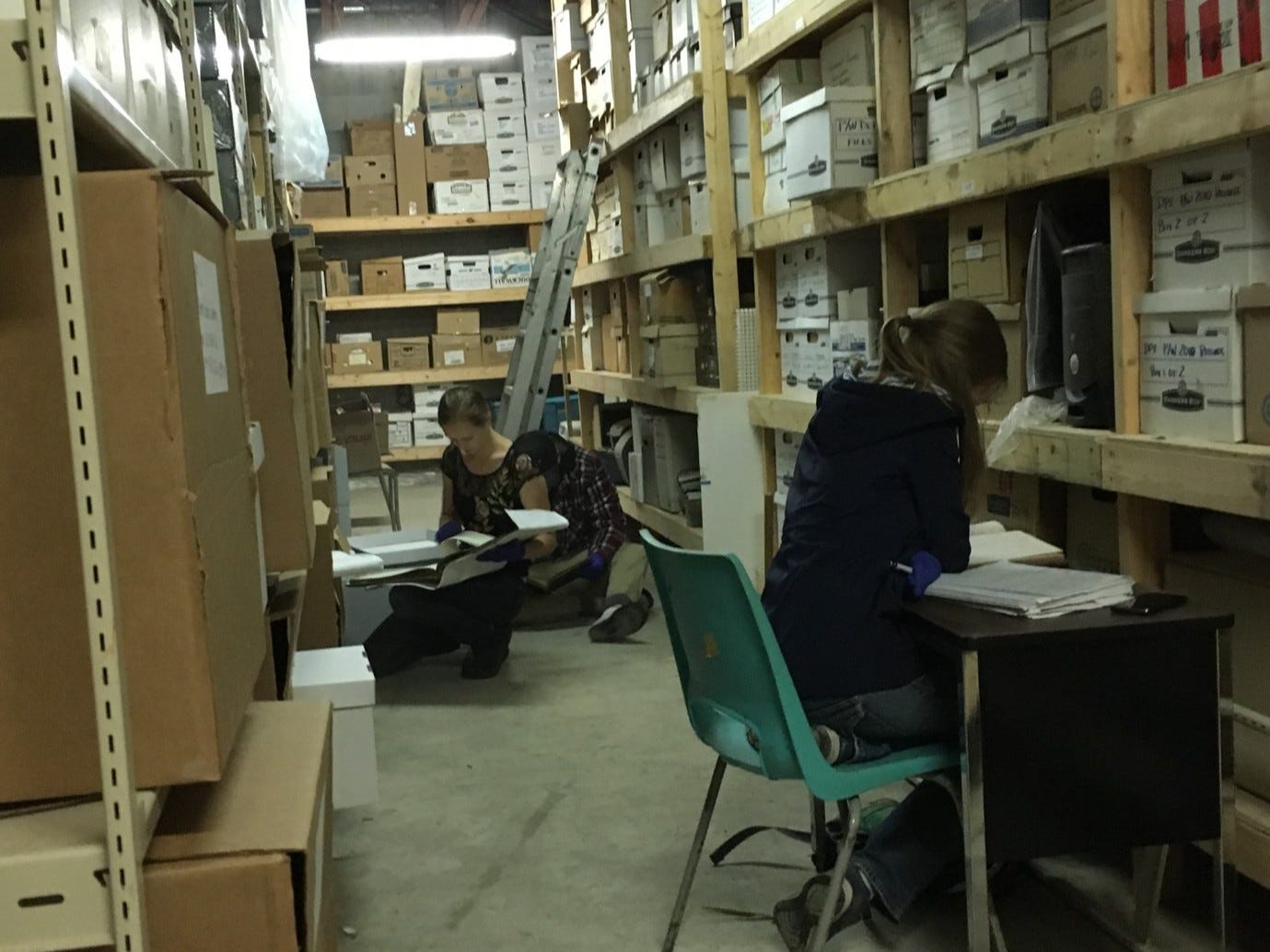
Work continues at FSK - more cataloguing, more wrangling AtoM, and more thought going into the storage of our collection. One of the largest difficulties to overcome (besides working as a lone volunteer archivist) is FSK's lack of a budget to support the preservation of their archival material. This isn't a position I've had to be in before - the organisations I've worked and volunteered with in the past have either had a small ringfenced pot of money for use in the archive, or at the very least been amenable to an application for funds. At FSK, though, things work slightly differently. It's structured entirely differently to a company or a council - largely due to its nature as an anarchist co-operative - but also, there's no central budget that can be distributed to the archive. This means that I'm having to be a lot more resourceful in how I'm storing and cataloguing the material.
Do what you can!
One facet of my approach to archives, which has developed considerably over the past few years, is an internalisation of the phrase "do what you can." Part of this approach, as I discussed in my article on the Mulberry Bush project, is the "More Product, Less Process" (MPLP) methodology. This focuses on maximising the output of the cataloguing process, while minimising the amount of time and effort spent on processing every item in the collection. This approach worked really quite well for the Mulberry Bush catalogue, where there were a vast amount of individual items to be catalogued and a limited time in which to catalogue them. It also removes a lot of the pressure that archivists often face - to create a perfect catalogue, to ensure all items are packaged and labelled, and to leave the collection with no room for improvement at the end of the project. MPLP acknowledges that this is an unrealistic aim, and provides a methodology through which the archivist can still produce a high-quality catalogue in a time-efficient manner.
This approach, while very useful in more traditional archives (I include in this description archives like the Mulberry Bush), does have some drawbacks in a more community-based setting. As a fascinating article by David Moles puts it, the MPLP approach risks putting too much emphasis on professionalism, on a neoliberal view of efficiency, and on the official control and recording of archival metrics. The focus on access which MPLP advocates for has long been the default approach in community archives - this in fact tends to be the driving impulse behind the creation and maintenance of such archives. Community archives exist, in many cases, to ensure communities and their members resist "symbolic annihilation" ("the affective impact of being ignored, misrepresented, or underrepresented in archives"), transcending it to a state of " “‘representational belonging” ("the feeling of complex and nuanced representation after such erasure"). These quotes from the influential archivist Michelle Caswell link back, in my mind, to the application of the "do what you can" approach to community archives like that of FSK.
In this kind of archive, the cataloguing and preservation process takes on quite a different character to that of a more "traditional" archive. It's a more intentional process, I find, where the decisions made by the archivist(s) have much more potential to affect the community directly. There's more of a sense that the work being done is meaningful, and will have tangible, real effects throughout the process. At least in my case, this makes the "do what you can" approach much more palatable: I know that while I might not be able to get things fully up to standard, or work as efficiently as I'd be able to in a traditional archive, all the work I'm doing feels much more meaningful. Directly working against symbolic annihilation, on whatever scale that may be, is a powerful experience (at least for me). The archive, in this sense, takes on its own role in the community: it brings people together around their history, it preserves that history for the use of the community, and it can strengthen the identity (and security therein) of that community.
When working in a community archive on a low budget, the "perfect archive" is often out of reach. However, I've found it useful to consider whether that concept is something that would actually serve the needs of the community. Traditional high-budget archiving often results in the material being hidden away from the user base, only made available upon request, and held separately from the outside world. While, obviously, it's important to ensure good storage conditions and environmental control, for an archive like FSK it's also important that the collection stays at the heart of the community. Therefore, at least in my own mind, it's less important to spend time ensuring perfectly sterile storage conditions if there's not the immediate budget for it, and if such a decision would make the collection less accessible to its owners and users.
Priorities and Saving Energy
For the second half of this article, I want to pivot towards some of the more practical concerns of low-budget archive work: how do you ensure preservation if you can't buy enough acid-free boxes for the whole collection? What does our digital preservation protocol look like? What am I doing about humidity?
The watchword for this whole project, really, has been prioritisation. Over the last few weeks I've been looking through the collection to ascertain which bits will need my attention first. Some parts, like the more recent printed radio programmes, are relatively low priority: they're being kept in a dry room, they're printed on modern paper, and are at most ten or eleven years old. Other parts, like the CDs and cassette tapes, are in much more need of attention. Stored in a relatively haphazard order in a variety of different packaging types, it's much more likely that they will either break (which has already happened to a couple) or degrade quite quickly if they aren't looked at relatively soon. Taking this kind of approach allows me to work quickly, without needing a huge amount of time or resources all at once - an approach which is very well suited to the FSK archive.
Taking a no-nonsense approach to prioritisation builds on the MPLP approach - some parts of the standard cataloguing process will just be out of reach with no budget, so it makes sense to avoid them and focus on what can be done. For example, I've been researching physical preservation methods for CDs and Minidiscs, and the standard "jewel cases" appear to be just fine for the majority of CD formats. While they do take up a bit more space than the paper envelopes I've used in other archives, they do ensure that the CD is kept "floating" - it's not resting on one edge, or flat on its back. The plastic they're made of (polystyrene) is an archival-quality material, which doesn't offgas, or produce harmful side-effects to material stored next to it. Other plastics, such as PVC (Polyvinyl chloride) will slowly leach hydrochloric acid into its surroundings as the plastic degrades. PVC also contains plasticisers, which have detrimental effects on media such as photographs or negatives - this is why photograph albums often cause photographs to glue themselves to the plastic sleeves they're stored in over time.
Luckily, these issues aren't present in the vast majority of CD cases. Good news for the low-budget archivist! This means we don't have to spend anything repackaging CDs - instead, we're able to keep them in their original containers, just re-labelling them as necessary. I'm taking this approach to the large collection of audio reel-to-reels we've amassed over the years as well: FSK was sent them by John Peel in the 1990s, and he was good enough to package them up in "archival quality" packaging. I'm not fully sure whether this means what I expect it to mean (acid-free, dyed with archival dye, and fully chemically stable), but it's better than nothing, and will likely be OK for some time to come.
On the digital side of things, as I mentioned in a previous article, open-source software is the way to go. Software licences, particularly those for cataloguing and digital preservation software, often run into the hundreds, if not thousands, of Euro. This is simply money FSK doesn't have, and even a large crowdfunding project might only be able to cough up the funds for one year of the licence. So, open-source is our friend here. AtoM, DROID, JHOVE and co. are very useful on this front, providing good quality services (albeit a little janky in places) at no cost to the user. Another benefit of the FSK system is being able to make use of the in-house servers and hard drives. Having this kind of resource available before the project even starts has been a real boon. This was something that I can't take for granted - the tech-oriented nature of the FSK collective means that a lot of the digital infrastructure necessary for a well-equipped archive is in place. This wouldn't necessarily be the case in another similar organisation.
Conclusion
Doing everything (or almost everything) in house, with the few resources we can, is a central theme of the FSK archive project. I'm under no illusion of being able to create ideal conditions for the material the collective has already preserved, but I am aiming to do the best I can with what I have. Making use of open-source software, a network of archive practitioners both here in Hamburg and back in the UK, and the skills and resourcefulness I've developed in previous archives, my goal is to leave the archive in a better situation than how I found it. When there's no budget, no dedicated storage room, and no knowledge of preservation embedded within the organisation, any kind of action taken is better than nothing. I'm confident that I'll be able to create something worthwhile during my time at FSK, and work with the community around this radio station to meet their memory preservation needs.
Get in touch!
Have you been dealing with similar issues in your archive (or non-archive!) work? I’d really value your input/feedback/reflections on the subject. This has been quite a steep learning curve for me, so anything you have to add would be welcomed. Feel free to write something in the comments!
Further Reading
Caswell, Michelle. Urgent archives: Enacting liberatory memory work. Taylor & Francis, 2021.
Moles, David. "Product, Process, People, Praxis: Indigenous and Community Archives against MPLP." (2022).
Rhys-Lewis, Jonathan. "The Maintenance of Archive Collections in Times of Constricting Budgets: Some Alternative Approaches under Development on the UK." Atlanti 26, no. 2 (2016): 105-112.
No posts
Comments
Nothing yet. Say the first thing.
Sign in to join the conversation.