
Dear friend,
A year or two ago, this would have sounded like science fiction cooked up for a late-night movie. Researchers at Stanford University and the Arc Institute have now used generative AI to design complete viral genomes. Nearly 300 of those computer-generated designs were selected, physically made and tested in a laboratory. Sixteen worked.
They were bacteriophages, viruses that infect bacteria, and they were able to reproduce and kill E. coli. According to the research published in Science and reported by Stanford on 6 August, several performed better than the natural virus used as the starting point. Three reportedly outcompeted the parent strain, while others defeated bacterial resistance that stopped the natural version.
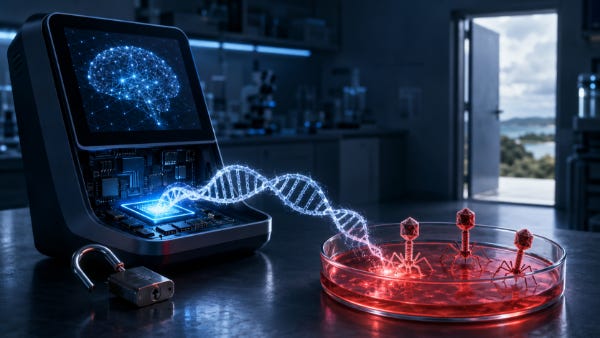


Sixteen designs became functioning viruses, with several outperforming the natural virus used as their template.
These phages attack bacteria rather than people, but the experiment proves AI can generate viable biological designs.
Evo 2 is openly available even though separate research suggests its safety restrictions may be bypassed.
After COVID, Australians should demand firm biosecurity rules and strict limits on future emergency powers.

The details surrounding this strange occurrence matter because this was far more than asking a computer to tinker around with one or two genes. The AI model produced each proposed genome from beginning to end. Researchers then turned those digital sequences into physical DNA and tested them. Most failed, but 16 became viable viruses that could infect bacteria and reproduce.
To be fair, there is a very good reason for scientists to be interested in this. Bacteriophages do not infect people, and phage therapy could become a lifesaver as more bacterial infections stop responding to antibiotics. A doctor facing a drug-resistant infection may one day be able to use AI to find a phage capable of killing it. I can understand the excitement around that prospect.
I still find it astonishing that we have reached the point where a computer can write a complete genetic blueprint and a laboratory can turn it into a working virus. Public debate about generative AI has mostly revolved around fake pictures, cheating students, computer code, and job losses. Biology is different. A bad image stays on a screen; a viable virus can reproduce once it finds the right host.
There are limits to what was achieved. Roughly five per cent of the tested designs worked, and the process still required DNA synthesis, laboratory equipment, and people who knew what they were doing. Some successful phages acquired mutations during testing, suggesting that ordinary evolution helped polish the AI designs. Dr Simon Jackson and Professor Jordi Garcia-Ojalvo raised those points in comments published by the Science Media Centre.
Five per cent does not sound impressive until a machine is generating hundreds or thousands of candidates. Repeated failure becomes less reassuring when each new batch can be produced quickly and cheaply. The number of working designs can rise even when the success rate remains poor.
Evo 2, the model used in this work, is openly available. The Arc Institute has published model access and code through its Evo 2 project and online repository. It was trained on more than nine trillion DNA base pairs gathered from across the tree of life. That is an extraordinary amount of biological material to place behind a tool that can generate whole genomes.
Its creators did make an effort to reduce the danger. They left out sequence data from viruses known to infect humans and other complex organisms, and they say Evo 2 was designed to avoid giving productive answers about those pathogens. I am glad they took those precautions. The difficulty is that a choice made by responsible researchers in one institute has no force over the next developer, company, hostile state or criminal group that downloads and alters the model.
Once open model weights are loose on the internet, the original creators cannot call them back. Copies can be modified and trained on different material. A separate preprint testing Evo 2’s safeguards found that leaving dangerous viral data out of the original training set may not be enough. Researchers fine-tuned the open model on sequences from harmful human-infecting viruses and reported that it then performed better on viral material it had not seen before.
That paper is still a preprint, so its findings should be treated as provisional. Even so, it exposes the weakness in relying on voluntary data exclusions. If somebody can download the model and later feed it the material its creators deliberately withheld, the safeguard may offer little protection against a determined user.
Johns Hopkins biosecurity specialists Moritz Hanke and Tom Inglesby put the problem plainly in a commentary published alongside the study:
“The ability to compose viral genomes using generative AI now exists; the governance to safely steer it does not.”
Their warning is available through Science. That should be enough to make any government stop and think before applauding the next breakthrough.
It is especially hard to accept after COVID. Australians saw state borders slammed shut, families split apart, and businesses ruined. Churches were restricted, QR check-ins became part of ordinary life, workers faced vaccine mandates, and peaceful protesters were treated as a public-order problem. Nearly every extraordinary measure came with the same instruction to trust the experts and stop asking awkward questions.
People remember how official advice changed, often without any honest admission that yesterday’s certainty had vanished. Grave decisions were made behind closed doors. Information was withheld, dissenting voices were pushed aside, and legitimate questions were dumped into the same basket as wild claims. Public trust did not survive that experience intact, and governments have only themselves to blame for it.
Against that background, a new theory is spreading. It predicts that an AI-created pathogen will eventually provide either the instrument or the excuse for another global shutdown. Certainly, the technical development supporting that claim is now real.
There is no public evidence that the Stanford or Arc researchers are planning such a thing. Accusing them personally would miss the point anyway. Once a capability has been created and widely distributed, its future use no longer depends on the intentions of its inventors.
A hostile government may see an opportunity to speed up a biological weapons program. A terror group may try to exploit a supplier with poor screening. A careless laboratory could make something it cannot contain. Then there is the political danger, which Australians have every reason to consider after 2020: authorities faced with a strange outbreak may again reach for censorship, mandates, movement controls, and open-ended emergency powers before the public has been given reliable information about the threat.
No one can honestly say that any of those events is destined to happen, although promises that they will never happen would be just as hollow. Waiting until a crisis has started would leave Parliament debating safeguards while frightened people are being told to obey first and ask questions later.
The pattern already feels depressingly familiar. Researchers make a breakthrough and release the technology. Governments begin talking about governance after the capability is out. International organisations then present themselves as the people best placed to manage the danger, while the public gets another lecture about trust and misinformation.
Australia should be extremely wary of handing this problem to the United Nations, the World Health Organization, the World Economic Forum, or some new panel of unelected international experts. Biological threats cross borders, so countries will have to work together but that cooperation should never give an overseas body control over Australian emergency powers, public debate, or the basic liberties of our citizens.
We have regulations already. The Office of the Gene Technology Regulator says most synthetic biology organisms fall under Australia’s rules for genetically modified organisms. The Commonwealth has also established an AI Safety Institute to examine emerging risks. Both may be useful, but neither was built specifically to deal with open AI models that can design complete viral genomes.
At the very least, Canberra should order a public national biosecurity audit of generative genome technology. Work involving the design of complete human, animal, or plant viral genomes should require licences and independent oversight. DNA-synthesis companies should be required to verify customers and screen orders for dangerous biological sequences, while laboratories should report serious incidents and near misses.
Open release should not be treated as an automatic virtue. If a model, training set, or fine-tuning method substantially lowers the barrier to creating a dangerous pathogen, access may need to be restricted. That will annoy parts of the scientific world and may slow some useful research. Poorly written rules could also drive legitimate work overseas, which is why the people writing them need to understand both the science and the danger.
We already accept this principle elsewhere. Explosives are controlled even though they are used to build roads, and nuclear material is secured even though nuclear science treats cancer and produces electricity. Biological design carries the same uncomfortable mix of promise and danger. Pretending that openness is always harmless will not make the danger disappear.
Safeguards for the science are only half the job. Australian law should also put hard limits on what governments may do during any future biological emergency. Extraordinary measures need strict expiry dates, quick parliamentary review, published evidence, and proper access to the courts. Australians should never again be told that censorship, indefinite mandates, or secret decision-making are acceptable merely because officials have declared an emergency.
COVID taught a bitter lesson about fear and concentrated power. People who surrender liberties during a crisis rarely get a calm chance to negotiate the terms, and officials who demand trust are often the least willing to show their work. That does not prove every dark prediction about AI viruses, but it gives Australians ample reason to insist on enforceable rules now.
The viruses created in this experiment kill bacteria rather than people. I hope the research leads to treatments that save lives. But I also want to know why artificial viral-genome creation has been opened to the world before governments have put credible safeguards around its most dangerous possible uses.
After what Australians endured during COVID, “we will work out the rules later” is nowhere near good enough.
Until next time, God bless you, your family and nation.
Take care,
A Nation First Staff Writer
Thanks for reading Nation First, by George Christensen! This post is public so feel free to share it.

George Christensen is a former Australian politician, a Christian, freedom lover, conservative, blogger, podcaster, journalist and theologian. He has been feted by the Epoch Times as a “champion of human rights” and his writings have been praised by Infowars’ Alex Jones as “excellent and informative”.
George believes Nation First will be an essential part of the ongoing fight for freedom:
“The time is now for every proud patriot to step to the fore and fight for our freedom, sovereignty and way of life. Information is a key tool in any battle and the Nation First newsletter will be a valuable tool in the battle for the future of the West.”
— George Christensen.
Find more about George at his www.georgechristensen.com.au website.
NOTE: Due to the large volume of emails I receive, it is not possible to email me and ask to be unsubscribed from this newsletter. You must do it yourself by following the simple processes listed below:
Comments
Nothing yet. Say the first thing.
Sign in to join the conversation.