
Text within this block will maintain its original spacing when published
Classical Ghazals in Performance & Postmodern Verse on the Page: Roger Sedarat’s Persian Translations
Translation as Ritual
To briefly introduce how I bring translation into performance, I offer a little overview of what I debuted to my fellow residents at MacDowell earlier this year: Fortune Pistachios.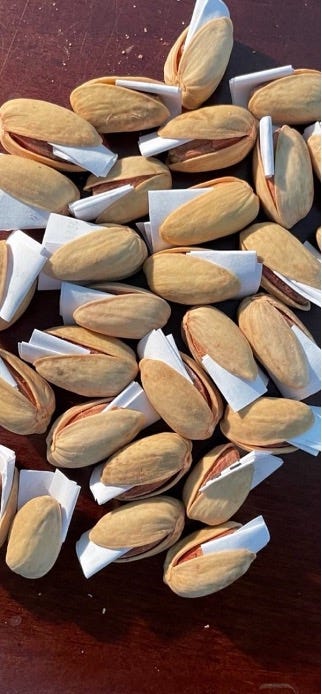
Text within this block will maintain its original spacing when published
As a long time translator of Hafez’s ghazals, I keep returning to what remains so hard to render from the Persian source culture. Yes, as Dick Davis has made clear, the poet’s mastery of puns just doesn’t carry over into English. But I obsess even more on how we Iranians experience the poems beyond literary critics. As much as text, I want the audience to receive the translation through the experience of my Persian culture as much as possible.
It’s a common practice for an Iranian when facing a decision or wanting some guidance to open the dīvān (“collected works”) of Hafez at random. Since he writes in contained couplets, wherever a finger lands, you get your fortune as your own miniature poem.
Inherently interdisciplinary, performance often borrows from different fields. I’ve been using rituals a lot these days in my teaching, which work well to connect students to each other in an age of techno-isolation. After some successful experiments in the classroom, I decided to pilot this one with Hafez:
From my emerging selection of translated ghazals, I randomly cut out couplets. Then, appropriating the American invention of Chinese fortune cookies, I inserted a couplet into individual pistachios. The chosen medium works well, since Iranians love pistachios and we also love to share. After introducing the concept, with my fellow MacDowell artists in a circle I let them each pick their fortune pistachio from a bag. We then took turns reading, creating a new Hafez poem out of so many, which meant something to each of them individually as well as to us as a group.
Unexpectedly, the participants treated this as a sacred experience. Leaving silence between each couplet, I felt part of a collective prayer. A couple of us, including me, cried during the experience. Throughout the rest of the residency, when I got to an artist’s studio I’d see their couplet pinned on their bulletin board. Even more profound, when saying their goodbye speeches the last night at dinner, they would share their couplets with us.
The best possible thing to come from this as a translator was the experience of hearing Hafez return to me in English through the voices of others. We collectively carried something intangible, beyond words, into our circle. I’ve never felt so close to the spirit of this 14th century mystic poet as I have through this ritualized reading.
Brief background on the source poet: Hafez, the great classical master of Persian poetry, was born in Shiraz, Iran, in the early 14th century. After losing his father at a young age, for a time he worked as a baker. An obviously gifted student devoted to religious study, he took his pen name for one who has memorized the Qur’an. The royal court under various rulers supported him as a poet, but after a falling out with the long reigning Shah Shuja, he had to leave his native Shiraz and for a time live in exile.
It’s fitting that a poet so engaged with mysticism should have so little definitive biography recorded about him. Much like we come to know his sensibility best through his verse, our understanding of his life surfaces through stories that are themselves worthy of literature. If his background like the hyperbole in his lines regarding the beloved’s beauty seems fictional, such creative rendering reveals even greater truths about him. The following anecdote appears especially key to his spiritual as well as aesthetic development:
Upon delivering bread as a young baker, Hafez caught sight of a beautiful woman named Shakh-e Nabat. His desire for her led to his keeping a vigil at the tomb of the poet Baba Kuhi, who promised to grant three wishes to anyone staying awake for forty nights at his burial site. When the angel Gabriel appeared before him, he forgot his infatuation with the woman and expressed his desire for the infinite beauty of God. Gabriel answered his prayer by leading him to his great spiritual teacher, Mohammad Attar. Many of the ghazals for which he remains so well-known followed from this relationship. When much older, he undertook another vigil for forty days and nights within a circle, after which he again saw his teacher. Drinking a cup of wine offered by this mystic, Hafez then achieved divine consciousness, further reflected in his later poems.
Earthly desire as metaphor for godly yearning in this story captures much about Hafez’s discipline with his writing as well as his spirituality. The heart’s devotion to beauty in the world, which leads to revelation of divine wisdom, ultimately transforms both poet and poetry.
Among Persian poets Hafez remains a master of the ghazal, excelling both in rhyme as well as in other intricate wordplay. Because of both its incredible style as well as its deft philosophical treatment of such themes as death, love, and spirituality, his verse has had a lasting and pervasive influence on Persian language and culture.
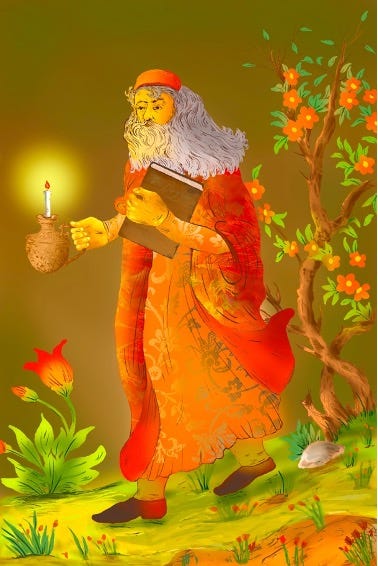
Samples from emerging manuscript: These Garden Nights: Ghazals of Hafez. In the spirit of interdisciplinary approaches to translation, I introduce them with a cover painted personally for this collection by the Iranian artist Nahid Hagigat. I think she captures much of Hafez here.
Text within this block will maintain its original spacing when published
                             **
I find myself lost somewhere in your room.
Despite the dark, I still stare in your room.
Don’t ask blind prophets for their great wisdom.
All hidden truths are laid bare in your room.
The rose and nightingale become a song.
I dance to sounds of nature in your room.
Love-sick, I know that you’re my medicine.
I’ve overdosed on your care in your room.
Try sweeping me like dust outside your door.
I’ll find a way through air back in your room.
Your currency of love is safe with me.
I guard such sacred treasure in your room.
The jockey’s spirit tames the wildest horse.
He gallops with great power in your room.
Why should I ever think of going home?
The sky has juggled its stars in your room.
Hafez’s poetry is your sweet voice.
He just records what he hears in your room.
                             **
Her locks of hair bind him. Untie the knot.
(Within this story’s tension lies the knot).
With best of friends all things are possible.
Together, this night, let’s challenge the “not.”
Those who transcended reason understand:
The language music plays transcribes the not.
The lovers dwell in possibility.
Faith in desire can’t help deny the not.
She tempts you with rejection of desire.
Her veil of beauty always hides the not.
The elder rightly told the younger crowd:
“Don’t think the sober one is wise; he’s not.”
For everyone who suffers without love:
Tell them stop sobbing and decry the not!
Give Hafez something for his suffering.
Pray he and his beloved tie the knot.
                             **
Postmodern Persian Translations
Some time ago on a visit to Iran a met a young poet through some artist friends with whom I really connected. We bonded over a certain postmodern sensibility, and I had the unique pleasure of gifting him some stories by Borges translated into Persian. He has a background in architecture, which I sense at times in the scaffolding of his stanzas. He also used to sing a punk band. Thankfully that irreverence pervades much of his verse.
Publishing under a pseudonym (H. Khavari) after getting into some trouble with the government, we continue our collaborative translation work of his poems on the Internet. Here a few favorites:
Infinite Regressions
We go to the coffee shop
to gossip about friends
at the coffee shop.
The anthropology professor
publishes photographs of graffiti
in his academic book.
The maid who works
for the family of chicken farmers
can’t buy her family a chicken.
Baback obsesses
over the curves in his guitar
more than his girlfriend.
To solve its economic crisis
Iran changes the name and value
of its currency.
On a nice day
I stay in my dark apartment
watching nature shows.
My sister plucks her eyebrows
so her friend Shirin
can draw on new ones.
                             **

Techno-Origami
The 3-D printer
worked over time
sculpting lemon trees
complete with bees
on budding flowers.
The overheated machine
filled the cardboard orchard
with the scent of hot plastic.
The 12th nightingale arrived
like a prophet
in a cloud of smoke,
considering the same hand
that pushed “print”
remained destined to strike
a single match
and wave goodbye
to a paradise
of paper.
                             **
At the Same Dead End
Digging through trash
I smell the whiskey
on Shamlu’s breath.
It’s not so strange.
He once stood here
recording the rhythm
of the butcher’s cleaver
like a journalist
for Satan’s newspaper.
In the ash of lilies
and the charred remains
of tortured canaries
I open a tin can
of dried vegetables,
find a beating heart.
If you follow the trail
of Shamlu’s last words
a little more literally.
It’s really not so strange.
He promised he’d send
his love into hiding.
About the translator
Roger Sedarat is the author of four poetry collections, most recently Haji as Puppet: an Orientalist Burlesque, which won the Word Work’s Tenth Gate Prize for a Mid-Career poet and was adapted for a staged performance with a grant from Atlantic Philanthropies. A recipient of the Willis Barnstone Prize for Translation, his renderings of classical and contemporary Persian have appeared in such journals as Poetry, Michigan Quarterly Review, and The Brooklyn Rail. He has performed his translations of classical and contemporary Persian verse at such venues as The Dodge Poetry Festival, Bowery Poetry Club, and Duke University. He is also the author of Emerson in Iran: the American Appropriation of Persian Poetry (SUNY Press), the first book on the seminal American poet-translator-philosopher of the Persian verse tradition, as well as co-author and translator of Nature and Nostalgia in the Poetry of Nader Naderpour (Cambria Press). He is currently completing a book of selected ghazals by the 14th century Persian poet Hafez.

Comments
Nothing yet. Say the first thing.
Sign in to join the conversation.