

Marriage plays a sizable role in Manic Pixie Dream Girl mythology as the epitome of boring bourgeois propriety. Marriage, followed closely by parenthood, is what respectable society tells us we should desire. It’s posited as the inevitable endgame of dating successfully, as something the straight world sees as the ultimate reward for finding someone willing to forsake all others and spend the rest of their life with you.
Since marriage is almost invariably depicted as the goal of boring, banal, basic bitches, it’s the enemy of Manic Pixie Dream Girls. This is particularly true when the Depressive Dude they’re saving from the plague of normality happens to be engaged, married, or recently divorced from a boring, banal, basic bitch.
Manic Pixie Dream Girls live in the sacred present tense. It’s all about living in the moment and seizing the day rather than making a commitment to devote yourself to one person until you die, your partner perishes, or you decide to call it quits.

Ben Stiller is an archetypal Depressive Dude in the same way that Zooey Deschanel, Audrey Hepburn, and Goldie Hawn were born to play Manic Pixie Dream Girls.
Stiller specializes in playing tightly wound neurotics who need to loosen the fuck up and live a little. Who is more qualified to do the loosening than a fantasy figure whose existential purpose is to selflessly teach lessons about joyful spontaneity?
In 2004’s Along Came Polly, Stiller plays Reuben Feffer, a neurotic Jew who is timid and overly cautious in both his personal and professional life. As a risk assessment expert for an insurance company, he ekes out a respectable living crunching numbers and making judgments in his quest to lead the least dangerous life possible.
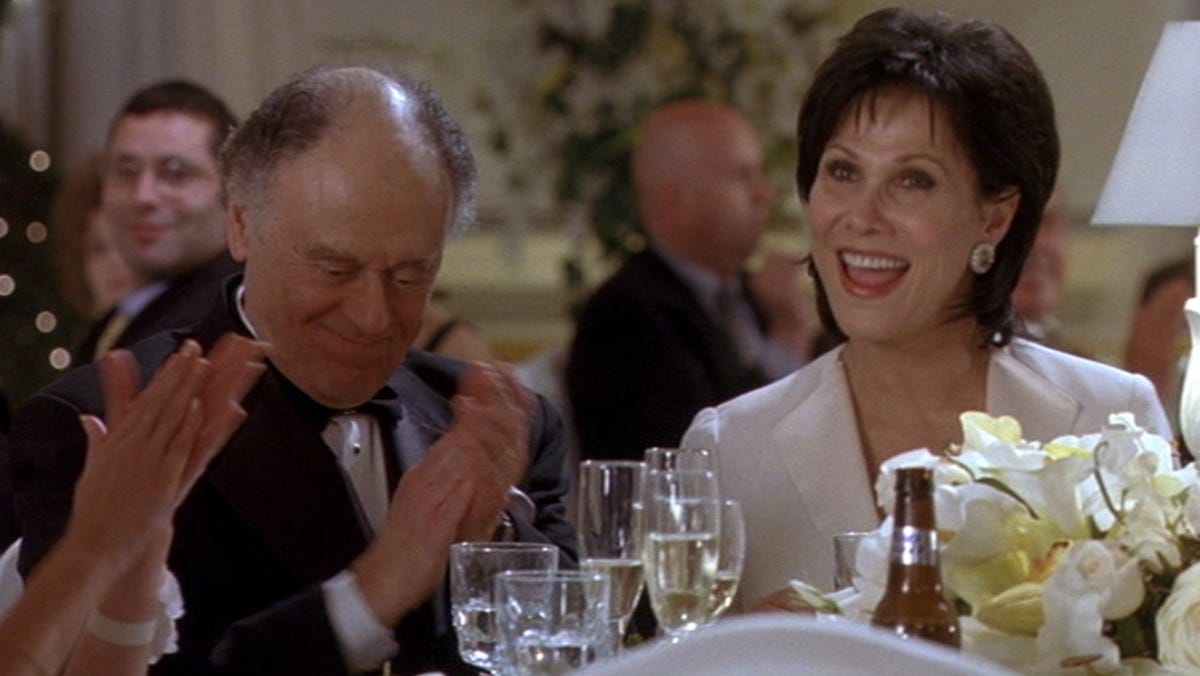
Rueben marries real estate agent Lisa Kramer (Debra Messing) because she seems like a safe bet. Reuben learns that sometimes what seems safe and agreeably boring can turn out to be anything but. Lisa breaks their wedding vows as soon as possible by cheating on him with Claude, a scuba instructor with a massive dong and questionable accent played by a scenery-chewing Hank Azaria, the king of campy comic ethnic cut-ups.
The humiliation is compounded when Lisa chooses to stay at the Caribbean resort with Claude rather than return to New York with her now-estranged husband. Everyone in the Big Apple seems to know that Reuben’s wife cheated on him on his honeymoon except for Polly Prince (Jennifer Aniston), a middle-school classmate he reconnects with when she’s a waitress at a party he attends with best friend Sandy Lyle (Phillip Seymour Hoffman), a former child star attempting a comeback by playing Judas in a community theater production of Jesus Christ Superstar.
Along Came Polly is full of professional funnymen and ringers, including Kevin Hart and Judah Friedlander, who play cameramen shooting a Sandy Lyle-themed E. True Hollywood Story that exists primarily in his vivid imagination.
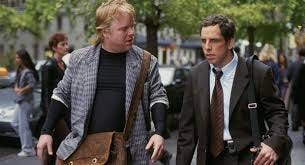
Yet Hoffman, one of the greatest dramatic actors in film history, is ten times funnier than anyone else. He’s a hoot as a deluded narcissist overflowing with unearned confidence, particularly where basketball is concerned.
Hoffman alone makes Along Came Polly almost worth watching. When Hoffman is onscreen, Along Came Polly becomes a different, better, funnier movie. He’s the film’s sole redeeming facet. Hoffman’s is a delightful surprise in a movie that otherwise hits all the expected beats.
Like Forces of Nature’s Sandra Bullock, Aniston is an unwitting icon of mainstream middle-of-the-road banality. That’s why Forces of Nature cunningly gave Bullock’s hair a subtle purple streak to set her Manic Pixie Dream Girl apart.

On a similar note, Along Came Polly gives Aniston the lower back tattoo synonymous in the public imagination, and the minds of moviegoers, with women of easy virtue, to drive home that she’s playing someone sexy, wild, and free, and not Rachel from Friends. Polly also has a blind ferret that functions as a sight gag, or rather, a sightless gag, and a kooky aspiration to write wildly inappropriate, unnecessarily violent children’s books.
In middle school, Polly was a quintessential geek, but she grew up to be a bohemian freak of the blandest variety.
Reuben doesn’t just have IBS, or Irritable Bowel Syndrome; he’s IBS in human form. If IBS attained sentience, it would be Stiller’s character.
Because he has such an intense and hilarious case of IBS, the malady of choice for lowbrow scatological comedies like this, Reuben stays away from spicy ethnic food.
White bread, mayonnaise, American cheese, and iceberg lettuce are good enough for Reuben, but Polly loves international cuisine. Polly is doing to Reuben’s palate what she’s doing to his life. She’s opening it up and filling it with flavor and heat.
Reuben masochistically endures Polly’s love for Indian food even as the veins in his forehead throb, sweat coats his body, and he has to race to the bathroom to vomit profusely or experience explosive diarrhea.

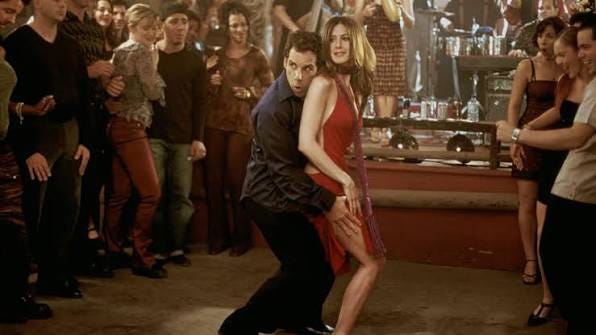
Next, Polly takes Reuben to a salsa club where she reconnects with Javier (Jsu Garcia) and dances with him in a manner that suggests sex, but hotter and more sensual and intimate.
The semi-cuck is understandably concerned when Javier lovingly gropes Polly’s ass. When he angrily confronts the Hispanic gentleman, Javier replies that he’s gay, and, like all homosexual gentlemen, makes a point of aggressively fondling the posteriors of the straight women he dances with.
A relieved Reuben takes salsa lessons from Javier, and dazzles the club and, to a lesser extent, Polly when he shows off his moves. This is supposed to be liberating and empowering for our hapless hero, but he’s forcing himself to do something he doesn’t want to do to impress Polly, the same way he made himself eat food that made him vomit for Polly’s sake.
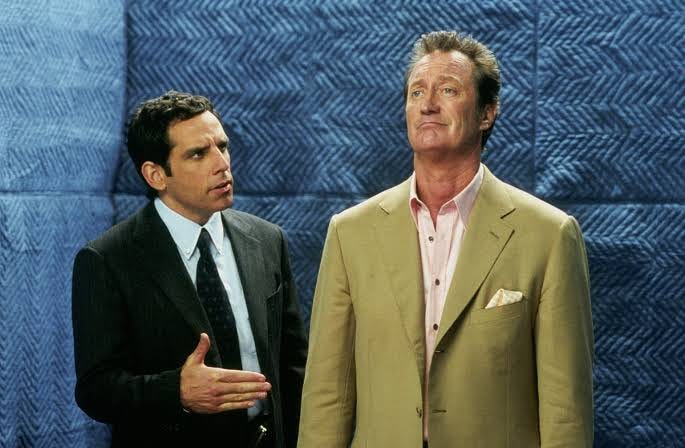
At work, Reuben is assigned to Stanley “Stan” Indursky (Bryan Brown), a Richard Branson-like daredevil millionaire entrepreneur whose philosophy is antithetical to Reuben’s. Like Polly, he’s on hand to teach the protagonist that a life without risk is no life at all.
Reuben is so enamored of Polly that he has his computer conduct a risk assessment comparing her with Lisa, who has returned home as the third act begins, asking Reuben to take her back, since she quickly tired of Javier and life in paradise.
As it lurches to a close, Along Comes Polly shamelessly commits itself to the hoariest romantic comedy cliches. Reuben must choose between professing his love to Polly before she gets on a plane and leaves him forever and showing up at a work meeting whose importance is hard to overstate.

The lovelorn doofus has Sandy impersonate him at the meeting to determine whether Reuben’s insurance company will cover Stan despite the thrill-seeker chasing death at least several times every month.
Sandy does a terrible job yet wins all the same, while Reuben begs Polly not to leave him and New York, and eats nuts off the filthy New York street to show just how much he’s changed.
He’s loving life! He’s embracing danger! He’s so overcome with joie de vivre that he wins Polly back and takes her to the exact same place in the Caribbean where his wife cheated on him with an insanely hung Frenchman.
It seems strange that the hero would return to the place of his most intense trauma, but Rueben thanks Claude for being the catalyst behind his exciting new life of adventure, sex, and danger.
If Claude hadn’t made sweet, passionate love to his wife, Rueben would still be married to her and terrified of life and its infinite riches.

To really drive home that Rueben is a changed man, he frolics naked on the beach and goes scuba-diving with Polly and Stan.
It’s standard rom-com fare with a soupçon of post-There’s Something About Mary gross-out gags involving an appropriately embarrassed-seeming Stiller, but audiences didn’t seem to mind.
The facile exercise in wish fulfillment resonated with moviegoers. It debuted at number one with a gross of just over $ 27.5 million.

Along Came Polly ended The Lord of the Rings: The Return of the King's month-long reign at the top of the box office, but it’s safe to say that the Oscar-festooned final entry in Peter Jackson’s blockbuster adaptation of J.R.R. Tolkien’s magnum opus went on to have slightly more of a cultural impact than Stiller and Aniston’s disposable comedy.
The box-office hit grossed nearly $180 million worldwide. It occupies an undistinguished place in the pantheon of movies about Manic Pixie Dream Girls. Otherwise, Along Came Polly is doomed to be nothing more than a trivia question and minor footnote in the epic stories of The Lord of the Rings and Phillip Seymour Hoffman.
Previous Manic Pixie Dream Girls:
Summer (Zooey Deschanel) (500) Days of Summer
Sarah Lewis (Sandra Bullock), Forces of Nature
Be notified the moment the Maniac Pixie Dream Girl Printopia campaign goes live at https://www.backerkit.com/c/projects/nathan-rabin/maniac-pixie-dream-girl/pre-launch
Purchase The Fractured Mirror, my magnum opus about American movies about filmmaking, which has a foreword from Gremlins 2: The New Batch director Joe Dante and illustrations from Felipe Sobreiro (Return of the Blues Brothers, The Authorized Al), from me here or from Amazon here
Sign up for an annual paid subscription to Nathan Rabin’s Bad Ideas at Nathan Rabin’s Bad Ideas and get instant access to all 20 Manic Pixie Dream Girl entries, 3 Fractured Favorites exclusive recommendations a week, the right to vote to determine which movies I need to review each week AND free copies of The Fractured Mirror and the “Weird Al” Yankovic-themed coloring book The Weird A-Coloring To Al! In honor of the 20th anniversary of Manic Pixie Dream Girls, it’s 20 percent off til October 1st! Take advantage of this special link here: https://nathanrabin.substack.com/MPDG20
Comments
Nothing yet. Say the first thing.
Sign in to join the conversation.