
Good Friday morning all! It’s Nate, your friendly neighborhood metaphysician. Today, I’ll wrap up this two-part post on Ozu, Buddhism, and my trip to the inn south of Tokyo where he wrote some of his most famous movies. Here's Part 1 if you missed it.
A topic you’ll see me write about here often is ambiguity, in its various forms. That is, the different kinds of limits that religion and spirituality pose to our everyday tools of understanding, how art and language offer entry points past or further boundaries to those limits, and how the politics of religion and spirituality become obscured by changing conditions of access to the experiences, forms of knowledge, and transformations that they occasion. Its particularly important to me in thinking about these boundaries, and the ambiguities they form, to also consider which cultural contexts are afforded relative levels of clarity or mystery, complexity or simplicity, universality or particularity.
Often, when art or religion presented in the US has some relationship to Asia, and in particular East Asia, we can very quickly begin hurdling towards the void, or pure, unadulterated spiritual truth. Ozu offers perhaps one of the best instances of what happens when art and spiritual truth interact in this way.
Take the author Donald Richie, for example. He was one of the first people to translate the cinema of Japan for English-language audiences. His books on Japanese film were important in introducing Japanese culture to post-war America. They won awards and sold well for the time. He held a few teaching positions, and even made some short films in Japan. His 1977 monograph, Ozu: His Life and Films, offers a useful moment to reflect on the relationship between film and religion, especially in the way he attempts to essentialize Ozu’s films, and how they express themselves in relation to Japanese culture.
As I mentioned, the way Ozu positions his camera and his relatively spare shot composition are often considered defining features of his films. This includes the relatively low position of his camera, which allows the camera's eye to move around a room in the same way one would move around some Japanese homes, from the floor. His “pillow shots,” too, are notable for their departure from standard Hollywood film grammar. There, the audience would be presented with a brief establishing shot, showing you where the action is taking place, and then jumping into an interior series of shot-reverse-shots of dialogue. Ozu, however, often presents a series of five- to ten-second still shots that wander around interiors and exteriors, offer spare motion, and establish their own kind of conversation with each other. What links these together, and makes the flow of his movies feel “natural” despite their meandering, is the subject of a lot of speculation. Richie offers a view common of the time (shared also by the coiner of the “pillow shot,” the fascinating France-based ex-pat filmmaker and theorist Noël Burch):
Text within this block will maintain its original spacing when published
“This traditional view is the view in repose, commanding a very limited field of vision. It is the attitude for listening, for watching. It is the same as the position from which one watches the Noh [traditional Japanese theater] or the rising moon, from which one partakes of the tea ceremony or a cup of hot sake. It is the aesthetic attitude; it is the passive attitude. Less poetically, it also represents the viewpoint of a then-majority of Japanese…it also resembles the attitude of the haiku master who sits in silence and observes, reaching essence through an extreme simplification. Inextricable from Buddhist precepts, it puts the world at a distance and leaves the spectator physically uninvolved.” (xii-xiii)
Ozu’s repose is many things, and so is Richie’s book and life in relation to the world of Japanese film. However the mu inscribed on his gravestone is, for Richie, a marker of this worldview he sees pervasive in Japanese culture and history—a kind of postage stamp for the import of his artistic vision to be mailed straight into the void of mushy spiritual truths. He goes on about these “empty” shots in the chapter on “Editing,”:
Text within this block will maintain its original spacing when published
“[T]hese shots are empty of both people and apparent intention, and they are therefore in themselves ambiguous. Though their use is not unknown in the West and in the East, form[ing] part of the vocabulary of traditional art, their use in Ozu is both particular and personal. These empty scenes form a hiatus not only because they deliberately create a pause…but because they do so within a context—the art of film—that presumes all parts complete, all scenes filled. Empty scenes thus create a major aesthetic paradox” The “aesthetic paradox” is, “the concept of mu—emptiness and silence are a part of the work, a positive ingredient. It is silence which gives meaning to the dialogue that went before; it is emptiness which gives meaning to the action that went before.” (179)
Richie's argument is, admittedly, compelling in a certain way. Though I and many before me have been troubled by the way his binary approach to film form tracks onto his use of East-West binaries. Everything that becomes associated with the “East” conforms to a very familiar pattern. Richie's insistence here that we contextualize the character of Ozu’s artistic expression as the general essence of Japanese people and art, one associated with passivity, silence, and mysterious simplicity, is an almost textbook example of Orientalism. Requiring that an artistic orientation be bound in this way to a spiritual truth, which defines and sits behind an entire civilization, can do a lot of harm. It can hem in people attempting to express themselves or live within range of these ideas, as they are asked to fit within certain boundaries and expectations of expression and identity. It also obscures the variety of lineages and innovations proper to the history of art, film, and performance in East Asia—what people were responding to in artistic traditions there (in addition to the imports of Hollywood), or even the potential means of hybridity between supposedly “Western” and “Eastern” aesthetics. Reading through the book, you can see these tension on full display even in his own thinking. Fascinating formal arguments and analyses of Ozu's films lose their ability to recognize the potential import of his singularity as they become expressions of the transcendental posture that lies behind East Asian art.
This is not to say Ozu’s films are devoid of mystery or a form of looking that we can locate in the history of Japanese architecture—or even of a relationship to Buddhism. It is to say that mystery as a category applicable to an entire culture, people, or civilization is a problem, one which continues today. And one whose interpretive gravity can obscure the historical, aesthetic, and philosophical qualities of one of film’s most lauded technical innovators and formal experimenters in Ozu. The one-way street of exoticism is also as reductive as it is productive. It limits the potential means of expression for anyone it targets. It also provides a logic in which to always find a certain truth behind any cultural form, offering an infinitely reproducible entry point for writers like Richie to have something to say about nearly anything in and around East Asian culture.
This is how I was introduced to Ozu—as a curious representative of Japanese cinema and the transcendental posture of its artistic traditions. For years I have wanted to find some new way into Ozu’s work. My impulse had always been to go to the actual place where he wrote and scouted for several of his most famous films, the Chigasaki-kan (the “Chigasaki Inn”) in Kanagawa Prefecture, about an hour or so train ride south of Tokyo. The other day I finally got the chance while in Japan for business, and a friend I was planning to meet up with fortuitously informed me that he was actually based near the inn itself. I had no idea what I would find, but to my enormous gratitude and delight, I was met by Hiroaki Mori, the fifth-generation owner and operator of the Chigasaki-kan. His experiences and reflections offered me so many more entry points to continue thinking about Ozu's films.
—
The Chigasaki-kan is located in a kind of arts belt that formed in the beach towns south of Tokyo, which became more easily accessible as Japan’s modern commuter rail system emerged in the early 20th century. Mori likened Kanagawa, the prefecture where Chigasaki is located (along with the historic capital, temples, and beaches of Kamakura), to Brighton—where the first generation of students and artists who studied abroad from Japan in London and the Oxbridge circuit also made their occasional travels.
If the singularity of Ozu’s vision was indeed shaped by the sight-lines of East Asian architecture, Mori is perhaps one of the most studied stewards of his vision, having spent his entire life moving through the rooms where Ozu came to write. He takes this role very seriously, with a studied and unpretentious curiosity, and was extremely generous with his time, showing me around each of the rooms Ozu would have used during his stays.
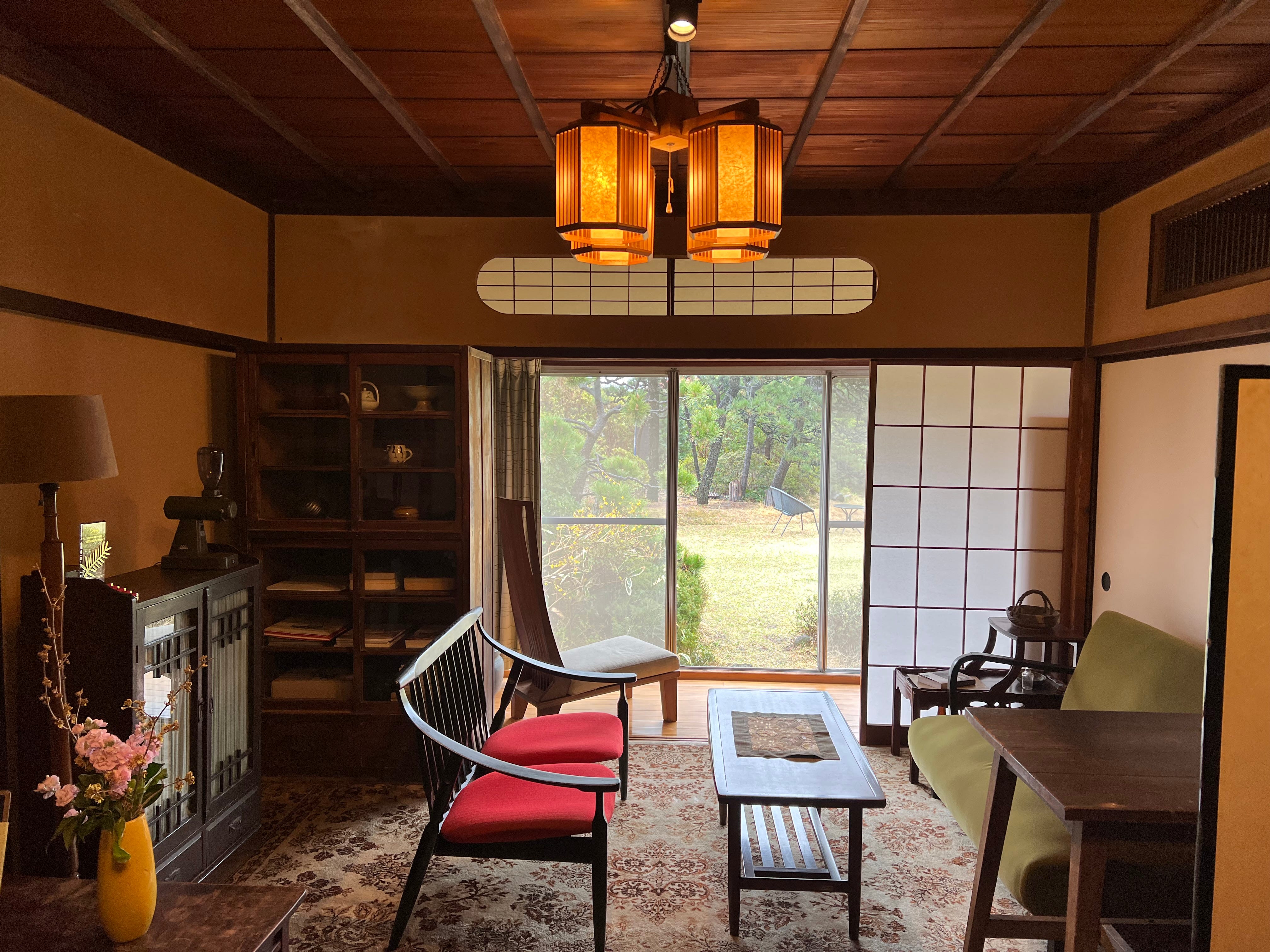
Ozu’s regular room, #2, is small but well appointed. Mori invited me to sit where Ozu is known to have sat, looking out at a set traditional sliding doors of paper and wood, composed of spare wooden squares that frame a small sitting area in front of two large glass windows that look out onto the inn’s southern gardens.
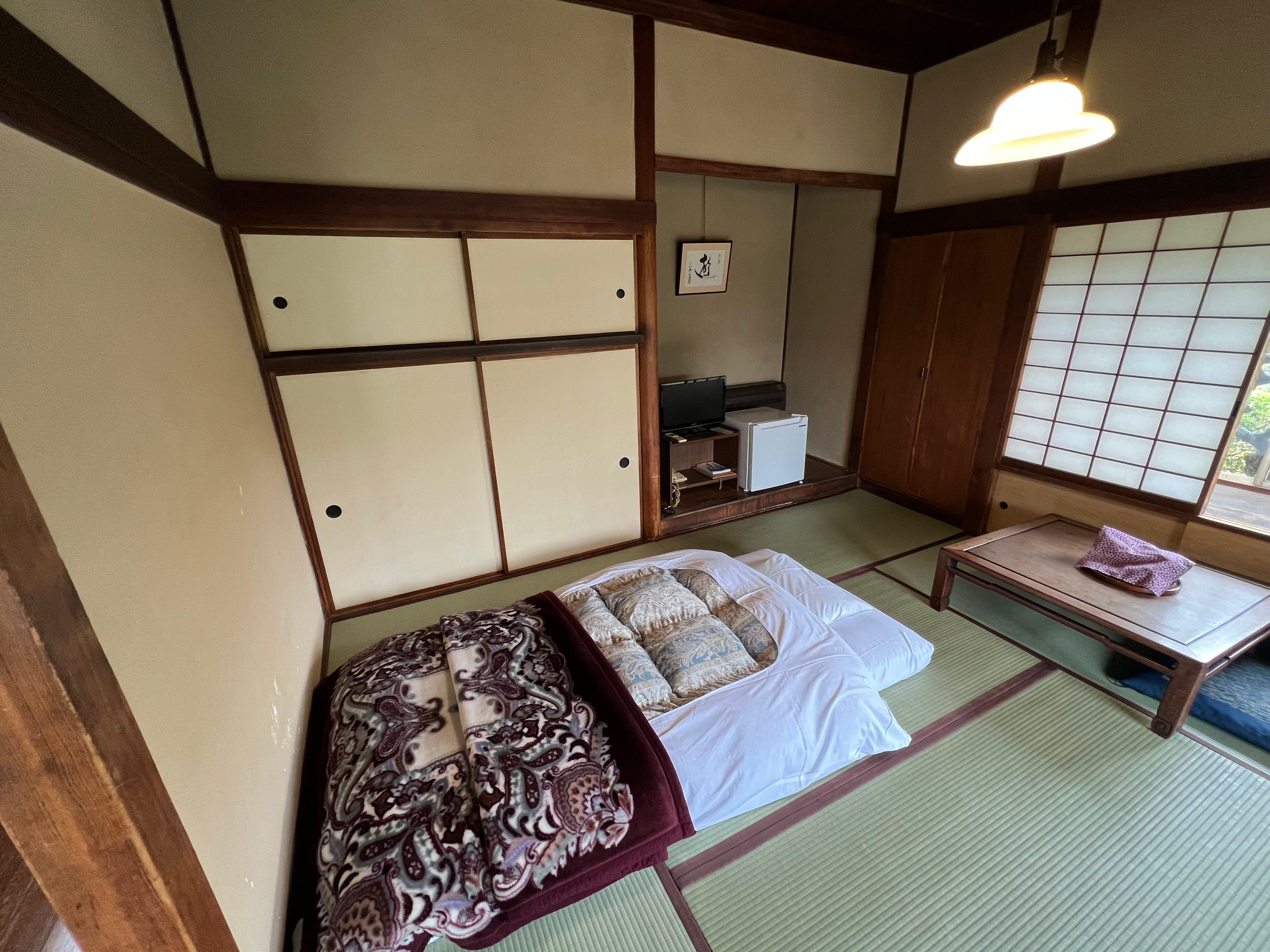
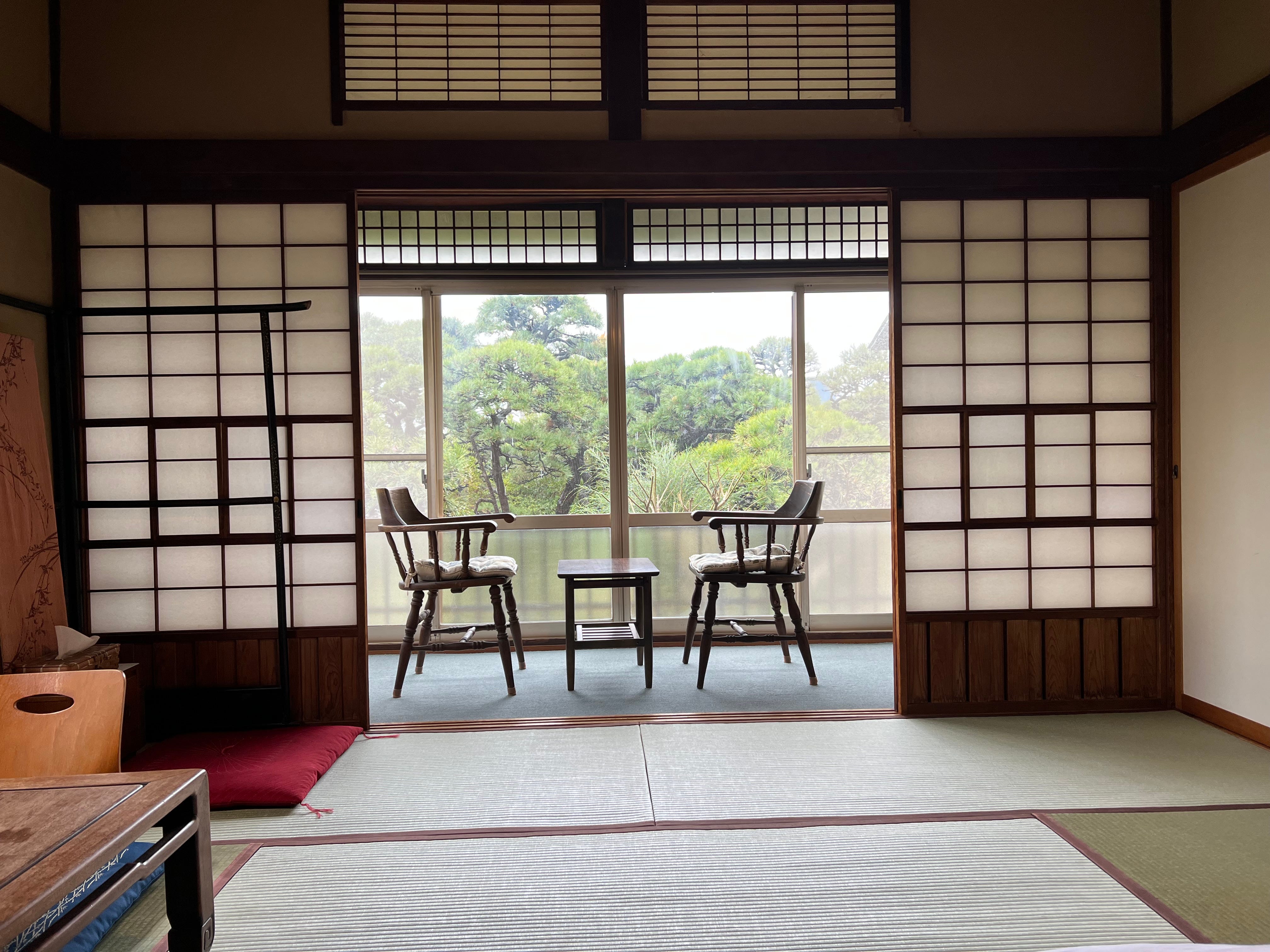
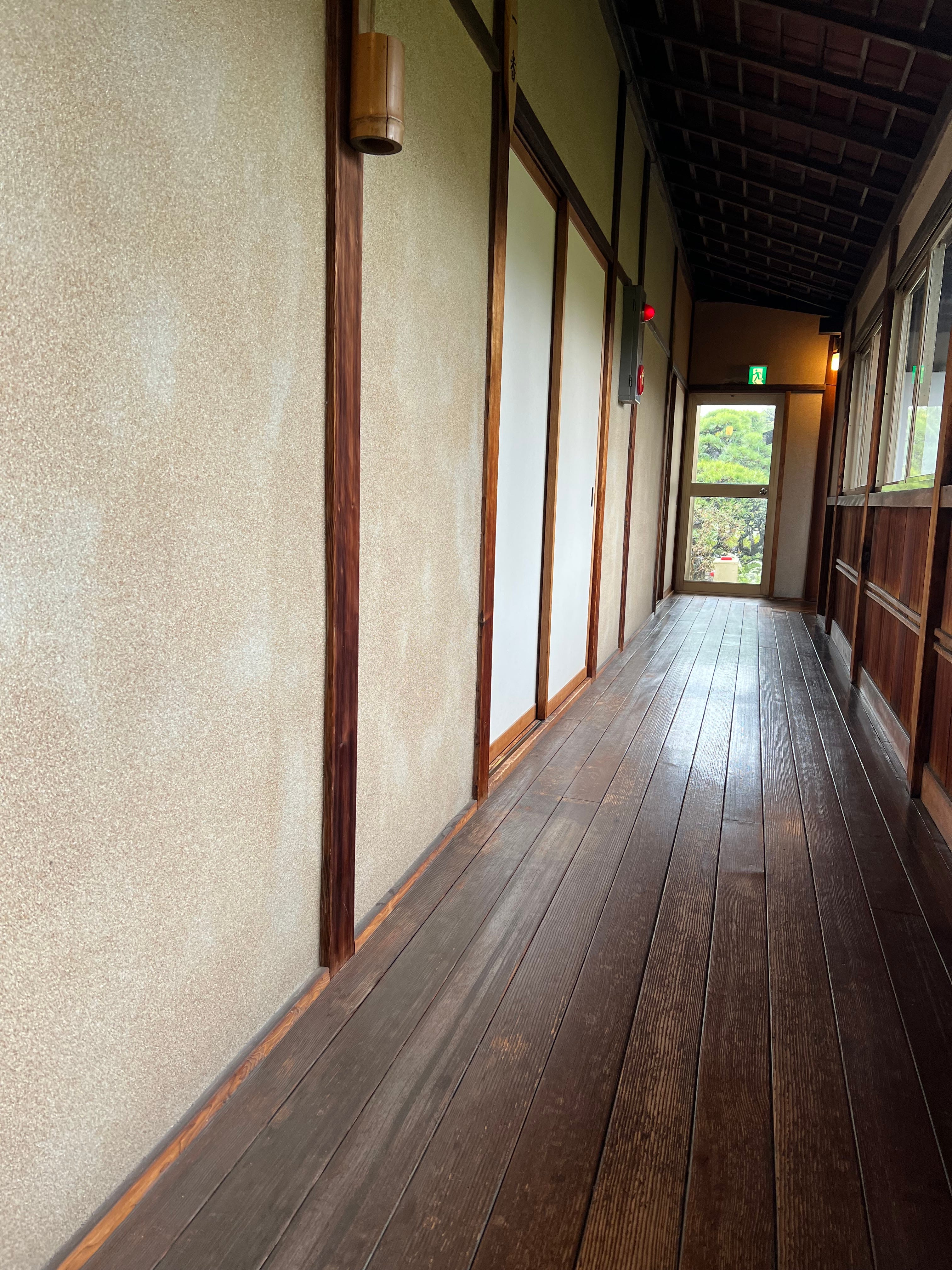
Here, Mori explains to me, you can see Ozu’s way of looking, and though I’m no expert into formalist film theory, I saw the framing. The angles. The juxtaposition of the views occasioned by the glass windows framed by paper screens. I saw it in the hallway, too:
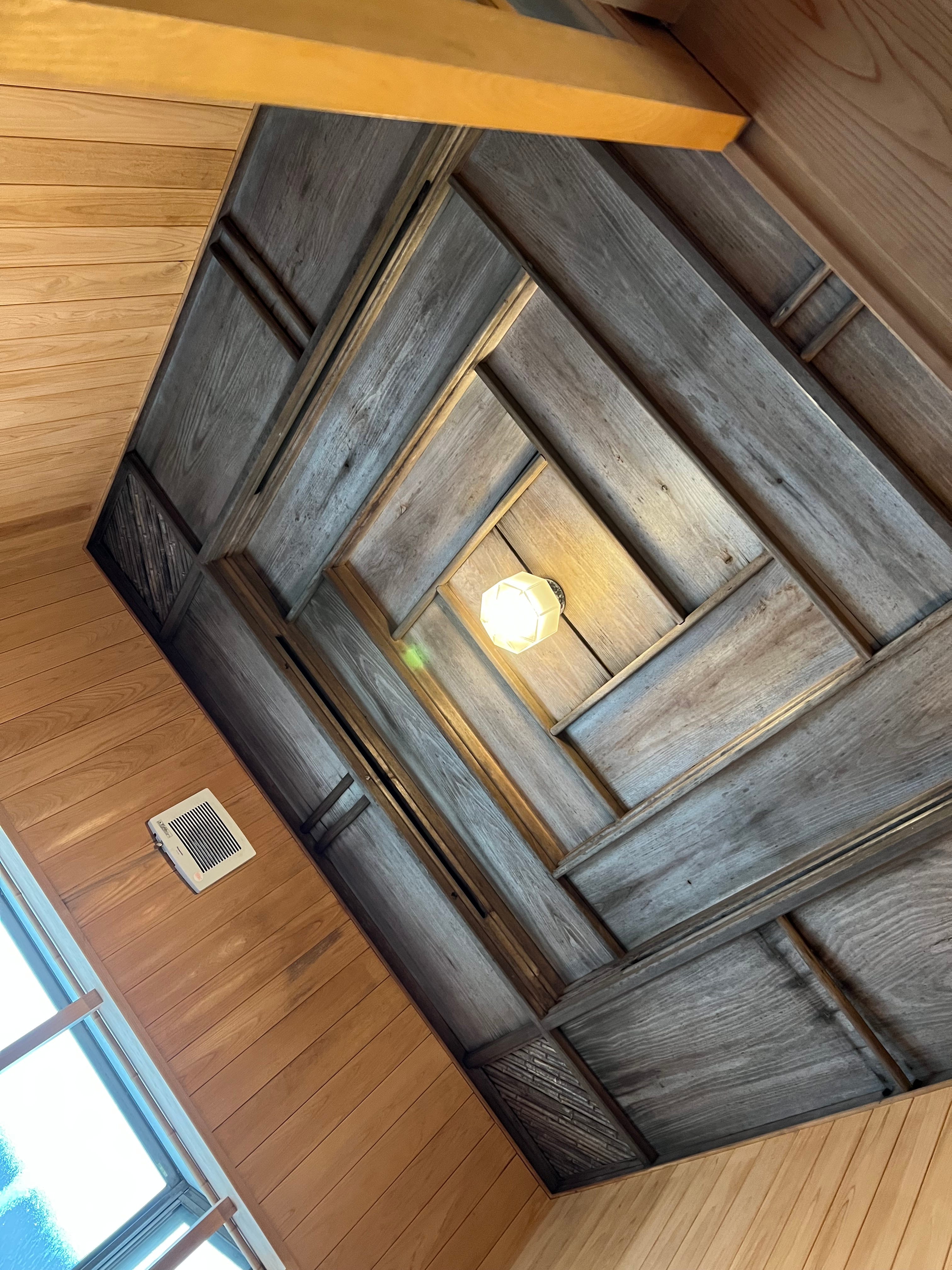
And, my favorite, in the original ceiling of one of the bath areas:
Over tea, Mori also told me what he knew of Ozu’s mu, something documented by a plenty of other biographical sources, but a story I was grateful to hear from him.
Ozu was drafted and deployed during the late 1930's, a particularly bloody moment in the colonial occupation and destruction of China. His wartime experiences are entire topic in and of themselves, however I'll relate this version as I heard it. While Ozu was stationed in China, he was only able to communicate through writing in the Chinese characters shared by inter-war Japan and China (the writing system of both changed significantly after the war). In Mori's version, mu was an important one of these, one especially recurrent in his curious means of communication, being shared by many common phrases in both the Chinese and Japanese of the time. At some point, Ozu even asked a local monk versed in Buddhist calligraphy to craft a mu specifically for him.
A stylized negation, drenched in philosophical history, as his means of communication while he served in Japan's occupying imperial forces. There's a lot to unpack there, but Mori's take gave me a lot to think about. His movies are sometimes critiqued for their placid portrayal of bourgeois post-war Japanese life. However, we could also see these beautifully paced, empty images and silences as a conscious antithesis to the simmering trauma that was bursting forth in every other aspect of post-war life in Japan. Mori noted that Ozu's wartime experiences had a lasting impact on his ability to interact with others, which kept him at a distance from many in his life for years after. The relation between his life and film, between the calm, internalized strife of his characters and the outward violence he and those around him experienced, potentially at his hands, asked continually relevant questions in this sense, rather than offering a prescriptive vision of the world.
The Chigasaki-kan is still a space for artistic repose, in whatever form we might imagine. The French Nobel laureate Jean-Marie Gustave Le Clézio wrote a novel there, freezing through an uninsulated winter stay. Mori also told me that Hirokazu Kore’eda has been coming to the inn for about thirteen years now to begin each new script writing process. In his estimation, the history of Japanese film was important to these creators. In a more immediate sense, people came not only to pay a particular kind of homage to Ozu and the artistic tradition of the area. His view was that filmmakers, in particular, were not there to dip into the active wellspring of creativity presided over by Ozu’s ghost. Rather, the Chigasaki-kan is where Ozu came when he was stuck, and so this was a place to engage in one of the quintessential and inevitable parts of the artistic process, which Ozu himself struggled with his whole life—being frustrated. Needing a break. And hoping that some new space or pace occasions the art.
At some point, I gave into my Herzogian impulses and asked him if people ever dream of Ozu while they’re in the room, which he answered with an emphatic yes. I’ll take his subsequent silence on the content of those dreams to be part of his duty as a friend and keeper of a place with such an intimate importance to those looking for ways to tell their own stories.
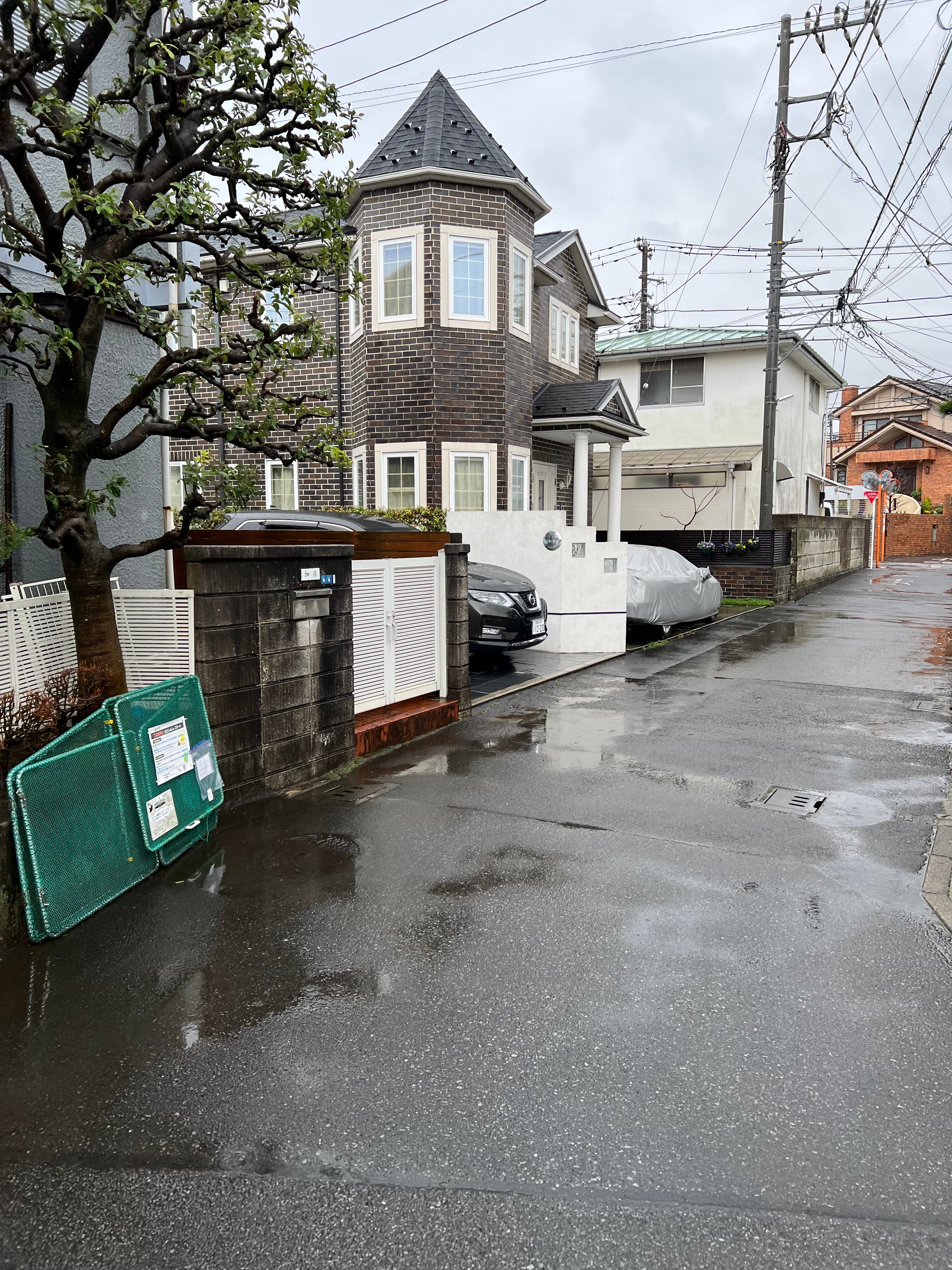
The surrounds are admittedly less of a country oasis than they once might have been. The friend I met there told me that you used to be able to see the water from the south facing rooms (including Ozu’s). Now, there are convenience stores, a cosmopolitan mix of domestic architecture (including a DC-style turret), and compact, white-shellacked shingle warehouses and small workshops. However, even in my brief time there, I found the way the inn had tucked itself into the swath of modern, suburban housing to have maintained its sense of porous but peaceful cloister.
I'll say, to me at least, his mu seems part joke, part negative theology of modern art, part testament of his wartime experiences—though I can’t say for sure that its more one than the other. I'm less interested than ever in pinning down what this mu means over the course of his movies, or as a theory of art. It's another piece of a puzzle, part of a question that continues to return in different forms given the staying power of his films. His movies, as well as their ever multiplying commentaries, make me think and feel something completely different every time, and so did every corner of the Chigasaki-kan.
Local Notes: On your way from Chigasaki Station, be sure to visit the Suzu no Ki Café, where I had an amazing Japanese curry, prepared by a French-trained chef and local restaurateur. The Chigasaki-kan answers inquiries in English, though be sure to book at least six months in advance, even during the off-season. I should note the inn is not an accessible space, an issue with most traditional inns in Japan, with some exceptions.
—
What I’m Reading:
The Guest Lecture, Martin Riker
The Will to Change: Men, Masculinity, and Love, bell hooks
Psychopolitics, Byung-Chul Han
What’s next:
What’s left of a secular society—or, how can we be skeptical of secularism from the left?
Have we moved beyond the New Age mistranslations of the Tibetan bardo (the “in-between”)?
Why are movies about religious founders so inherently difficult to make? (I'm looking at you, Keanu)
Comments
Nothing yet. Say the first thing.
Sign in to join the conversation.