
“I don’t even like opera. Like, not at all.”
Those words flew out of my mouth without much thought.
I was relatively new in my tenure as an executive at Qualcomm, a wonderful company full of wonderful people. They had brought me in after a pretty successful tenure in the state legislature followed by a pretty unsuccessful campaign for mayor.
I was doing a multitude of different things, but on this particular day I had been called in for a specific assignment.
Qualcomm had made a significant investment in the arts community in San Diego, including the opera.
Now the opera was on the verge of bankruptcy.
Its collapse would ripple across the city’s arts community, affecting musicians, performers, stage crews and set designers. It mattered to the cultural and economic life of San Diego.
Because of the company’s sizable contribution, they had a seat on the opera’s board.
I was being told I would now fill it.
My assignment was simple: Do all I could to ensure the opera survived.
I couldn’t imagine anything worse.
Opera isn’t generally performed in a language I speak. Even when it is, I can’t understand what they are saying.
The one time I had gone, it felt like a struggle to know whether I was supposed to watch the words scrolling across the top of the screen or the people moving around onstage. It was too hard a choice. I fell asleep.
I respected the talent. I understood that opera was an important art form. And I knew it contributed to the economy, enriched the culture of the city and meant a great deal to the people who loved it.
I just wasn’t one of them.
I assumed most opera lovers had about as much interest in sitting on the tailgate of my truck, drinking a Bud Heavy outside a Cody Jinks concert, as I had in spending another night in a suit at the opera. (These days it would be a Bud Zero. More than three years sober and counting.)
Still, I took the assignment. I wasn’t given a choice.
My first board meeting lasted something like six hours. It was contentious. People did not just threaten to quit. They got up and walked out. There was a lot of drama. And emotion. You could say it was kind of like an opera but with people yelling instead of singing.
Contracts were renegotiated, staff was reduced and expectations were reset. The organization had to reimagine how it operated.
I don’t know how much I contributed, but we succeeded. The opera survived.
Along the way, I met some incredibly kind and thoughtful people. I came to a deeper appreciation of opera.
That still doesn’t mean I like it.
I rarely go today. By rarely, I mean not once since I left the board.
But while I served, I went.
My wife would roll her eyes every time I referred to intermission as halftime. There was a first half, a break to get food and use the bathroom, and a second half. I still don’t see the problem.
During one halftime, I had the dullest conversation of my entire life. With Al Gore. I couldn’t wait for the little chimes to ding and send us back to our seats.
Another evening, we were seated beside one of the opera’s major donors and his wife.
It was about halfway through the second half (almost the fourth quarter for those keeping score at home).
And he was asleep.
Not nodding off. Completely out.
His wife didn’t notice.
She was enthralled by what was happening onstage.
She wasn’t merely watching the performance. She seemed to be somewhere inside it.
It was like the music and singing had become a part of her.
At a particularly powerful moment, tears began to run down her face.
Not sadness. Just pure emotion.
She didn’t brush them away.
She didn’t look around to see if anyone had noticed.
Right then, I don’t think anything existed outside what she was taking in.
Her husband slept through the whole thing.
There is something truly beautiful about watching another person become completely immersed in an experience. Watching them surrender to a moment without embarrassment, restraint or concern for how they might appear.
I was touched by how deeply she was moved.
But I didn’t understand it.
The opera was in a language I didn’t speak.
At that point in my life, so was the emotion she felt.
There was a lot I didn’t see back then.
Even more I didn’t feel.
I knew energy, drive, adrenaline and survival.
I had a relentless desire to outrun the past and get where I was going as quickly as possible.
The present wasn’t really a place I experienced. It was just the passageway I hurried through on my way to whatever came next.
I didn’t watch a sunrise, truly listen music or find the simple beauties that surround us daily.
There was no art on my walls. Just pictures.
The pictures mattered. They still do.
They showed me where I had been, what I had done and who had been there with me. They documented the people I love, the things I had survived and the better parts of the journey.
I had spent years hanging evidence of my life on the walls. The meaning was clear.
Everything was linear. Literal. Easy to understand.
At the time, that suited me.
Feeling things could slow you down. Looking too closely at the past could interfere with whatever you had ahead.
The problem with always searching for more is that it is impossible to ever actually arrive.
Eventually, all that motion ran full speed into something it could not move.
The slowing down that followed was forced.
I spent 45 days in a trauma rehab center without any meaningful connection to the outside world.
I was stuck in that same passageway but with nowhere to go.
That is when I walked into a dusty arena and met a Tennessee Walker named Star.
I wrote about our time together more fully in The Perfection of a Horse, because what happened in that arena changed the direction of my life:
Star had crossed the arena and pressed her face against mine.
Nose to nose.
Breath to breath. I leaned into her, face to face, because she was strong enough to remain exactly where she was.
And in that steadiness, something in me finally softened.
The tension I had been gripping for years loosened.
Not because it was taken from me, but because I no longer had to hold it.
It felt like the clenched, vigilant, exhausted part of me began to melt.
Even in that essay, I struggled to put words to the full experience.
In the years that followed, I found peace in AA rooms, meditation and of course with my own horses.
I slowed down. By choice this time.
I hear music differently. Sunsets mean more. Quiet no longer feels like anxious time that needs to be filled.
I began to notice what had been around me all along.
On a meditation retreat for combat veterans, I told a friend about my experience with equine assisted therapy.
A few weeks later, he sent me a link to a painting.
He said it felt like me.
I opened it. And everything stopped.
I was enthralled.
It wasn’t something I merely looked at. I felt as though I had stepped inside it.
Tears began to run down my face.
I bought it immediately and had it shipped as fast as possible.
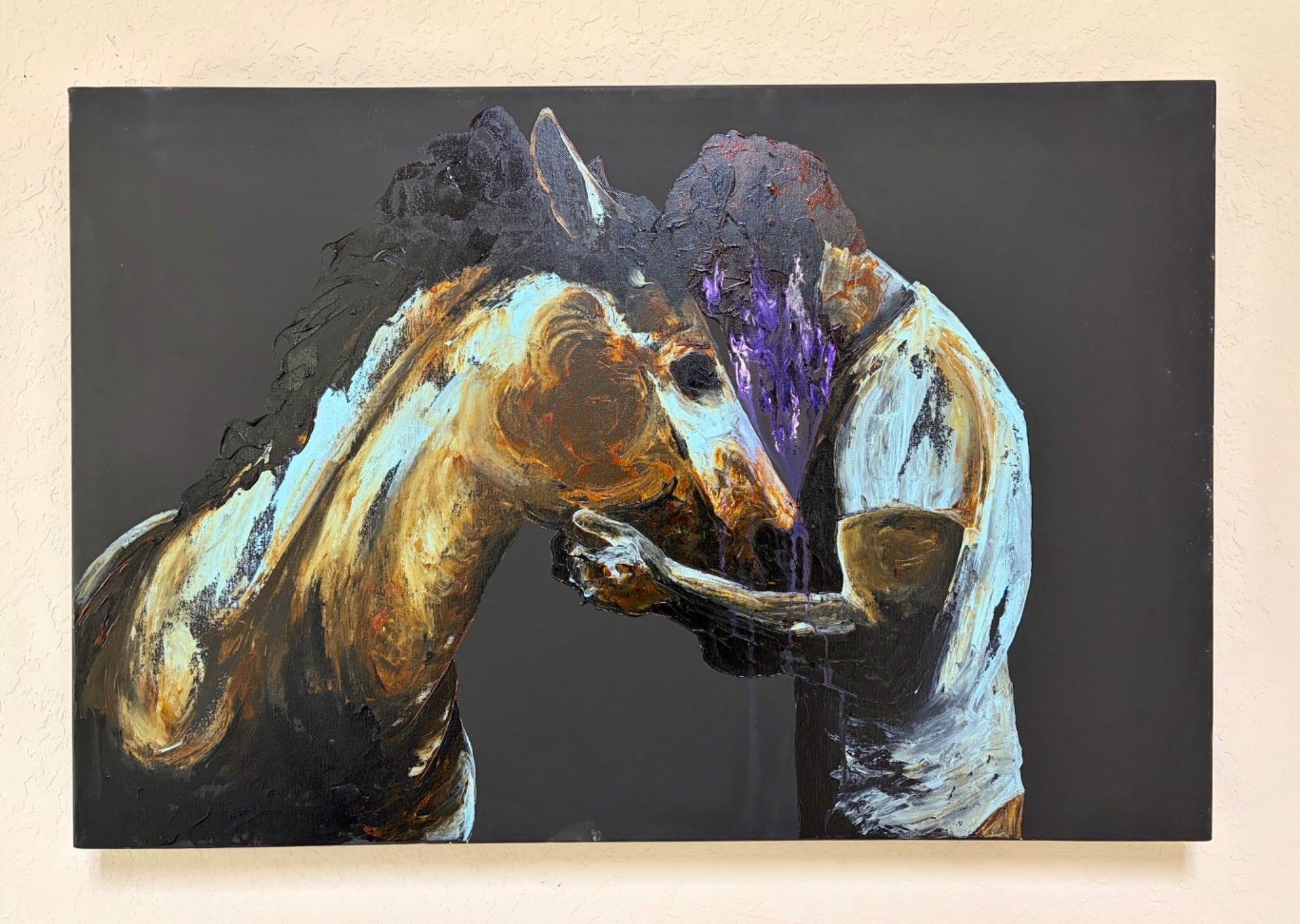
It took me back to a moment in my life that I had felt deeply but had never fully known how to explain.
There is nothing in the background of the painting.
No corral. No round pen. Only a man and a horse.
He is leaning into her.
He is not holding her to keep her in place.
He is holding her because he needs to know that she is there. He needs an anchor.
The horse simply holds steady.
He stands directly in front of her, in one of the few places where a horse cannot see clearly.
That is trust.
The horse’s eye is open. The man’s face is hidden.
It feels like the horse can see him at a moment when he cannot see himself.
The painting is not smooth or polished.
It is thick, jagged and uneven. It has rough edges. Like life.
Purple streaks run down between them.
I do not know what the artist intended them to mean. I know what I see.
The purple looks like bruising to me. The visible mark abuse leaves behind. But here it is not trapped beneath the skin. It is pouring out.
I see someone finally letting go.
The essence of training a horse is pressure and release.
The essence of equine-assisted therapy for me was connection and then release.
For most of my life, I thought art was something you had to be trained to understand.
I assumed there was a correct interpretation hidden inside the work, and people with the proper expertise knew how to find it. They knew what it meant.
This painting asked none of that from me.
I did not need to know the artist’s intention.
I thought art was something you had to understand. I did not realize it could understand you.
The photographs on my walls reminded me of my life.
The painting that now hangs with them helps me understand it.
Opera still does not really speak my language.
This painting did.
And when I first saw it, I finally understood the woman sitting beside me all those years before.
She wasn’t crying because she understood opera better than I did.
She was crying because, for a few minutes, it understood her.
Something in the music had reached a place inside her that ordinary life could not.
Years later, staring at this painting with tears running down my own face, I understood.
The painting now hangs on the wall directly in front of my desk. It is there as I write this.
When I look at it, I remember Star. The dusty arena. I see the man I was and the moment that changed him.
I had spent years trying to outrun pain. I did not realize how much beauty I was running past.
Maybe healing is not only learning how to live with less pain.
Maybe healing is becoming able to feel beauty again.
Maybe healing is learning to see.
If this resonated, you can subscribe for free to receive new essays by email. If you’d like to support the work, there’s also an optional paid subscription:
If you know someone who might enjoy reading this, please share:
No posts
Comments
Nothing yet. Say the first thing.
Sign in to join the conversation.