
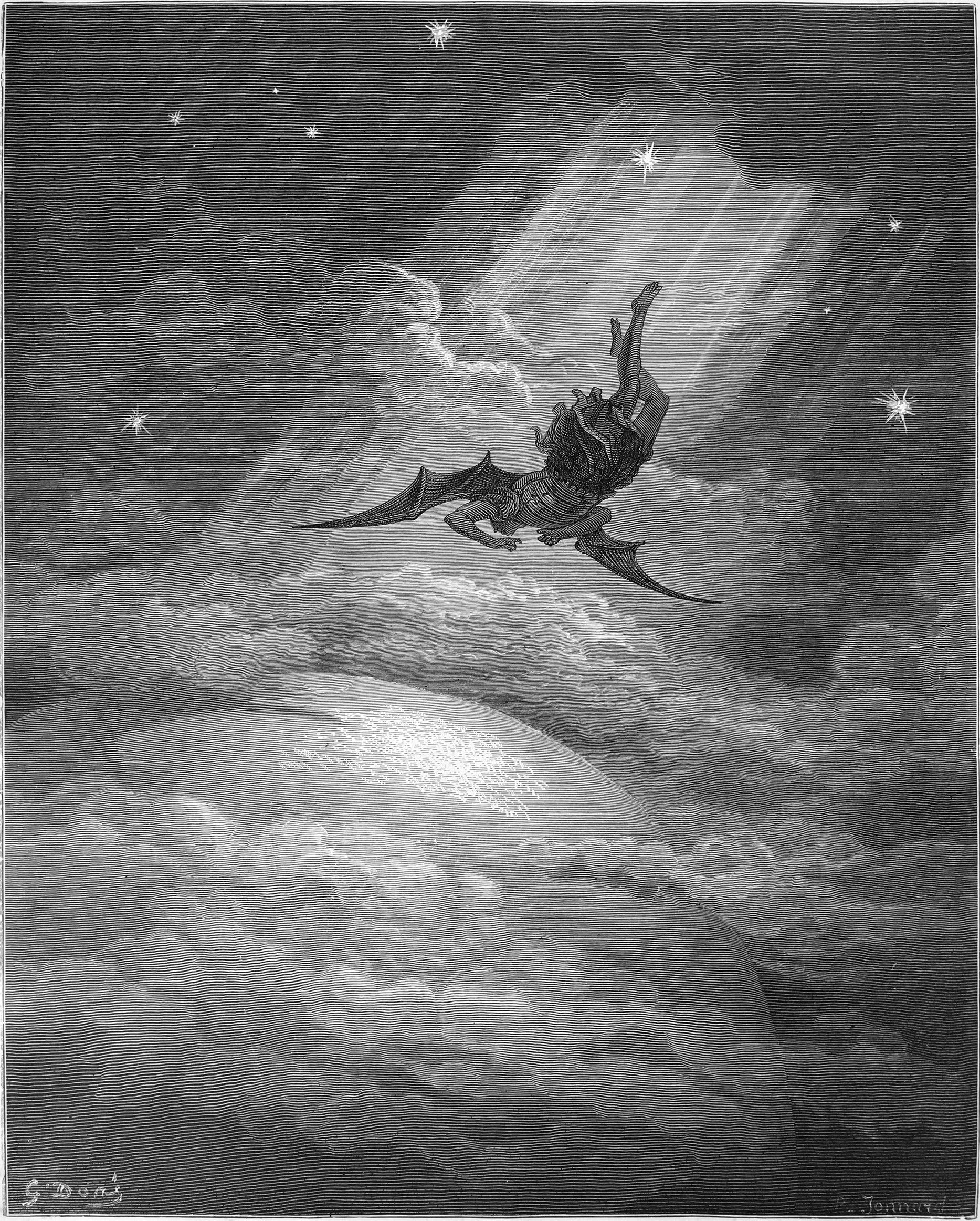
We know the story:
The figure we know as Satan was once named Lucifer. An archangel, the grandest and most beautiful of God’s creatures. But in his hubris, he thought he could be equal with God, leading to a rebellion and heavenly war which ended with him and a third of the angels cast out of heaven.
Did this actually happen? You may be surprised to hear me say this, but… yes and no.
To see what I mean by this, we’re gonna have to look at how Satan came to be the figure he’s known as today. As we do so, we’ll see how this personification of evil came from something quite different, how various authors and editors of the Bible changed and negotiated with the stories they worked with, and how much inspiration was drawn from extra-Biblical tales by the time we get to the New Testament.
We’ll also see, after tracing the history of Satan—and this is my core interest in this series—how this development of the concept of Satan reflects the psycho-social phenomena of the people in its contexts, how it actually teaches us more about ourselves than we realize, and what is one of the biggest lies we can believe about him.
Let’s begin.
“Satan” is a transliteration of the Hebrew word śāṭān (שָׂטָן), and its earliest mentions in the Hebrew Bible don’t use it as a proper noun. It wasn’t originally a name. Instead, it was a title for a particular function or role.
While commonly translated as “adversary” or “accuser” (suggested by scholars like Peggy Day in her book An Adversary in Heaven: śāṭān in the Hebrew Bible), I’m more convinced by Ryan E. Stokes’ argument that śāṭān is better translated more precisely as “attacker with lethal intent.”1
Based on how the word is used throughout the Hebrew Bible, Stokes argues, the śāṭān is not just any kind of adversary, and is certainly not one who “accuses,” but one who seeks to destroy. Let’s look at some examples.
In 1 Samuel 29, David is living among the Philistines to escape from Saul, and here he is attempting to join them in their battle against Saul’s army. But they said of him,
"Send the man back, so that he may return to the place that you have assigned to him; he shall not go down with us to battle, or else he may become a śāṭān to us in the battle. For how could this fellow reconcile himself to his lord [Saul]? Would it not be with the heads of the men here?" (1 Sam. 29:4, NRSVUE).
Here it’s obvious that they were referring to David as a potential adversary who would kill them. Note that in these early appearances, the śāṭān is often a human being.
In 2 Samuel 19, we find the episode in which one of David’s warriors, name Abishai, urges David to let him put Shimei to death for what he did in their previous encounter where Shimei cursed David.
But David said,
"What have I to do with you, you sons of Zeruiah, that you should today become a śāṭān to me? Shall anyone be put to death in Israel this day?" (2 Sam 19:22).
David isn't indicating that Abishai would be acting against him, but rather on his behalf. Another way to render the translation is "become a śāṭān for me."2
In these two examples, we see the word śāṭān referring to a temporary role or function a person takes on that seeks to lethally attack someone. And in both cases, that function would be carried out in the service of a liege: Abishai executing Shimei on David’s behalf, and the Philistines concerned that David would kill them to re-establish his loyalty and relationship with Saul.
The term can also refer to military and political opponents, as in 1 Kings 11:25 where the text describes God stirring up King Rezon to plague Solomon:
"He was a śāṭān of Israel all the days of Solomon."
It’s quite clear to me that “accuser” wouldn’t be the appropriate translation here either. King Rezon certainly did not intend to merely accuse Israel, but to destroy and conquer them.
And we must not forget the comical story in which the word śāṭān appears. In Numbers 22, we get Balaam and his donkey.
Balaam was journeying to assist Balak, king of Moab, against the Israelites, and "God's anger was kindled because he was going, and the angel of the LORD took his stand in the road as his śāṭān." The donkey perceived the danger and three times took steps to evade the angel. Each time the donkey did this, however, Balaam, who was oblivious to the threat to his life, beat his donkey for what he mistook as insubordination. Then the donkey spoke, “What have I done to you, that you have struck me these three times?” Once Balaam became aware of the angel in his path “with a drawn sword in his hand,” the angel said to him,
"Why have you struck your donkey these three times? I have come out as a śāṭān because your way is perverse before me. The donkey saw me and turned away from me these three times. If it had not turned away from me, surely just now I would have killed you and let it live."
Having grown up in church, I too often forget that the angel wasn’t intending on stopping Balaam with a simple rebuke. The angel was going to kill him. Sunday school tended to sanitize that part.
Again in this case, the śāṭān comes out as someone with lethal intent. Notably though, this is the first time the term is used for a superhuman, angelic being. And as time went on, śāṭāns increasingly began to be viewed as superhuman agents who did God’s bidding. Like in the book of Zechariah.
In this passage, the prophet Zechariah has a vision of “the high priest Joshua standing before the angel of the LORD and the śāṭān standing at his right hand to śāṭān [maybe “accuse,” but more likely, “execute”] him” (3:1). Joshua was wearing filthy clothes — representing the sins of Israel — and the śāṭān was ready to do its job.3
But the LORD said to the śāṭān, “The LORD rebuke you, ha-śāṭān [“the satan”]! The LORD who has chosen Jerusalem rebuke you! Is not this man a brand plucked from the fire?” The angel of the LORD then commanded that Joshua’s filthy clothes be removed, and said, “See, I have taken your guilt away from you, and I will clothe you with festal apparel.”
When I was younger, I would look at this story and think, “Yes of course, Satan here is the enemy of God, which is why he is being rebuked!” Except that at this point in Jewish theological history, the śāṭān was not understood as God’s enemy, and interpreting it as the Satan we think of today is anachronistic and hermeneutically irresponsible.
The term ha-śāṭān with the definite article appears in only two books in the Hebrew Bible. One of them is here in Zechariah’s vision and the second is in Job, which we’ll get to later in the series. (The mentions of the śāṭān in both books were likely written in the 6th century BCE, which means Zechariah and Job share similar points in the development of the śāṭān figure.)
The use of the definite article doesn’t indicate that a proper name for a Satan persona is intended. Rather, Hebrew theology had developed so that the śāṭān is now a specific official within the heavenly court whose job is to test humanity’s righteousness, condemn them for their sins, and execute lethal judgment. That’s what is in view here.
Again, I’m persuaded by Ryan Stokes that the śāṭān in Zechariah should be seen as a sort of executioner, if we are to take the previous uses of the term into account. Calling this figure an “accuser” is to imply that it does primarily the accusing while someone else (maybe God or the angel of the LORD) carries out the judgment. But if the previous passages we’ve looked at offer any clue, it’s safe to say that the śāṭān carries the primary function of executing judgment, even if it does some accusing along the way.
Let’s reiterate the two main takeaways so far:
The śāṭān is better understood as “attacker with lethal intent.”
When the word developed from a generic term to eventually referring to a particular superhuman being, that being was understood as one who worked for God, who did his bidding, who was a member of the heavenly court tasked with carrying out divine judgment.
Nowhere in the Hebrew Bible was the śāṭān seen as God’s enemy, nor was the word used as a proper name.
But there might be one exception. It’s far from conclusive among critical scholars whether this might actually be the first known instance of śāṭān occurring as a proper name. But that’s not the only thing that is fascinating about this passage: as we’ll see, the śāṭān wasn’t even in the original version of the story.
And that’s where we’ll pick up in Part 2.
Ryan E. Stokes, “Satan, YHWH's Executioner” (JBL 133, 2014), 257.
Peggy Day, "Abishai the śāṭān in 2 Sam 19:17-24," (1987), 545.
Stokes writes: "Joshua is guilty of some unspecified iniquity, which Zechariah associates with the priest's filthy garments (3:3-4), so the śāṭān's attack on Joshua's life is not without justification" (Stokes, "Satan, YHWH's Executioner," 264).
Comments
Nothing yet. Say the first thing.
Sign in to join the conversation.